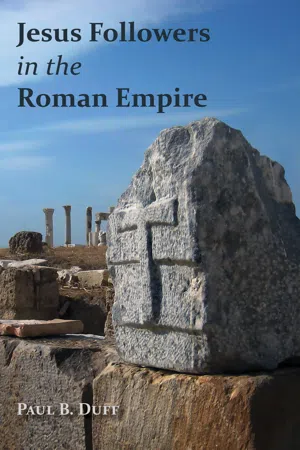
When Jesus of Nazareth began proclaiming the kingdom of God early in the first century, he likely had no intention of starting a new religion, especially one that included former pagans. Yet a new religion did eventually develop—one that not only included non-Jews but was soon dominated by them. How did this happen? Jesus Followers in the Roman Empire by Paul Duff offers an accessible and informed account of Christian origins, beginning with the teaching of Jesus and moving to the end of the first century. Duff's narrative shows how the rural Jewish movement led by Jesus developed into a largely non-Jewish phenomenon permeating urban centers of the Roman Empire. Paying special attention to social, cultural, and religious contexts—as well as to early Christian ideas about idolatry, marriage, family, slavery, and ethnicity— Jesus Followers in the Roman Empire will help readers cultivate a deeper understanding of the identity, beliefs, and practices of early Christ-believers.
- 275 pages
- English
- ePUB (mobile friendly)
- Available on iOS & Android
eBook - ePub
Jesus Followers in the Roman Empire
About this book
Information
Topic
Theologie & ReligionSubtopic
Biblische StudienSECTION 1
SETTING THE STAGE
CHAPTER 1
Hellenistic Culture, Jewish Religion, and Roman Power
In order to understand the Jesus movement, we must first understand something about the political and cultural environment of the society in which it took root. Of course, Jesus and his immediate followers were born and raised as Jews in Judea, the ancient homeland of Israel. But Judea, although Jewish, was hellenized (at least to some extent), like the rest of the eastern Mediterranean.1 That is to say, it participated in the Greek culture that Alexander the Great had spread throughout the territories that he had conquered several centuries earlier.
But the Jewish religion and Hellenistic culture comprise only part of the background. Rome’s political dominance also needs to be added to this mix. Each one of these three factors, Hellenism, Judaism, and Roman power contributed significantly to the world in which the Jesus movement came into existence. Each also influenced the Jesus movement as it later spread throughout the empire. We will open our examination of these three important phenomena with Alexander’s propagation of Greek culture.
Hellenistic Culture: The Legacy of Alexander
The man we know as Alexander the Great was born in Macedon (what is now the north central part of Greece) in 356 BCE, roughly three and a half centuries before the birth of Jesus. Alexander’s father, Philip II, was the reigning monarch in Macedon and his mother, Olympias, was the daughter of the ruler of the neighboring kingdom of Epirus. Although at the time Persia was the dominant empire in the eastern Mediterranean, Alexander was nonetheless raised to appreciate the culture of the Greek city-states to the south. His father deemed it appropriate that he receive a Greek education and so, as a young teen, Alexander was tutored by the philosopher Aristotle, one of the great Greek thinkers of the ancient world.
Alexander’s father Philip was an accomplished military leader. He had conquered all of the lands between the Dalmatian coast (modern-day Albania) and the Hellespont (the strait of water—now called the Dardanelles—between the Aegean Sea and the Sea of Marmara). But, Philip was not content with these conquests. His plan was to cross the Hellespont into Asia and challenge the Persian Empire, a kingdom that had dominated the area for two centuries. To that end, Philip sent an expeditionary force down the western coast of Asia Minor (modern-day Turkey) to build support for his invasion among the Greek speakers there.2 Philip, however, was never to realize his goal; he was assassinated in 336. Nevertheless, a few years later, Alexander decided to implement his late father’s strategy.
Alexander arrived in Asia in 334 BCE with almost fifty thousand troops. In the year that followed, he engaged and defeated the main body of the Persian army at a place called Issus, in southeastern Asia Minor, although the Persian king, Darius, managed to avoid capture. Alexander, rather than immediately pursuing Darius, marched south along the eastern shore of the Mediterranean, conquering cities in Syria, Phoenicia, Samaria, and Judea.3 Alexander then continued along the coast into Egypt. Once in Egypt, he turned his attention to religious matters. As one ancient historian wrote, “A sudden desire now seized Alexander to visit and consult [the Egyptian god] Ammon in Libya, both because the oracle of Ammon was truthful and because [the Greek heroes] Perseus and Heracles had consulted it. . . . In any case, he set out with this in mind and imagined that he would obtain more precise knowledge of his own affairs” (Arrian, Anab. 3.3.1–2).4 When he reached the temple of Ammon, the shrine’s chief priest purportedly hailed him as “the son of the god.” It was later alleged that shortly thereafter, the famous oracles at Didyma and Erythrae (both on the western coast of present-day Turkey) likewise proclaimed Alexander the son of Zeus.
Leaving Egypt, Alexander led his army into Mesopotamia where he again met Darius and the latter’s reconstituted army at Gaugamela, a site east of modern-day Mosul, Iraq. Darius was decisively defeated but managed to escape once again. Alexander, although eager to capture the Persian king, nevertheless first took control of the important Persian cities of Babylon (in the southern part of current-day Iraq) and Susa (in what is now western Iran). He then resumed his pursuit of Darius, following him into Bactria (Afghanistan), where the Persian ruler was finally killed, not by Alexander but by one of his own former governors. Following Darius’s death, Alexander continued east through what is now Pakistan and entered India. His army, however, after campaigning nonstop for almost a decade, would go no farther. At the Hyphasis River (now named the Beas), his soldiers rebelled. Reluctantly, Alexander turned his army around and headed west, back to Babylon.5
Shortly after his return to Babylon, in 323 BCE, Alexander fell ill. Within a few days, at the age of only 32, he was dead. Rumors quickly began to circulate that Alexander had been poisoned. It was alleged that Cassander, the son of Antipater—who had faithfully ruled Macedon in Alexander’s absence—had slipped him wine mixed with a deadly toxin. Many believed the rumors. Antipater certainly had motive; shortly before, Alexander had summoned him to Babylon (Antipater had been feuding with Olympias, Alexander’s mother). Fearing for his life, Antipater ignored Alexander’s summons and sent his son Cassander instead, allegedly armed with the poison. But whether there is any truth to the rumor that Alexander was poisoned by Cassander is unclear. Although it is certainly possible, there are other possible explanations for his sudden death.6
But regardless of how he died, Alexander had clearly not planned for his death; he had not named a successor. Who would take his place? Alexander’s young Bactrian wife Roxane was pregnant at the time and her soon-to-be-born son was a likely candidate. Another possible successor was Alexander’s half brother, Arrhidaeus (later renamed Philip). But neither Roxane’s son nor Alexander’s half brother were very strong candidates. The former, as a child, would have been incapable of ruling and the latter was mentally challenged. Consequently, the decades following Alexander’s death were filled with instability and intrigue as many of those in the deceased leader’s former inner circle vied for control.
Among those who seemed most likely to succeed were Perdiccas, a former page of Alexander’s father, and two of Alexander’s bodyguards, Ptolemy and Lysimachus. The latter two received control of Egypt and Thrace, respectively. Each of them would play important roles in the years to come. For the time being, however, Perdiccas was in the strongest position. He was named regent of the empire and retained control of the army. Although Alexander’s son and his half brother Arrhidaeus were ultimately recognized as kings, they were in Babylon, under the control of Perdiccas; he ruled in their names.7 But within a few years, Perdiccas was assassinated by his generals, one of whom was named Seleucus. This same Seleucus would ultimately come to control many of Alexander’s eastern territories.
Besides Ptolemy, Lysimachus, and Seleucus, another important figure to emerge was Antigonus “Monophthalmus” (“one-eyed”). Antigonus, a generation older than Alexander, had not accompanied the conqueror in his eastern campaigns but had instead been assigned the task of protecting Alexander’s supply lines. This he did from a base in Phrygia (in what is now west central Turkey). From that base, Antigonus was able to seize many of the conquered Near Eastern territories following Alexander’s death. Indeed, within the span of less than a decade, most of the territory between the Hellespont and Babylon was under his control.
Antigonus’s rapid consolidation of power alarmed his rivals; they were forced to band together to challenge him. In 301 BCE, the combined forces of Cassander (the alleged poisoner of Alexander), Lysimachus, and Seleucus (one of the assassins of Perdiccas) faced the army of Antigonus at Ipsus, a site in central Asia Minor. Antigonus’s forces were defeated and Antigonus himself was killed. His territory was subsequently divided among the victors: most notably, Lysimachus added western Asia Minor and much of what is now Bulgaria and eastern Greece to his territory in Thrace; Seleucus gained eastern Asia Minor, Syria, and Mesopotamia. Ptolemy, although he did not participate in the battle against Antigonus, nevertheless seized Judea and southern Syria and added them to his territory of Egypt; Judea and southern Syria were supposed to go to Seleucus for the latter’s role in the defeat of Antigonus. But they were already in the possession of Ptolemy, and Seleucus was not in a position to get them back. The territories would remain contested for a century.
Although some political stability emerged following Ipsus, it was short-lived. Within two decades, Lysimachus was dead, killed in battle by the forces of Seleucus. Thereafter, his territory was fought over by the Attalids, who ruled the city of Pergamum (now Bergama, in the northwest part of Turkey); Seleucus and his successors; and several waves of Gauls (Celtic tribes that had invaded from the west in the first half of the third century BCE).8 Cassander fell ill and died a few years after Ipsus; his territory was seized by Demetrius, the son of Antigonus Monophthalmus, but it was only held for a short time; Demetrius was soon defeated and imprisoned by Seleucus.
Of all of the would-be successors of Alexander, only Ptolemy and Seleucus would realize any kind of long-term success. Both established kingdoms that would last into the first century BCE. But their dynasties seemed incapable of coexisting in peace. Each seemed intent on destroying the other. In fact, in the early years of the second century BCE, the Seleucids nearly achieved their goal. But, at the gates of Ptolemy’s city of Alexandria, the Seleucid ruler Antiochus IV was met by the Roman legate, Gaius Popilius Laenas, who ordered Antiochus to stand down and to evacuate Egypt immediately. If Antiochus refused, he would be answerable to Rome. The Seleucid ruler reluctantly complied. The fact that Rome could make such a demand of Antiochus IV illustrates the waning political influence of the eastern kingdoms. Rome had been gathering power in the West while the Seleucids and Ptolemies skirmished in the East. By the middle of the second century BCE, the power and influence of the eastern kingdoms had diminished notably in the face of Rome’s rise to power.
Nevertheless, while neither Alexander nor his followers were ever to realize fully their political ambitions, their cultural influence on the eastern Mediterranean was significant. Greek-style cities emerged throughout the territories conquered by Alexander; Greek became the lingua franca of trade and government; indigenous Asian gods were identified with members of the Greek pantheon and so something like Greek religion arose in the East. In short, the Greek way of life became widespread.9 Indeed, even after the arrival of the Romans, the Greek language continued to hold sway in the East.
Because of the vast cultural change that took place in the territories conquered by Alexander, the later writer Plutarch compared the conqueror to a philosopher. A philosopher’s responsibility, Plutarch believed, was to civilize humans and Alexander had civilized the barbarian East. As Plutarch saw things, because of his conquests,
Homer was commonly read, and the children of the Persians, of the Susianians,10 and of the Gedrosians11 learned to chant the tragedies of Sophocles and Euripides. And although Socrates, when tried on the charge of introducing foreign deities, lost his cause to the informers who infested Athens, yet through Alexander Bactria12 and the Caucasus learned to revere the gods of the Greeks. Plato wrote a book on the one ideal constitution, but because of its forbidding character he could not persuade anyone to adopt it; but Alexander established more than seventy cities among savage tribes, and sowed all Asia with Grecian Magestries, and thus overcame its uncivilized and brutish manner of living. . . . If, then, philosophers take the greatest pride in civilizing and rendering adaptable the intractable and untutored elements in human character, and if Alexander has been shown to have changed the savage natures of countless tribes, it is with good reason that he should be regarded as a very great philosopher (On the Fortune or the Virtue of Alexander, 5 [Babbit, slightly revised]).
While Plutarch obviously underestimated the positive aspects of eastern culture (or the idea that civilization even existed there prior to Alexander’s arrival), his testimony nevertheless indicates the enormous cultural influence that Alexander’s conquests had throughout the Mediterranean world and areas to the East. Sometimes the hellenization that followed in Alexander’s wake was embraced enthusiastically. At other times, it was resisted. Regardless of the response, it significantly changed the character of the various eastern Mediterranean cultures, Judaism included.
Hellenization and Judaism: Two Encounters
From the time of Alexander until the Muslim conquest—a period of approximately a millennium—Judea was hellenized to one degree or another. As mentioned above, shortly after Alexander’s death, Judea was occupied and controlled by the Hellenistic Ptolemaic dynasty. The Ptolemies held it until 198 BCE, when the Hellenistic Seleucid ruler Antiochus III “the Great” finally wrested it away from the Ptolemies. Although hellenization affected Judea and the religion of its people in a number of ways, for our purposes, two examples stand out. The first, the translation of the Jewish Scriptures from Hebrew into Greek, began while Judea was under the political control of the Ptolemies. The fact that the Scriptures were translated at all indicates that many Jews—specifically those living outside of Judea—could no longer read Hebrew. The translation enabled them to maintain a connection both to their cultural roots and to their homeland. Without it, diaspora Judaism would have unlikely remained as vital as it did.
The second example of Hellenism’s impact on Judaism, the imperial suppression of Jewish practices in Judea, came about after control of Judea was surrendered to the Seleucids. For various complex reasons that are still not entirely clear, the desire of some in Judea to live in the Hellenistic style ultimately led to the Seleucid proscription of all native religious practices. Although the Seleucids were ultimately unsuccessful in this endeavor, the attempt left its mark. Among other things, it demonstrated Judaism’s resilience in response to the threat that its cultural and religious practices would be swept away.
The Translation of Hebrew Scriptures into Greek: The Creation of the Septuagint
According to an account narr...
Table of contents
- Title Page
- Copyright
- Dedication
- Contents
- Acknowledgements
- Abbreviations
- Introduction
- Section One: Setting the Stage
- Section Two: Inside the Movement
- Section Three: Accommodation and Resistance
- Conclusion
- Bibliography
- Index of Names and Subjects
- Index of Scripture and Other Ancient Texts
Trusted by 375,005 students
Access to over 1.5 million titles for a fair monthly price.
Study more efficiently using our study tools.
Frequently asked questions
Yes, you can cancel anytime from the Subscription tab in your account settings on the Perlego website. Your subscription will stay active until the end of your current billing period. Learn how to cancel your subscription
No, books cannot be downloaded as external files, such as PDFs, for use outside of Perlego. However, you can download books within the Perlego app for offline reading on mobile or tablet. Learn how to download books offline
Perlego offers two plans: Essential and Complete
- Essential is ideal for learners and professionals who enjoy exploring a wide range of subjects. Access the Essential Library with 800,000+ trusted titles and best-sellers across business, personal growth, and the humanities. Includes unlimited reading time and Standard Read Aloud voice.
- Complete: Perfect for advanced learners and researchers needing full, unrestricted access. Unlock 1.5M+ books across hundreds of subjects, including academic and specialized titles. The Complete Plan also includes advanced features like Premium Read Aloud and Research Assistant.
We are an online textbook subscription service, where you can get access to an entire online library for less than the price of a single book per month. With over 1.5 million books across 990+ topics, we’ve got you covered! Learn about our mission
Look out for the read-aloud symbol on your next book to see if you can listen to it. The read-aloud tool reads text aloud for you, highlighting the text as it is being read. You can pause it, speed it up and slow it down. Learn more about Read Aloud
Yes! You can use the Perlego app on both iOS and Android devices to read anytime, anywhere — even offline. Perfect for commutes or when you’re on the go.
Please note we cannot support devices running on iOS 13 and Android 7 or earlier. Learn more about using the app
Please note we cannot support devices running on iOS 13 and Android 7 or earlier. Learn more about using the app
Yes, you can access Jesus Followers in the Roman Empire by Paul B. Duff in PDF and/or ePUB format, as well as other popular books in Theologie & Religion & Biblische Studien. We have over 1.5 million books available in our catalogue for you to explore.