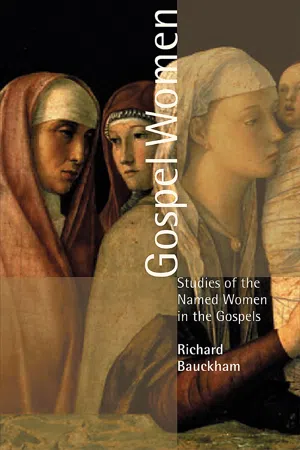
There have been many studies of the women in the Gospels, but this is a new kind of book on the subject. Rather than offering a general overview of the Gospel women or focusing on a single theme, Richard Bauckham studies in great depth both the individual women who appear in the Gospels and the specific passages in which they appear.
This unique approach reveals that there is much more to be known about such women than previous studies have assumed. Employing historical and literary readings of the biblical texts, Bauckham successfully captures the particularity of each woman he studies.
An opening look at the Old Testament book of Ruth introduces the possibilities of reading Scripture from a woman's perspective. Other studies examine the women found in Matthew's genealogies, the prophet Anna, Mary of Clopas, Joanna, Salome, and the women featured in the Gospel resurrection narrative. A number of these women have never been the subject of deep theological enquiry.
Unlike most recent books, Bauckham's work is not dominated by a feminist agenda. It does not presume in advance that the Gospel texts support patriarchal oppression, but it does venture some of the new and surprising possibilities that arise when the texts are read from the perspective of their female characters.
Astute, sensitive to issues of gender, and written by one of today's leading theologians,
Gospel Women will be of interest to a wide range of readers.
- 343 pages
- English
- ePUB (mobile friendly)
- Available on iOS & Android
eBook - ePub
About this book
Information
CHAPTER 1
The Book of Ruth as a Key to Gynocentric Reading of Scripture
Ruth lay down with a man on the threshing floor
for Your sake. Her love was bold
for Your sake.1
1. The Female Voice in Ruth
André Brink’s novel The Wall of the Plague is written in the first person. The novelist is a male Afrikaner, the “I” of the narrative is a “coloured” (mixed race) South African woman. The thoroughgoing adoption of a female character’s perspective is intensified by vivid accounts even of distinctively female physical experience. But in the concluding short section of the novel the voice changes. The woman’s South African white male lover speaks, and in the last two pages of the work reveals that he, not she, has written the story, as an attempt to “imagine what it is like to be you.” As he approaches the task of writing the narrative the reader has just completed, he fears failure: “how can I, how dare I presume to form you from my rib? … To do justice to you an essential injustice is required. That is the heart of my dilemma. I can never be you: yet in order to be myself I must imagine what it is to be you.”2 By this ingenious device of two levels of fictional authorship, the real author distances himself from the attempt he has made to imagine what it is like to be this woman. It is, after all, only a white male’s attempt to imagine what it is like to be a mixed-race woman. But readers have known this all along. How does the final revelation function for them? Is it the author’s bid to preempt their charge that he has not been fully successful? More seriously what it does is to acknowledge, within the imaginative world the novel has created, the readers’ consciousness that behind the female voice lurks a male author. Until the penultimate page of the novel this consciousness has had only extra-textual status. The more successfully the novel creates its own world that readers inhabit, the more independent it is of anything they know about the author. But for most readers, in this case, especially given the South African nationality of both author and characters, the contrast between the white male author and the mixed-race female narrator is so powerful that it inevitably impinges on their reading. Were the contrast between author and narrator less evocatively stark, the final revelation might subvert an illusion hitherto little affected by the readers’ extra-textual knowledge. But as it is, the revelation draws this knowledge into the world of the novel itself and makes into an inner-textual reality the tension between extra-textual knowledge and inner-textual world that they have never entirely been able to escape.
The book of Ruth is not a first-person narrative, but it does adopt predominantly the female perspective of its two main characters, Naomi and Ruth, one an Israelite, one a Moabite. It has no author’s name on its title page and so does not oblige us to think its author female or male, Moabite or Israelite. I suppose that all readers have taken for granted that the author was an Israelite, but the contrast between Moabite character and Israelite audience has loomed larger in their consciousness than that between Moabite character and Israelite author. (This may be in part because Ruth’s Moabite origin plays no role in the story once she has committed herself to Naomi and left Moab, though it is also the case that we lack the cultural equipment to make much sense of the question whether, when the narrative adopts Ruth’s perspective, it adopts a convincingly Moabite perspective.) On the other hand, the assumption of male authorship, made largely without question by traditional historical scholarship,3 has been challenged by recent work that finds strong evidence that Ruth is “a female text”4 or “a collective creation of women’s culture”5 or “an expression of women’s culture and women’s concerns.”6 However, this challenge is not mainly directed at demonstrating that the author was a woman. This is a real possibility, but evidence that the text genuinely reflects women’s experience and convincingly adopts a woman’s perspective and so should, in that sense, be identified as a “female text” or “women’s literature,” cannot actually demonstrate female authorship. Just as there is no reason, other than androcentric prejudice, to accept the traditional, usually unexpressed, assumption that ancient Israelite women did not compose literature, so there is no reason to deny to a male author in ancient Israel the imaginative capacity to adopt a woman’s perspective that modern male novelists such as Brink display.7 Whether the real author was male or female we cannot know.8 The assumption of female authorship that some recent feminist critics9 have adopted is designed to dispel the kind of tension between extra-textual knowledge and inner-textual world that readers of Brink’s novel experience and that readers of Ruth could experience if they both accepted the traditional assumption of male authorship and were alert to gender issues and perspectives in the text. Since we have no extra-textual information about the author, however, this kind of tension need not arise. We can safely leave the real author in the uncertainties of historical possibility in this case. What recent feminist discussions of Ruth seem to me to have shown is that the voice with which the text speaks to its readers is female.10 Readers are offered and drawn into an ancient Israelite woman’s perspective11 on ancient Israelite society. Everything in the text is coherent with such a perspective.12
Until, that is, the last few verses. In the genealogy (4:18–22) a male voice speaks, reciting the patrilineal descent of King David from Perez and attributing to Boaz a place of honor, as seventh name in the genealogy whose tenth generation is David. In the usual manner of Israelite genealogy, women are excluded as irrelevant to the genealogy’s purpose of demonstrating the male line of descent. The male voice is unmistakable, but might be understood as the collective voice of the compilers of traditional genealogies, from which an extract is here made, or as the voice of a redactor who, for whatever reason, has appended these verses to a work that originally ended at verse 17, or, finally, as the voice of the author. Most (though not all)13 feminist readings of Ruth, implicitly relying on the traditional critical judgment that the genealogy is a later appendix, stop short of it.14 They allow the last word to the women of Bethlehem (4:14–17), who conclude the story with emphatically a women’s perspective on the birth of Ruth’s child. The male perspective of Boaz and the people at the gate, which concerns itself with maintaining the name and inheritance of Elimelech and Mahlon and securing descent for Boaz himself (4:9–12), is relativized by the quite different perspective on the same events that the women express. What for a few verses had threatened to become, after all, a men’s story is thus reclaimed by the women as Ruth’s and especially Naomi’s story. But since it is this final ascendancy of the women’s perspective in the story that establishes the meaning of the whole and its character as women’s literature, it becomes important to interpret the male voice that, at least in the final form of the text as we have it, appears to have the last word.
The importance of this issue can be illustrated by suggesting, for example, that here we have a parallel to the ending of Brink’s novel. The author finally reveals himself as male and—one might have to say—undermines the authority of the female voice he has adopted as narrator of the story. His concern is patrilineal descent, and he has adopted a female perspective in order to persuade his readers that the patriarchal laws and conventions that function to secure it in cases where it might otherwise be lost work in the interests of women as well as men. In this way the genealogical conclusion could support that minority of feminist critics who pass a negative verdict on Ruth, arguing that the actions of Ruth and Naomi, though seemingly courageous and independent, function to secure male interests. A male author has adopted a female voice in order to hold up for admiration and imitation women who are “paradigmatic upholders of patriarchal ideology.”15 However, this interpretation of the function of the genealogy is not very plausible, if only because the genealogy merely traces David’s descent through Boaz and his father Salmon from Perez. If, as is generally supposed, Boaz’s marriage to Ruth is a kind of levirate marriage designed to secure a son for her dead husband Mahlon and a grandson for Naomi’s husband Elimelech, this is entirely ignored by the genealogy. As a means simply of securing a son for Boaz, which is the only fact in the story that the genealogy acknowledges, the story is ludicrously redundant.
A more conventional suggestion would explain the function of the genealogy as an editorial addition that extends the point made already by 4:17b (itself regarded by some as an addition to the original text, added before the genealogy).16 Verse 17b serves to connect the story with the broader biblical story of God’s dealings with Israel by pointing out that Naomi’s grandson Obed became the grandfather of David. The addition of the genealogy “serves to formalize” this point.17 In this case, the final verses of the book open up a canonical-critical perspective. The genealogy gives the book of Ruth a canonical setting in the larger corpus of the Hebrew Bible. However, a feminist canonical criticism could not ignore that in this addition a male voice succeeds the female voice that told the story. While the connection with David in verse 17b is made by tracing David’s descent from Naomi, in the genealogy the women’s perspective of the story is entirely supplanted. In this case the genealogy seems to function to subsume the gynocentric story of Ruth into the predominantly androcentric perspective of the rest of Scripture. Reading Ruth as women’s literature would have to be an exercise in resisting its canonical “shaping.”
In due course, I will offer an alternative to both of these suggestions for interpreting the male voice in 4:18–22. But these suggestions may serve to show both that the traditional question about the originality or otherwise of these verses needs to be reconsidered in the light of textual gendering, and also that reading Ruth as women’s literature can profitably raise questions about the canon. What will it mean to read Ruth as women’s literature18 not only in itself, but as women’s literature within a predominantly androcentric canon? Against the understandably dominant feminist tendency to evaluate the canon negatively, I shall suggest that the book of Ruth can play an essential role in a feminist canonical hermeneutic that both accepts the normative function of the canon and also resists the androcentricity of much of the canonical literature.
2. Women’s and Men’s Perspectives
I begin with two aspects of the relationship between social structures and the characters. First, how far are the characters at odds with patriarchal structures? The story certainly presupposes social and economic structures that make it very difficult for a woman to survive without a male provider. Naomi’s plight is to have neither husband nor son, and Ruth’s remarkable and courageous commitment to Naomi consists in sacrificing the chance of a husband in Moab in order to share Naomi’s plight, without hope of gaining a husband thereby. It is true, as many feminist critics point out, that the two women exercise independence and initiative within the rather restricted options the structures of their society permit them, and through their solidarity and resourcefulness secure their future against the odds. It is also true that there are, in this society, some institutional structures designed to provide for their situation. One function of the narrative is surely to show the legal structures of Israelite society operating, as they should, to the advantage of the most vulnerable groups in society: childless widows and resident aliens (Naomi is one, Ruth is both). The law of gleaning provides one means of support for those who could not grow their own crops,19 while the laws of redemption and levirate marriage enable a widow without a son to acquire economic security by marrying and bearing a son who can inherit her first husband’s property.20 But the narrative shows these legal provisions operating for the benefit of Naomi and Ruth only because Ruth, Naomi, and Boaz make them so operate—only because Ruth acts with חסד (loyalty or caring responsibility), only because both women act with initiative and mutual support, and only because Boaz responds with חסד. He allows Ruth to glean beyond her legal right (2:15–16), and, as the example of the nearer kinsman (4:6) shows, he had the legal option not to marry her. In both cases he meets Ruth’s initiative with חסד. Thus the legal structures over which the elders in the gate preside operate for the good of the women when both the women and the man make them do so. Though the women are certainly self-determinative to a significant extent, it is hardly the case, as sometimes claimed, that they subvert or circumvent the structures of society. It is more that they make those legal provisions that were designed for their advantage actually work for their advantage.
Second, it is with regard to the operation of these legal provisions that the story most effectively contrasts male and female perspectives. From the death of Elimelech (1:3) onward, the story adopts the perspective of Naomi and subsequently also of Ruth. It concerns their struggle to achieve “security” (1:9; 3:1), which is finally accomplished by Ruth’s marriage and the birth of her son. But there is one major interruption of this women’s persp...
Table of contents
- Cover
- Title Page
- Copyright
- Dedication
- Contents
- Acknowledgments
- Introduction
- 1. The Book of Ruth as a Key to Gynocentric Reading of Scripture
- 2. The Gentile Foremothers of the Messiah
- 3. Elizabeth and Mary in Luke 1: Reading a Gynocentric Text Intertextually
- 4. Anna of the Tribe of Asher
- 5. Joanna the Apostle
- 6. Mary of Clopas
- 7. The Two Salomes and the Secret Gospel of Mark
- 8. The Women and the Resurrection: The Credibility of Their Stories
Trusted by 375,005 students
Access to over 1.5 million titles for a fair monthly price.
Study more efficiently using our study tools.
Frequently asked questions
Yes, you can cancel anytime from the Subscription tab in your account settings on the Perlego website. Your subscription will stay active until the end of your current billing period. Learn how to cancel your subscription
No, books cannot be downloaded as external files, such as PDFs, for use outside of Perlego. However, you can download books within the Perlego app for offline reading on mobile or tablet. Learn how to download books offline
Perlego offers two plans: Essential and Complete
- Essential is ideal for learners and professionals who enjoy exploring a wide range of subjects. Access the Essential Library with 800,000+ trusted titles and best-sellers across business, personal growth, and the humanities. Includes unlimited reading time and Standard Read Aloud voice.
- Complete: Perfect for advanced learners and researchers needing full, unrestricted access. Unlock 1.5M+ books across hundreds of subjects, including academic and specialized titles. The Complete Plan also includes advanced features like Premium Read Aloud and Research Assistant.
We are an online textbook subscription service, where you can get access to an entire online library for less than the price of a single book per month. With over 1.5 million books across 990+ topics, we’ve got you covered! Learn about our mission
Look out for the read-aloud symbol on your next book to see if you can listen to it. The read-aloud tool reads text aloud for you, highlighting the text as it is being read. You can pause it, speed it up and slow it down. Learn more about Read Aloud
Yes! You can use the Perlego app on both iOS and Android devices to read anytime, anywhere — even offline. Perfect for commutes or when you’re on the go.
Please note we cannot support devices running on iOS 13 and Android 7 or earlier. Learn more about using the app
Please note we cannot support devices running on iOS 13 and Android 7 or earlier. Learn more about using the app
Yes, you can access Gospel Women by Richard Buckham,Richard Bauckham in PDF and/or ePUB format, as well as other popular books in Theology & Religion & Biblical Criticism & Interpretation. We have over 1.5 million books available in our catalogue for you to explore.