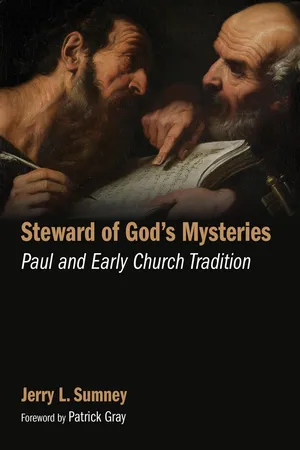
One view that perennially springs up among biblical scholars is that Paul was the inventor of Christianity, or that Paul introduced the idea of a divine Christ to a church that earlier had simply followed the ethical teaching of a human Jesus. In this book Jerry Sumney responds to that claim by examining how, in reality, Paul drew on what the church already believed and confessed about Jesus.
As he explores how Paul's theology relates to that of the broader early church, Sumney identifies where in the Christian tradition distinctive theological claims about Christ, his death, the nature of salvation, and eschatology first seem to appear. Without diminishing significant differences, Sumney describes what common traditions and beliefs various branches of the early church shared and compares them to Paul's thought. Sumney interacts directly with arguments made by those who claim Paul as the inventor of Christianity and approaches the questions raised by that claim in a fresh way.
- 223 pages
- English
- ePUB (mobile friendly)
- Available on iOS & Android
eBook - ePub
About this book
Information
CHAPTER 1
Thinking about Paul’s Place in the Early Church
In this book we will search Paul’s letters for preformed traditions that he did not formulate. We will look for occasions when he uses such traditions as a means to persuade his churches to believe a particular doctrine or act in a particular way. We will observe what kinds of theological claims these traditions make and look for points of continuity and points of difference in relation to Paul’s theology. The point of this examination is to bring some light to a slice of the church’s history in its first few decades, particularly where Paul’s teachings stand in relation to those in the church before him and those in other branches of the church during his ministry. We will try to identify where some distinctive theological claims about Christ, his death, the nature of salvation, and eschatology first seem to appear. We will also examine the traditions about the Lord’s Supper to gain some insight into how they developed.
One view of Paul’s relationship to those in the church before him that is resurrected every twenty years or so claims that Paul is the inventor of “Christianity” or that Paul is the one who invented the divine Christ; before him, the church had simply followed the ethical teaching of a human Jesus. Among the more recent such works are those of Hyam Maccoby (The Mythmaker: Paul and the Invention of Christianity, 1987), Barrie Wilson (How Jesus Became Christian, 2008), and James Tabor (Paul and Jesus: How the Apostle Transformed Christianity, 2012). Modern versions of this thesis go back at least as far as Joseph Klausner (1943), and before him to Adolf Harnack and William Wrede. A similar view of Paul’s relationship to the earlier and non-Pauline branches of the church appears in scholars who see the Q community or others holding to the teaching of Jesus without the christological and soteriological beliefs of the later (post-Pauline) church.1
It is interesting to note that when Wrede called Paul “the second founder of Christianity,” he meant it as a compliment.2 He meant that Paul turned the church into a universal religion. What Wrede claimed as something good has become an accusation in those who now claim that Paul invented Christianity.3 The tales of how Paul single-handedly took over the church have become more elaborate in these recent claims. The tone and methods of these works are more those of conspiracy theory writings than those of careful history.
In this chapter we will review some aspects of these studies. We begin by looking at some assertions of those who contend that Paul invented Christianity. They identify a number of things about Paul and his teachings that they claim are shocking. We will then make some observations about the methods of historical research they employ. The brief glimpses at these studies will help clear the table before we begin to explore whether or how Paul is dependent on earlier church teaching. We will survey the diversity of views within the early church that Paul’s letters evidence. Finally in this chapter we will set out a method for identifying preformed material in Paul’s letters. This method will guide the work in the rest of the study to try to see what beliefs were held by those outside Paul’s influence.
Assertions That Paul Invented Christianity
The assertion that the religion of Paul was not the religion of Jesus is often claimed to be a radical and hidden idea.4 This claim is correct in many ways and not surprising. Jesus was never a Christian and was never a member of the church. The church does not begin until some followers of Jesus experience his resurrection and then have the experience of feeling that the risen Christ is in some way facilitating the presence of God in their midst. The church is composed of those who believe that God vindicated the message and ministry of Jesus through the resurrection. Even by the Gospel accounts, no one believed this before Jesus was crucified. The rest of this book will help one see what kinds of claims this experience led them to make about Jesus. Of course, in the earliest days all church members remained observant Jews. They saw no contradiction between making claims about what God had done in Christ and being faithful Jews.
There is now debate among Pauline scholars about how long the church continued to see itself as a group wholly within Judaism. Some contend that Paul’s churches, which had mostly gentile members, continued to be a subgroup within the local synagogues at least as long as Paul was alive. Even if many of those churches were separate from the local synagogues, as I think they were, Jewish members of those churches would have remained members of their synagogues. The list of troubles Paul says he endured in 2 Cor 11:21b–29 includes chastisements received from synagogue authorities. He continues to submit to the authority of synagogue officials even as he is a missionary of the church. So while Paul is a member of the church and Jesus never was, Paul maintains, at least in some ways, his observance of Judaism. So both Jesus and Paul were adherents of Judaism, but only Paul was a church member. Paul is, then, a member of a different religious movement than Jesus, even though both were observant Jews.
Some who claim that Paul invented Christianity say that he shifted the movement away from an emphasis on the teaching of Jesus to an emphasis on teaching about the Christ.5 There is here an important truth that, again, is not really shocking or new. The church from its beginning was not just about passing on the teachings of Jesus. It was a movement that made claims about who Jesus was and, as we will see, began calling him Messiah/Christ very early. Wilson also claims that it is unusual to say that Paul’s religion emerged from a different revelation than that of Jesus.6 Of course, since the risen Jesus was the speaker in the Acts accounts of Paul’s revelation, this is hardly surprising news. Indeed, it has to be true.
The claim that there was this shift from the teaching of Jesus to teachings about him, though, contains an internal fallacy; it presents readers with a false dilemma. The move to proclaiming things about Jesus’s identity does not need to signal that his teachings are being ignored. In places it is clear that Paul expects members of his churches to know stories of the life of Jesus and to know his teachings (e.g., 1 Cor 7:10). As we will see, for Jesus’s followers to have a reason to continue to think about his teachings, they had to formulate an understanding of his identity in the wake of his execution as an insurrectionist. So they had to begin proclaiming things about his identity that made him worth remembering, not just remember his teachings. Further, as Elisabeth Schüssler Fiorenza points out, the Jesus traditions were formative for the urban non-Palestinian churches because the first people to take the message outside Palestine were Jews who went to other Jews and synagogue adherents. These missionaries led those who listened to adapt the Jesus tradition to their different cultural settings.7
Wilson makes what he also seems to see as a shocking revelation when he says that the “New Testament is not a neutral collection of early Christian writings.”8 This is also true and nearly self-evident. It is clearly a collection intended to help the church maintain its belief in Christ and to guide its behavior. The collection intends its readers to believe certain things about Jesus and to reject other claims. What Wilson and Maccoby want to claim beyond this is that the whole New Testament is the product of the Pauline branch of the church, which is dramatically different from the earlier, Palestinian church.9 Looking at traditions in Paul’s letters will help us evaluate whether the divide between the predominantly Jewish churches and those Paul founded is as wide as those who charge Paul with inventing Christianity contend.
Historical Methods
Beyond the sensationalizing of some assertions about the early church, there are also serious questions about the historical methods employed in some of these studies. A prime example is Maccoby’s view of Paul’s psychological motivation to invent Christianity. He notes that the Ebionites say that rather than being a Pharisee, Paul was a gentile who converted to Judaism to marry a priest’s daughter. When the marriage was refused, he turned against the law. Maccoby argues that the truth behind this story is that Paul was in love with Judaism itself. As a deputy of the high priest who persecuted believers in Christ, Paul converted to Judaism. But when his ambitions within Judaism were thwarted, he became involved with the “Jesus movement” and became the creator of a savior religion.10
To weave this tale, Maccoby relies on a fourth-century text, the Panarion of Epiphanius. In this work, Epiphanius describes and argues against various understandings of Christianity that he rejects. In his account of the teachings of the Ebionites, Epiphanius says they tell this story of the conversion of Paul and the failed marriage. Maccoby acknowledges that this is not historical, but then chooses elements of it he needs to create his version of Paul. So Maccoby’s view of Paul is based on a psychologizing of an admittedly nonfactual account of Paul’s life that appears in a polemical account of the group whose beliefs contain the story. This is hardly solid historical methodology.
Similarly, Tabor looks to Jerome, who wrote in the late fourth and early fifth century, to support his version of Paul’s biography. While Tabor acknowledges that Paul was Jewish and a Pharisee (and so not as much of a liar as Maccoby charges), he was not from Tarsus but from Gischala in Galilee. While this does not directly contradict what Paul says about himself, neither is it good evidence. Still, Tabor at least does not change what his source says to construct an otherwise unsupported biography of Paul.
Maccoby identifies the Ebionites as the “authentic successors” of the Jerusalem church.11 It seems likely that the Ebionites were, indeed, a group that grew out of the Palestinian church. The Ebionites continued to be a Torah-observant church, as the Jerusalem church was. But calling them that church’s “authentic successors” is a value judgment, not a historical statement. Maccoby means that he likes what they taught better than he likes Paul. Maccoby says their beliefs were consistent with the Jerusalem church because they believed, among other things, that Jesus was just a human and that he intended to establish an earthly kingdom.12 But these beliefs are not really what Epiphanius reports about the Ebionites. Epiphanius does say that some Ebionites believe Jesus was born a human, but he also says that others say he was an archangel (2.30.16.4–5; 2.30.14.4; see other options in 2.30.3.4; 2.30.17.6). Other Ebionites say he was not a human because when his family came to talk with him (Matt 12:46–50) Jesus said that his family members are those who do the will of God (2.30.14.5). Those who do think he was born a human seem to have an adoptionist Christology, though Epiphanius says they do not agree among themselves (2.30.3.4–6; 2.30.18.5–6). If Maccoby is right about what the Jerusalem church believed, the Ebionites did not remain faithful to it. Indeed, Ephiphanius says that the Ebionites even say that Jesus commanded his followers to reject the temple sacrifices (2.20.16.4–7). The Ebionites, then, do not reflect what Maccoby wants to find when we look at the full description in Epiphanius.
When Maccoby moves from constructing a story of Paul’s life, he describes Paul’s religion as a combination of Gnosticism, mystery religions, and Judaism.13 Scholars from the nineteenth and first half of the twentieth century often pointed to elements in those religions as the sources for the teachings of the early church. More recent scholarship acknowledges that there was no fully formed pre-Christian Gnosticism. This means it could not have been a source for Paul. Interpreters are also now more careful about saying that parallels indicate dependence. That is, similarities do not automatically show that one religion was dependent on the other.
Maccoby’s kind of construction of history is also evident in his means of supporting t...
Table of contents
- Title Page
- Copyright
- Dedication
- Contents
- Foreword: Paul’s Place in Christian Tradition, by Patrick Gray
- Preface
- Abbreviations
- 1. Thinking about Paul’s Place in the Early Church
- 2. “Christ Died for Us”: The Meaning of the Death of Jesus
- 3. “Jesus Is Lord”: The Identity of Jesus
- 4. “For Our Sins”: Understandings of Salvation
- 5. “The Coming of the Lord”: Envisioning the Kingdom
- 6. “In Remembrance of Me”: The Lord’s Supper
- 7. “I Handed On to You . . . What I Received”
- Bibliography
- Index of Authors
- Index of Subjects
- Index of Scripture and Other Ancient Texts
Trusted by 375,005 students
Access to over 1.5 million titles for a fair monthly price.
Study more efficiently using our study tools.
Frequently asked questions
Yes, you can cancel anytime from the Subscription tab in your account settings on the Perlego website. Your subscription will stay active until the end of your current billing period. Learn how to cancel your subscription
No, books cannot be downloaded as external files, such as PDFs, for use outside of Perlego. However, you can download books within the Perlego app for offline reading on mobile or tablet. Learn how to download books offline
Perlego offers two plans: Essential and Complete
- Essential is ideal for learners and professionals who enjoy exploring a wide range of subjects. Access the Essential Library with 800,000+ trusted titles and best-sellers across business, personal growth, and the humanities. Includes unlimited reading time and Standard Read Aloud voice.
- Complete: Perfect for advanced learners and researchers needing full, unrestricted access. Unlock 1.5M+ books across hundreds of subjects, including academic and specialized titles. The Complete Plan also includes advanced features like Premium Read Aloud and Research Assistant.
We are an online textbook subscription service, where you can get access to an entire online library for less than the price of a single book per month. With over 1.5 million books across 990+ topics, we’ve got you covered! Learn about our mission
Look out for the read-aloud symbol on your next book to see if you can listen to it. The read-aloud tool reads text aloud for you, highlighting the text as it is being read. You can pause it, speed it up and slow it down. Learn more about Read Aloud
Yes! You can use the Perlego app on both iOS and Android devices to read anytime, anywhere — even offline. Perfect for commutes or when you’re on the go.
Please note we cannot support devices running on iOS 13 and Android 7 or earlier. Learn more about using the app
Please note we cannot support devices running on iOS 13 and Android 7 or earlier. Learn more about using the app
Yes, you can access Steward of God's Mysteries by Jerry L. Sumney in PDF and/or ePUB format, as well as other popular books in Theology & Religion & Biblical Criticism & Interpretation. We have over 1.5 million books available in our catalogue for you to explore.