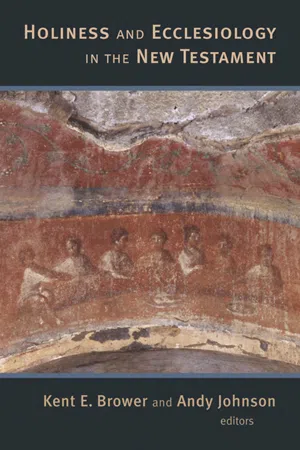
Throughout the biblical story, the people of God are expected to embody God's holy character publicly. Therefore, holiness is a theological and ecclesial issue prior to being a matter of individual piety.
Holiness and Ecclesiology in the New Testament offers serious engagement with a variety of New Testament and Qumran documents in order to stimulate churches to imagine anew what it might mean to be a publicly identifiable people who embody God's very character in their particular social setting.
Contributors:
J. Ayodeji Adewuya
Paul M. Bassett
Richard Bauckham
George J. Brooke
Kent E. Brower
Dean Flemming
Michael J. Gorman
Joel B. Green
Donald A. Hagner
Andy Johnson
George Lyons
I. Howard Marshall
Troy W. Martin
Peter Oakes
Ruth Anne Reese
Dwight Swanson
Gordon J. Thomas
Richard P. Thompson
J. Ross Wagner
Robert W. Wall
Bruce W. Winter
eBook - ePub
Holiness and Ecclesiology in the New Testament
- 416 pages
- English
- ePUB (mobile friendly)
- Available on iOS & Android
eBook - ePub
Holiness and Ecclesiology in the New Testament
About this book
Information
Carnal Conduct and Sanctification in 1 Corinthians: Simul sanctus et peccator?
Given the catalogue of sinful behavior in the Christian community in Corinth that Paul addressed in 1 Corinthians, one is astonished by what he says of them on three occasions. He does not state that they should be sanctified, that they will be sanctified in heaven, but that they are already sanctified (1:2, 30; 6:10). This declaration seems to be a highly inappropriate, if not irresponsible, one to make in the light of their indulgence in fornication and adultery, which they justified on the basis of the popular aphorism that “all things are permitted for me” (6:12, 15; 10:8, 23). Paul’s statement is all the more surprising because he clearly warns them immediately prior to the discussion of the former problem that those who commit fornication and other sins in a catalogue of vices, will not inherit the kingdom of God (6:9). How can Paul, in the light of this latter statement, not only believe but also tell the Corinthian Christians in their present spiritual condition on three occasions that they have been sanctified? Would we ourselves be comfortable informing Christians who are behaving as the Corinthians did that they “are sanctified” (1:2)?
It is also very unlikely that we would then immediately proceed, as Paul did, with a thanksgiving prayer for the grace of God given to them, affirming that he had “enriched them” in every way, “that the testimony of Christ was confirmed among them,” and that God “will strengthen them to the end, so that they will be blameless on the Day of the Lord Jesus” (1:4-9).1 As the letter unfolds it emerges that their behavior was unholy and culpable. Would we follow up the declaration of holiness in 1:2 with these affirmations of similar behavior in a Christian congregation today?
The Christian tradition to which the one who is being honored in this volume belongs gives more than notional assent to the doctrine of holiness and it does so at a time when the emphasis on the personal and corporate pursuit of holiness appears largely to have slipped from the agenda of wider Christianity. It has been replaced by what could be called “consumer” Christianity where Christians “shop” around for a church that suits them. This shift away from an emphasis on holiness simply reflects the focus of our contemporary society that is possessed by possessions and passions. The former is promulgated on the premise that need and greed are the engines that drive human beings because life is seen to consist in the abundance of possessions and pleasures. The latter has been endorsed by the dominant popular philosophical system of the past eighty years. It began with psychological hedonism that spawned the “Roaring Twenties” and was made even more culturally acceptable half a century ago by Hugh Heffner in his Playboy magazine which published his defense of hedonism in a series entitled “The playboy’s philosophy.” It was Walter Lippmann who astutely observed “that the pursuit of happiness is the most unhappy pursuit.” Is it really the message of 1 Corinthians that the present pursuit of holiness is the most Christian pursuit, and is obligatory at the corporate and personal level? If so, how does one make sense of Paul’s declaration to Christians that they are sanctified, even though their behavior is distinctly unsanctified, i.e., unholy? Carnality and holiness are surely antonyms in 1 Corinthians.
When used in this chapter, the term “carnality” covers the same range of meanings supplied by the Oxford English Dictionary, namely “sensual, unsanctified, worldly” and is not restricted to the first meaning. This is important because sanctification is so often seen in the Christian community as solely the antithesis to the first meaning when reading either 1 Corinthians or the larger Pauline corpus.
In order to unravel Paul’s teaching on sanctification in this letter it is proposed (I) to highlight aspects of Corinthian culture that are reflected in the issues he discusses in order to understand that carnality covers more than sexual issues, and then to explore his teaching on Christian sanctification, (II) to discuss the concept of “Christ our sanctification,” (III) to examine unsanctified conduct in the sanctified; and then (IV) to note the divine discipline exercised on those whose unsanctified living provokes the Lord’s intervention. This chapter seeks to clarify Paul’s teaching on the critical doctrine of sanctification in this penultimate era of salvation in which Christians now live.
I. The Extent of Christian Carnality
How carnal was Roman Corinth? While it is generally not known that “to Cretianize” in Greek was widely used as a first-century synonym “to tell lies,”2 all seem to be aware that “to Corinthianize” had, for centuries, referred to having sexual intercourse with a prostitute.3 The latter term originated from a Classical Greek play and belonged to the Greek era of Corinth, as did the story that on the Acrocorinth there was a temple of Aphrodite that housed one thousand prostitutes. This was a myth from the Greek period as there was no temple prostitution in the Corinth of Paul’s day for two reasons — (i) The newly built first-century temple to Aphrodite was a small construction on the edge of the Acrocorinth overlooking this proud Roman colony; (ii) by this period Aphrodite, the patron of the new colony founded by Rome in A.D. 44 had been Romanized and was now known as Venus, the divine “mother” of the imperial family. No longer the naked sex icon of the Greek period, she was now a well-clad and highly respectable goddess.4
Taking cognizance of these facts is critical as there is a temptation to read 1 Corinthians as a letter written to a city that was saturated with prostitutes and whose male inhabitants were hopelessly addicted to promiscuity. It is then concluded that the conduct of those Christians was totally explicable and sexual purity was the main issue Paul addressed in his letter. Such a perception misreads the secular mores of Roman Corinth and obscures the important teaching on the breadth of Christian corporate and personal holiness that encompasses matters well beyond the sphere of their sexuality. This letter addresses critical issues concerning holiness in our contemporary church, just as it did for that nascent congregation in the A.D. 50s.
While statistical information does not tell the whole story, it is interesting to note that, based on the number of words that Paul used to address different issues, the three longest discussions in 1 Corinthians are devoted to divisiveness among Christians (1:10–4:21), the misuse of spiritual gifts (12–14), and eating in the idol temple as a matter of a “right” (8–11:1). Paul’s responses occupy 19.6 percent, 18.5 percent, and 17 percent of the length of the letter respectively.5 The first two problems show that sexual issues were not the only unsanctified matters Paul had to deal with at length and, even on the third matter, sexual misconduct was not the central problem.
Would our contemporary preachers have begun by first addressing the problem of “politics” in the church and not sexual issues? This is what Paul does in 1 Corinthians 1:10–4:21. It has to do with conduct that he describes as secular, i.e., “walking according to secular dictates,” “behaving like [secular] men,” and categorizing their conduct as “carnal” (σάρκινος/σαρκικός, 3:1-3). It came about with Christians importing mores governing the teacher/pupil relationship from secular education into their perception of ministry and disciple-ship in the church. That this should happen is entirely explicable because the students of the teachers at the secondary and tertiary levels of education were called by the same term used of the disciples of Christ (μαθηταί).6
Like the Trojan horse, along with that designation came secular conventions. They determined how an orator would relate to his pupils in this important era of the dawning of the Second Sophistic and how his students would slavishly follow him. They were expected to imitate his ways, to give exclusive loyalty to him and to be in competition with the disciples of other teachers as to whose instructor was superior — hence Paul’s selection of the terms “strife” and “zealousness” drawn from the semantic domain of education (παιδεία) to describe what Paul saw as the cult of following Paul, Apollos, or Peter (1:11-13; 3:3-4). At the time of writing 1 Corinthians the Christians were playing the first two off against each other, as if they were in competition with one another for followers — just as secular teachers were (4:6).7 Paul indicates that this giving of exclusive loyalty was idolatrous (1:13). He wanted no followers, because the ministers belonged to the church and not vice versa (3:21-23). There was nothing salacious involved in this major issue that Paul addressed first. It was very much a replication of their secular way of thinking and one that was destroying the Christian fellowship of brothers.8
The serious issue of incest occupies the next section of the letter. What deeply troubled Paul was that some Christians boasted not about the sin but the status of the person sexually involved with his stepmother. It was he, and not she, who was to be excluded from the Christian community for we can presume that she was not a Christian. Exclusion from personal contact and table fellowship go well beyond the boundaries of incest and includes issues that are seen to be equally serious, i.e., covetousness, idolatry, verbal abuse, drunkenness, and swindling other people (5:10).9
Vexatious litigation over the smallest matters was a standard way of bringing into the public domain conflict situations between individuals, for interpersonal strife was very much part and parcel of first-century life.10 Under Roman law such litigation was off limits between family members, hence the astonishment that in the family of God “brothers go to law against brothers and that before unbelievers” (6:6).11 A judge determined the outcome of a case and jurors were elected to office by a wealth test. They were known to be corrupt in their decision-making process that was influenced by the rank and status of the respective contestants. They were “unjust” in their decisions and open to being influenced by bribes. Financial penalties were imposed on the person who lost the case (6:1-8).12
In 6:9-20 behavior is related to what ancient historians have designated “the unholy trinity” of eating and drinking and immorality.13 That was expected of young men when they assumed the toga virilis on reaching manhood — food was for the belly and the belly for food and the body was made for sex.14 Cicero argued that this had always been the case, when he wrote of those who rejected the well-known aphorism “it is permitted” (licitum est).
If there is anyone who thinks that youth should be forbidden affairs even with courtesans, he is doubtless eminently austere, but his view is contrary not only to the license of this age, but also to the custom and concessions of our ancestors. For when was this not a common practice? When was it blamed? When was it forbidden? When, in fact, was it that what is permitted was not allowed (quod licet, non liceret)?15
Apart from Paul, Tacitus saw the temptations that opened up to young men on receiving the toga virilis as a persistent danger. “The elegant banquet … along with the use of the toga … are the enticements of Romanization to vice and servitude.”16 Nicholas of Damascus in his life of Augustus records at that age he was not “in attendance with the young men as they get drunk, not to remain at drinking parties past evening nor to have dinner … and he abstained from sex just at the time when young men were particularly sexually active.”17 We are certain that “it is permitted” was a popular aphoristic saying of young men that justified their excessive eating and drinking and after-dinner sex (6:2) — it was not a misunderstanding of Paul’s gospel.18 The sexual sin was not that of adultery but fornication because it created a one-flesh relationship through intercourse with a prostitute and was not a breach of marriage, i.e. adultery. The Sitz im Leben points to activities at feasts and not brothels.
Chapter 7 is Paul’s longest discussion of marriage, singleness, divorce, and chaste conduct prior to marriage as well as the remarriage of widows, all of which are seen as a Christian “calling.” He also addresses the issues of social pressures open to those concerned with “class,” i.e., Jewish/Gentile identity, or bonded service and manumission and voluntary indentured service into a Roman household for a set period so that Provincials could secure Roman citizenship (7:17-24). It shows that some Christians were keen to be upwardly mobile in the established class system for reasons of personal and financial advantage and thus there was the need for standard teaching in all the churches, not just the church in Corinth (7:17).
Guests at major civic feasts sat down to eat and drink in the temple precincts and rose up “to play,” i.e., engaged in what was politely called “after dinners” by courtesy of the traveling brothels.19 However, Paul goes back to the core issue as to why some Christians were attending, i.e., to exercise their constitutional rights as Roman citizens. He confronts the arguments some put forward as to why they should be present and then extrapolates at length on not exercising his rights as an apostle (chap. 9). He again rejects the popular aphorism that “all things are permitted” (10:23), and demands what was antithetical, i.e., they must give no offence to Jews or Greeks or to the church of God but seek the welfare of neighbors that they may be saved. He cites himself as an example. Therefore they must imitate him by not exercising their rights, just as he himself imitates Christ in this matter (10:32–11:1). Carnal conduct was not only manifested in their moral misconduct but in their worldly way of operating on the basis of their civic rights and not on their gospel responsibilities. As Roman society was founded on the basis of the constitutional “rights,” Paul demands a major inversion of thinking.
In discussing the exercising of spiritual gifts at the expense of relationships in the Christian meetings, Paul makes a devastating judgment. In 13:1-3 he categorically states that however “gifted” the ministry of Christians may be, if it is not motivated by love then their words are empty and they themselves “are nothing.” Even though they have prophetic powers and great faith, they gain nothing...
Table of contents
- Cover
- Title Page
- Copyright
- Contents
- Contributors
- Abbreviations
- Dedication to Alex R. G. Deasley—Paul M. Bassett
- Introduction: Holiness and the Ekklēsia of God—Kent E. Brower and Andy Johnson
- The Dead Sea Scrolls and New Testament Ecclesiology—George J. Brooke
- Holiness in the Dead Sea Scrolls: The Priorities of Faith—Dwight Swanson
- Holiness and Ecclesiology: The Church in Matthew—Donald A. Hagner
- The Holy One of God and His Disciples: Holiness and Ecclesiology in Mark—Kent E. Brower
- Gathered at the Table: Holiness and Ecclesiology in the Gospel of Luke—Richard P. Thompson
- The Holiness of Jesus and His Disciples in the Gospel of John—Richard Bauckham
- Holiness in the Book of Acts—I. Howard Marshall
- Reading Paul with Acts: The Canonical Shaping of a Holy Church—Robert W. Wall
- “You Shall Be Cruciform for I Am Cruciform”: Paul’s Trinitarian Reconstruction of Holiness—Michael J. Gorman
- Made Holy by the Holy Spirit: Holiness and Ecclesiology in Romans—Peter Oakes
- Carnal Conduct and Sanctification in 1 Corinthians: Simul sanctus et peccator?—Bruce W. Winter
- The People of God in a Pluralistic Society: Holiness in 2 Corinthians—J. Ayodeji Adewuya
- Circumcision in Galatia and the Holiness of God’s Ecclesiae—Troy W. Martin
- Church and Holiness in Ephesians—George Lyons
- Working Out Salvation: Holiness and Community in Philippians—J. Ross Wagner
- The Sanctification of the Imagination in 1 Thessalonians—Andy Johnson
- The Perfection of Christ and the Perfecting of Believers in Hebrews—Gordon J. Thomas
- Living as Exiles: The Church in the Diaspora in 1 Peter—Joel B. Green
- Holiness and Ecclesiology in Jude and 2 Peter—Ruth Anne Reese
- “On Earth as It Is in Heaven”: Holiness and the People of God in Revelation—Dean Flemming
Trusted by 375,005 students
Access to over 1.5 million titles for a fair monthly price.
Study more efficiently using our study tools.
Frequently asked questions
Yes, you can cancel anytime from the Subscription tab in your account settings on the Perlego website. Your subscription will stay active until the end of your current billing period. Learn how to cancel your subscription
No, books cannot be downloaded as external files, such as PDFs, for use outside of Perlego. However, you can download books within the Perlego app for offline reading on mobile or tablet. Learn how to download books offline
Perlego offers two plans: Essential and Complete
- Essential is ideal for learners and professionals who enjoy exploring a wide range of subjects. Access the Essential Library with 800,000+ trusted titles and best-sellers across business, personal growth, and the humanities. Includes unlimited reading time and Standard Read Aloud voice.
- Complete: Perfect for advanced learners and researchers needing full, unrestricted access. Unlock 1.5M+ books across hundreds of subjects, including academic and specialized titles. The Complete Plan also includes advanced features like Premium Read Aloud and Research Assistant.
We are an online textbook subscription service, where you can get access to an entire online library for less than the price of a single book per month. With over 1.5 million books across 990+ topics, we’ve got you covered! Learn about our mission
Look out for the read-aloud symbol on your next book to see if you can listen to it. The read-aloud tool reads text aloud for you, highlighting the text as it is being read. You can pause it, speed it up and slow it down. Learn more about Read Aloud
Yes! You can use the Perlego app on both iOS and Android devices to read anytime, anywhere — even offline. Perfect for commutes or when you’re on the go.
Please note we cannot support devices running on iOS 13 and Android 7 or earlier. Learn more about using the app
Please note we cannot support devices running on iOS 13 and Android 7 or earlier. Learn more about using the app
Yes, you can access Holiness and Ecclesiology in the New Testament by Kent Brower, Andy Johnson, Kent Brower,Andy Johnson in PDF and/or ePUB format, as well as other popular books in Théologie et religion & Critique et interprétation bibliques. We have over 1.5 million books available in our catalogue for you to explore.