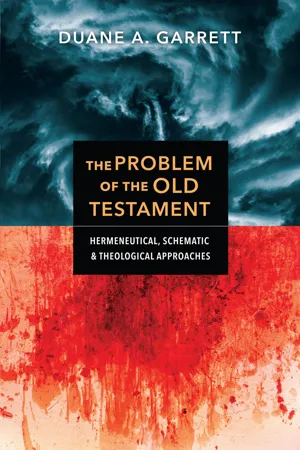
The Problem of the Old Testament
eBook - ePub

The Problem of the Old Testament

Hermeneutical, Schematic, and Theological Approaches

  1. 408 pages
  2. English
  3. ePUB (mobile friendly)
  4. Available on iOS & Android
eBook - ePub

The Problem of the Old Testament

Hermeneutical, Schematic, and Theological Approaches

About this book

Biblical Foundations Book Awards Finalist

For Christians, the Old Testament often presents a conundrum. We revere it as God's Word, but we don't always comprehend it. It has great truths beautifully expressed, but it also has lengthy lists of names that we cannot pronounce, detailed rules for religious rites that we never observe, and grim stories that we never tell our children. Theologians and laypeople throughout church history have struggled to define it, interpret it, and reconcile it with the New Testament.

In The Problem of the Old Testament, Duane A. Garrett takes on this conundrum and lays a foundation for constructive study of the Old Testament. He surveys three primary methods Christians have used to handle the Old Testament, from the church fathers to today: hermeneutical, schematic, and conceptual. Garrett also explores major interpretive topics such as the nature of the law, the function of election and covenants, and how prophecy works, boldly offering a way forward that is faithful to the text and to the Christian faith.

"I argue," Garrett writes, "that the Old Testament is fulfilled in Jesus Christ and that it is authoritative and edifying for Christians." This thorough, accessible work is essential reading for all students of Scripture seeking to discover the Old Testament's riches beyond the challenges.

Frequently asked questions

Yes, you can cancel anytime from the Subscription tab in your account settings on the Perlego website. Your subscription will stay active until the end of your current billing period. Learn how to cancel your subscription.
No, books cannot be downloaded as external files, such as PDFs, for use outside of Perlego. However, you can download books within the Perlego app for offline reading on mobile or tablet. Learn more here.
Perlego offers two plans: Essential and Complete
  • Essential is ideal for learners and professionals who enjoy exploring a wide range of subjects. Access the Essential Library with 800,000+ trusted titles and best-sellers across business, personal growth, and the humanities. Includes unlimited reading time and Standard Read Aloud voice.
  • Complete: Perfect for advanced learners and researchers needing full, unrestricted access. Unlock 1.4M+ books across hundreds of subjects, including academic and specialized titles. The Complete Plan also includes advanced features like Premium Read Aloud and Research Assistant.
Both plans are available with monthly, semester, or annual billing cycles.
We are an online textbook subscription service, where you can get access to an entire online library for less than the price of a single book per month. With over 1 million books across 1000+ topics, we’ve got you covered! Learn more here.
Look out for the read-aloud symbol on your next book to see if you can listen to it. The read-aloud tool reads text aloud for you, highlighting the text as it is being read. You can pause it, speed it up and slow it down. Learn more here.
Yes! You can use the Perlego app on both iOS or Android devices to read anytime, anywhere — even offline. Perfect for commutes or when you’re on the go.
Please note we cannot support devices running on iOS 13 and Android 7 or earlier. Learn more about using the app.
Yes, you can access The Problem of the Old Testament by Duane A. Garrett in PDF and/or ePUB format, as well as other popular books in Theology & Religion & Biblical Studies. We have over one million books available in our catalogue for you to explore.

Information

1

DEFINING THE PROBLEM

WE CHRISTIANS REVERE THE OLD TESTAMENT. We experience the grandeur of creation in Genesis 1. In the books of Samuel, we see so vividly the strengths and flaws of David that we feel we know him personally. The peaceful lyrics of Psalm 23 reassure us of the love of God. Isaiah 53 surpasses even the four Gospels in its ability to inform our minds and break our hearts over the passion of Christ.
But much of the Old Testament is not like that. 1 Chronicles 6:62 says that the Gershomites were assigned thirteen towns from the territories of Issachar, Asher, Naphtali, and Manasseh. While this was no doubt important to the Gershomites, it is not clear what we should do with it. Zechariah 4, a vision involving a lampstand and olive trees, is almost impenetrably obscure. In Psalm 17, David proclaims his moral purity, rails against his enemies, and calls on God to destroy them. This troubles us, both in his protests of purity and in his hostility toward enemies. Ezekiel 16:23-29 graphically recounts Lady Jerusalem’s sexual exploits. And few of us rejoice to know that Oholibamah daughter of Anah bore to Esau three sons named Jeush, Jalam, and Korah (Gen 36:14) or that Jerusalem’s temple pillars had capitals shaped like lilies (1 Kings 7:22).
The Old Testament is the foundation of the New Testament, but we do not know how to fully assimilate it to the Christian faith. It is canonical for us, but we often do not comprehend it. It has great truths beautifully presented, but it also has lengthy lists of names that we cannot pronounce, detailed rules for religious rites that we never observe, and grim stories that we never tell our children. In candid moments, we confess our inability to come to terms with its rituals, lists, sad tales, and diatribes. Some of the books, like a verbose politician, go on and on with no apparent plan. Some books are disturbing: Ecclesiastes appears skeptical, even denying afterlife, while Esther and Song of Songs never mention God. Theologians and laypeople alike can find the Old Testament hard to apply, hard to reconcile with the gospel, and far removed from their religious practice. Christians read it selectively and devotionally, but the beauty of Psalm 23 does not remove the bewilderment they feel elsewhere.
The problem of the Old Testament is unlike any other. Many Christians say they never worry about eschatology or divine foreknowledge since God can sort out all of that. No one can so blithely dismiss concerns about the Old Testament. It is not, like predestination, an esoteric concept residing in the mind of God. It is a book set right before us. It is Holy Scripture, taking up two thirds of the canon. It instructs us in righteousness, and we are expected to read it daily. But like beautiful but ill-fitting shoes, or like medicine with grim side effects, sometimes the Old Testament doesn’t work well for the Christian. It is someone else’s mail; it is hand-me-down clothes; it just isn’t us.
We can describe the problem with three propositions:
  • ā–  The Old Testament is hard to define.
  • ā–  The Old Testament is hard to read.
  • ā–  The Old Testament is hard to reconcile with the New.

THE OLD TESTAMENT IS HARD TO DEFINE

AN ELUSIVE DEFINITION

It is difficult to appreciate the Old Testament if we do not know what it is. For the New Testament, the following could pass as a definition:
The New Testament is a collection of apostolic documents composed of narrative, epistolary, and apocalyptic texts. Its topic is the gospel, defined as salvation through participation by faith in the death and resurrection of Jesus, the Messiah sent from God. The New Testament contains the essential elements of Christianity: the deeds and teachings of Jesus, the story of the beginning of the Christian church, and the contours of Christian theology as established in the context of the early church experience.
Whatever its shortcomings, this small definition tells us what the New Testament is, what it teaches, its literary genres, and its source. It is based upon explicit and frequent statements in the New Testament telling us that its central and organizing topic is the gospel of Jesus.
It is difficult to create an analogous definition for the Old Testament. A Christian might entertain one of the following three proposals, or some combination of them.
Definition one: the Old Testament concerns YHWH’s covenantal relationship with Israel. This definition has the advantage of being based in explicit statements in the Old Testament. It also has quite a few problems.
  • ā–  Some Old Testament books do not address Israel’s covenants with God. Job is set outside of Israel. Ecclesiastes and Proverbs do not deal with Israel’s salvation history. Song of Songs and Esther mention neither God nor the covenants.
  • ā–  It is not self-evident that covenants are the central, defining feature of the Old Testament. I will argue below that the covenants are in fact secondary to a more foundational concept.
  • ā–  We cannot assume that the covenants all have the same purpose or are tied to each other. They may be diverse, having different concerns, stipulations, and outcomes. A given covenant may have no connection at all to the other covenants.
  • ā–  If they are neither foundational nor unified in purpose, it is hard to see how the covenants can define the Old Testament. The covenants are simply a part of the message, and some covenants are more important than others. By contrast, the gospel of Christ is singular in nature, is found throughout the New Testament, and is foundational.
Definition two: the Old Testament is a set of books built around God’s promise to send the Messiah to save humanity from sin. This has value but also has problems. Most problematically, the validity of the claim is not self-evident; it must be proven.
  • ā–  A great deal of the Old Testament does not talk about a messianic figure. A Christian may claim, for example, that the sacrifices of Leviticus foreshadow Christ. But viewed from within, nothing in Leviticus suggests that the sin offering represents a messiah who will make atonement for us. The book simply gives instructions for how the Israelites are to carry out ritual worship by sacrificing sheep and cattle. Other books, too, give scant explicit attention to a future messiah. Jeremiah seldom overtly refers to a messianic savior. Genesis 36 is a genealogy of Edomite chieftains! By contrast, the claim that the New Testament focuses on the gospel of Jesus Christ is established by countless explicit statements to that effect throughout its twenty-seven books.
  • ā–  The claim that the Old Testament looks for a messianic savior is not a definition of the Old Testament. It is a faith-based assertion about the goal of the Old Testament. I believe the claim is correct, but we must demonstrate it.
Definition three: the Old Testament is God’s Word to us, a guidebook for our instruction and edification. This, too, is true but problematic.
  • ā–  This statement does not define the Old Testament at all. Rather, it makes a faith-claim about why God gave us the Old Testament, telling us nothing about its message, content, or genre.
  • ā–  The definition creates in us a set of expectations that, when not met, lead us to remake the Old Testament into what we think God’s Word ought to be. We open the Old Testament looking for spiritual instruction, but soon find ourselves dismayed by genealogies, obsolete religious rules, and inscrutable discourses.
  • ā–  We cope by reading it as a secret code, searching for a Christian meaning hidden in obscure details. For example, when a priest performed a cleansing ritual for someone who had a skin disease, he used two clean birds, cedar wood, scarlet yarn, hyssop, a clay pot, and water (Lev 14:4-6). Does the wood represent the cross and the red yarn represent the blood of Jesus? What about the birds, the clay pot, and the other elements? Whatever one may make of this, the search for a deeper meaning tacitly admits that the obvious meaning of the verse—that the cleansing ritual required these materials—has no value for the Christian.
  • ā–  As some do with Psalm 23 and the like, we pick out our favorite passages and ignore the rest. We create a private playlist of God’s greatest hits, commonly called a ā€œcanon within the Canon.ā€
Whichever path we follow, our pious definition prevents us from hearing the Old Testament on its own terms.
The task before us is daunting. We must define the Old Testament in a manner that fits its context and honestly reflects its contents. Our definition must be sufficiently detailed to reveal the diverse nature of the Old Testament yet show how the whole holds together.

SUBJECTIVISM AND BIBLICAL THEOLOGY

In trying to understand the Old Testament, we naturally need to work carefully through the text. But there is a problem. As Christians, we are inclined to believe that the Old Testament is in harmony with the New even before we have looked at it. Before we can even begin our task, therefore, we need to consider the problem of objectivity in biblical studies. Our description of the Old Testament has little meaning if it has been shaped less by its content and more by our prior religious convictions.
The beginning of biblical theology. Biblical theology (under that name) began when Johann Gabler gave a lecture on March 30, 1787. He distinguished ā€œbiblical theologyā€ from ā€œdogmaticsā€ (often called ā€œsystematic theologyā€ today). Dogmatics, he argued, is a methodical presentation of what a given church believes in a specific time and place. Most churches express their beliefs in a creed, a statement of faith that arises in a climate of controversy and seeks to address the problem of the day. The ancient Nicene Creed, which was drawn up during the Arian controversy, focuses on Christology (the Arians denied that Christ was God incarnate). Lutheran creeds, addressing conflicts with more radical Protestants, insist on the real presence of Christ’s body in the Eucharist (the radical Protestants denied this). The Westminster Confession, representing English Reformation theology, goes out of its way to undercut Roman Catholic sources of authority (the Apocrypha and the decrees of church councils). Baptist creeds set themselves apart by rejecting paedobaptism. Recent Evangelical creeds, drawn up in response to controversies about the Bible, make strong assertions about biblical authority. The Nicene Creed, by contrast, never mentions the Bible and says nothing about the Eucharist or biblical authority because when it was developed, these were not raging controversies. Dogmatic theology is strongly influenced by contemporary issues.
Against ā€œdogmatics,ā€ Gabler says, ā€œbiblical theologyā€ tries to explain what the biblical writers believed in their historical settings.1 A biblical scholar might focus on Jeremiah and investigate what the prophet believed about God, Israel, the nations, the social order, and so forth. Jeremiah’s beliefs are fixed in the past and therefore remain untouched by current trends and controversies. A competent scholar should be able to describe objectively what Jeremiah believed and what issues he thought were important, since it is simply a matter of drawing the information out of a fixed text. And after collecting objective data from the entire Old Testament, a scholar could describe the message of the whole—its biblical theology. For Gabler, biblical theology escaped the problem of subjectivism.
But difficulties in Gabler’s scheme are obvious. If contemporary trends influence our dogmatic theology, won’t these forces also influence our reading of Jeremiah? Jeremiah’s beliefs are indeed fixed in the past, but we have no direct access to the prophet. We can only infer what he believed from his book, and what he believed is not always evident. We might project our beliefs and attitudes onto him. We may ask questions that are alien to his world. We might answer our questions with inferences that do not legitimately arise from the text. Conversely, the prejudices of our times may blind us to issues that matter...

Table of contents

  1. Cover
  2. Title Page
  3. Dedication Page
  4. Contents
  5. Preface
  6. Abbreviations
  7. Part One: Facing theĀ Problem
  8. Part Two: Inadequate Solutions
  9. Part Three: AĀ New Approach
  10. Part Four: Case Studies inĀ Prophecy
  11. Appendix: Bonus Material from TheĀ Problem ofĀ theĀ OldĀ Testament: Preexilic Prophecy: IsaiahĀ 7:14
  12. Bibliography
  13. Subject Index
  14. Scripture Index
  15. Notes
  16. Praise forĀ TheĀ Problem ofĀ theĀ OldĀ Testament
  17. About theĀ Author
  18. More Titles from InterVarsity Press
  19. Copyright