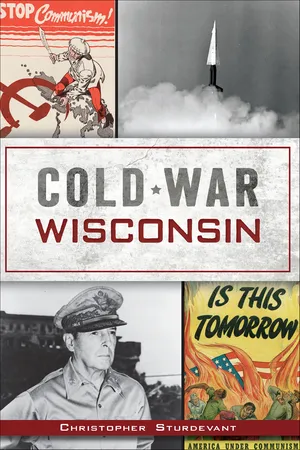
As the Cold War gripped the world with fear of espionage and nuclear winter, everyday Wisconsinites found themselves embroiled in the struggle. For decades, the state's nuclear missiles pointed to the skies, awaiting Soviet bombers. Joseph Stalin's daughter sought refuge in the small town of Richland Center. With violence in Vietnam about to peak, a cargo ship from Kewaunee sparked a new international incident with North Korea. Manitowoc was ground zero for a Sputnik satellite crash, and four ordinary Madison youths landed on the FBI's most wanted list after the Sterling Hall Bombing. Local author and chairman of the Midwest Chapter of the Cold War Museum Chris Sturdevant shares the tales of the Badger State's role in this titanic showdown between East and West.
- 144 pages
- English
- ePUB (mobile friendly)
- Available on iOS & Android
eBook - ePub
Cold War Wisconsin
About this book
Information
Subtopic
Military & Maritime HistoryIndex
HistoryCHAPTER 1
COLD WAR ORIGINS
AN ERA BEGINS WITH POLAR BEARS
The story of the origins of the Cold War is a unique telling in and of itself. Ask ten economists their opinion and you will receive eleven different answers. Similarly, ask historians or students of history “when” the Cold War began or ended and multiple answers emerge as assigned possibilities. Premises of the Cold War would suggest that the fruits of the Cold War were sown at the Yalta Conference in 1945, a military standoff with the Berlin Blockade and Airlift in 1948–49, or the moment the USSR conducted its first nuclear test in 1949, igniting a nuclear arms race between the superpowers. Other insightful research suggests that the beginnings of the Cold War were initiated as an American B-29 was forced down by Soviet fighters over northern Korea on August 29, 1945.1 Taken as a whole, these are but several answers to the many facets of the Cold War with the Soviet Union. None of these answers is incorrect, and this offers both the master and apprentice a Cold War era up for tremendous debate. What Polar Bears have to do with the origins of the Cold War will be unraveled in the following pages.
The fascinating saga of the Cold War follows a rather interesting arc during the twentieth century. To be clear, the modern Cold War was certainly a vestige of the Second World War. The Allied powers, out of necessity, included the Soviet Union during the Second World War. In June 1945, the big three Allied powers of the United States, Great Britain and the Soviet Union met in Yalta one final time during the war to draw up postwar maps and assign spheres of influence around the globe. Due to espionage employed by the Soviets and British, a not-so-well-kept secret between the three powers was the advanced stage development of an atomic bomb by the United States. By August 1945, two atomic bombs would be dropped on the Japanese cities of Hiroshima and Nagasaki. Distrust was well underway, and the Second World War would soon make way for the Cold War.
During those tumultuous days of the war’s end, both the Americans and Soviets rushed to glean scientists from defeated Germany to perfect Nazi rocket designs, build supersonic aircraft and help create, test and deploy atomic weapons. During Operation Paperclip, the United States would capture an enterprising young engineer named Wernher von Braun. He and other former Nazi engineers and scientists would eventually shape the United States space program. The acceleration of the space program would become established by the Soviet Union’s launch of Sputnik in 1957, the first man-made satellite in space.
Espionage and information would become a key weapon in fighting the Cold War. Suspicions had already supposed that a post–World War alliance between the United States and Soviet Union would not likely exist. Milwaukee native George Kennan, a relatively unknown diplomat to Americans at the American embassy in the Soviet Union, concluded such in his famous “Long Telegram,” describing the mood inside the Soviet Union in 1946.2 Information on the other side’s progress in a quest for domination could mean the difference between life or death for military participants and civilians alike. Thus, the Second World War would sow the seeds of intimidation, harassment and testing each other’s will by exploiting strengths and weaknesses all over the globe for decades during the twentieth century.
FIGHTING IN THE COLD:
AMERICAN TROOPS ARE SENT TO RUSSIA
AMERICAN TROOPS ARE SENT TO RUSSIA
For those of us too young or not yet born at the time, it is difficult to imagine witnessing world war only to see the dawn of another. The tragedy of the Cold War began under the cloud of a war whose vast scope and brutality was unprecedented, ravaging the European continent for what seemed an eternity. Millions of lives were lost as new weapons of devastating destruction were created and utilized on the battlefield and on civilians. Even as Allied victors determined postwar boundaries, it was a dire time for millions who had endured starvation, homelessness and unsanitary conditions. Europe was ripe for revolution and occupation; the emboldened communist snake in Russia was ready to strike on a worldwide level.
Hence the story of the Cold War unfolds. Winston Churchill decried godless communism, while an early “Iron Curtain” was described as descending on and across Europe. A “Red Scare” started like a wildfire in the United States, sending the population into a frenzy. War veterans of the American Legion swore an oath to “foster and perpetuate a 100% Americanism.” Various adherents to communism, socialism and anarchism were rounded up, arrested and jailed. From his perch in the U.S. Justice Department, a young J. Edgar Hoover identified these suspected communists in America, going so far as to deport a significant number of those suspected to Soviet Russia. In the final months of the “war to end all wars,” a division of five thousand American troops mistakenly believed that it was being sent to the front lines of Europe. Instead, the men found themselves in a desolate and frightening place never imagined: bitterly cold North Russia. Some eight thousand American servicemen were also deployed to Vladivostok in Siberia. Soon these troops would come face to face with the Red Army.
The Great War was drawing to a close; it was 1918.
POLAR BEARS AND THE ALLIED INTERVENTION
INTO THE RUSSIAN CIVIL WAR
INTO THE RUSSIAN CIVIL WAR
Winston Churchill, known to most as a prime minister of Great Britain during the Second World War, was one of the first to foresee the danger and damage that communism was capable of inflicting on the world. As a minister of munitions and then secretary of state for war, Churchill in 1919 was very clear when stating that Bolshevism should be “strangled in its cradle.”3 Like his actions and stance against the rise of Nazism a generation later, everything in his power was laid bare in confronting Soviet communism early on. The world was shocked to its core when the Bolsheviks, led by Vladimir Lenin, Josef Stalin and others, ousted the Russian Provisional Government led by Alexander Kerensky in 1917. Not only did the Allies of the First World War lose an important, strategic nation in confronting the kaiser’s Germany, but communist ideology also threatened world order. The militant brand of socialism espoused by these Bolsheviks declared war on every country that embraced capitalism, laissez-faire attitudes, liberties and other tenets that hold together democracies and republics. Hence an intervention into Russia was drawn up. The British then recruited other nations to partake in the crusade to strangle Bolshevism in its cradle.
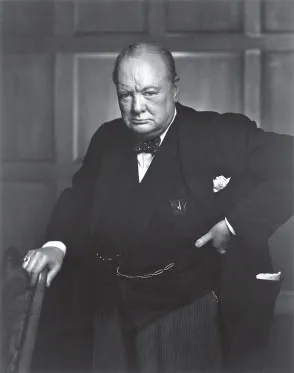
Winston Churchill, advocate of the Allied Intervention into North Russia in 1918. Library of Congress.
As assistance was asked of Woodrow Wilson to take part in the Russian intervention, all the American soldiers in North Russia and Siberia were placed under command of the British. This fact was not lost on these American troops. Soldiers who held strong feelings about this chain of command would often vocally remind their superiors of the incurrence of taking orders from a nation that America had fought against for its own freedom dating back to the Revolutionary War and War of 1812. To make matters worse, American soldiers were issued Russian rifles upon arrival. The guns often jammed and were inaccurate against an enemy they knew little about in a foreign place.4 Bad weapons, sickness, cold frigid weather and a population that didn’t support the interventionists made for a bizarre episode in a strange, alien place.
Wisconsin ties were crucial in this seminal world event, as from a local perspective, many of the soldiers sent to North Russia were from the Midwest. As the Polar Bear Expedition Digital Collection site summarizes succinctly:
During the summer of 1918, the U.S. Army’s 85th Division, made up primarily of men from Michigan and Wisconsin, completed its training at Fort Custer, outside of Battle Creek, Michigan, and proceeded to England. While the rest of the division was preparing to enter the fighting in France, some 5,000 troops of the 339th Infantry and support units (one battalion of the 310th Engineers, the 337th Field Hospital, and the 337th Ambulance Company) were issued Russian weapons and equipment and sailed for Archangel, a Russian port on the White Sea, 600 miles north of Moscow.5
These soldiers would survive a journey full of sickness into the Arctic regions of Russia, only to find themselves thrust into battle with Bolshevik forces in faraway Archangel and Murmansk in 1918–19. Archangel and Murmansk are two of only a few Russian port cities accessible by ship on the coast of the Arctic Circle. These men would join forces with not only British forces but also Canadian, French, Polish and other nationalities fighting the Red Army. Most would find themselves fighting along railways, riverways and other corridors that the Bolsheviks would challenge to fight the invading forces.
On a separate front, several time zones from the North Russian Arctic forces, other Wisconsinites would deploy to Vladivostok in Siberia on the Pacific coast. These men would also join a diverse group of interventionists from many countries. For a variety of reasons, as well as self-interest, tens of thousands of Japanese, French, British Commonwealth, Chinese and others would intervene to fight on the battleground of far eastern Siberia. American troops would take up defensive positions in that region, operating the Trans-Siberian Railroad and guarding rail lines along the Pacific coast in that country. The Allied Intervention on all fronts would throw most of its support to the White Armies battling for control with the Bolshevik forces over the fate of Russia during the Russian Civil War.
One prominent Wisconsinite deployed to North Russia was John Cudahy. Cudahy was born the son of Patrick Cudahy, a namesake that continues to grace bacon, kielbasa, sausages and other meat packages throughout grocery stores in the Milwaukee area and beyond. In 1918, John Cudahy was a first lieutenant in the 339th Infantry regiment with Allied Expeditionary Forces sent to North Russia. In his book Archangel: the American War with Russia, Cudahy was openly critical about the experiences of the Allied Intervention into Russia. An inadequate force intervened, the interventionists underestimated the opposing Red Army, the local population did not support the effort and there was no moral fortitude toward victory.6 As Cudahy pointed out, despite the bitter cold, men from northern Wisconsin and the Upper Peninsula of Michigan did not mind the severe weather. The troops were given adequate warm fur coats and blankets.7 The issue with the intervention became clear when the snow settled in, and offense maneuvers were limited due to snow in the alien country and hostile attitudes of the locals. John was battle tested early on November 11, 1918, when the lieutenant attacked one thousand Bolsheviks holding the village of Tulgas on the Northern Dvina River.8 John Cudahy would go on to serve as an ambassador to Poland and Belgium, as well as representing diplomatic ties to Luxembourg and Ireland. Without discussing his own role in the faulty campaign, he outlined several reasons for its failure. The Patrick Cudahy Company continues to be a strong local company headquartered in Cudahy, Wisconsin.
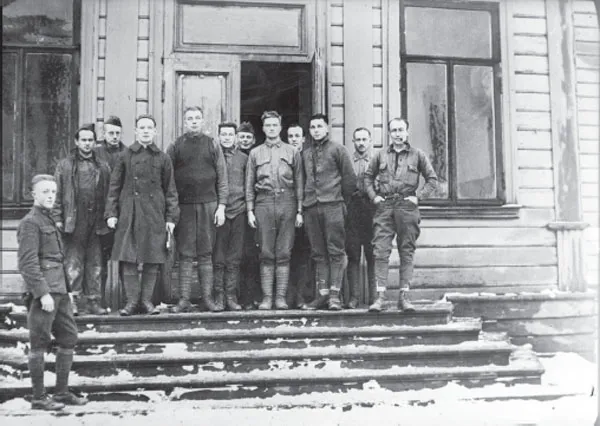
Men from the 339th Infantry in Archangel, North Russia, 1919. Library of Congress.
WHY WERE THESE SOLDIERS IN SUCH FARAWAY REGIONS?
Ostensibly, troops in both North Russia and Siberia had several goals to meet as their objectives. The first order of business in North Russia, as the First World War continued to rage in Europe in 1918, was for troops to immediately fortify an eastern front from which the newly minted Russian Bolshevik government withdrew in 1917. After suffering a series of losses by the kaiser’s German armies, the Treaty of Brest-Litovsk was signed. Immediately, German forces would be able to concentrate on the Allied advances in the west, much to the consternation of Allied commanders in France and Britain. As a hedge against the German and Japanese forces, however, local Soviets in both North Russia and Vladivostok welcomed the Allied interventionists since Russia no longer had a potent, if any, force to protect itself from invasion from east or west.9
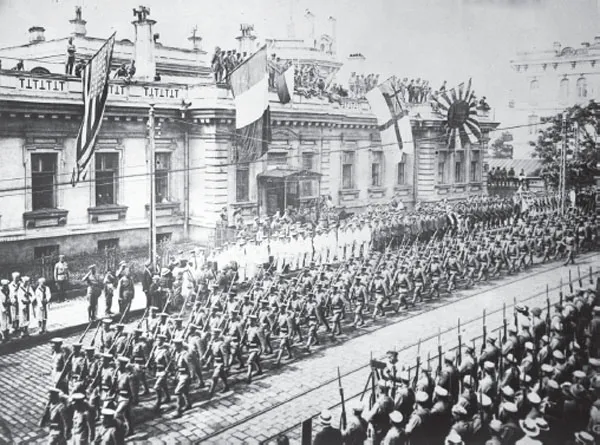
United States troops in Vladivostok, Siberia. Library of Congress.
Other goals of the Allied interventionists would be to protect and procure Allied armaments and supplies sent to the Czarist government during the First World War. Supplies, foodstuffs and other materials to secure and enhance the prior Czarist military from Germany’s assaults on the eastern front were conceivably in storage, and the Allies wanted neither the Germans nor the Bolsheviks to gain control of them. Yet another reason would be to allow Czech troops safe passage to exit Central Europe via the Trans-Siberian Railway en route to Siberia. During the First World War, Czech troops, guided by their own self-interest of independence, joined Czarist Russia in fighting the Axis powers. The Axis powers included the Austro-Hungarian empire, overseeing the lands that the Czechs, Bohemians and Slovaks inhabited, places that preferred independence. Toward the latter part of the war, these Czech Legion troops were caught between the Germans and Bolsheviks and sought a way out of the region to join up with French troops. An agreement was made to allow these troops passage east to Vladivostok. During their painstakingly slow movement east, they encountered and fought Bolshevik troops. The Czech Legion was perhaps the strongest group fighting in the Russian Civil War, taking charge of the Trans-Siberian Railway as it fought its way out. President Woodrow Wilson was hesitant to send any men to Russia or Siberia but acquiesced based on these goals.
FIGHTING AFTER VERSAILLES:
THE RUSSIAN CIVIL WAR
THE RUSSIAN CIVIL WAR
The First World War ended on November 11, 1918, with an armistice signed at Compiègne in France. However, the treaty did nothing to conclude the war aims of the interventionists in North Russia or Siberia. Even if the treaty had included those men who served in both theaters, those troops were trapped by Arctic sea ice formations in the Archangel and Murmansk region. There was no way to extract these men and bring them home, even if they were recalled from battle by decree by their respective governments.
As noted, in the early stages of arrival, the interventionists were welcomed and invited by local Russian leaders to take up positions in North Russia. The threat of the German advance was still present, and the Bolsheviks, having immediately and swiftly dismantled the Czarist military, were useless in defending their own territory. These men who made up the Allied Intervention thoroughly believed in the mission to expel the communists from power. Many, however, would question their usage in a war that was not adequately managed and had shifting priorities as the intervention went on.
Once the First World War ended with the armistice, a different set of priorities ensued. In 1918, the German kaiser abdicated and consequently was defeated, and Russia no longer had a threat of invasion on its territory on the eastern front. Using the interventionists to hedge against further invasion of Germans into Russia was no longer necessary. Attempts to oust these armies that had overstayed their welcome ensued by the Bolsheviks, and a campaign to create the Red Army for the new Soviet Russia was undertaken by Leon Trotsky.
Another goal of protecting stocks sent and stored by Czarist Russia was also rendered obsolete by the interventionist forces. Armaments, food stocks, fuel supplies, blankets and other items sent to assist the Czarist war efforts were pillaged by locals and storehouses abandoned by the time the Allies reached the North Russian port cities. By all accounts, the Czech legionnaires were doing quite well on their own. As Winston Churchill continued to advocate “strangling” the Bolsheviks in their cradle, the goal of defeating the Bolsheviks early in their tenure was haphazardly followed. With ice blocking soldiers’ exit, and at the mercy and transportation of the British, the wishes of the British command were the final word. Soldiers in the 339th Infantry and other units intervening would spend many more months fighting the early Red Armies.
Going on the offensive, the intervening armies of North Russia would undertake operations against the Red Army during the cold winter of 1918–19. They would push the Red Army south along rivers and railroads. White Armies would be loosely affiliated, ...
Table of contents
- Front Cover
- Half Title Page
- Title Page
- Copyright
- Contents
- Preface
- 1. Cold War Origins
- 2. Operation Rollback: Insurrection Behind the Iron Curtain
- 3. The Day Under Communism: Mosinee on May 1, 1950
- 4. Joseph McCarthy: Hero or Pariah?
- 5. The Sky Is Falling: Sputnik IV Crashes in Wisconsin
- 6. Nuclear Missiles in Wisconsin: Project Nike
- 7. Cold War Casualties: Bombers Crash While Training Over Wisconsin Airspace
- 8. A Soviet Princess Takes Refuge in Wisconsin
- 9. USS Pueblo: A Small Kewaunee Ship Impounded in North Korea
- 10. Stasi Prisoners in Our Midst
- 11. A Safe House in Milwaukee
- 12. Cold War Personalities
- 13. Terror in Madison: Sterling Hall Explosion
- 14. Military Bases in Wisconsin during the Cold War
- 15. Legacy of the Cold War
- Epilogue. The Cold War Abroad: Visiting Cold War “Battlefields”
- Notes
- About the Author
Trusted by 375,005 students
Access to over 1.5 million titles for a fair monthly price.
Study more efficiently using our study tools.
Frequently asked questions
Yes, you can cancel anytime from the Subscription tab in your account settings on the Perlego website. Your subscription will stay active until the end of your current billing period. Learn how to cancel your subscription
No, books cannot be downloaded as external files, such as PDFs, for use outside of Perlego. However, you can download books within the Perlego app for offline reading on mobile or tablet. Learn how to download books offline
Perlego offers two plans: Essential and Complete
- Essential is ideal for learners and professionals who enjoy exploring a wide range of subjects. Access the Essential Library with 800,000+ trusted titles and best-sellers across business, personal growth, and the humanities. Includes unlimited reading time and Standard Read Aloud voice.
- Complete: Perfect for advanced learners and researchers needing full, unrestricted access. Unlock 1.5M+ books across hundreds of subjects, including academic and specialized titles. The Complete Plan also includes advanced features like Premium Read Aloud and Research Assistant.
We are an online textbook subscription service, where you can get access to an entire online library for less than the price of a single book per month. With over 1.5 million books across 990+ topics, we’ve got you covered! Learn about our mission
Look out for the read-aloud symbol on your next book to see if you can listen to it. The read-aloud tool reads text aloud for you, highlighting the text as it is being read. You can pause it, speed it up and slow it down. Learn more about Read Aloud
Yes! You can use the Perlego app on both iOS and Android devices to read anytime, anywhere — even offline. Perfect for commutes or when you’re on the go.
Please note we cannot support devices running on iOS 13 and Android 7 or earlier. Learn more about using the app
Please note we cannot support devices running on iOS 13 and Android 7 or earlier. Learn more about using the app
Yes, you can access Cold War Wisconsin by Christopher Sturdevant in PDF and/or ePUB format, as well as other popular books in History & Military & Maritime History. We have over 1.5 million books available in our catalogue for you to explore.