- 128 pages
- English
- ePUB (mobile friendly)
- Available on iOS & Android
eBook - ePub
About this book
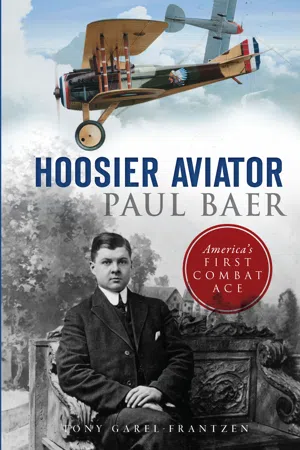
Indiana native Paul Baer was an American pilot of many firsts. Born into a modest midwestern family in the late 1800s, Baer grew up short and shy in Fort Wayne. Not short on ambition, he volunteered to join a new breed of combatant: the fighter pilot. Dogfighting in the skies over France during World War I, Baer earned a giant reputation as the first-ever American to shoot down an enemy plane and the first to earn the title of "combat ace" for earning five victories--before being shot down himself. Author Tony Garel-Frantzen celebrates the 100th anniversary of Baer's aerial heroics with rarely seen images, a previously unpublished POW letter from Baer himself and a look at the restless raptor's life of roaming.
Information
Subtopic
Military BiographiesIndex
HistoryPART I
AN APPRENTICE HUNTER
CHAPTER 1
BAER’S BEGINNINGS
Like most years in human history, 1866 served up a potpourri of contrasting events ranging from the trifling to the triumphant, the tedious to the transformational.
Americans grappled with the work of uniting the nation after four years of bitter civil war. The first daylight armed robbery of a bank in peacetime occurred in Liberty, Missouri, courtesy of outlaw Jesse James. Anne Sullivan, born in Massachusetts, was destined to be instrumental in helping Helen Keller overcome the dual scourge of being deaf and blind. In Cincinnati, the Red Stockings baseball club, predecessor of the modern-day Cincinnati Reds, was organized in July. Robert Leroy Parker was born in Utah and set forth on his journey to be a professional robber of trains and banks. Most know him better as Butch Cassidy, leader of the Wild Bunch gang. A Quaker pharmacist invented what we now call root beer. No doubt creatures everywhere breathed a sigh of relief upon learning the American Society for the Prevention of Cruelty to Animals (ASPCA) was founded in New York City.3
The story of Paul Baer also has its beginnings in January 1866. Many of the early facts about his family life have faded in the foggy passage of time. A timeline from the precious few details still recoverable begins with his mother.
As the country welcomed in the new year, Hiram and Emeline Parent also welcomed their fourth child, Emma. According to the 1870 U.S. Federal Census,4 Hiram Parent, forty-seven, was an Ohio farmer, and Emeline Kegg, thirty-five, reported her occupation as “keeping house.” Their daughter, Emma, was born in Fort Wayne (Allen County), Indiana. She joined the Parent family, which already included two girls and a boy: Mary, fourteen; William, ten; and Kitty, four.
Three years earlier and a mere thirty-two miles to the west of Fort Wayne in Cecil (Paulding County), Ohio, Emma’s future husband was born. Benjamin Baer and his wife, Amanda Buttermore, gave birth to Alvin E. on March 13, 1863. Meanwhile, when Emma was four, her parents moved their family to Milan, Indiana, about eighty miles to the southeast of Indianapolis in Ripley County.
How Emma’s path crossed with Alvin’s we cannot be sure, but cross it did. They were married on January 18, 1887, in Allen County, Indiana.5 She was twenty-one and Alvin was twenty-four. Christmas that year brought them a present in the form of a daughter, Mabel Naomi, born on December 25.
The following summer, Emma’s mother, Emeline Kegg, died on July 25, 1888, at the age of fifty-eight. A second child, Arthur, was born in May 1892. The Baers’ third child, Paul Frank, was born on January 29, 1894. Emma lost her father, Hiram, on November 1, 1899, at the age of eighty. Perhaps her grief was eased by the birth of her fourth child, Alvin Webster “Buddy” Baer, nine days later.
Paul, who had hazel eyes, brown hair and rosy cheeks, attended Nebraska Elementary, Jefferson Middle School and Clay School. Elma and Alvin’s marriage was falling apart during this period. Perhaps it was the pressures of raising four children. Or perhaps Emma or Alvin—or both—had wandering eyes or hearts. In any event, when Paul Baer was twelve, his parents divorced. An unemotional, one-line notice in the local newspaper summed up the end of their nineteen-year marriage: “Emma Baer was granted a divorce today by Judge O’Rourke and given the custody of the four children.”6 Alvin, an engineer on the New Orleans and Mobile division of the Louisville and Nashville Railroad Company, relocated to Mobile, Alabama. Time passed, and on August 31, 1908, Emma married Frederick E. Dyer in Detroit, Michigan. Born in Michigan, Dyer’s occupation was listed as a miner.7 Dyer was thirty-two, and Emma was now thirty-eight; they lived on Hollman Street in Fort Wayne.
Thanks to one historian’s effort,8 some of the highlights of Baer’s early days have been preserved. In Paul Baer Scrapbook, author Herb Harnish noted that one of Baer’s first jobs was working as “an office boy to Oscar Foellinger,”9 who became publisher of the Fort Wayne News-Sentinel in 1916. Foellinger was the son of a shoe manufacturer, served as business manager for the Fort Wayne Journal-Gazette and spent two years as an accountant on the West Coast. Foellinger later died of a heart attack while on a hunting trip in Canada in the fall of 1936.10
From his early days, the diminutive five-foot-eight Baer very much disliked being in the spotlight and was even more averse to talking about himself. Alvin Baer once told a reporter that “Paul is the most timid of our four children. His sister [Mabel], the oldest child, fought all of the battles at school. And she made a finished job of it.” But Baer overcame at least some of his childhood timidity in the skies over France. Said his father to the reporter, “Fighting has been Paul’s game for some time.”11 The same could be said for Baer’s aptitude for mechanics.
With the advent of the car, most Indiana cities within two hundred miles of Detroit became part of the massive automobile industry after 1910.12 Not surprisingly, Baer’s “early interest in mechanical things” resulted in his enrolling in the Cadillac Automobile Company’s School of Applied Mechanics in 1911 in Detroit, where he “was employed as an apprentice machinist, despite being a high school dropout.”13 He earned a certificate from the school after two years of study—“the longest period of time he would remain in one place for the rest of his short but colorful life.”14
Meanwhile, six years was apparently all that Emma could tolerate of her second husband, Frederick Dyer. Like her first divorce, Emma’s second marriage ended on a day in November, this time in 1914. Apparently, Mr. Dyer had a temper, as indicated in the “Courthouse News” roundup in the local paper:
Thanksgiving week has brought no relief from the flood of divorce complaints pouring into the local courts and the troubles of mismated couples continue to be brought to the courts for settlement. Emma B. Dyer wants a divorce from Frederick E. Dyer. She also wants alimony in the sum of $1,000 and an order restraining the defendant from visiting or molesting her. Mrs. Dyer’s chief cause for complaint is that her husband has threatened to “knock her brains out.” She does not fancy this proceeding any more than she does his habit of spending too much of his money for booze, she says, so she wants to get rid of him. Harper and Fuelber are attorneys for the plaintiff.15
Baer16 was about to embark on a series of globe-trotting adventures. As Herb Harnish put it, “Reviewing the activities of Paul Baer leads one to believe that he adopted as his creed Teddy Roosevelt’s statement that men should lead lives like a cavalry charge.”17
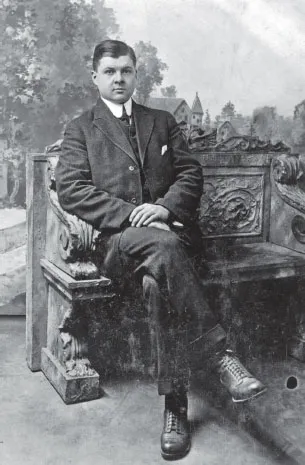
A portrait of Baer taken in January 1916 while he was in Detroit. Paul Baer Collection, Allen County–Fort Wayne Historical Society.
For Baer and hundreds of other adventure-seeking young men in the early 1900s, they indeed would charge ahead with their lives in a cavalry the likes of which the world had never seen—an air cavalry. However, first would come a call to action from south of the border: “Eleven Americans Are Shot Down When Mexicans Conduct an Armed Invasion of New Mexico.”18 This was the newspaper headline that greeted residents of Fort Wayne as they awoke on a cold and gray Thursday, March 9, 1916. A smoldering conflict on the Mexican border had come to a head in Columbus, New Mexico. The Fort Wayne News reported the following:
Invading the United States at the head of about 500 mounted followers, Francisco Villa attacked this little town [Columbus, New Mexico] guarded by 300 American cavalrymen, applied the torch to its principal buildings and before finally driven back into Mexico after two hours’ desultory firing, killed four United States troopers and at least seven American civilians. Only the desperate bravery of the outnumbered American soldiers prevented a massacre greater than the slaughter of eighteen helpless Americans at Santa Ysabel, Mexico, Jan. 10. Pablo Lopez, who led the Villistas in the Ysabel massacre, is reported to have been with Villa in the attack on Columbus at 4:30 a.m. today. Three Americans Villa held prisoners before the raid on Columbus are reported to have been killed and their bodies burned.19
According to the U.S. Army Center of Military History, “elements of the 13th Cavalry repulsed the attack, but there were 24 American casualties (14 military, 10 civilian). Immediate steps were taken to organize a punitive expedition of about 10,000 men under Brigadier General John J. Pershing to capture Villa.”20 These steps included a call-up of various military units, including the Indiana National Guard, to perform patrols along the U.S.-Mexico border.
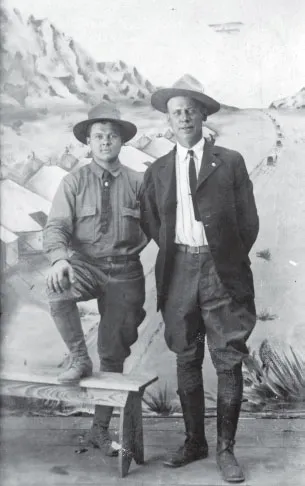
Baer and a friend take time out for a photo while chasing Pancho Villa in 1916 in Mexico. Paul Baer Collection, Allen County–Fort Wayne Historical Society.
Baer, now twenty-two,21 was stirred by the news and left civilian life to serve “with the Indiana National Guard as a truck driver in the Mexican Border Campaign.”22 Although members of the Indiana National Guard engaged in no action, their time served on the U.S.-Mexico border “provided a dress rehearsal for the general mobilization for World War One.”23
Baer’s service in the Mexican Border Campaign held his attention for less than a year. In late 1916, a higher calling summoned him in a new direction.
CHAPTER 2
FLEDGLING BIRDMAN
The United States maintained a neutral position at the outset of World War I in August 1914. But for some young Americans, the lure and romance of joining the battle against Germany to defend a long-standing bond linking America to France was too much to resist. American volunteers signed up to fight with the French in the trenches, serve as corpsmen attending the wounded and answer the desperate call for ambulance drivers to transport the thousands of soldiers wounded in combat.
As the role of the airplane took on increasing importance, however, French leaders quickly realized that “the presence of a band of young Americans in French uniform, fighting the spectacular battles of the sky, would be certain to arouse a widespread interest and sympathy” in the United States.24 However, what to call the outfit they served with got mangled in the process:
Considerable confusion exists in the minds of many persons about the difference between the Lafayette Escadrille and the Lafayette Flying Corps. This famous aeronautic body was the Section d’Aviation of the Legion Etrangere in the early days of the war. To mark the number of Americans who were sharing the dangers and victories the name was changed to the Franco-American Flying corps. But as the United States was not then at war with Germany [a] complaint was made that this was a breach of neutrality. To avoid giving offense the name was changed to the Lafayette Flying Corps, which is the present designation.25
America’s arrival in the war in April 1917 further complicated matters. “The first aero squadrons of the U.S. Air Service that went into combat in France during World War I were under the tactical control of French and British units, and the victory credits earned by members of these units during this period were confirmed and recorded by the French or British.” Once U.S. squadrons were reporting to the American Air Service, a program for crediting victories was put in place.26
The impact this miniscule group of American volunteer pilots had in the early days of the war played a key role in forming the tide of public opinion that stirred America’s decision to enter the war. Yet according to one American pilot, he and his colleagues were oblivious to the role they played and wouldn’t have cared had it been pointed out because they were occupied with other matters:
It was a virulent disease known as “the unconquerable pioneering spirit of our hardy forefathers” that led most of us into sticking our noses into something where we had no real business. And I’ll wager that just like us, if they could have only been brought to admit it, those “hardy pioneers” had plenty of moments when they wished they’d stayed where they were and minded their own affairs. None of us had any real idea of what we were getting into. We had hold of the bear’s tail and no one to help us. With few exceptions, I believe most of us would have welcomed an opportunity to bow out gracefully.27
The reliance on foreign volunteers was not without concerns. French officials expressed misgivings at Americans and other foreigners enlisting in the French army for two reasons: “One was the need of ceaseless vigilance against spies. In the second place, there was no place or need for volunteer aviators. Hundreds of young Frenchmen were clamoring for admittance.”28 But the demand far exceeded the relatively few vacancies available. Still, the exploits of the pilots, publicized by press on both sides of the Atlantic Ocean, generated widespread interest among young American men.
The French ultimately concluded that no international law prevented U.S. citizens from joining the French military provided their recruitment did not take place in America. Desperate for American support, the chief of French Military Aeronautics agreed near the end of 1915 to assemble all American flyers into one squadron. The following year, American aviators flying with various squadrons in the French army were reassigned into one unit, called the Escadrille Americaine (ultimately renamed the Lafayette Flying Corps). As its reputation grew, young American men could not resist the lure of this daringly different kind of adventure:
With the advent of aviation in warfare a new call was sounded to attract the adventurous and strong. The very love of sport itself seemed to spiritualize the aviators’ service at the front. With its natural appeal to those instincts of sportsmanship with which every youth...
Table of contents
- Front Cover
- Half Title
- Title Page
- Copyright
- Dedication
- Contents
- Acknowledgements
- Introduction
- Part I. An App rentice Hunter
- Part II. The Restless Raptor
- Postscript
- In Their Honor
- Notes
- About the Author
Trusted by 375,005 students
Access to over 1.5 million titles for a fair monthly price.
Study more efficiently using our study tools.
Frequently asked questions
Yes, you can cancel anytime from the Subscription tab in your account settings on the Perlego website. Your subscription will stay active until the end of your current billing period. Learn how to cancel your subscription
No, books cannot be downloaded as external files, such as PDFs, for use outside of Perlego. However, you can download books within the Perlego app for offline reading on mobile or tablet. Learn how to download books offline
Perlego offers two plans: Essential and Complete
- Essential is ideal for learners and professionals who enjoy exploring a wide range of subjects. Access the Essential Library with 800,000+ trusted titles and best-sellers across business, personal growth, and the humanities. Includes unlimited reading time and Standard Read Aloud voice.
- Complete: Perfect for advanced learners and researchers needing full, unrestricted access. Unlock 1.5M+ books across hundreds of subjects, including academic and specialized titles. The Complete Plan also includes advanced features like Premium Read Aloud and Research Assistant.
We are an online textbook subscription service, where you can get access to an entire online library for less than the price of a single book per month. With over 1.5 million books across 990+ topics, we’ve got you covered! Learn about our mission
Look out for the read-aloud symbol on your next book to see if you can listen to it. The read-aloud tool reads text aloud for you, highlighting the text as it is being read. You can pause it, speed it up and slow it down. Learn more about Read Aloud
Yes! You can use the Perlego app on both iOS and Android devices to read anytime, anywhere — even offline. Perfect for commutes or when you’re on the go.
Please note we cannot support devices running on iOS 13 and Android 7 or earlier. Learn more about using the app
Please note we cannot support devices running on iOS 13 and Android 7 or earlier. Learn more about using the app
Yes, you can access Hoosier Aviator Paul Baer by Tony Garel-Frantzen in PDF and/or ePUB format, as well as other popular books in History & Military Biographies. We have over 1.5 million books available in our catalogue for you to explore.