- 128 pages
- English
- ePUB (mobile friendly)
- Available on iOS & Android
eBook - ePub
About this book
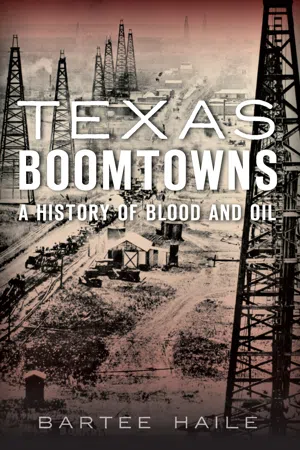
On January 10, 1901, Beaumont awoke to the historic roar of the Spindletop gusher. A flood of frantic fortune seekers heard its call and quickly descended on the town. Over the next three decades, Texas's first oil rush transformed the sparsely populated rural state practically beyond recognition. Brothels, bordellos and slums overran sleepy towns, and thick, black oil spilled over once-green pastures. While dreams came true for a precious few, most settled for high-risk, dangerous jobs in the oilfields and passed what spare time they had in the vice districts fueled by crude. From the violent shanties of Desdemona and Mexia to Borger and beyond, wildcat speculators, grifters and barons took the land for all it was worth. Author Bartee Haile explores the story of these wild and wooly boomtowns.
Trusted by 375,005 students
Access to over 1.5 million titles for a fair monthly price.
Study more efficiently using our study tools.
Information
Subtopic
Business HistoryIndex
History1
IT ALL STARTED AT SPINDLETOP
Texas at the end of the nineteenth century was the land of cattle and cotton. Since there were no cows to punch and no cotton to pick in town, 83 percent of the 4 million Texans lived out in the country or in communities with less than 2,500 people. San Antonio, Houston, Dallas and Fort Worth, the four largest cities, in that order, had a combined population of 167,000. Texas, like the rest of the old South, was a rural state, pure and simple.
The fact that there was oil in Texas was no secret. For centuries Indian tribes had wondered what to do with the black, sticky substance that oozed from the ground and thickened into puddles. Spanish explorers who came across tar balls on the beaches in the 1500s used the gooey substance to waterproof their leather boots.
For nineteenth-century ranchers and farmers desperate for water, oil was an annoyance that got in the way and poisoned their wells. As late as 1902, W.T. Waggoner, owner of one of the biggest ranches in the Lone Star State, famously said, “I wanted water, and they got me oil. I tell you I was mad, mad clean through. We needed water for ourselves and our cattle to drink.” He sang a different tune a decade later after the Electra discovery added millions to the Waggoner family fortune.
Most historians credit Lyne T. Barret with drilling the first productive oil well in Texas history near Nacogdoches in 1866, the year after the end of the Civil War. He strived to scrounge up the money and technology to make the most of the find but struck out on both counts. Reconstruction made investors skittish about risking their capital in Texas, no matter how promising the prospects, and the equipment had not been invented to efficiently pump, store and transport crude oil (often just called “crude”) to market. The biggest problem was what to do with the oil once it was extracted. Locomotives and other steam-powered engines burned coal. Before the mass production of motor vehicles with internal combustion engines, the primary uses for the fossil fuel of the future was lubrication and kerosene for lamps, a limited market to be sure.
Due more to a lack of interest than a lack of effort, thirty years passed without any progress on the petroleum front in the Lone Star State. Then one day in 1897, an executive with Standard Oil opened a letter with a Corsicana, Texas postmark. It was from the top official of a town Joseph Stephen Cullinan had never heard of, and the mayor swore with the zeal of a tent evangelist that his community was sitting on top of a fortune in black gold.
Cullinan, the son of Irish immigrants, was born in Pennsylvania on New Year’s Eve 1860 a short distance from the first oil well on the North American continent. The ambitious Irishman went to work for John D. Rockefeller as a twenty-two-year-old roughneck and, in a decade and a half, worked his way up to the front office at Standard Oil.
The Texas politician closed his letter with an open invitation to Cullinan to drop by and take a look whenever he had the chance. On a cross-country trip later that year, the skeptical easterner stopped at Corsicana just to satisfy his curiosity. A guided tour of the local terrain convinced the self-taught geologist that the mayor was on to something so big that he cancelled his West Coast vacation.
Moving at a speed that made the Texans’ head spin, Cullinan arranged the financing for the first pipeline and refinery in state history, which he christened the J.S. Cullinan Company. The Yankee struck oil with his first round of exploratory wells, and the next thing the people of Corsicana knew was that they had a bona-fide boom on their hands. But before anyone could count his money, their patron had to figure out what to do with so much crude (two million barrels by the end of 1900), no small challenge in the horse-and-buggy era. Cullinan solved the problem, at least in part, by extolling the virtues of petroleum as locomotive fuel and a dust-settling agent for dirt roads.

Meanwhile, in the southeastern corner of the Lone Star State, Pattillo Higgins had become the laughingstock of Beaumont with his unshakeable certainty there was a sea of oil hidden under Spindletop Hill, a salt dome south of the city. With a résumé that included draftsman, inventor, artist, geologist, cartographer, engineer, naturalist and industrial designer, the fourth-grade dropout was entitled to a fair hearing. But most people were so blinded by his youthful transgressions and his dogmatic disposition that their knee-jerk reaction was to reject anything that came out of his mouth.
In his teens, Higgins was a troublemaking terror. The climax of his adolescent crime wave was a confrontation with sheriff ’s deputies that left one lawman dead and the seventeen-year-old with an arm so badly injured it had to be amputated. At his trial for murder, Higgins claimed he shot the deputy in self-defense, and the sympathetic jury acquitted him of all charges. Five years of raising hell as a one-armed lumberjack ended one night at a Baptist revival where the preacher persuaded him to turn his back on his evil past. “I used to put my trust in pistols,” the born-again believer often said, “but now my trust is in God.”
Returning to Beaumont a changed man, Higgins went into business for himself making bricks. On a visit to brick and glass factories back East, he saw the superiority of ovens that burned oil and gas. He remembered the salt dome on the edge of town that old-timers had long maintained held an unlimited supply of the same two resources. Higgins decided Spindletop was the perfect spot for an industrial center and for years could think of little else.
No men of means and influence in Beaumont wanted to have anything to do with Higgins’s pipe dream. But in George W. Carroll, he finally found his financial angel. Carroll committed himself body, soul and bankroll to the Spindletop project not because he shared his controversial vision but because they were two peas in the same religious pod. The devout Baptist would come to regret his role in turning God-fearing Beaumont into a wicked boomtown and spent the rest of his life trying to repent for his sin. Twice he was a candidate on the Prohibitionist ticket, for governor in 1902 and two years later for vice president, and gave away his personal fortune to Baylor University and a host of charitable causes. Carroll died in 1935 practically penniless in a room at the Beaumont YMCA built with his money.
By 1899, Higgins had nothing but three dry holes to show for Carroll’s generosity. Even more than money, which he had a flair for finding, he required an expert on salt domes with the know-how to push pipe through unstable layers of sand to the oil down below. So he launched a nationwide talent search with advertisements in newspapers, magazines and industry publications.
That was how Pattillo Higgins and Captain Anthony F. Lucas met. The Austrian-born and educated engineer answered the ad with a chapter-and-verse history of his life and career that impressed the Texan, who took pride in never being impressed by anybody, whatever their credentials.
Higgins had cast a wide net and by pure luck had hooked the foremost authority on salt domes. As superintendent for a salt-mining operation in Louisiana, Lucas had detected trace amounts of oil deep down in the dome deposits. For that reason alone, he was more open to Higgins’s heretical views, though not as passionate.
Higgins had lost control of Gladys City Oil, Gas and Manufacturing, the company he founded in 1892, to the board of directors. Since he was not on speaking terms with his estranged partners, it fell to Lucas to negotiate the rights to Spindletop Hill. After cutting Higgins in for 10 percent of the profits, the naturalized citizen was ready to drill.
But like Higgins and others before him, Lucas had no answer for the sand that caused the hole to cave in every few feet. Running out of money and ideas at a depth of only 575 feet, the dejected captain called a time-out to weigh his options. With the fanatic Higgins and his own wife urging him to stick with it, Lucas sold two East Coast investors who had been instrumental in the development of the Corsicana field on the promise of Spindletop. They agreed to put up the money on one condition: Pattillo Higgins was out in the cold.
Every bit as significant as the infusion of cash was driller Curt Hamill’s cure for the collapsing sand as described on the website of the Paleontological Research Institution: “Instead of pumping water down the hole to flush out the cuttings produced by the action of the drill, he used mud. This proved to help not only in retrieving the cuttings, but just as importantly, it was found that the mud stuck to the sides of the hole and kept it from caving in…mud has been used in almost every drillhole around the world ever since.”
Hamill’s master stroke made slow but steady progress over the next two months. With the well down to 880 feet, Captain Lucas told the crew to take the Christmas holidays off and come back to work on New Year’s Day.
In good spirits and well rested after their break, the workers pushed past one thousand feet in a week. They were lowering the drill back down the hole after an equipment change on the morning of January 10, 1901, when mud mysteriously began bubbling to the surface. That had not happened before, and everyone stopped to stare at the strange sight. Seconds later, the drill pipe shot straight up out of the hole spewing mud all over the rig and the transfixed crew. Baffled by the weird antics of the well, they withdrew a safe distance to wait for the all-clear.
Five minutes passed without a sound from the Lucas One or the uneasy roughnecks. The silence was suddenly shattered by a noise stunned spectators would compare to a “cannon shot.” The ear-splitting sound was the overture for a high-speed eruption of mud and natural gas that preceded the main attraction: a geyser of oil that soared 150 feet into the clear Lone Star sky.
Captain Lucas was chewing the fat with a friend in a downtown Beaumont store. The telephone rang. The owner answered and handed the receiver to the visitor. “It’s your wife,” he casually informed him. Lucas listened in slack-jawed amazement to the wonderful news that Spindletop was indeed the real thing.

Standing room only at a well somewhere in southeast Texas. San Jacinto Museum, MSS0200-227, Houston Public Library, HMRC.
For nine days, the wild well defied every effort to contain its phenomenal flow. By Lucas’s reckoning, the early rate was 100,000 barrels a day, more than all the producing oil wells in the United States put together.

The broad smile on the farmer’s face said it all in this photograph from the Hull Oil Field in Liberty County. MSS0100-0455, Houston Public Library, HMRC.

Houston skyline in 1926 with two more tall buildings under construction. MSS0100-1216, Houston Public Library, HMRC.
“Buckskin Joe” Cullinan wasted no time in getting from Corsicana to Beaumont. One of the first true oilmen on the scene, he alerted his former associates at Standard Oil to the history-making discovery. Surprised by their failure to grasp the game-changing significance of Spindletop, he made up his mind that Standard Oil’s loss would be his gain. To ensure his success, Cullinan built a storage tank, bought every drop of cheap crude he could lay his hands on and sat back to wait for the price to go up.
Beaumont went from a decidedly dull town of nine thousand to a full-blown boomtown of fifty thousand in six months. By the end of 1901, Spindletop was studded with two hundred closely packed wells owned and operated by one hundred separate companies. Gulf, Amoco, Humble and other charter members of “Big Oil” got their start at Spindletop.
Reckless drilling practices, as well as outright sabotage, often sent sections of the Spindletop field up in flames. During a particularly dangerous blaze, Joe Cullinan implored a district judge to grant him broad emergency powers to fight the fire. The hard-nosed oilman read the order issued by the obliging magistrate and snorted in disgust, “This is not enough!”
“What more do you need?” the judge asked. Cullinan replied, “I want the authority to kill a man if such is necessary in the discharge of my duty!” The order was promptly amended to give Buckskin Joe the power of life and death at Spindletop. When word spread that he could legally shoot troublemakers on sight, arsonists and assorted wrongdoers made themselves scarce.
In 1902, Cullinan and several oilfield cronies merged with eastern money lenders to form the Texas Company. For eleven years, the Irishman served as president of Texaco, and his relocation of the company headquarters to Houston in 1905 set the stage for the inevitable emergence of the Bayo...
Table of contents
- Front Cover
- Half Title
- Title Page
- Copyright
- Dedication
- Contents
- Acknowledgements
- Introduction
- 1. It All Started at Spindletop
- 2. A County Gone Crazy
- 3. Boom Brought a World of Trouble
- 4. Bad Old Days in Bloody Borger
- 5. Drowning in an Ocean of Oil
- Bibliography
- About the Author
Frequently asked questions
Yes, you can cancel anytime from the Subscription tab in your account settings on the Perlego website. Your subscription will stay active until the end of your current billing period. Learn how to cancel your subscription
No, books cannot be downloaded as external files, such as PDFs, for use outside of Perlego. However, you can download books within the Perlego app for offline reading on mobile or tablet. Learn how to download books offline
We are an online textbook subscription service, where you can get access to an entire online library for less than the price of a single book per month. With over 1.5 million books across 990+ topics, we’ve got you covered! Learn about our mission
Look out for the read-aloud symbol on your next book to see if you can listen to it. The read-aloud tool reads text aloud for you, highlighting the text as it is being read. You can pause it, speed it up and slow it down. Learn more about Read Aloud
Yes! You can use the Perlego app on both iOS and Android devices to read anytime, anywhere — even offline. Perfect for commutes or when you’re on the go.
Please note we cannot support devices running on iOS 13 and Android 7 or earlier. Learn more about using the app
Please note we cannot support devices running on iOS 13 and Android 7 or earlier. Learn more about using the app
Yes, you can access Texas Boomtowns by Bartee Haile in PDF and/or ePUB format, as well as other popular books in History & Business History. We have over 1.5 million books available in our catalogue for you to explore.