
- 192 pages
- English
- ePUB (mobile friendly)
- Available on iOS & Android
eBook - ePub
Military History of New Jersey
About this book
War came to Garden State soil early. The Dutch fought the Indians in Kieft's War, while the English fought the Spanish in the War of Jenkins' Ear and the French, Swedes and native nations in dozens of other conflicts. New Jersey played an integral role as the "Crossroads of the American Revolution." The Battle of Trenton, the crossing of the Delaware and battles at Monmouth and Springfield helped the colonies break free from Britain. During both world wars, German submarines lurked along the coastline. Historian David Petriello presents a comprehensive military history of New Jersey, highlighting the state's major and lesser-known engagements and contributions to the defense of the nation.
Information
Topic
StoriaSubtopic
Storia militare e marittimaCHAPTER 1
CONQUERING THE DELAWARE AND THE HUDSON: THE MILITARY HISTORY OF NEW NETHERLANDS AND NEW SWEDEN
The importance of the area that would become New Jersey can be attested to through the numerous conflicts fought on its soil. Occupying a moderate climate zone along the coast, controlling access to two major river systems and being situated between the various Northern and Southern Colonies, the area of the future Garden State proved desirable to many different groups. Due to this, the first century and a half of New Jersey’s existence as a European colony was hardly a time of peace. Confrontation with native inhabitants, competition among the European powers themselves and local instability all contributed to numerous military episodes that ravaged the area. In fact, this era would see the most battles to occur on the state’s soil apart from the Revolutionary War years.
PRE-COLUMBIAN CONFLICT
Europeans were not the first to bring violence and war to the region. The Lenape, or Delaware, an Algonquin tribe who inhabited the environs of New Jersey and eastern Pennsylvania before the arrival of the Europeans, had numerous tales and legends about battles that were both mythical and historical. One of these involved the Yah-qua-whee, a word that has been translated as either “monster” or “mastodon.” According to the Delaware, the Great Spirit placed the Yah-qua-whee on the earth to benefit the natives, but they instead became destructive, making war against both man and the other animals. “It was fierce, powerful, and invincible, its skin…so strong and hard that the sharpest spears and arrows could scarcely penetrate it.”1 A fierce battle ensued, in which the other animals, both great and small, fought the monsters. The hills, mountains and forests became devastated, but in the end, thanks to the ferocity of the animals and the lightning bolts of the Great Spirit, the Yah-qua-whee were defeated. Their own weight drowned them amid the muck and blood of the battlefield, with their great bones occasionally being discovered by the natives years later. The Great Spirit would compensate man by causing cranberries to grow among the marshes and bogs, representing both the muck and blood of the battle and producing life from death.2
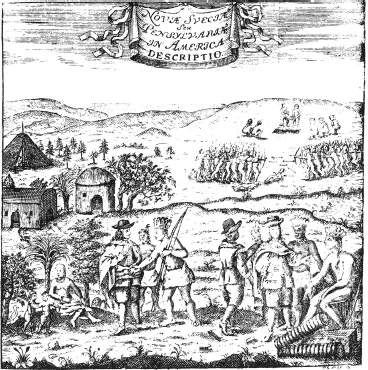
Depiction of Susquehannock Indians with a battle between tribes in the background. Library of Congress.
The early Indians of the region themselves proved to be no less warlike than the monsters inhabiting their woodlands. While evidence is scarce of defensive works built around the villages of the Lenape, historians have been able to prove the existence of palisades around the settlements of the Susquehannock, an Iroquoian speaking people.3 These people, an enemy of the Lenape, were also known to have built numerous forts throughout the eastern Pennsylvania region, constructions that would have been unnecessary in a peaceful environment.4 The Swedes and Dutch would eventually refer to the Susquehannock people as the Minqua, a derivative of the Lenape term for them, which translates as “treacherous.” Well into the colonial period, the Minqua were reported by the Europeans as viciously waging war against the other tribes of the area. In his journal, David de Vries noted that fugitive natives he met in 1633 claimed that the Minqua “had killed about ninety men of the Sankiekans.”5 Delaware legends tell of a time before the arrival of Europeans during which long wars were fought with the six Iroquois nations. “But the former were always too powerful for the Six Nations. The latter were convinced that if they continued the wars, their total extirpation would be inevitable.”6
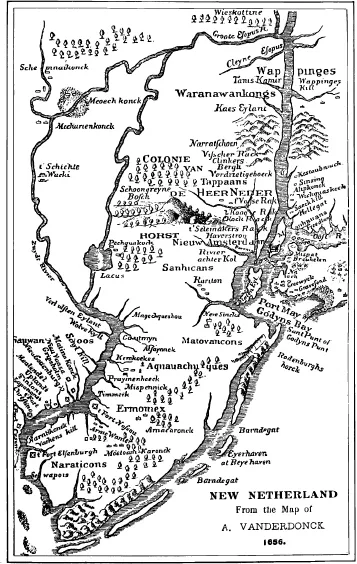
A map of the native tribes of New Jersey as of 1656. From King’s Handbook of New York City: 1893.
Yet at the same time, rivalries existed as well within the various groups. The Sankhikan, who inhabited the central part of New Jersey, were known to be deadly enemies of the Manhattan tribe, both of whom were Lenape people. An excavation at Tottenville on Staten Island in 1895 uncovered the remains of three pre-Columbian skeletons. All gave evidence of having been executed, with the group being pierced over twenty-three times by arrows of differing compositions.7 New Jersey was the site of internal conflict for hundreds of years and was a border region in the long-standing rivalry between the Iroquois and Algonquin people, a role it would again play with the arrival of various European powers.
DUTCH AND SWEDES AT WAR
The first major exploration of the region by Europeans proved to be a harbinger of the further conflict that was to follow. In 1609, Henry Hudson, sailing aboard the Half Moon, skirted the coastline of New Jersey exploring the region for the Netherlands. Measuring around eighty-five feet in length and carrying only sixteen intrepid men, the vessel was hardly an overpowering warship. As Hudson rounded Sandy Hook and approached modern-day Keansburg, he dispatched a sixteen-foot shallop with five men aboard to explore the area of the Kill Van Kull and Newark Bay. As the men sailed through the area, they were approached by two large canoes, each twenty feet in length and carrying a total of twenty-six natives. From the accounts delivered later by the men, it appears that the encounter quickly turned violent. Robert Juet, a member of Hudson’s crew, recorded in his journal what took place:
So they went in two leagues and saw an open Sea, and returned; and as they came back they were set upon by two Canoes, the one having twelve, the other fourteen men. The night came on, and it began to rain, so that their Match went out; and they had one man slain in the fight, which was an English-man named John Colman, with an Arrow shot into his throat, and two more hurt.8
The natives unleashed their arrows on the crewmen in the boat, beginning a small battle that ended with their retreat after the Dutch returned fire. The four other crew members returned the body of their deceased comrade to Hudson the next morning after a difficult and fearful night on the water. The explorer subsequently ordered his body to be buried ashore at what became known as Colman’s Point in modern-day Keansburg. No further attacks occurred, and the Half Moon continued on its way to discover what would become New York City.
The first battle to take place in New Jersey has been commemorated in numerous ways over the past four centuries. The scene has been memorialized in a mural on the walls of the Hudson County Courthouse, depicting the first recorded murder in the state.
Likewise, poet Thomas Frost paid homage to the battle and Colman in a poem first published in 1908:
And suddenly our unshaped dread
Took direful form and sound.
For from a near nook’s rocky shade,
Swift as pursuing hound,
A savage shallop sped, to hold
From stranger feet that strand of gold.
And rageful cries disturbed the peace
That on the waters slept;
And Echo whispered on the hills,
As though an army crept,
With flinty axe and brutal blade,
Through the imperforate forest shade.
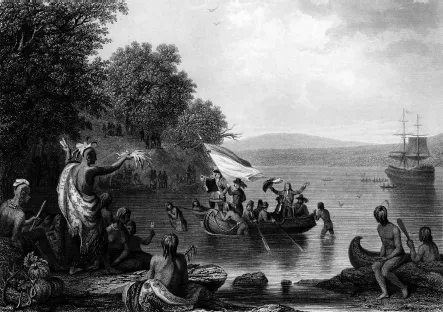
The arrival of Henry Hudson in New Jersey. Gilder Lehrman Collection.
“What! are ye cravens?” Colman said;
For each had shipped his oar.
He waved the flag: “For Netherland,
Pull for yon jutting shore!”
Then prone he fell within the boat,
A flinthead arrow through his throat!9
Seven years after the Dutch established New Amsterdam, Captain Cornelius Jacobsen Mey, the namesake of Cape May, built Fort Nassau at the mouth of Big Timber Creek near Red Bank in Gloucester County. Erected in 1623, this was perhaps the first European settlement on the eastern bank of the Delaware River. Yet the fortress proved to be anything but secure. While exploring the area during the winter of 1630–31, David de Vries reported finding the stronghold abandoned, its ruins inhabited by natives. Local Indians who had ostensibly gathered to trade even attempted to attack de Vries and his crew, though luckily for the Dutch captain, he was warned by a friendly native woman.
The previous year, a similar situation had unfolded at the Dutch settlement of Swanendael. In his journal, de Vries claims that an argument had erupted between the Dutch commander of the settlement and the Minquas after one of the latter had stolen the company’s metal coat of arms to make into a pipe. The natives, angered after the exchange, returned later and butchered the Dutch as they worked in the fields.
In descending the stairs one of the Indians seized an axe and cleft his head so that he fell down dead. They also relieved the sick man of life, and shot into the dog, who was chained fast, and whom they most feared, twenty-five arrows before they could dispatch him. They then proceeded towards the rest of the men, who were at work, and, going amongst them with pretensions of friendship, struck them down. Thus was our young colony destroyed.10
By the time their bloody business was done, thirty-two Dutch lay dead in the settlement. De Vries would describe the scene as follows: “It was almost burnt up. Found lying here and there [were] the skulls and bones of our people, and the heads of the horses and cows which they had brought with them.”11
The natives of northern and central New Jersey and the surrounding regions would continue to be a problem for a generation. Johan Printz of New Sweden once famously said, “Nothing would be better than that a couple hundred soldiers should be sent here and kept here until we broke the necks of all of them in the river.”12 Yet the Indians of South Jersey largely avoided fighting the Europeans. This internal pacifism when combined with the neighboring, buffering colonies of Pennsylvania and New York did much to isolate most of New Jersey from the frontier wars and Indian raids characteristic of the Middle Colonies.
In fact, the vast majority of all battles to be fought in the Garden State during this time period occurred between European nations. In 1635, a decade after the establishment of the Dutch along the Delaware, a group of English settlers from Connecticut attempted to take Fort Nassau during one of its unoccupied periods. Wouter van Twiller, the director general of New Netherlands, had already lost the Connecticut Valley to English settlers and therefore moved decisively to counter this new threat to the Dutch colonial empire in America. The fort was quickly retaken, and David de Vries brought the thirteen to fourteen English prisoners back to New Amsterdam, where they were eventually sent back to the Connecticut colony from which they had come. New Jersey was again safely under Dutch control, but this situation was to last for only a few short years.
Another failed settlement attempt by the English under Sir Edmund Plowden during the 1640s was paralleled by a more successful expedition by the Swedes. In March 1638, Peter Minuit, formerly of the Dutch East India Company, sailed with two ships up the Zuydt Riviere, as the Dutch referred to the Delaware River. His two ships, the Kalmar Nyckel and the Fogel Grip, with twenty-six men aboard from various nations, were tasked with establishing a fort and trading post for the queen of Sweden. Minuit moved two miles up the Minquas Kill, or Christina River, firing off his cannons to claim the area.
The Grip, after partaking in a failed trade mission to the English settlement of Jamestown, sailed upriver toward the Dutch fort at Timber Creek. Challenged by the garrison at Fort Nassau, the ship eventually retreated back down the Delaware. Realizing that the Swedish claim had to be secured, Minuit began the construction of Fort Christina at modern-day Wilmington, Delaware. The fort was a square structure containing two log buildings, a storehouse and a dwelling. Though Minuit armed the bastion with the cannon from the Kalmar Nyckel, an uneasy peace was maintained between the Swedes and the Dutch for the next few years.
The first serious challenge to both parties in the area came again from English expansion into New Jersey. Seven years after Britain’s first attempt to infiltrate the area, a second expedition sent from New Haven Colony set up trading posts at the Schuylkill and Varken’s Kill, modern-day Salem Creek, in 1642. These settlements further strained the fur trade for both the Dutch and Swedish. In response, Governor Kieft of New Netherlands proposed a joint task force be sent to drive the English out. In accordance with this, Jan van Ilpendam was dispatched from Fort Nassau with twenty men and two yachts. The English refused to leave, and Van Ilpendam resorted to force to remove them from the area. The settlement at Salem was broken up and reduced to ashes. The English had again been driven from New Jersey.
KIEFT’S WAR
The first major war to be fought in New Jersey erupted soon after the expulsion of the English. William Kieft, the leader behind that move, had arrived in New Netherlands in 1638. He was in charge of a small yet potentially profitable colony of about eight hundred souls. Starting in 1630, the Dutch inhabitants of Manhattan had also been spilling over into modern-day Hudson County, establishing the patroonship of Pavonia. Kieft’s dealings with the natives soon turned antagonistic. Attempts by the governor to extract tribute from the tribes failed and only strained relations further. The theft of some pigs from the farm of David de Vries ultimately became the cause de célèbre that allowed Kieft to launch a punitive raid against a Raritan village on Staten Island. The Raritans, in return, would burn de Vries’s house and kill four of his workers.
Murder followed murder as the situation slowly escalated. A local Dutchman, Claes Swits Rademacher, was murdered with an axe by a Wappinger in 1641. That same year, a drunken brawl turned violent between Hackensack Indians and some Dutch colonists at AchterKol along the present-day Hackensack River. Fear among the residents led to the formation of a council of twelve to deal with the impending cri...
Table of contents
- Front Cover
- Half Title
- Title Page
- Copyright
- Contents
- Foreword
- Introduction
- 1. Conquering the Delaware and the Hudson: The Military History of New Netherlands and New Sweden
- 2. New Jersey in the Wars of Empire: Colonial New Jersey’s Military History
- 3. Crossroads of the Revolution: New Jersey and the Fight for Independence
- 4. From Little Turtle to Tecumseh: New Jersey and the Wars of the Early Republic
- 5. From the Halls of Montezuma to the Shores of New Jersey: New Jersey and Manifest Destiny
- 6. Twice Against Lincoln: The Civil War in New Jersey
- 7. New Jersey and the USS Maine: The Garden State in the Age of Imperialism
- 8. Sabotage and Submarines: New Jersey and the Great War
- 9. Against the Axis: New Jersey in World War II
- 10. Cold War along the Hot Shore: New Jersey and the Wars of Modernity
- Notes
- About the Author
Trusted by 375,005 students
Access to over 1.5 million titles for a fair monthly price.
Study more efficiently using our study tools.
Frequently asked questions
Yes, you can cancel anytime from the Subscription tab in your account settings on the Perlego website. Your subscription will stay active until the end of your current billing period. Learn how to cancel your subscription
No, books cannot be downloaded as external files, such as PDFs, for use outside of Perlego. However, you can download books within the Perlego app for offline reading on mobile or tablet. Learn how to download books offline
Perlego offers two plans: Essential and Complete
- Essential is ideal for learners and professionals who enjoy exploring a wide range of subjects. Access the Essential Library with 800,000+ trusted titles and best-sellers across business, personal growth, and the humanities. Includes unlimited reading time and Standard Read Aloud voice.
- Complete: Perfect for advanced learners and researchers needing full, unrestricted access. Unlock 1.5M+ books across hundreds of subjects, including academic and specialized titles. The Complete Plan also includes advanced features like Premium Read Aloud and Research Assistant.
We are an online textbook subscription service, where you can get access to an entire online library for less than the price of a single book per month. With over 1.5 million books across 990+ topics, we’ve got you covered! Learn about our mission
Look out for the read-aloud symbol on your next book to see if you can listen to it. The read-aloud tool reads text aloud for you, highlighting the text as it is being read. You can pause it, speed it up and slow it down. Learn more about Read Aloud
Yes! You can use the Perlego app on both iOS and Android devices to read anytime, anywhere — even offline. Perfect for commutes or when you’re on the go.
Please note we cannot support devices running on iOS 13 and Android 7 or earlier. Learn more about using the app
Please note we cannot support devices running on iOS 13 and Android 7 or earlier. Learn more about using the app
Yes, you can access Military History of New Jersey by David Petriello in PDF and/or ePUB format, as well as other popular books in Storia & Storia militare e marittima. We have over 1.5 million books available in our catalogue for you to explore.