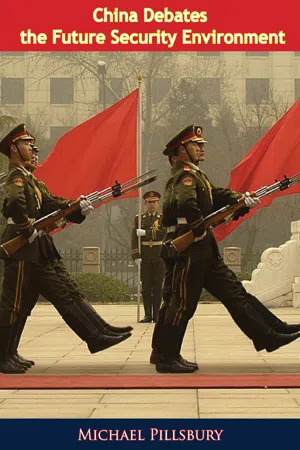
eBook - ePub
China Debates the Future Security Environment
- 474 pages
- English
- ePUB (mobile friendly)
- Available on iOS & Android
eBook - ePub
China Debates the Future Security Environment
About this book
This study offers over 600 selected quotations from the writings of over 200 Chinese authors published from 1994 to 1999. Analysis and interpretation are kept to a minimum so that the Chinese may speak for themselves. Many Chinese scholars assisted with this study by providing hard-to-get books and articles unfamiliar to most Westerners. Half the authors were interviewed in China. They explained some of the viewpoints in recent debates about the future security environment. Debates in China are generally concealed, and frequently authors pretend they do not exist. However muted they may be, China's debates about the future nevertheless exist and merit attention if we are to understand the premises of China's national strategy and set a baseline from which to measure any future change in these premises.
Information
Subtopic
Military & Maritime HistoryIndex
History1: THE MULTIPOLARITY DEBATE
THE VISIONS OF MORE THAN 30 AUTHORS are presented in this chapter about the geopolitical features of the future. They reveal debates between orthodox and reformist authors about which nations will be the most powerful by 2020, what kinds of international alignments will form, and the nature of the post-Cold War transitional pattern.
THE CURRENT ASSESSMENT, 1986-99
China’s current assessment of the future security environment is based on the kind of calculations Sun Zi and the Warring States strategists would recognize. It was issued before the collapse of the Soviet Union and the end of the Cold War and can be dated to early 1986. The assessment characterizes the present world as being in a “new era” of transition that will last several decades. During this period, great rivalries will emerge among the powers, and many local wars will be fought (as large as Korea in 1950 or the Gulf War in 1991), as a “re-division of spheres of influence” and a struggle for world leadership takes place. Bosnia is one example of the strife that typifies the era, because the Bosnia conflict is frequently called a “struggle between the United States and the European Union for domination of Europe.” NATO enlargement, which China opposes, is another example of this “struggle to redivide spheres of influence.” The outcome of this transitional period of “turbulence” will have the following eight features:
• After the transition period is complete, there will no longer be any “superpowers” but instead a “multipolar world” in which five major nations—China, the United States, Japan, Europe and Russia—will each have roughly equal Comprehensive National Power (CNP).{65}
• The nations that will do “best” in competitive terms during the transitional period will pursue “peace and development” and enhance their economic competitiveness. By avoiding local wars, they can decrease defense expenditures and avoid the damage of warfare. Chinese authors frequently assert that the collapse of the Soviet Union and the decline of the United States are due in large part to extremely high defense spending and diminishing competitiveness in CNP.
• Today’s “sole superpower” is in severe decline. The United States risks declining so extensively in contrast to the rise of other nations that it will fell to the level of a mere “common major nation.”{66} This continual weakening of U.S. strength in the decades ahead is an important feature of the Chinese assessment, so this study provides more details on this subject than on China’s views of other major powers.
• After the transition to the multipolar world, a new “world system” will emerge to govern international affairs, one that will probably resemble the current Chinese proposal of the “Five Principles of Peaceful Coexistence.” Chinese authorities assert that world politics since the 1800s always has had a “system” or a “strategic pattern.” Under those rules, there is a competition among powers that includes a global division of spheres of influence. Chinese historical textbooks discuss the “Vienna System” of 1815-70; an intermediate system when Germany and Italy each unified and Japan launched the Meiji Reform; the “Versailles System” of 1920-45; the “Yalta System” of 1945-89; and the present “transition era.”
• The new Chinese-style world system of the Five Principles will be much better than systems of the past and present, because there will be harmony, no “power politics,” and no more “hegemony.”{67} This harmonious world requires a transition away from capitalism in the major powers toward some type of “socialist market economy.” Just as China has modified the doctrines of Marx, Engels, Lenin, and Stalin to produce what Deng Xiaoping called “Socialism with Chinese Characteristics,” so will the United States, Germany, Japan, and Russia ultimately develop their own socialist characteristics.
• Some Chinese military authors believe that there is now underway a revolution in military affairs (RMA) that will radically change future warfare. Several recent Chinese books assert that the United States may not exploit the RMA as well as other nations in the decades ahead.{68} China’s generals “plan to be better, to be ahead of everyone...and become latecomers who surpass the old-timers” in the new revolution.{69}
• A major global nuclear war is highly unlikely for two decades. This official forecast is a sharp change from the forecasts of Chairman Mao that a global nuclear war was inevitable.{70} Therefore, China claims to have cut its defense spending from more than 6 percent of gross national product (GNP) in the 1960s and 1970s, to between 2 and 3 percent when the current assessment came into force by the mid-1980s, and down to about 1.5 percent of the GNP in the 1990s. This claim by China that it has drastically reduced defense spending, which included cutting the People’s Liberation Army (PLA) from 7 to 3 million, is based on China’s expectation that it can remain above the fray of local wars during the turbulent transition era ahead.
• There are many global forces at work for luan (turbulence, a word that also may be translated as chaos), including the potential for nationalist, militarist takeovers of Japan and India. The “main trend” in the world is toward “peace and development,” but “potential hot spots exist which could lead to the involvement of major powers and regional powers in direct military confrontation.”{71} As suggested by one writer, this is true even in Asia: “Although the Asia-Pacific region has been relatively stable since the end of the Cold War, there are also many uncertainties there. If certain hotspot problems are not handled properly, they may cause conflicts, confrontations, and even war in this region, thus wrecking the peace, stability, and prosperity of the region.”{72}
Within the framework of this strategic assessment, China’s analysts discuss a number of subjects in their journals and books.{73} For example, the question frequently arises about how current events fit into the framework. Some Chinese authors see the following examples of the “turbulent period of transition” as suggesting that former spheres of influence are being “re-divided.” While not all Chinese authors included in this volume would agree with all these findings, the examples demonstrate how the framework of the assessment of the future is applied in practice:
• The United States is exploiting Russian weakness by enlarging NATO in order to increase its domination of its European NATO allies.
• The United States (“its hegemonistic ambitions further inflated”) is forcing Japan to increase its financial support for U.S. bases and forces in Japan under the guise of the Defense Guidelines.{74}
• The United States arranged the Bosnian settlement at Dayton to dominate further its European NATO allies.
• Japan is seeking to embroil the United States and China in a struggle that will weaken both Washington and Beijing.{75}
• Some in the United States are fearful of China and seek to contain or block China’s gradually increasing influence by promoting the China Threat Theory. This is wrong because “China has neither the strength nor the will to compete with the United States and other big powers in global affairs”{76}
• Central Asia may be the location of political struggles and wars among the big powers as the former Soviet sphere of influence is redivided. For example, a recent article stated, “Following the Soviet Union’s disintegration, the United States has cast its covetous eyes on Central Asia, the ‘second Middle East of the next century,’ with the goal of eventually controlling most of the energy resources in Central Asia.” The article asserts that in 1998 “Russia and the United States continued their contention in Central Asia by covert and overt means. The basic situation is still that ‘the United States is on the offensive while Russia is on the defensive.’ What has changed is that Russia has switched its ‘passive defense’ to ‘active defense.’” The author concludes that this change means the United States will “find it difficult to have a free rein in Central Asia.”{77}
• NATO airstrikes against Yugoslavia in spring 1999 were a part of a U.S. plan to gain control over Eurasia. “On the surface, the ‘salvation” of the ethnic Albanians in Kosovo by NATO troops seems to be out of ‘humanitarian considerations’ but some important geostrategic interests are undoubtedly hidden behind this operation.”{78} An article entitled, “What are NATO’s Motives in Bombing the Federal Republic of Yugoslavia,” explained, “Kosovo is located in the middle of the Balkan Peninsula and the peninsula is at the meeting point of Europe, Asia, and Africa. It is an important corridor joining the north, south, east, and west and leading to Asia and Africa....The United States knows full well the importance of the Balkan region and has regarded it as a ‘new priority for consideration’....In this region, it can strengthen its security system in the Mediterranean and the North Atlantic to the west; can consolidate the ‘southern wing of NATO’ to the south through converging it with its Middle East strategy; can infiltrate and expand in the Black Sea and the Caspian Sea regions to the west, that is, the outer Caucasus and Central Asia regions, weakening and squeezing out Russian forces and influence, and taking a step further, can press on to China’s northwestern boundary to coordinate from afar with its Asia-Pacific strategy; and finally, can exercise restraints on its European allies to the north, especially the NATO move southward. In this way, the United States will be able to properly fulfill its ambition of making Europe more important and practicing hegemony in the world.”{79}
MULTIPOLARITY PROCLAIMED IN 1986
Chinese analysts do not observe international scholarly standards by footnoting each other or providing bibliographical information. Most authors write as if they were the sole Chinese to ever deal with an issue, in sharp contrast to Western scholarly books and articles, where the author is expected to make clear his debt to earlier work and narrowly and modestly to describe his new contribution. Thus, no Chinese author writing in the 1990s refers to the origins of the current view of the future security environment. Interviews have established that it was Huan Xiang, Deng Xiaoping’s national security adviser, who had both access to scholarly experts from Shanghai as well as experience as China’s ambassador to Britain, who announced its features in early 1986, just after the U.S.-Soviet summit. Huan’s speeches and articles in 1984 and 1985 described a world structure that was changing, but it was still unclea...
Table of contents
- Title page
- TABLE OF CONTENTS
- Advance praise for China Debates the Future Security Environment
- FOREWORD
- PREFACE
- PROLOGUE: Ancient Lessons
- 1: THE MULTIPOLARITY DEBATE
- 2: AMERICA’S DECLINING ROLE
- 3: JAPAN AND INDIA-Dangerous Democracies
- 4: A WEAK RUSSIA’S FUTURE
- 5: GEOPOLITICAL POWER CALCULATIONS
- 6: FORECASTING FUTURE WARS
- 7: CONCLUSIONS
- CHINESE LANGUAGE BIBLIOGRAPHY
- APPENDIX 1: The Definition of Strategic Assessment
- APPENDIX 2: Assessment Institutions
Trusted by 375,005 students
Access to over 1.5 million titles for a fair monthly price.
Study more efficiently using our study tools.
Frequently asked questions
Yes, you can cancel anytime from the Subscription tab in your account settings on the Perlego website. Your subscription will stay active until the end of your current billing period. Learn how to cancel your subscription
No, books cannot be downloaded as external files, such as PDFs, for use outside of Perlego. However, you can download books within the Perlego app for offline reading on mobile or tablet. Learn how to download books offline
Perlego offers two plans: Essential and Complete
- Essential is ideal for learners and professionals who enjoy exploring a wide range of subjects. Access the Essential Library with 800,000+ trusted titles and best-sellers across business, personal growth, and the humanities. Includes unlimited reading time and Standard Read Aloud voice.
- Complete: Perfect for advanced learners and researchers needing full, unrestricted access. Unlock 1.5M+ books across hundreds of subjects, including academic and specialized titles. The Complete Plan also includes advanced features like Premium Read Aloud and Research Assistant.
We are an online textbook subscription service, where you can get access to an entire online library for less than the price of a single book per month. With over 1.5 million books across 990+ topics, we’ve got you covered! Learn about our mission
Look out for the read-aloud symbol on your next book to see if you can listen to it. The read-aloud tool reads text aloud for you, highlighting the text as it is being read. You can pause it, speed it up and slow it down. Learn more about Read Aloud
Yes! You can use the Perlego app on both iOS and Android devices to read anytime, anywhere — even offline. Perfect for commutes or when you’re on the go.
Please note we cannot support devices running on iOS 13 and Android 7 or earlier. Learn more about using the app
Please note we cannot support devices running on iOS 13 and Android 7 or earlier. Learn more about using the app
Yes, you can access China Debates the Future Security Environment by Michael Pillsbury,National Defense University in PDF and/or ePUB format, as well as other popular books in History & Military & Maritime History. We have over 1.5 million books available in our catalogue for you to explore.