"In the 1920's millions of Model T's were on the road. More than 15,000,000 were made."
The fantastic story of the trendsetting Ford Model T is described in this book with numerous illustrations throughout. Exceptionally detailed and well researched this book is a must for any car or automobile enthusiast.
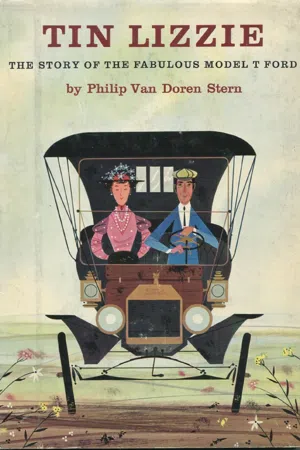
- 217 pages
- English
- ePUB (mobile friendly)
- Available on iOS & Android
eBook - ePub
About this book
Information
Subtopic
American Civil War HistoryIndex
History1 I Remember the Model T
To estimate the number of [passenger] pigeons in one of those mighty flocks...let us take a column one mile in breadth, (which is far below the average size) and suppose it is passing over us without interruption for three hours at the rate of one mile a minute. This will give a parallelogram of 180 square miles. Allowing two pigeons to the square yard, we have 1,150,136 pigeons in one flock.
—JOHN JAMES AUDUBON
Ornithological Biography, 1831-1839
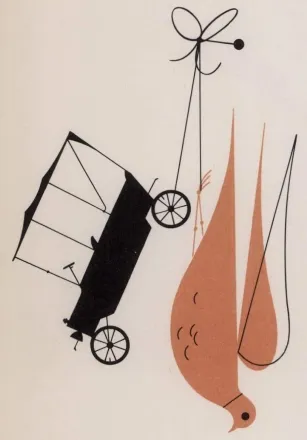
THE PASSENGER PIGEON, which had been so extraordinarily abundant in America, became extinct in 1914, when the last one died in captivity at the Cincinnati Zoological Gardens. Like the passenger pigeon, the Model T Ford once swarmed over the land. At the height of its popularity in the 1920’s, many millions of Model T’s were running on the roads of America. Then they were literally ubiquitous, for they had penetrated not only to every corner of this country, but to the most remote nations of the earth. From Alaska to Zanzibar, the famous “Tin Lizzie” went everywhere. It spread the idea of the automobile—of individual motorized transportation—across the world.
More than 15,000,000 Model T’s were made. The first were produced in the autumn of 1908, and the last one rolled off the assembly line in May, 1927, to be replaced by the Model A. They lingered on the roads for a long while and were a common sight during the next 15 years, but the Second World War took heavy toll of them. Since then they have become less and less frequently seen, and must inevitably share the fate of the passenger pigeon.
In 1948, when R. L. Polk and Company made a survey of registered Model T passenger cars in the 48 states, they found only 49,869 Model T’s left. There were others unaccounted for because they were stored away or kept without licenses on farms. Since 1948 their number has dwindled sadly. They are scarce enough to fetch a premium price when in good running condition, but a few are still being broken up by junk yards every year. And fire, collision, rust, and general neglect are also reducing the fast-thinning ranks.
Most of us who are over 40 had our first experience in automobiling when we drove a Model T Ford. Its controls may seem complicated to the young person who has been brought up with modern driving aids like automatic transmission, power steering, and power brakes, but compared to most cars of its day, the Model T was sublimely and absurdly simple. It had two speeds forward, and a reverse which, when everything else failed, could be pressed into service as an extra brake. There were two sets of regular brakes—one operated by a pedal and the other by a hand lever. This lever was an ingenious device. Pushed all the way forward, it put the car into high; then, as it was pulled back to an approximately vertical position, it automatically released the clutch; pulled still farther back, it served as a hand brake which could be locked into position to keep the car from rolling—or from creeping ahead on its sometimes too-eager transmission bands.
This probably sounds more complicated than it actually was. Young people who gaze with open-mouthed wonder at the Model T’s three pedals can rest assured that three feet were never required to drive it. Not even a Model T could go in two directions at once, so the reverse pedal (the center one) was ordinarily not used until the car had been declutched and brought to a stop.
Since the Model T was just about as simple as an automobile can be, most owners could make emergency repairs; and a screwdriver, a pair of pliers, a few assorted wrenches, and a bit of wire were about all one needed to get the car going again. Some owners went in for more elaborate equipment and even ground their own valves, which, according to factory instructions, were supposed to be reseated every three months.
The Model T was a homely car, smaller and lighter than any automobile now made in America. It was purposely designed with a high clearance so it could make its way through the dreadful morasses, rocky gullies, and rutted cow tracks that passed for roads in the first part of this century. And the Model T was provided with such amazingly loose-jointed wheels that all four of them could be bent at violently different angles and still function.
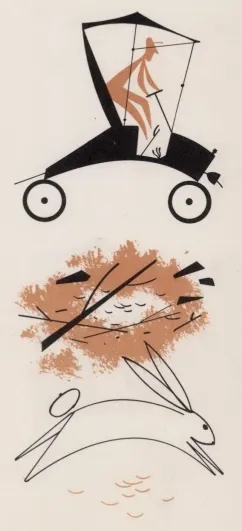
It had planetary transmission and a low-tension magneto built into the flywheel; and the very earliest examples had two hand levers (one for reverse), but these were soon replaced by the more familiar three-pedal, one-hand-lever type. When the top of the touring car was up, only a tall man could reach it, for it was seven feet above the ground. Gasoline was fed by the natural force of gravity from a 10-gallon tank located under the front seat, and a marked stick was used to measure the amount of fuel on hand. Only the first few cars were equipped with a water pump, which was quickly eliminated to bring down costs, and a thermosiphon system was substituted in its stead. “Thermosiphon” may sound very impressive, but actually it refers to just another natural force that was being put to practical use. It simply means that hot water rises while cool water sinks—and that is how the Model T circulating system worked. As water was heated by the engine, it rose to the top of the radiator and was replaced by cooler water coming up from below. Sometimes, especially on hot days or on steep hills, this elementary cooling method didn’t work fast enough, and the water became so hot that the radiator boiled over. The patient Model T driver, who was used to such minor emergencies, then pulled his car to the side of the road and waited for its angrily sputtering engine to cool off.
People who had been brought up with horses were easily able to make the transition to the modern automobile on this simply constructed car. Lee Strout White, in his famous tribute “Farewell to Model T,” alluded several times to owners’ thinking of their cars as creatures similar to the horse. Speaking of the Model T’s planetary transmission, he said:
Engineers accepted the word “planetary” in its epicyclic sense, but I was always conscious that it also meant “wandering,” “erratic.” Because of the peculiar nature of this planetary element, there was always, in Model T, a certain dull rapport between engine and wheels, and even when the car was in a state known as neutral, it trembled with a deep imperative and tended to inch forward. There was never a moment when the bands were not faintly egging the machine on. In this respect it was like a horse, rolling the bit on its tongue, and country people brought to it the same technique they used with draft animals...Often, if the emergency brake hadn’t been pulled all the way back, the car advanced on you the instant the first explosion occurred and you would hold it back by leaning your weight against it. I can still feel my old Ford nuzzling me at the curb, as though looking for an apple in my pocket.
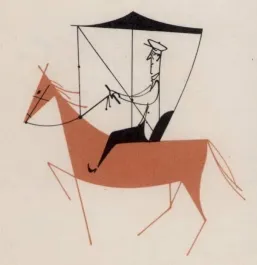
Perhaps this is animistic thinking—something to which the human race is notoriously addicted—but it may have been the Model T’s quality of seeming to be alive that endeared it to so many of its owners. Certainly most of us remember it fondly today, even though we may often have cursed at it, called it unprintable names, or kicked petulantly at one of its unoffending tires when its cold and unresponsive engine refused to reply to our vigorous cranking. Now we think kindly of the Model T, for associated with it is a whole area of recollection that covered what were surely the best years of our lives.
Its hard-sprung, stiff-backed, black leatherette seats were graced by the girls who shared our expeditions and adventures. In summer, when the top was strapped down, the sun beat on their heads, and the dust of the nearly always dusty roads settled on their hair and begrimed their pretty faces. In winter, even when the top and curtains had been protectively put up, the wind blew coldly around the poor girls, and the rain crept inside to wet their long skirts and drip down soggily on their high shoes. But despite their unflattering costumes, these girls lent beauty to a vehicle that badly needed such a loan.
The Model T was admittedly ugly, although an argument might be made for it on aesthetic grounds as the essence of pure functionalism. But to the modern eye it looks much too high and square, and its silhouette seems as clumsy as a bony old cow’s. Actually there was no need to streamline its body or round off its various protuberances, for the Model T was not intended to go more than about 40 miles an hour on a smooth level road. It was designed primarily for farm and family use, and practicality rather than beauty was its makers’ aim. They achieved their purpose so admirably that the Model T became the most widely used single make of large machine product in all history.
Inexpensive as it was, purchasing a Model T meant a major investment for most people, and months and sometimes years of planning and saving were required to bring about the arrival of the great day when the family got its first automobile. One of the commonest snapshots made in America during the period from 1909 to 1927 was one that showed a whole family sitting proudly in their newly delivered, shiny black Model T Ford.
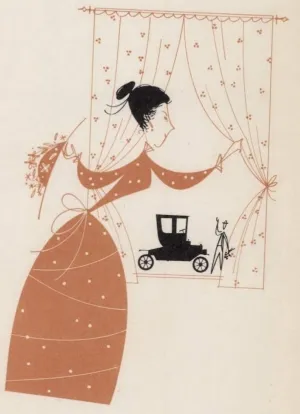
There they all are, preserved by photography’s silver magic from that day to this. Father is at the steering wheel, looking a little apprehensive about having to manage the strange and fearfully wonderful new machine he has just acquired. Alongside him, personifying the mechanical age that wa...
Table of contents
- Title page
- TABLE OF CONTENTS
- 1 I Remember the Model T
- 2 The World into Which the Model T Was Born
- 3 Henry Ford Before the Model T
- 4 Predecessors of the Model T
- 5 The Birth of the Model T
- 6 The Transcontinental Race
- 7 The Rise of the Model T
- 8 How the Model T Was Built
- 9 The Model T Got Around
- 10 Famous People and the Model T
- 11 The Death of the Model T
- 12 The Model A
- 13 The Model T Today
- 14 Testimony of the Witnesses
- 15 Gimmicks and Gadgets
- 16 Model T Folklore, Jokes, Anecdotes, and Music
- 17 Reference Data
Trusted by 375,005 students
Access to over 1.5 million titles for a fair monthly price.
Study more efficiently using our study tools.
Frequently asked questions
Yes, you can cancel anytime from the Subscription tab in your account settings on the Perlego website. Your subscription will stay active until the end of your current billing period. Learn how to cancel your subscription
No, books cannot be downloaded as external files, such as PDFs, for use outside of Perlego. However, you can download books within the Perlego app for offline reading on mobile or tablet. Learn how to download books offline
Perlego offers two plans: Essential and Complete
- Essential is ideal for learners and professionals who enjoy exploring a wide range of subjects. Access the Essential Library with 800,000+ trusted titles and best-sellers across business, personal growth, and the humanities. Includes unlimited reading time and Standard Read Aloud voice.
- Complete: Perfect for advanced learners and researchers needing full, unrestricted access. Unlock 1.5M+ books across hundreds of subjects, including academic and specialized titles. The Complete Plan also includes advanced features like Premium Read Aloud and Research Assistant.
We are an online textbook subscription service, where you can get access to an entire online library for less than the price of a single book per month. With over 1.5 million books across 990+ topics, we’ve got you covered! Learn about our mission
Look out for the read-aloud symbol on your next book to see if you can listen to it. The read-aloud tool reads text aloud for you, highlighting the text as it is being read. You can pause it, speed it up and slow it down. Learn more about Read Aloud
Yes! You can use the Perlego app on both iOS and Android devices to read anytime, anywhere — even offline. Perfect for commutes or when you’re on the go.
Please note we cannot support devices running on iOS 13 and Android 7 or earlier. Learn more about using the app
Please note we cannot support devices running on iOS 13 and Android 7 or earlier. Learn more about using the app
Yes, you can access Tin Lizzie by Philip Van Doren Stern in PDF and/or ePUB format, as well as other popular books in History & American Civil War History. We have over 1.5 million books available in our catalogue for you to explore.