- 128 pages
- English
- ePUB (mobile friendly)
- Available on iOS & Android
eBook - ePub
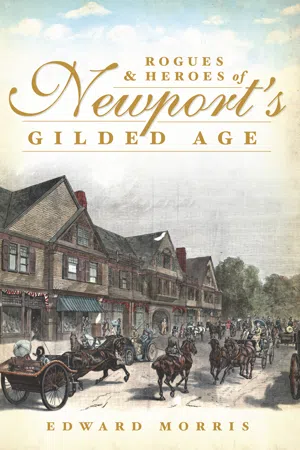
Rogues and Heroes of Newport's Gilded Age
About this book
Newport, Rhode Island, was the summer playground of the Gilded Age for the Astors, Belmonts and Vanderbilts. They built lavish villas designed by the best Beaux Arts-style architects of the time, including Richard Morris Hunt, Charles McKim and Robert Swain Peabody. America's elite delighted in referring to these grand retreats as "summer cottages," where they would play tennis and polo and sail their yachts along the shores of the Ocean State. The coachman had an important role as the discreet outdoor butler for Gilded Age gentlemen--not only was he in charge of the horses, but he also acted as a travel advisor and connoisseur of entertainment venues. From the driver's seat, author and guide Edward Morris provides a diverse collection of biographical sketches that reveal the outrageous and opulent lives of some of America's leading entrepreneurs.
Information
Topic
GeschichteSubtopic
Nordamerikanische GeschichteIII
COACHMAN’S DRIVE-AROUND TOUR
DOWNTOWN HARBOR FRONT AND COLONIAL NEWPORT
Navy’s First Headquarters in Newport
In addition to leading the thirteen colonies into gaining independence, Newport had become a major station of the U.S. Navy and continued this role until 1953, when the headquarters were moved to Norfolk and Newport News, Virginia.
Newport’s wharves and facilities had been devastated by the British occupying forces. Some merchants returned. Efforts to revive trade were struck another blow in the War of 1812 and yet another by a great storm in 1815. The port never regained its prowess in shipping. Its revival as a resort for tourists came in the 1840s with the inauguration of the Fall River line steamships, which provided daily service to New York for ninety years, until 1937.
The First Navy Ship Commissioned
It was the navy that kept Newport’s economy afloat. John Paul Jones commissioned the first U.S. Navy ship, the Bronn vessel, as the Providence on this island. And the first naval battle of the Revolutionary War took place just north of the Newport Bridge.
Newport Bridge was renamed after Rhode Island’s recently retired U.S. senator Claiborne Pell. The bridge was opened in 1969 with a span of 2.5 miles, making it the longest suspension bridge in New England. The span is two hundred feet above the water to accommodate huge U.S. Navy aircraft carriers, which are no longer based here.
Where the First Colonists Kept Goats
Goat Island got its name when the first colonists kept their goats on it instead of building fences. The stone marks the site of Fort George, from which the colonists fired thirteen cannon rounds at the gunboat HMS St. George.
In 1869, this island was designated a navy torpedo manufacturing station; two years later, the first propelled torpedo was built here. In 1880, the first boat specifically designed to fire torpedoes was built here. During World War II, seventeen thousand torpedoes were manufactured on this island in huge plants employing twelve thousand in three round-the-clock shifts. In place of those plants, you now see condominiums and the unusually shaped Hyatt Regency Hotel, designed to withstand hurricane-force winds. And across the water to the south is Fort Adams, the first part of it built in 1799 and named after our second president.
Navy’s Highest Institute of Learning
Just north of Newport Bridge is Coasters Harbor Island, the U.S. Naval War College—the U.S. Navy’s highest institute of learning. Candidates were required to have 9.5 years of service as officers just to enroll. It was founded in 1884 by Admiral Stephen B. Luce, who also founded the Navy Training Center here the previous year.
The white building with the little cupola was built much earlier, in 1820, as a retirement house, as well as a pesthouse and workhouse for the poor. Officers studying nuclear strategy in there during the Cold War must have felt quite uneasy about the future.
In 1951, the Navy Officers’ Candidate School was founded on that island, and during its forty-two years in Newport, it graduated 100,573 officers—more than the U.S. Navy Academy at Annapolis, which was also located in Newport during the four years of the American Civil War.
In 1946, Newport was homeport for one hundred of the navy’s ships; by 1973, it was down to forty-three ships, and since has vastly diminished. But many training schools and facilities are still here, and for some years, there were a couple of old aircraft carriers in mothballs.
A Museum of Ship Models and Accounts of Navy Battles
The Navy War College has a museum of ship models and personal accounts of major navy battles that is open to the public.
The group of houses to the north of this causeway to Newport Bridge, and from the seawall back to the railway tracks, is called The Point. Easton’s Point was named after the Quaker descendants of Nicholas Easton, who developed it into building lots. More than one hundred of the three hundred or so pre–Revolutionary War houses surviving in Newport today are located there.
The house on the far right was built in 1749. After the Revolution, wealthy privateer Simeon Potter (yes, he had a license to plunder French and Spanish ships) gave it to the proprietors of Long Wharf so they could open the first “free” school here for poor children.
Long Wharf is the street running along the water at the far right. It was lined with wharves and sheds, and the wealthy merchants who owned them banded together as early as the eighteenth century to promote Newport trade. They set prices and quality standards in candle making and built the Brick Market (an open market house and grain storage) in the center of town.
Where Thirty-one Pirates Were Hanged
Long Wharf was where the first colonists Easton and Brenton built their first wharves just after settling here in 1639 and where thirty-one pirates were hanged in 1723. The west end of Long Wharf is now owned by the State of Rhode Island and is used by our local lobstermen to keep their boats and bring in their catches. To the north is the Newport Shipyard, Newport’s last remaining shipyard.
The second house to the left of the Potter House was owned by Isaac Dayton, who after the Revolution moved to Ohio and helped found the city of Dayton, which still bears his name.
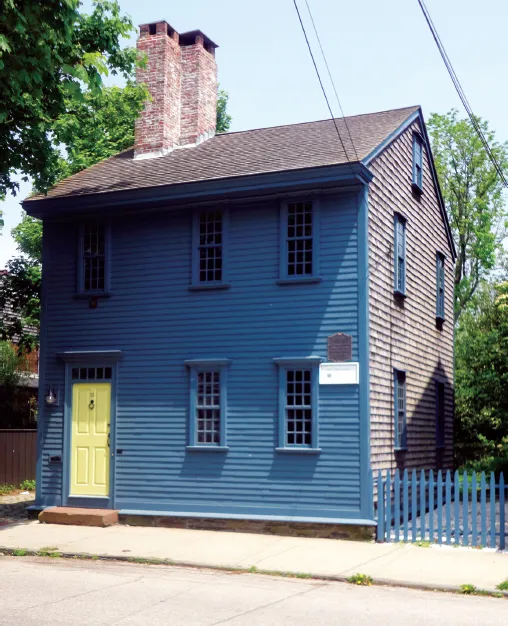
The Isaac Dayton House.
To the left of that house, the two houses before the corner are the home and counting house of the merchant trading family of Jahleel Brenton. Yes, they kept their accounts in the counting house, not just counting their money there.
An Outspoken Tory Had to Flee
One of the finest examples of Colonial houses in America is the Hunter House, first on the waterside of Washington Street (which was originally called Water Street). The south end of this house was built in 1748 by Jonathan Nichols Jr.; the north end was added in 1756 by Joseph Wanton Jr. They were both wealthy merchants, and both served as deputy governors of Rhode Island. But Wanton was an outspoken Tory and had to flee to New York with the British troops when they pulled out in 1779.
The French Admiral de Ternay chose this house for his billet but became ill and died here. He was buried in the Trinity Church cemetery. This house is open to the public through the Preservation Society of Newport County, the largest of several nonprofit educational organizations offering for-fee tours of historic properties in Newport.
The Hunter House contains a fine collection of antique Chippendale-style furniture, hand crafted, in part, by three generations of the Townsend and Goddard cabinetmaking families here in Newport. The collection is probably even more valuable than the finely paneled house.
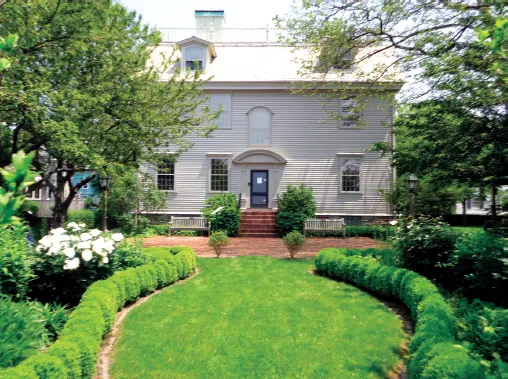
The Hunter House and garden.
Captain William Kidd Buried Treasure?
Among Newport’s better-known pirates were William Mayes Jr., whose father built the Whitehorse Tavern, and Captain Thomas Payne, who retired from pirating and built his retirement home in Jamestown, where the notorious pirate captain William Kidd visited him. That started the rumor that Kidd buried some of his famous treasure there—they say some still dig for it to this day.
America’s Cup Avenue was named after the famous sailing race trophy, usually awarded every four years. It is promoted by the New York Yacht Club, which first won the cup off the Isle of Wight in England in 1851 and defended it successfully until Dennis Connor’s loss to Australia II in 1983.
On the far side of the street is Cardines Baseball Field, built in 1908—four years before Fenway Park in Boston. This is where Babe Ruth, the “Sultan of Swat,” began his career in the minor leagues with a team called the Providence Braves. The stadium itself was built by the Works Progress Administration (WPA) in 1937. The field was named after Barnardo Cardines, Newport’s first casualty in World War I.
Across the street to the west is the Newport County Convention and Visitors’ Information Center, and to its south the Newport Marriott Hotel and the remnant of Long Wharf, where Brenton and Easton built their first wharves in about 1641.
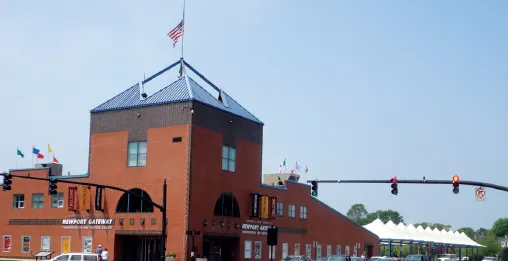
The Visitors’ Information Center.
Heading south on America’s Cup Avenue, a group of fifty stores on the left were built during a 1975 redevelopment program around the original colonial Brick Market, completed by the Long Wharf Merchants Association in 1772.
On the right is the harbor master's office and a hotel. A little more to the south are Bannisters and Bowens Wharves. There, in place of the original docks and sheds of the merchants—and a dozen rum distilleries—as well as shipbuilders and sail and rope makers, you will now find restaurants, nightclubs, galleries and condominiums.
There Were Twenty-two Rum Distilleries Here
The Newport Historical Society has reported that in 1770 there were twenty-two rum distilleries here. No wonder Newport was the first vacation resort in America!
The white church spire on the left belongs to Trinity Church, rebuilt in 1726 by Newport’s first renowned carpenter-builder (as they were called then), Richard Munday. The green park around it was dedicated by Queen Elizabeth II herself during her 1976 American bicentennial visit. The city aptly named it Queen Anne Square.
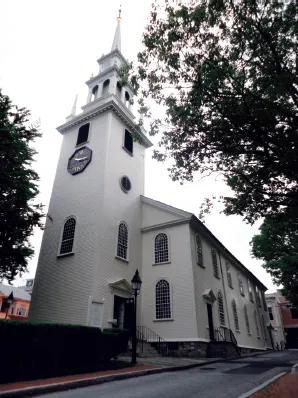
Trinity Church, built in 1725.
The name Queen Anne was chosen because England’s Queen Anne began her reign in 1702, the same year that the original Trinity Church was built on this site.
America’s Cup Avenue runs into Thames Street, one of the earliest s...
Table of contents
- Front Cover
- Half Title
- Title Page
- Copyright
- Contents
- Preface
- Acknowledgements
- I. History of Colonial Newport
- II. Biographies
- III. Coachman’s Drive-Around Tour
- Bibliography
- About the Author
Trusted by 375,005 students
Access to over 1.5 million titles for a fair monthly price.
Study more efficiently using our study tools.
Frequently asked questions
Yes, you can cancel anytime from the Subscription tab in your account settings on the Perlego website. Your subscription will stay active until the end of your current billing period. Learn how to cancel your subscription
No, books cannot be downloaded as external files, such as PDFs, for use outside of Perlego. However, you can download books within the Perlego app for offline reading on mobile or tablet. Learn how to download books offline
Perlego offers two plans: Essential and Complete
- Essential is ideal for learners and professionals who enjoy exploring a wide range of subjects. Access the Essential Library with 800,000+ trusted titles and best-sellers across business, personal growth, and the humanities. Includes unlimited reading time and Standard Read Aloud voice.
- Complete: Perfect for advanced learners and researchers needing full, unrestricted access. Unlock 1.5M+ books across hundreds of subjects, including academic and specialized titles. The Complete Plan also includes advanced features like Premium Read Aloud and Research Assistant.
We are an online textbook subscription service, where you can get access to an entire online library for less than the price of a single book per month. With over 1.5 million books across 990+ topics, we’ve got you covered! Learn about our mission
Look out for the read-aloud symbol on your next book to see if you can listen to it. The read-aloud tool reads text aloud for you, highlighting the text as it is being read. You can pause it, speed it up and slow it down. Learn more about Read Aloud
Yes! You can use the Perlego app on both iOS and Android devices to read anytime, anywhere — even offline. Perfect for commutes or when you’re on the go.
Please note we cannot support devices running on iOS 13 and Android 7 or earlier. Learn more about using the app
Please note we cannot support devices running on iOS 13 and Android 7 or earlier. Learn more about using the app
Yes, you can access Rogues and Heroes of Newport's Gilded Age by Edward Morris in PDF and/or ePUB format, as well as other popular books in Geschichte & Nordamerikanische Geschichte. We have over 1.5 million books available in our catalogue for you to explore.