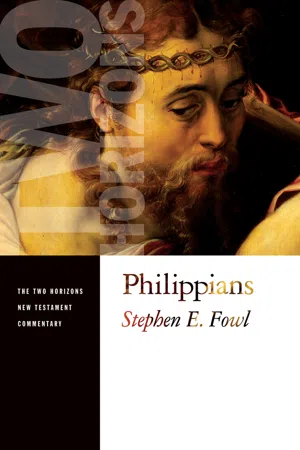
In this fine new commentary on Paul's letter to the Philippians, Stephen Fowl notes that for the great premodern commentators of the Christian tradition, the literal sense of Scripture is always regulated by theological concerns. Thus, unlike commentaries that simply append theology to historical criticism, Fowl's volume displays disciplined attention to the text of Philippians in ways that enhance rather than frustrate theological inquiry.
While Fowl engages the great scholars of the past, John Chrysostom and Thomas Aquinas among them, he also draws a novel theology of friendship from Paul's letter and unpacks how the teachings of Philippians might be embodied today by Christians in the West.
- 264 pages
- English
- ePUB (mobile friendly)
- Available on iOS & Android
eBook - ePub
Philippians
About this book
Information
Print ISBN
9780802825513
Commentary on Philippians
1:1-2
1 Paul and Timothy, slaves of Christ Jesus, to all the saints in Christ Jesus who are in Philippi with the overseers and the deacons: 2 Grace to you all and peace from God our Father and the Lord Jesus Christ.
Sometimes introductions can reveal a great deal about what is to come in a text. Although there are a few hints here in these verses of themes that will reappear later, Philippians begins in a fairly conventional way. The greeting of “grace and peace” is the way all of the Pauline letters in the NT begin. Scholars often speculate that Paul here combines the standard Greek greeting, “grace” (χάρις/charis), with a Greek translation of the standard Hebrew greeting, “peace” (εἰρήνη/eirēnē or shalom/שׁלוֺמ). There is, however, no direct evidence for this view. Rather than explain how this standard greeting came to be, it is more important to recognize that it is a thoroughly Christian expression. It reminds us that this is a letter from Christians to Christians. Paul presumes this commonality and later in the epistle he will speak more about the nature and shape of the life he and the Philippians share in Christ.
We are further told that grace and peace come from “God our Father and the Lord Jesus Christ.” Paul uses this expression in several places (Rom 1:7; Gal 1:3; 2 Cor 1:2; 2 Thess 1:2; Phlm 3; also Eph 1:2). Although this phrase is relatively common at the beginning of Paul’s letters, this language also anticipates the robust christological implications behind 2:9-11. In addition, at the very beginning of the epistle we are reminded that God is source of the common life which Paul and the Philippians share in Christ. Paul will rely on the three-way nature of this relationship at several points later in the epistle.
Verse 1 identifies both the senders and the recipients of the epistle. Paul and Timothy are identified as the senders of the epistle.1 Paul (Παῦλος/Paulos) is the Greek/Latin name the apostle consistently uses in place of his Hebrew name, Saul (שׁאול/Shaul). The change in name begins when the apostle begins his missionary activity (cf. Acts 13:9). Timothy is also listed as a sender of this epistle as in 1 and 2 Thessalonians (along with Silvanus), 2 Corinthians, Philemon, and Colossians. With the exception of Philemon and Philippians, the authors of these epistles primarily speak in the first person plural. In Philemon and here in Philippians the voice is singular and clearly Paul’s rather than Timothy’s.2 Nevertheless, Phil 2:19-22 makes it clear that Timothy is well known to the Philippian Christians. Moreover, on the evidence of Acts, Timothy was present at the founding of the church (16:1, 13) and later visited the church on Paul’s third missionary journey (19:22; 20:3-4).3 It would seem, then, that Timothy is included here in the greeting of the epistle because he, too, shares in the common bond which unites Paul and the Philippians in Christ rather than because Paul seeks to buttress Timothy’s authority in the light of his plans to send Timothy to Philippi.4
Philippians is one of the few letters where Paul does not identify himself as an apostle.5 This may be because he has no need to assert his apostolic authority to a congregation with whom he is on such good terms. Instead, both Paul and Timothy are identified as “slaves of Christ Jesus.” While many English translations prefer the word “servant,” “slave” is a more accurate translation of the Greek δοῦλος/doulos. Readers, however, should not presume that ancient slavery was comparable with the race-based slavery practiced in the U.S. Slavery was widespread in Paul’s world. Primarily, one could become a slave by being captured in battle or by falling into debt. Slaves in Paul’s world performed a wide variety of jobs, including working in households as well as in areas such as education and medicine.6 One of the initial things the Philippians would want to know about any slave they encountered was to whom that slave belonged. Paul and Timothy are slaves of Christ.
This identification of Paul and Timothy as slaves of Christ is taken up in a variety of more and less direct ways in the course of the epistle. Paul’s work in founding the church in Philippi was part of his service to Christ. This service provides a rationale for his care for the Philippians (1:7). Moreover, like all slaves, he is accountable to his master, who will evaluate his service. Hence, the maintenance of the Philippian congregation as a faithful witness to Christ provides a basis for evaluating Paul’s service on the “day of Christ” (2:16-17).
Most importantly, however, Paul desires to see certain dispositions and habits formed in the Philippians (see especially 2:1-4, 5). These dispositions are paradigmatically exemplified by Christ, but also concretely displayed by Paul and Timothy. Hence, it is relevant that Paul and Timothy are slaves of Christ, who himself takes on the form of a slave (2:7).7
The recipients are initially identified here as “saints” (ἅγιοι/hagioi) in Christ Jesus. Indeed, with the use of “all” here Paul designates the entire congregation. This emphasis on “all” of the Philippians is picked up throughout 1:3-11 as well. The designation “saints” occurs also in the greetings of Romans, 1 and 2 Corinthians, Ephesians, and Colossians as a way of identifying the churches to whom these epistles are addressed.8 What does this way of identifying Christian congregations tell us?
It is clear from Paul’s unhesitating application of this word to the Corinthian congregations that “saints” is not primarily a reference to the moral achievements of these congregations. Rather, Paul has taken over a word used to describe Israel in the LXX and applied it to these congregations.9 The allusions here go back to Exod 19:6; 23:22, where the Lord speaks of setting Israel apart as a “kingdom of priests and a holy nation.” Further, in Leviticus the Lord repeatedly calls Israel to a divine holiness (11:44, 45; 19:2; 20:7, 26).10 In part, this call is based on God’s setting the people of Israel apart and delivering them up out of Egypt (11:45). Deut 7:6-8 again designates Israel as a holy people of God’s own choosing and redeeming (see also 14:2, 21). Moreover, Pss 15:3; 33:9; 73:3; and 1 Macc 10:39 (LXX) also use “saints” to designate all or a part of the people of God in much the same way Paul seems to use the term.
Thus, we can say that both for the LXX and for Paul “saints” appears to designate a body of people chosen by God. The term bespeaks God’s formation of a particular body of people and God’s desires for them to be holy. For Paul to use this language of the Philippians is to connect them to God’s activity of forming, redeeming and sanctifying a people.11 “To us, the early Christian self-designation as ‘the saints’ is almost embarrassing…. But the word once expressed much of what was meant by ‘contrast society.’ The church understood itself to be the sacred people of God’s possession, a people with a pattern of life which differed from that of the world.”12 In designating the congregations he addresses as “saints,” Paul is indicating that they are a people set apart, not because of their moral perfection, but by the work of God.
It is important to remember, however, that the Philippians’ status as “saints” is tied to being “in Christ Jesus.” The real question here is what is the force of the preposition “in”? On numerous occasions Paul uses “in Christ” to speak of a distinct group or community comprised of believers.13 In addition, recall that the use of “saints” also is tied to the formation of a particular people. This would indicate that identifying the Philippians as “saints in Christ Jesus” defines both the parameters of the community and the character of that community. Fee rightly captures both of these aspects when he notes, “That is, Christ Jesus is both responsible for their becoming the people of God, and as the crucified and risen One, he constitutes the present sphere of their new existence.”14 Being in Christ locates one within that community founded by Christ, and thereby, within the realm governed by Christ. What is not always recognized, however, is that when Paul speaks this way he is speaking in political terms. He is speaking of a community whose character and common life are defined by the lordship of Christ.
The next phrase of the verse geographically locates this community in Philippi. Given Philippi’s status as a Roman military colony, it may be that “in Christ” and “in Philippi” can be read as setting up the two political realms vying for the allegiance of the Philippian Christians, who, ultimately, are reminded in 3:20 that their commonwealth is in heaven.
What Paul’s language here simply presumes, but what contemporary Christians must remember, is that if Christ’s lordship is to have any material reality in the present, then there must also be a community of people whose faith and practice, whose hopes and desires, whose very life and death, are shaped by their allegiance to their Lord. Apart from this, language about being in Christ and attempts to call Christ Lord, begin to lose their coherence. As G. Lohfink notes, “being in Christ means living within the realm of Christ’s rule — and that realm is the church.”15 Clearly, Christians are divided over how the church should be ordered and what its constitutive practices are. This divisiveness is itself a profound wound in the body of Christ. Nevertheless, to follow Paul and to speak of the church as the body of Christ or, as in Philippians, of “saints in Christ” demands the real material presence of a community of Christians, not simply individual Christians enjoying discrete inner transactions with God. The central Christian confession that Jesus Christ is Lord calls forth and requires that community known as the church.16
Finally, two subgroups within the congregation are also mentioned in the greeting, the “overseers” (ἐπίσκοποι/episkopoi) and “deacons” (διάκονοι/diakonoi). This is the earliest appearance of the word “overseer” in the NT. While “elder” and “overseer” seem to be used interchangeably in other early texts such as Acts (especially 20:17-28), the Pastorals, and 1 Clement, at least by the late second century “overseer” becomes distinct from “elder” and signifies the first of the church’s three orders of ministry, bishops. But bishops did not cease to be elders. The development of the episcopate out of the presbytery was “not so much an isolated act as a progressive development, not advancing everywhere at a uniform rate, but exhibiting at one and the same time different stages of growth at different churches.”17
Paul is not talking about the monarchical episcopate in its later forms here in Philippians. Nevertheless, he does single out these two groups in the greeting. Although we are not likely to learn the precise nature and composition of these two groups, it is still intriguing to ask why Paul mentions them here in the greeting of the epistle. There are two basic positions that most commentators adopt here. One holds that this reference anticipates the comments of 4:2-3 directed at Euodia and Syntyche, who were clearly leaders in the congregation and were quarreling with each other. “Thus, both the ‘all’ with which the address begins and the addition of ‘with the overseers and the deacons’ at the end anticipate the problem of friction that has arisen within the community, perhaps within the leadership itself.”18 The nature and extent of the “friction” within the community, however, are extremely unclear. Equally unclear are the formal positions of Euodia and Syntyche within the leadership of the community. Hence, in regard to this proposal, one can only say “perhaps.”
The other view goes back at least as far as Chrysostom. It argues that the “overseers and deacons” were the ones responsible for sending Epaphroditus to Paul.19 One might well have expected, however, that these leaders would have again been mentioned in 4:10-20. Again, there is no strong evidence to tip the scales in the direction of either of these possibilities.
Given the very limited scope of our information, we simply have to say that while these two terms indicate offices within the church, we do not really know very much about what those offices involved in the NT period outside the discussion in 1 Tim 3:1-13. More importantly, for the purposes of understanding Philippians, we do not really know why Paul mentioned these two groups here at the beginning of the epistle. It is, however, important to note that Paul designates himself as a “slave” and not an apostle, while addressing himself to “overseers and deacons.” We may not have reason to assume that these “overseers and deacons” needed to be reminded that they, too, were slaves of Christ. Nevertheless, the juxtaposition of Paul the apostle, yet slave, with the “overseers and deacons” should remind all holders of church office that “slave of Christ” is a more foundational identity marker for Christians than “apostle,” “overseer,” or “deacon.”
Within this greeting we have the initial hints of two major theological themes in Philippians which Paul will develop in the course of the epistle. The first concerns the common bond in Christ which unites Paul, the Philippians, and God in a three-way relationship. The second theme which Paul hints at concerns the material, political visibility of the Philippian Christian community. As the epistle moves on to 1:3-8 Paul more directly discusses the nature of his relationship with the Philippians in Christ.
1:3-11
3 I thank my God because of all my remembrances of you. 4 I always make each of my prayers for you with joy 5 because of your participation with me in the gospel from the first day until now. 6 I am also confident that the one who...
Table of contents
- Cover
- Title Page
- Copyright
- Contents
- Acknowledgments
- Abbreviations
- Introduction to Philippians
- Commentary on Philippians
- Theological Horizons of Philippians
- Bibliography
Trusted by 375,005 students
Access to over 1.5 million titles for a fair monthly price.
Study more efficiently using our study tools.
Frequently asked questions
Yes, you can cancel anytime from the Subscription tab in your account settings on the Perlego website. Your subscription will stay active until the end of your current billing period. Learn how to cancel your subscription
No, books cannot be downloaded as external files, such as PDFs, for use outside of Perlego. However, you can download books within the Perlego app for offline reading on mobile or tablet. Learn how to download books offline
Perlego offers two plans: Essential and Complete
- Essential is ideal for learners and professionals who enjoy exploring a wide range of subjects. Access the Essential Library with 800,000+ trusted titles and best-sellers across business, personal growth, and the humanities. Includes unlimited reading time and Standard Read Aloud voice.
- Complete: Perfect for advanced learners and researchers needing full, unrestricted access. Unlock 1.5M+ books across hundreds of subjects, including academic and specialized titles. The Complete Plan also includes advanced features like Premium Read Aloud and Research Assistant.
We are an online textbook subscription service, where you can get access to an entire online library for less than the price of a single book per month. With over 1.5 million books across 990+ topics, we’ve got you covered! Learn about our mission
Look out for the read-aloud symbol on your next book to see if you can listen to it. The read-aloud tool reads text aloud for you, highlighting the text as it is being read. You can pause it, speed it up and slow it down. Learn more about Read Aloud
Yes! You can use the Perlego app on both iOS and Android devices to read anytime, anywhere — even offline. Perfect for commutes or when you’re on the go.
Please note we cannot support devices running on iOS 13 and Android 7 or earlier. Learn more about using the app
Please note we cannot support devices running on iOS 13 and Android 7 or earlier. Learn more about using the app
Yes, you can access Philippians by Stephen E. Fowl in PDF and/or ePUB format. We have over 1.5 million books available in our catalogue for you to explore.