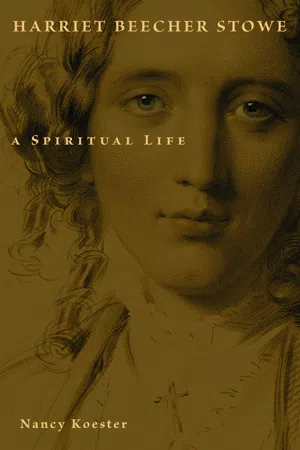
"So you're the little woman who started this big war," Abraham Lincoln is said to have quipped when he met Harriet Beecher Stowe. Her 1852 novel
Uncle Tom's Cabin converted readers by the thousands to the anti-slavery movement and served notice that the days of slavery were numbered. Overnight Stowe became a celebrity, but to defenders of slavery she was the devil in petticoats.
Most writing about Stowe treats her as a literary figure and social reformer while downplaying her Christian faith. But Nancy Koester's biography highlights Stowe's faith as central to her life -- both her public fight against slavery and her own personal struggle through deep grief to find a gracious God. Having meticulously researched Stowe's own writings, both published and un-published, Koester traces Stowe's faith pilgrimage from evangelical Calvinism through spiritualism to Anglican spirituality in a flowing, compelling narrative.
- 384 pages
- English
- ePUB (mobile friendly)
- Available on iOS & Android
eBook - ePub
About this book
Information
CHAPTER ONE
This Old House
Harriet Elizabeth Beecher was born on June 14, 1811, the sixth living child of Lyman and Roxana Beecher. Babies were “no longer a novelty” in the family, so each new arrival had to find a place among “the wants and clamors of older children,”1 Harriet later recalled. The house was full of the wants and clamors of adults too, for Lyman Beecher was the minister of the local Congregational church in Litchfield, Connecticut. His parishioners often came to the Beecher home, and clergy passing through town would have dinner and stay overnight with the Beechers. To make ends meet, the Beechers often took in boarders. In such a busy household, the children had to be “washed and dressed and catechized, got to school at regular hours in the morning, and [sent] to bed inflexibly at the earliest possible hour of the night.”2
Beecher children were given chores to do according to their age and capability. The vegetable garden had to be weeded and fruit picked in season, the chickens fed, eggs gathered, the cow milked and horses tended. The older boys caught fish in nearby streams or hunted for small game, while the girls picked berries to make into jams and jellies. Bread was baked at home; even the yeast had to be cultured or “caught” from the air. Water was collected in rain barrels or pumped by hand. Kindling was split and stacked by the stone hearth and the bare wood kitchen floor was scrubbed with sand to keep it clean. Sewing machines were not yet available, so every stitch of clothing and bedding was done by hand. Most people made their own candles, soap, and brooms, or traded for goods in kind.
Travel was slow in 1811 in the days before railroads, though in Harriet’s childhood the first steamboats began chugging along the Ohio and Mississippi Rivers. Work began on the Erie Canal when Harriet was six years old, and when she was seventeen, the first telegraph message was sent in the United States. The world of Harriet’s childhood was not all that different from that of her parents’ generation.
Harriet’s father, Lyman Beecher, was born in 1775, a premature baby so small no one thought he would live. His mother survived only a few days after giving birth, and the women attending the birth said it would be a mercy if the baby died too, since the father would not be able to take care of him. So the women wrapped the child and set him aside while they tended the mother. But Lyman Beecher defied expectations and laid hold on life. He was given into the care of an aunt and uncle, who raised him on their farm near Guilford, Connecticut. But Lyman had little interest in farming; instead he wanted to go to school.
Beecher was converted under the preaching of Timothy Dwight at Yale College, where he committed his life to “the Church of God, my country, and the world given to Christ.” He saw himself as “harnessed to the Chariot of Christ, whose wheels of fire” were rolling onward, “high and dreadful to his foes, and glorious to his friends. I could not stop.”3 If the Lord’s chariot got mired in mud, or if Lyman Beecher collapsed in harness, then his family needed to climb out and push.
As a young man Beecher vowed “never to marry a weak woman.” He needed a wife with “sense” and “strength to lean upon.” He found a woman who was strong and sensible, but from a higher class than Beecher himself. Roxana Foote was the granddaughter of a general who served under George Washington. Roxana was a cultivated young woman who could sing, speak French, and paint miniature portraits on ivory. She enjoyed mathematics and studied chemistry; indeed, “the whole circle in which she moved was one of uncommon intelligence, vivacity, and wit.” Lyman called Roxana his better half “both intellectually and morally.” Best of all, she possessed a “restful and peace-giving” temperament that allowed her to rise above every trial. Lyman saw in Roxana “those qualities … [which were] indispensable to my happiness.”4
But Roxana’s family was too worldly for Lyman Beecher. They exchanged Christmas gifts and read novels! Roxana even devised a bookstand so that she could read novels while spinning flax. More troubling was the fact that Roxana and her family were Episcopalians. Lyman Beecher would be a Congregationalist minister, but Episcopalians did not recognize Congregationalists as “real” clergy. Episcopalians recognized as valid only one form of ministry: ordination (holy orders) by the laying on of hands, from a bishop who stood in apostolic succession. Without this particular rite, Lyman Beecher could not be a real minister in the eyes of Episcopalians. Fortunately Roxana was willing to bend on this point.
For his part, Lyman Beecher saw conversion as the only way to become a Christian. And now he was in love with a woman who saw no need for conversion, since she was baptized and raised in the faith. That issue — how one becomes a Christian — would be very significant in the life of Harriet Beecher Stowe.
Lyman and Roxana wrote to each other about this when they were courting. Lyman urged Roxana to bewail her sins and seek conversion. But Roxana “could not remember a time when she was anything less than deeply in love with God.”5 Lyman tried to convict Roxana of her sinful, depraved nature, so that she could repent and be saved. And Roxana became so introspective that her family feared Lyman was driving her to distraction.
He probably was. Lyman decided that if Roxana possessed a particular virtue, then he would be satisfied that she was really a Christian. That virtue was “benevolence” (also called “disinterestedness”) — pure love, free from all taint of self-interest. Since all people are sinners, true benevolence must be God’s gift. Of course, it is hard to know if one’s love is completely free from self-interest. New England theologians came up with a litmus test: a person who is truly benevolent must be sincerely willing even to be damned for the glory of God.
Lyman therefore asked Roxana if she would be willing to be damned for the glory of God. She replied that she was not willing to be forsaken by God, and that God would not be glorified by the damnation of her soul or anyone else’s. And Lyman answered, “Oh, Roxana, what a fool I’ve been!” Lyman was not about to give her up; but what if that meant he did not love God supremely?6 The question troubled him, but not enough to make him end the courtship.
When Lyman Beecher completed his studies at Yale, he was licensed to preach and then ordained to serve a church in East Hampton on Long Island. In addition he was to serve a nearby settlement of free blacks and the Indian village of Montauk.7
All That and Heaven Too?
In the fall of 1799, Lyman married Roxana and brought her to East Hampton. Roxana’s sister Mary came along. Except for one long street with a windmill at each end, wagon ruts sufficed for roads. There were no stores, and anything not made locally was brought in by boat. Few trees grew there, so Beecher planted an orchard. “All here is the unvaried calm of a frog pond, without the music of it,” Mary wrote. “A kind of torpor and apathy seems to prevail over the face of things, as standing water begins to turn green.”8
The artistic Roxana wanted to have something beautiful in her home. She wove a rug and painted a floral design on it using pigments she had ground and mixed herself. No other family in East Hampton possessed a rug. When an old deacon called on the Beechers, he hardly dared to tread on it. “D’ye think ye can have all that an’ Heaven too?”9 the old man wondered aloud.
Their first child, Catharine, was born in 1800, followed by William in 1802, Edward in 1803, Mary in 1805 and George in 1809. Roxana managed the household and cared for the children with her sister Mary’s help. Back then, even people of modest means hired help for chopping wood, hauling water, washing clothes, and cooking. Two black cooks, Zillah and Rachel, worked for the Beechers not as slaves, but as indentured servants.
Lyman Beecher gave his all to ministry. Almost every night of the week he preached and taught at one of the three points of his parish.10 What he saw in the Montauk village alarmed him: rum sellers exploited the Indians to the point of degradation. Later Beecher helped launch a major campaign against drunkenness.
But the first social issue he tackled was dueling. In this polite form of murder, gentlemen could defend their honor against insult and injury. Duels were fought under agreed-upon rules, using pistols or swords. As long as the duel was properly conducted, killing another man was legal. The practice had critics, but in 1804 dueling became a national scandal when Aaron Burr (Vice President of the United States) shot and killed Alexander Hamilton (Secretary of the Treasury) in a duel at Weehawken, New Jersey.
From his pulpit Lyman Beecher thundered that dueling was a sin, and said clergy should refuse Holy Communion to duelists and deny them a Christian burial. Duelists, said Beecher, should not be allowed to vote. A nation that allows dueling must repent — or face the awful judgment of God. The sermon was published and Lyman Beecher’s name began to spread beyond Long Island.
After years of trying, Beecher stirred up a revival in East Hampton. God has a moral government, he declared, and we are accountable to it. Everyone is responsible to become a citizen of God’s government (through conversion) and then live accordingly. Many of Beecher’s flock were converted.11 Then Beecher preached on God’s moral government at a synod meeting in Newark and published his sermon: “The Government of God Desirable.” Beecher’s blend of divine power and personal freedom appealed to Americans born after the Revolution, which cast off imposed rule and created a new government.
Encouraged by his success, Beecher drove himself hard. He suffered a breakdown (then called a “state of nervous prostration”) from which it took a year to recover. Then he stepped back into harness to pull the chariot of the Lord once again.
In the winter of 1809 a sixth child was born to the Beechers. They named her Harriet, after one of Roxana’s sisters. But the baby contracted whooping cough and Roxana stayed up “night after night, taking care of the child till she was exhausted,” Lyman later recalled. He told Roxana to get some rest while he watched over the child. But when Roxana woke up, little Harriet was dead. Roxana “was so resigned that she seemed almost happy,” Lyman wrote. Though the loss of this child hurt her deeply, she accepted it as God’s will. “After the child was laid out, she looked so very beautiful that [Roxana] took her pencil and sketched her likeness on ivory.”12
The Beecher family was hard pressed to make ends meet. Lyman’s salary of $400 a year would not stretch far enough to feed and clothe his family. Roxana and her sister Mary earned a little money by keeping school in their home and boarding four students. But the congregation balked when Beecher asked for a raise. Some disliked his revival preaching and wanted him to leave. Others insisted Beecher must live within his means. In their minds, the congregation was not ungenerous; East Hampton even had a custom that “one fourth of the whales stranded on the beach were always presented to the minister as a portion of his salary.”13 Whale oil was precious, but it would take more than a cut of blubber to lubricate the Beechers’ budget. Lyman informed the congregation that unless they paid his debts and raised his salary to $500 per year plus firewood, he would resign on grounds of inadequate support.14
Then in January of 1810, Beecher received an invitation to preach at a Congregational church in Litchfield, Connecticut. After he did so, the congregation offered him $800 per year plus firewood — twice what Beecher made in East Hampton. Litchfield seemed like an excellent place for a rising young minister. Stagecoach lines connected it to New York and Boston, as well as to Hartford and Albany.15 Here were several thriving businesses and trades, a law school, and a girls’ academy. The town was “a delightful village on a fruitful hill” with “a population both enlightened and respectable.” Its broad streets were “shaded by splendid elms” and graced by “many spacious and beautiful colonial houses.”16
So it was that in 1810 the Beechers left Long Island for Litchfield with five children. Roxana’s sister, Mary, came too. Her companionship and willing hands greatly eased Roxana’s burden. And the children loved Mary like a second mother; Catharine called Aunt Mary “the poetry of my childhood.” But Mary had suffered a tragedy. At the age of seventeen she married a wealthy merchant and sailed with him to Jamaica. Once on his plantation she discovered that he already had a family by a slave woman. “What she saw and heard of slavery filled her with constant horror and loathing,” the family recalled. Mary returned to New England alone, and the Beechers embraced her as one of the family. Despite her sorrow, Mary charmed everyone with kindness and sympathetic feeling. Mary wrote that it was her “matchless sister” Roxana “who stepped between me and the grave and gave me back life with all its charms.” Roxana’s kindness restored Mary’s life.17
In the winter of 1811 Roxana was pregnant again. In a letter to her sister-in-law Esther Beecher, Roxana said that the weather was cold and the firewood running low; Rev. Beecher was away on ministerial business. A houseguest needed food and a bed. There was an accident in the kitchen: one of the hired girls accidentally cut her finger off! Two of the children were sick. There was no time for reading, so Roxana resolved to be content with the knowledge she already had plus what she could glean from the conversation of others.18
Time would soon become still more precious: that June Roxana bore another daughter. This one also was called Harriet, the name being important in the family. The new little Harriet was the first Beecher child to be born in Litchfield.
Harriet’s earliest memories were of summer evenings in their town in the Berkshires, with “golden sunsets, and moonlight nights … the doors and windows of the houses stood innocently open all night for the moon to shine in.”19 Litchfield winters, on the other hand, were severe. Snow drifted high, and “ice and sleet storms” had “sublime power and magnitude.”20 On winter nights she would lie curled up under the blankets with her sisters while gusts of wind rattled the windows and moaned in the chimneys. A big storm could make the old house groan like a ship on the high seas. And there were other sounds. In the walls lived rats that defied all attempts to eradicate them. So loud was their “gnawing and sawing” that it seemed “as if they had set up a carpenter’s shop.” Harriet fancied that “whole detachments o...
Table of contents
- Cover
- Title Page
- Copyright
- Contents
- Acknowledgments
- Introduction
- 1. This Old House
- 2. Your Daughter, Sir!
- 3. On the Waves
- 4. We Mean to Turn Over the West
- 5. Nobody Knows Who
- 6. A Deep, Immortal Longing
- 7. If I Live
- 8. Uncle Tom’s Cabin: The Story of the Age
- 9. I Grant I Am a Woman
- 10. Harriet Takes London
- 11. A Reformer’s Pilgrimage
- 12. By Thy Wrath Are We Troubled
- 13. The Minister’s Wooing
- 14. The Galling Harness of War
- 15. A Real and Living Power
- 16. The Queen Bee of That Hive
- 17. Moonshiny Mazes
- 18. Resolved into Love
- Epilogue
- Abbreviations
- Notes
Trusted by 375,005 students
Access to over 1.5 million titles for a fair monthly price.
Study more efficiently using our study tools.
Frequently asked questions
Yes, you can cancel anytime from the Subscription tab in your account settings on the Perlego website. Your subscription will stay active until the end of your current billing period. Learn how to cancel your subscription
No, books cannot be downloaded as external files, such as PDFs, for use outside of Perlego. However, you can download books within the Perlego app for offline reading on mobile or tablet. Learn how to download books offline
Perlego offers two plans: Essential and Complete
- Essential is ideal for learners and professionals who enjoy exploring a wide range of subjects. Access the Essential Library with 800,000+ trusted titles and best-sellers across business, personal growth, and the humanities. Includes unlimited reading time and Standard Read Aloud voice.
- Complete: Perfect for advanced learners and researchers needing full, unrestricted access. Unlock 1.5M+ books across hundreds of subjects, including academic and specialized titles. The Complete Plan also includes advanced features like Premium Read Aloud and Research Assistant.
We are an online textbook subscription service, where you can get access to an entire online library for less than the price of a single book per month. With over 1.5 million books across 990+ topics, we’ve got you covered! Learn about our mission
Look out for the read-aloud symbol on your next book to see if you can listen to it. The read-aloud tool reads text aloud for you, highlighting the text as it is being read. You can pause it, speed it up and slow it down. Learn more about Read Aloud
Yes! You can use the Perlego app on both iOS and Android devices to read anytime, anywhere — even offline. Perfect for commutes or when you’re on the go.
Please note we cannot support devices running on iOS 13 and Android 7 or earlier. Learn more about using the app
Please note we cannot support devices running on iOS 13 and Android 7 or earlier. Learn more about using the app
Yes, you can access Harriet Beecher Stowe by Nancy Koester in PDF and/or ePUB format, as well as other popular books in History & Historical Biographies. We have over 1.5 million books available in our catalogue for you to explore.