eBook - ePub
Available until 4 Feb |Learn more
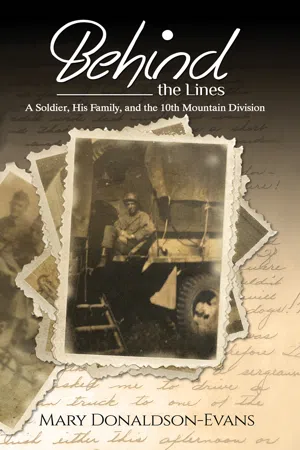
Behind the Lines
A Soldier, His Family, and the 10th Mountain Division
This book is available to read until 4th February, 2026
- 188 pages
- English
- ePUB (mobile friendly)
- Available on iOS & Android
eBook - ePub
Available until 4 Feb |Learn more
About this book
The year 2020 marks the 75th anniversary of the German surrender in World War II. The 10th Mountain Division, the army's first mountaineering unit, led the Allies to victory in Italy in 1945. Their soldiers are often celebrated for their heroism and ingenuity and remembered for their steep losses in the campaign to defeat Nazi Germany. Yet it has been estimated that no more than 14% of troops overseas in World War II ever saw combat.
Behind the Lines is the story of a 10th Mountain Division soldier from the other 86%, someone who toiled to deliver munitions and supplies to troops on the battlefront and who documented his experiences in letters home to his wife in Minnesota. Narrated by the soldier's daughter who, some 70 years later, finally read the correspondence between her parents and became acquainted with them as they were when she was a baby, the experiences of this soldier and of the wife he left behind reveal the day-to-day challenges of their plight, the tensions but also the unexpected rewards of their situation, and the all-too-common prejudices of a tumultuous era often dubbed 'heroic'. Behind the Lines mines the correspondence to describe the anguish and the longing of a young couple separated by a war that would change the course of modern civilisation.
Frequently asked questions
Yes, you can cancel anytime from the Subscription tab in your account settings on the Perlego website. Your subscription will stay active until the end of your current billing period. Learn how to cancel your subscription.
No, books cannot be downloaded as external files, such as PDFs, for use outside of Perlego. However, you can download books within the Perlego app for offline reading on mobile or tablet. Learn more here.
Perlego offers two plans: Essential and Complete
- Essential is ideal for learners and professionals who enjoy exploring a wide range of subjects. Access the Essential Library with 800,000+ trusted titles and best-sellers across business, personal growth, and the humanities. Includes unlimited reading time and Standard Read Aloud voice.
- Complete: Perfect for advanced learners and researchers needing full, unrestricted access. Unlock 1.4M+ books across hundreds of subjects, including academic and specialized titles. The Complete Plan also includes advanced features like Premium Read Aloud and Research Assistant.
We are an online textbook subscription service, where you can get access to an entire online library for less than the price of a single book per month. With over 1 million books across 1000+ topics, we’ve got you covered! Learn more here.
Look out for the read-aloud symbol on your next book to see if you can listen to it. The read-aloud tool reads text aloud for you, highlighting the text as it is being read. You can pause it, speed it up and slow it down. Learn more here.
Yes! You can use the Perlego app on both iOS or Android devices to read anytime, anywhere — even offline. Perfect for commutes or when you’re on the go.
Please note we cannot support devices running on iOS 13 and Android 7 or earlier. Learn more about using the app.
Please note we cannot support devices running on iOS 13 and Android 7 or earlier. Learn more about using the app.
Yes, you can access Behind the Lines by Mary Donaldson-Evans in PDF and/or ePUB format, as well as other popular books in Scienze sociali & Biografie nell'ambito delle scienze sociali. We have over one million books available in our catalogue for you to explore.
Information
Chapter 1
Love in the Time of War
“I’ve seen better legs than that on a turkey!”
Poor Dad. Of all the comments he made to our mother during the fifty-plus years of their married life, that’s the one that first comes to mind. We—my husband and I, our young children, and my seventy-something parents—were scrambling over rocks on the North Shore of Lake Superior, and Mom was wearing what we used to call pedal pushers, those casual pants that come just below the knee. Maybe, as an older woman with a fine network of veins in her legs, she should have put on long pants. However, it was a hot day. Mom’s embarrassment about her unattractive legs took second place to her desire to be comfortable. She’d only be with family, after all. Dad was just trying to be funny, but the insult must have stung.
* * * * *
Scroll back, way back, to the war letters. Here I discover a very different relationship between my parents.
On September 13, 1943, just over two months shy of his thirty-third birthday, Dad receives a dreaded missive from the Selective Service Administration: Uncle Sam wants him. Less than three weeks later, on October 5, he boards the bus in Duluth, Minnesota. Destination: Saint Paul, where he is to report for duty at Fort Snelling. Leaving behind his twenty-eight-year-old wife and me, their almost nine-month-old daughter, Dad is sick with grief and fear, emotions that will be palpable in his letters to Mom and in Mom’s letters to him. It is at Fort Snelling that his twenty-two-month correspondence with Mom begins. Their letters—while not love letters in the conventional sense—throb with the longing of a forced separation that had no end in sight. The allusion, in this chapter’s title, to Gabriel García Márquez’ famous novel, Love in the Time of Cholera, is not gratuitous. For while magical realism plays no role here, and while love and war are not conflated, as are love and cholera in the Colombian novel, there can be no doubt that the latter influences the former and that the role of patience is paramount.
Dad hasn’t been in the army for a week when he writes from Fort Snelling: “I’m so darn lonesome for you and the baby—I always will be until this thing is over, and I hope that’s soon.”
Dad’s hope will not be realised.
The war in Europe will drag on for another year and seven months. And it will be nearly three months after victory is declared on May 8, 1945, before Dad will be shipped home from Italy. During this period, he writes daily letters, usually addressed to “Dearest Lillian and Mary” and signed with “Loads of love and kisses”. Sometimes he feels more fatherly than husbandly. On those occasions he addresses his letters to “Dearest Mommy and Daughter” and the love and kisses come from “Daddy”. Most of the letters are practical and informative: He writes about guard duty and KP (‘kitchen police’ duties such as washing dishes, food prep, etc.), the proper way to make a bed, what he had for dinner. He makes requests (most often for candy, flints for his cigarette lighter, ink for his pen) and he gives lots of instructions to Mom, advice about everything from handling the finances to dealing with the relatives. He writes endlessly about me: “She is in my heart along with you at all times.”
Dad is not discharged until December 1, 1945. The pain of the long separation is relieved briefly by several weekend furloughs in 1943 and 1944 and by a two-month period (December 5, 1943 to February 3, 1944) during which Mom manages to land a nursing job in a hospital in the mid-sized town (fewer than 30,000 people in 1943) of Lawton, Oklahoma, right next to Fort Sill, where Dad is stationed. The rest of the time they have to be content with letters and phone calls, packages and pictures.
The phone calls leave a lot to be desired.
Dad tends to prefer operator-assisted person-to-person calls to the cheaper station-to-station calls. Person-to-person calls, in which the caller is charged only if a specified person is available at the other end, are popular during this era when long distance phone calls are expensive. But there are frustrations. Sometimes Mom and Dad get their wires crossed and miss each other; other times Dad has to wait hours for the call to go through. The connection is often poor, and the time is sharply limited.
“Here I am, sitting on pins and needles in the Recreation Hall waiting to get a call through to you,” he writes at 2:20 p.m. on November 14, 1943, just over a month in. “I am calling person-to-person, so if you have gone to work, they will probably reach you at the hospital. I placed the call at 11:20 this a.m., and then went back to dinner. The operator said it would take from one to two hours. She is goofy as it’s been 3 hours already and still no connection. I’m going to use the money you sent me to pay for the call. It costs $2.45 for person-to-person for 3 minutes. I’d give anything to hear your voice for just a minute though, Darling.”
He aches for the sound of her voice! He calls her ‘Darling’. He’s willing to spend a lot of money to get through to her: In 1943, $2.45 had the buying power of $36.69 in 2020. For Dad, separation from Mom was clearly intolerable from the beginning, despite his apparent inability to express the depth of his feelings.
Now Mom, she’s another story. In contrast to Dad, she is unreserved in her letters, at times a bubbling well of passion! And this brings me to another problem with phone calls. Sometimes it’s hard to control your emotions. Dad reproaches Mom for this: “I don’t like to hear you carry on when I call you, honey. Better not do it again or I’ll be real mad. So keep your chin up and all will come out OK.”
Dad’s threat notwithstanding, Mom has a hard time keeping her composure on the phone. From Fort Meade, Maryland, just one month before he’s shipped out to Italy, Dad writes: “But gee, you make me feel bad when you let your voice get shaky, honey. I could tell that you were about to cry again. And you know how that hurts me when you let yourself go to pieces like that. Please don’t do it again cause one of these days I’ll get real mad about it.”
Now, Chuck and I know a thing or two about Dad’s anger. He had a terrible temper, and even a small incident could trigger it. Sometimes, at the dinner table, he’d spill his milk. (Dad always drank a tall glass of milk with his dinner.) It was never his fault when he spilled something. Someone else—usually one of us kids—made him do it. He would leap up from the table and carry on as if his glass had been filled with liquid gold and it had seeped through the floorboards. At such times, we’d stay out of his way while Mom cleaned up the mess. Dad wouldn’t usually administer an actual spanking for spilled milk, but he might give us a smack across the rear if we were too close.
So, when Dad writes, “I’ll get real mad about it,” what exactly does he mean? How will he express his anger when he’s hundreds of miles away? Shout? Hang up on her? Refuse to call again? Stop writing letters?
Oh Dad, you paper tiger, you!
Dad’s letters don’t exactly burn with unquenchable passion. His love for Mom sounds more practical than sentimental. He needs Mom, and she fulfils his needs. “When I was feeling so sick today, I thought of how nice it would be to have you with me,” he writes from Italy in August 1944. Mom was a nurse, after all!
I’m not denying a physical dimension to Dad’s appreciation for Mom. He props her photo up in front of him when he writes and shows it to all his buddies, understandably proud to have snagged a woman as beautiful as Mom for his wife. Standing less than five feet tall, with large hazel eyes, a small nose and a beautiful smile, Mom was the perfect counterpart for Dad, with his short stature, his good looks and his full head of (prematurely) grey hair. Dad expresses relief when Mom tells him that she didn’t let herself be persuaded to cut her long brown hair. For now, at least, she can wear her proper little bun under her nurse’s cap by day, and Dad understands that when he returns, she’ll still be able to let down her hair by night. He doesn’t appear overly concerned when she tells him she’s gained weight, which for him means that she’s probably twenty pounds over her ideal weight of 112 lbs. “I’ll still love you even though you are an armful!”
Young kids are often repulsed by the thought of their parents’ sensuality. Not us. We’re old enough to be captivated. We’re amused when we read that Dad was jealous because Mom had befriended the wife of her old boyfriend, tickled when he tells her not to “get too friendly with the bus drivers” who take her to and from work, delighted when he promises her that he’s going to go to bed early so as to dream of her.
When words fail Dad to express his love for Mom, he sends gifts—lilies at Easter, chewing gum whenever he can get his hands on it, a cameo brooch when, in August 1944, he has a chance to do some shopping in Pompei (a tourist town known more for the ancient ruins of Pompeii than for jewellery stores). However, the most touching anecdote involves a trip to Venice where Dad buys a one-of-a-kind china cup and saucer for Mom. He’s overwhelmed by the crowds in Saint Mark’s Square: “People are walking and running in all directions. Now, darling, just picture me walking around with that cup and saucer, waiting for someone to bump into me and knock it out of my hands. I was really guarding it with my life as I paid too much for it to have it smashed before I got back to camp.”
I find this image particularly poignant: an American GI, jostled on all sides, trying to cross the bustling Piazza San Marco while cradling a fragile gift in his arms.
In uniform or in civvies, there was something boyish about Dad, a slight man (only 5' 7" tall and 130 pounds). Indeed, when I read between the lines of Dad’s letters, I discover that his love for Mom at times seems more filial than conjugal. I need to remind myself that this self-described ‘Momma’s Boy’, the second-to-youngest son in a large family, had lost his mother just two years previously. Dad didn’t get married until he was 29 years old, unusually late in that era (if not in our own). It wasn’t that he didn’t have girlfriends—he did, for he was charming—but rather that Mom was the first woman who really stole his heart. He met her at St. Mary’s Hospital where he was visiting his younger brother, Ray, who had fallen from a roof. Dad took one look at the petite nurse taking care of his brother and he was smitten. Mom, for her part, was five years younger than Dad, but because she had scoliosis and was thus ‘flawed’ in her view, she was convinced that she would never marry. She was wrong. If anything, her condition won for her a husband who, always solicitous, would scrub the kitchen and bathroom floors for her, on his hands and knees, throughout their married life. Mom’s spinal curvature may have marred her otherwise flawless beauty, but it was scarcely noticeable, as she dressed to camouflage it, and she had her nurses’ uniforms specially tailored to accommodate her irregular figure. A can-do woman, she was independent and headstrong, and these qualities too undoubtedly drew Dad to her. Unfortunately, as the following passage illustrates, he was somewhat prosaic in expressing his love for her:
“Yes, darling, you and Mary are my best and only girls. There will never be any others, I assure you. So far, I haven’t even seen a decent looking one in these parts. The best friend I have in the world besides you two is my helmet now. I use it to carry water, to wash and shave in, to wash clothes in, to sit on at the movies and other times during the day, also as a candle holder and most important as a lid.”
I wonder how Mom felt as she read that. It’s not every lover who puts his beloved on the same plane as a helmet. A rose, maybe, but a helmet? Move over, Elizabeth Barrett Browning!
So much for Dad as a young lover. Perhaps his letters were reserved because he had doubts about the privacy of military mail? Mom, on the other hand, whose letters, like Dad’s, would have been subject to censorship once Dad left the United States, is not intimidated, and this holds true from the beginning. She actually alludes on several occasions to carnal relations. On March 23, 1944, she teases Dad: “I could stand a lot of ___ and loving tonight.” That little blank, so quaint today when four-letter words once considered taboo are sprinkled liberally throughout speech and writing, doesn’t mystify us, and we have no trouble deciphering her message.
She is more obvious in the letter she writes in April 1944. Looking forward to Dad’s last second-to-the-last furlough, before he’s shipped out to Italy, Mom hints that from the point of view of her menstrual cycle, the timing is good: “For once in my married life—the dates … are okay for me. Understand, honey? I don’t feel so good today, but I’ll feel wonderful by Saturday night, darling.” A few months later, she writes to him in Italy, telling him that when he gets home, “you’re going to get so much loving. I’ll bet you’ll get more tired than me (haha).” He would have a long time to prepare for that exciting reunion. A year later, Mom is still waiting. In a letter that burns with frustrated desire, she describes a movie outing with her female friends:
“Last night, Mabel, Connie and I went to the show, ‘Thrill of a Romance’ with Van Johnson. Golly, it was so darn good we sat through it twice. You know, darling, mushy etc. Guess we all realized what we’ve been missing. …Van Johnson lit a spark inside us, as we sure wanted you guys badly last night.”
What Mom doesn’t mention is that the film that so moved her and her friends, the eighth highest grossing film of 1945, also featured Esther Williams, one of her favourite actresses. Many scenes were shot in the water. Small wonder that Mom, who loved to swim, was enthralled by this tale of a swim instructor who falls in love with a war hero. Her letter, sent after Dad was shipped home, is marked “Return to Sender” so we have to imagine Dad reading it with Mom by his side. Did he snatch her into his arms, his ardour fuelled by the tender sentiments expressed in the letter? Or had the thrill of his return worn off by the time the letter arrived?
It’s rather ironic to think that Mom would reveal her erotic desires in her letters, because the woman Chuck and I remember was sometimes rather cold. While Dad and his big kiss-on-the-lips family were boisterous and demonstrative, Mom was not one for extravagant displays of affection. How many times did we hug her, only to have her stiffen beneath our embrace? Admittedly, we may have been trying to win back her affection after doing something stupid or naughty, but the situation must have occurred often enough to leave a lasting impression.
But her affection for Dad, during the war years, now that was unmistakable. Mom’s nearly illegible scrawl hides some powerful emotions. Whereas Dad’s paternal love often seems equal to his affection for his wife, Mom has clear priorities. She’s determined to work in Lawton to be near Fort Sill. On October 17, 1943, she writes:
“I keep thinking that in only another month, I’ll be with you. I have definitely made up my mind, honey. I want to be with you as much as I can. Of course the baby too, but she’s so small that she won’t mind too much.”
Ten days later, she comes back to the same theme, pretending to be subordinate but hinting of a defiance that came to define her:
“I’ll be greatly disappointed if you tell me not to come, but whatever you say of course goes. Honey, I try to get adjusted, but I just can’t. It seems like if I have to choose between you and the baby right now, I want to be near you. She’s so good and healthy and fine wherever she goes that she wouldn’t miss me for a while…all I do is think how I can manage being nearer you!”
The fact that she’ll be missing her baby’s first Christmas does not deter her, for her parents will step in, and the baby (she thinks) will be none the wiser. “I said that our Xmas was just you and I being together. Mary will have so many things she won’t mind you and I not being there this year.”
Dr Benjamin Spock’s Baby and Child Care was not to be published until 1946, but clearly, Dr Spock’s theories on toughening up babies and making them independent were already in the air. Mom, at any rate, was not a coddler. But shunting off baby to grandparents for two months before she’s yet a year old? What would modern child psychologists think about that? For at least the last several decades, experts have insisted on the importance of the first twelve months of a baby’s life and the lasting effects of maternal deprivation, ideas not yet articulated in 1943. While it’s true that normal rules do not apply during wartime, it’s hard to imagine modern parents sending their first child to the grandparents’ house to celebrate her first Christmas and her first birthday without them.
I once heard, from the pulpit, a sermon on the theme of parenting. The priest maintained that the greatest gift that parents could give their children was not their love for them but their love for each other.
Maybe Mom was right after all.
She expresses her love for Dad not only by her words but by her actions as well. When he leaves for Fort Snelling, she tucks little love notes throughout his duffle bag. A week after he’s joined the army, he writes that he’s “still finding notes in my sewing kit”.
She sleeps on his pillow at night and talks to it and kisses it so much that she’s “afraid I’m going to have to get a new pillow for you when you return”. She draws lips filled with x’s on his letter. One Sunday morning when she’s feeling blue, she gets a phone call from Dad and it makes her so happy that “I just kissed and kissed and hugged Mary after you called. Poor thing, she didn’t know what it was all about”. She sends him greeting cards that have loving messages on them. And she bakes him lots of soldier cookies (more about that later).
But young lovers also fight, and Mom and Dad are no exception. They fight about Mom’s working, about the imperious tone of one of Dad’s requests, and about whose suffering is more acute. In one of those “you think you’ve got it bad” letters, Dad writes of his discouragement and solitude, co...
Table of contents
- Behind the Lines
- About the Author
- Dedication
- Copyright Information ©
- Acknowledgement
- Prologue
- Introduction: The Discovery
- Chapter 1 Love in the Time of War
- Chapter 2 Missing Baby
- Chapter 3 Bad Habits
- Chapter 4 Keeping the Faith
- Chapter 5 The Pens of Our Father
- Chapter 6 No Place Like Home
- Chapter 7 The Home Front
- Chapter 8 Prejudice Overcome? Meeting the Other
- Chapter 9 Dad and the 10th Mountain Division
- Chapter 10 After the Letters: A Son Remembers
- Chapter 11 Following Dad: A Daughter’s Pilgrimage
- Appendix: Photos