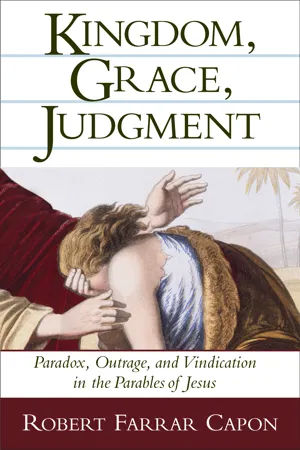
eBook - ePub
Kingdom, Grace, Judgment
Paradox, Outrage, and Vindication in the Parables of Jesus
- 531 pages
- English
- ePUB (mobile friendly)
- Available on iOS & Android
eBook - ePub
Kingdom, Grace, Judgment
Paradox, Outrage, and Vindication in the Parables of Jesus
About this book
Here in one volume is Robert Farrar Capon's widely praised trilogy on Jesus' parables —
The Parables of the Kingdom, The Parables of Grace, and The Parables of Judgment. These studies offer a fresh, adventurous look at all of Jesus' parables, treated according to their major themes. With the same authorial flair and daring insight that have earned him a wide readership, Capon admirably bridges the gap between the biblical world and our own, making clear both the original meaning of the parables and their continuing relevance today.
Information
CHAPTER ONE
Introduction
A PARABLE OF THEOLOGY AND FAITH
I know it is a risky thing to begin a book on Jesus’ parables of grace with a parable of my own on the perils of theologizing; nevertheless …
A certain couple once built a house. They set it on solid foundations and made it proof against all weathers. But in their haste to take up occupancy, they made no provision for access to the front door. To enter, they simply leaped up onto the doorsill and yanked themselves in. As they began to feel more at home, however, they decided to make their comings and goings more convenient. First, they built a short flight of steps. These served well for a while, but eventually they replaced them with a small, plainish porch on which they could sit and contemplate the excellences of their house. In good weather, they even entertained friends there with wine, cheese, and conversation.
Soon enough, though, they tore down this first porch and built a much larger one. They gave it a roof supported by carpenter gothic columns; they surrounded it with intricate railings; they provided it with a wide, low-pitched staircase; and they decorated it everywhere with gingerbread ornamentation.
Many years passed, during which they enjoyed both the porch and the house. But then, on a cold and stormy night, the woman came to the man as he sat by the fire and shook a sheaf of bills in front of him. “Have you ever considered,” she said annoyedly, “how much we spend on the upkeep of our porch? For something that’s usable only four months of the year — and not even then, if one of us is sick — the cost-benefit ratio is appalling. Between the dry rot and the peeling paint, not to mention the lawsuit your friend Arthur brought against us when he caught his ankle in the gap left by those missing boards, it’s more trouble than it’s worth. Tear it down and let’s go back to the way we started: no porch, no steps, no nothing; just up into the house by one leap.”
My parable, obviously, is about the relationship between faith and theologizing. Equally obviously, it is more an allegory than a parable; but since even Jesus allowed himself a number of such simple, this-stands-for-that stories, let it pass. My point in starting with it is to put what I am up to in this book into perspective. The house in which the couple lived represents faith — the simple act of deciding to trust Jesus (and, consequently, Jesus’ words as we have them), no matter what we, on any given day or in any given intellectual weather, may happen to think about them. On the other hand, the various accesses, plain steps or fancy porches, that they added to their house stand for our attempts at theologizing — that is, for any and all of the explanations we come up with when we try to render our house of faith more intelligible, more attractive, or more acceptable to the intellectual tastes of our neighbors or friends.
Inevitably, any author who tries to interpret Jesus’ parables will spend most of his time on the porch. He will, of course, take it for granted that there is a house of faith to which the porch should remain firmly attached, and he will, if he is wise, make it clear that only the house can provide a completely safe place in which to live. Nevertheless, since the woman in my parable came to such a dim view of porches, a few comments on her objections would seem to be in order.
It is tempting simply to agree with her. So much of what both the world and the church consider to be the essential message of the Gospel is simply interpretation. It is generally assumed that Christianity teaches that people cannot be saved unless they accept some correct, or at least some Official Boy Scout, understanding of what Jesus did or said. Take the atonement, for example — the scriptural insistence that our sins are forgiven by trusting a Jesus who died on the cross and rose from the dead. The usual view is that this trust inevitably involves accepting some intellectual formulation of how Jesus’ death and resurrection could possibly have achieved such a happy issue out of all our afflictions. You know: he was able to bring it off because he was both God and man and so could bridge the gulf that sin had put between the two; or, his death was effective because it was a ransom paid to the devil; or, it did the job because the power of his sacrificial example softened even hard hearts and moved people to better behavior; or, his resurrection solved the problem of sin because it brought about a new creation in which sin had no place. The point is not whether any of those interpretations is true, or even adequate (some are more so, some less); it is that none of them is strictly necessary for laying hold of the atonement Jesus offers. All you need for that is to believe in him — to say “Yes, Jesus, I trust you,” as opposed to “No, Jesus, get lost.” Your subsequent understanding of how such a simple yes can do so vast a work may make you glad, sad, scared, or mad; but in no case can it be what saves you — or, for that matter, condemns you.
This distinction needs to be applied just as much to the words of Jesus as it does to his works. People tend to think that unless they can arrive at some satisfying interpretation of this parable or that, the parable in question may safely be left out of account. But just as the work of Jesus (say, in his death and resurrection) has whatever effect it has quite independently of the theologies we happen to hammer onto it, so Jesus’ words — simply because they are Jesus himself speaking — have whatever power he has, no matter what we may think about them. His parables are not so much word-pictures about assorted external subjects as they are icons of himself. Like good poems, they not only mean, but be: they have a sacramental effectiveness. Whether we “get” them or not, therefore, they remain first and foremost his way of getting to us. They are lights shining out of the house of faith itself, inviting us home. What we do with them as we sit out on the porch of interpretation may make us appreciate them more or less, but it cannot damage the lights, and it certainly doesn’t turn them off.
As an instance of how all this applies in practice, consider how it corrects a misconception of what we commonly call the teaching of the faith. Christian education is not the communication of correct views about what the various works and words of Jesus might mean; rather it is the stocking of the imagination with the icons of those works and words themselves. It is most successfully accomplished, therefore, not by catechisms that purport to produce understanding but by stories that hang the icons, understood or not, on the walls of the mind. We do not include the parable of the Prodigal Son, for example, because we understand it, nor do we omit the parable of the Unjust Steward because we can’t make head or tail of it. Rather, we commit both to the Christian memory because that’s the way Jesus seems to want the inside of his believers’ heads decorated. Indeed, the only really mischievous thing anyone can do with the Gospel is insist on hanging only the pictures he happens to like. That’s what heresy really is: picking and choosing, on the basis of my interpretations, between the icons provided to me. Orthodoxy, if it’s understood correctly, is simply the constant displaying of the entire collection.
Still, interpretation, like porch-building, is practically inevitable. We are, after all, thinking beings, and we think about everything we do, up to and including the act of faith: almost no one lives out an entire lifetime simply by leaping into the ungarnished doorway of the house of faith. Accordingly, the woman in my parable was advocating a rather more austere lifestyle than most of us are in fact willing to put up with. Let’s see, then — assuming that her husband took exception to her comprehensive demolition plans — what might be said for his more tolerant view of the situation.
No doubt he would begin by conceding her valid points: first, that a porch is no place to live; second, that porch-builders often betray a taste for the rococo; and last, that porches rot faster than houses. The work of theological interpretation has the same drawbacks. To begin with, it is mostly just a fun thing to do in good company on a warm afternoon when your kidney stones are not acting up. If it is taken much more seriously than that — if it is seen as the center from which life derives its meaning — it will fail us in precise proportion to our need to make it succeed. In all of us, there are doubts and despairs (to paraphrase Auden) smoldering at the base of the brain; everyone who rests his life on his ability to hold his world together by an intellectual synthesis runs the risk that someday, years hence perhaps, the doubts will suddenly “blow it up with one appalling laugh.”
Likewise, theological thought has a penchant for elaborating itself beyond not only sense but good taste. Once someone devises a system or theme for building the porch to his faith, the temptation is to continue the work of construction whether it serves the purposes of the house or not. Hence all the theologies that manage to take the Gospel of grace — of forgiveness freely offered to everyone on the basis of no works at all — and convert it into the bad news of a religion that offers salvation only to the well-behaved. Hence, too, all the moralistic interpretations of the parables: sermons on the duty of contentment from the Laborers in the Vineyard, and little lessons in loveliness from the parable of the Good Samaritan.
Finally, all systems of theological interpretation, plain or fancy, rot out at an alarming rate. Unlike the house of faith, they are exposed to the wind and weather of prevailing opinion. Even if a theologian never once doubts anything about his system, it remains endlessly vulnerable to scorn, ridicule, or just plain disinterest from the outside. The sheer labor of keeping up with the repairs necessitated by such forces has kept more theologians than one from ever spending as much as a single night under a snug roof.
Still, having made those concessions, the man in my parable would insist that porch-building, whether it is inevitable, worthwhile, tasteful, expensive, or not, is a fact. Most people who have faith have some intellectual structure tacked in front of it. But precisely because that is true, those who invite others to visit or to stay in their house of faith are faced with a difficulty: the only way to get guests to the door is to walk them across the porch. Theologizing may not be a saving proposition, but it lies between almost everybody and the Saving Proposition Himself.
Accordingly, he would point out that there is something to be said, no matter how much or how little porch you have on your faith, for keeping that structure as attractive and sound as you can. Its uprights should be set solidly on concrete Gospel footings. Its stringers — the principal interpretative devices by which the flooring is held up — should be made of something scripturally sound, not of humanistic balsa wood or used timbers from someone’s old, collapsed theological building. Above all, its floorboards must be all in place and all nailed down tight. It will not do for anyone to leave spaces in the decking — to install only the scriptural boards he likes and to omit those he doesn’t. A theological porch must include every side of every scriptural paradox. A system, for example, that is all love and no wrath is no better than one that is all wrath and no love. In either case, the unsuspecting guest is liable to break an ankle because of what was left out.
But enough. My parable was as much, or more, for me as for you. If you will try not to insist that my porch be exactly like yours, I shall resist the temptation to force mine on you. All I really care about is that both our structures have no missing boards. So for now, come up on my porch and have a seat. Here begins the work of interpreting the parables.
CHAPTER TWO
Death and Resurrection
THE TOUCHSTONE OF THE PARABLES OF GRACE
On the principle that the simplest plan is the best, I propose to deal with the parables of Jesus in the order in which they occur in the Gospels of Matthew, Mark, and Luke. Naturally, this requires that the discrepancies in these accounts — their sometimes differing sequences of events and materials — be harmonized into a single order; but rather than invent a harmony of my own, I shall take the liberty of adopting the numbering system for Gospel passages devised by Kurt Aland in the Greek-English edition of the Synopsis Quattuor Evangeliorum (United Bible Societies).* Beyond that, there are only a few other housekeeping details to be noted. I shall be working from the original Greek, principally from the text employed by Aland in the Synopsis but also from the second edition of the Aland, Black, Martini, Metzger, Wikgren text, from the twenty-second edition of the Nestle text, and from the Schmoller Concordance. The translations offered will be largely my own, but they will take into account the versions I habitually consult, namely, the King James Version (KJV), the Revised Standard Version (RSV), Today’s English Version (TEV), the New International Version (NIV), and, to a lesser degree, the Clementine Vulgate (VgCL), the Jerusalem Bible (JB), the New English Bible (NEB), and the New Testament in Modern English by J. B. Phillips (JBP).
Looking at Jesus’ parables as a whole, I find that they can be divided into three consecutive groups. The first group consists of what I call the parables of the kingdom, namely, the parables that occur in the Gospels prior to the feeding of the five thousand (that is, before Matt. 14, Mark 6, and Luke 9). I have already dealt with these in The Parables of the Kingdom. The second group, which I shall call the parables of grace, includes all the parables, acted as well as spoken, that the Gospel writers place between the feeding of the five thousand and the triumphal entry into Jerusalem (the latter occurring at Matt. 21, Mark 11, and Luke 19). The final group, the parables of judgment, consists of the remaining parables, almost all of which the Gospel writers place between the triumphal entry and the beginning of the passion narrative (at Matt. 26, Mark 14, and Luke 22).
While all such divisions are to some degree arbitrary, it seems to me that this one has the merit of relating Jesus’ parables to the development of his thought about the nature of his messianic mission. Consider, for example, my choice of the feeding of the five thousand as the point of transition from the parables of the kingdom to the parables of grace.
At the beginning of his ministry, Jesus presents himself as a fairly standard-issue messianic claimant. He exorcises demons, he gives sight to the blind, he makes the lame walk, he heals lepers, he restores hearing to the deaf, he raises the dead, and he proclaims good news to the poor. Not only that, but he teaches as one having authority in himself, and not as the scribes and Pharisees. In short, he appears as the kind of wonder-working rabbi to whom at least the common people flock enthusiastically. Even at this early stage, however, he also indulges in certain unmessianic actions that inevitably upset the religious authorities of the day. He breaks the sabbath, he associates with tax collectors and prostitutes, and, in general, he sits conspicuously loose to the law-abiding expectations that the Jewish establishment had for any proper Messiah. Indeed, even before he presents his parables of the kingdom, the Pharisees and the Herodians have already begun to think about killing him (Matt. 12, Mark 3, Luke 6).
Still, there is an element in his thinking — namely, the centrality to his mission of his own death and resurrection — that has not yet been clearly formulated. True enough, the early kingdom parables (especially those that employ the imagery of seed being put into the ground) are not incapable of being given a death-resurrection interpretation; but in telling them, Jesus does not yet seem to be talking about his own dying and rising. These early parables focus chiefly on the paradoxical characteristics of the kingdom; they portray it as catholic rather than parochial, actually present rather than coming at some future date, hidden and mysterious rather than visible and plausible; and they set forth the bizarre notion that the responses the kingdom calls for in the midst of a hostile world can vary from total involvement to doing nothing at all. But these first parables do not, in any developed way, enunciate the paradoxical program by which the kingdom is in fact accomplished, that is, by death and resurrection.
The development of that theme comes, as I see it, only in the parables of grace — and it comes after a series of events and utterances (Aland nos. 144-164) that show Jesus more and more preoccupied with death. Beginning with the death of John the Baptist (Matt. 14, Mark 6; cf. Luke 3), and continuing through the feeding of the five thousand (Matt. 14, Mark 6, Luke 9, John 6), the first prediction of his death and resurrection (Matt. 16, Mark 8, Luke 9), the transfiguration (Matt. 17, Mark 9, Luke 9), and the second prediction of his death and resurrection (Matt. 17, Mark 9, Luke 9), he gradually reaches a clear realization that the working of the kingdom is mysteriously but inseparably bound up with what Luke (9:31...
Table of contents
- Cover
- Title Page
- Copyright
- Contents
- A Word about Parables
- The Parables of the Kingdom
- The Parables of Grace
- The Parables of Judgment
Trusted by 375,005 students
Access to over 1.5 million titles for a fair monthly price.
Study more efficiently using our study tools.
Frequently asked questions
Yes, you can cancel anytime from the Subscription tab in your account settings on the Perlego website. Your subscription will stay active until the end of your current billing period. Learn how to cancel your subscription
No, books cannot be downloaded as external files, such as PDFs, for use outside of Perlego. However, you can download books within the Perlego app for offline reading on mobile or tablet. Learn how to download books offline
Perlego offers two plans: Essential and Complete
- Essential is ideal for learners and professionals who enjoy exploring a wide range of subjects. Access the Essential Library with 800,000+ trusted titles and best-sellers across business, personal growth, and the humanities. Includes unlimited reading time and Standard Read Aloud voice.
- Complete: Perfect for advanced learners and researchers needing full, unrestricted access. Unlock 1.5M+ books across hundreds of subjects, including academic and specialized titles. The Complete Plan also includes advanced features like Premium Read Aloud and Research Assistant.
We are an online textbook subscription service, where you can get access to an entire online library for less than the price of a single book per month. With over 1.5 million books across 990+ topics, we’ve got you covered! Learn about our mission
Look out for the read-aloud symbol on your next book to see if you can listen to it. The read-aloud tool reads text aloud for you, highlighting the text as it is being read. You can pause it, speed it up and slow it down. Learn more about Read Aloud
Yes! You can use the Perlego app on both iOS and Android devices to read anytime, anywhere — even offline. Perfect for commutes or when you’re on the go.
Please note we cannot support devices running on iOS 13 and Android 7 or earlier. Learn more about using the app
Please note we cannot support devices running on iOS 13 and Android 7 or earlier. Learn more about using the app
Yes, you can access Kingdom, Grace, Judgment by Robert Farrar Capon in PDF and/or ePUB format, as well as other popular books in Theology & Religion & Biblical Criticism & Interpretation. We have over 1.5 million books available in our catalogue for you to explore.