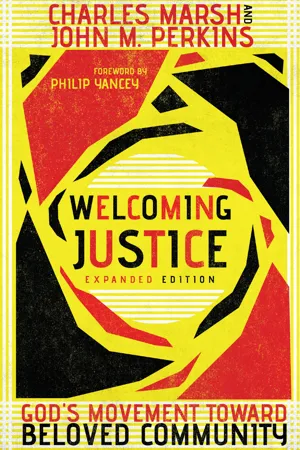
It was not that long ago that African Americans and other minorities were excluded from many spheres of American public life. We have seen remarkable progress in recent decades toward Martin Luther King Jr.'s dream of beloved community. But this is not only because of the activism and sacrifice of a certain generation of civil rights leaders. It happened because God was on the move.Historian and theologian Charles Marsh partners with veteran activist John Perkins to chronicle God's vision formore equitable and just world. They show how the civil rights movement was one important episode in God's larger movement throughout human history of pursuing justice and beloved community. Perkins reflects on his long ministry and identifies key themes and lessons he has learned, and Marsh highlights the legacy of Perkins's work in American society. Together they show how abandoned places are being restored, divisions are being reconciled, and what individuals and communities are now doing towelcome peace and justice. The God Movement continues yet today. Come, discover your part in the beloved community. There is unfinished work still to do.
- 144 pages
- English
- ePUB (mobile friendly)
- Available on iOS & Android
eBook - ePub
About this book
Information
Topic
Theology & ReligionSubtopic
Christian Ministry1
The Unfinished Business of the Civil Rights Movement
CHARLES MARSH

When Martin Luther King Jr. moved to Montgomery, Alabama, in the spring of 1954, civil rights activism was not on his mind. King went to Montgomery because the Dexter Avenue Baptist Church offered a great salary, a comfortable parsonage and a highly educated congregation. The fact that King wasn’t looking to become an activist did not come as a disappointment to the congregation. Dexter Avenue had no interest in hiring a racial crusader. Its members had long prided themselves on their access to white elites and their own relative social privilege. Though they shared a common hope for a future without Jim Crow, they were not going to ignite the fires of dissent.
The day after Rosa Parks refused to move from her seat in the front of the bus, Ralph Abernathy talked King into accepting the leadership of the Montgomery Improvement Association (MIA). But King accepted only after being reassured that the boycott would be over in a day. As president of the MIA, King made clear in his first list of demands, which were presented to National City Buslines, that the protest was not about challenging segregation. The NAACP found his demands so weak that they refused to endorse his list.
At that time, King was no fan of nonviolence either. Glenn Smiley, a white staff member visiting Montgomery with the Fellowship of Reconciliation, claimed to have discovered “an arsenal” in his parsonage.1 “When I was in graduate school,” King had said, “I thought the only way we could solve our problem . . . was an armed revolt.”2
By the end of the second month of the boycott, King had fallen into despair about his leadership and the direction of the boycott. On a gloomy day in January 1956, fearing that he was a complete failure, King offered his resignation as the president of the MIA. It was not accepted, but King’s doubts about his own abilities as a pastor and organizer remained real and unabated.
Later in that month, King returned home to his parsonage around midnight after a long day of organizational meetings. His wife and young daughter were already in bed, and King was eager to join them. But a threatening call—the kind of call he was getting as many as thirty to forty times a day—interrupted his attempt to get some much-needed rest. When he tried to go back to bed, for some reason he could not shake the menacing voice that kept repeating the hateful words in his head.
King got up, made a pot of coffee and sat down at his kitchen table. With his head buried in his hands, he cried out to God. There in his kitchen in the middle of the night, when he had by his own account come to the end of his strength, King met the living Christ in an experience that would carry him through the remainder of his life. “I heard the voice of Jesus saying still to fight on,” King later recalled. “He promised never to leave me, never to leave me alone. No never alone. No never alone. He promised never to leave me, no never alone.”3
In the stillness of the Alabama night, the voice of Jesus proved more convincing than the threatening voice of the anonymous caller. The voice of Jesus gave him the courage to press through the tumultuous year of 1956 to the victorious end of the Montgomery Bus Boycott. More than that, it gave him a vision for ministry that would drive him for the rest of his life.
When the MIA held a weeklong Institute on Nonviolence and Social Change near the end of their boycott, King looked back at their long hard struggle for justice and made clear its ultimate aim. Though a boycott had been necessary to end discrimination in Montgomery, that boycott was not the end. “The end,” King said, “is reconciliation, the end is redemption, the end is the creation of the beloved community.”4
I begin with this remarkable moment from the early days of King’s involvement in the Civil Rights movement because it points us toward the unfinished business of welcoming justice, the theme of this book. King shows us the plot line of the Civil Rights movement. More than that, he points to the very goal of God’s movement in the world. God gathers us into the family of faith not only for our own sake, but also so that we might welcome justice and build beloved communities for the sake of the world. That is the purpose that drives followers of the risen Christ. It is the movement of the Spirit that began at Pentecost and has continued in faithful communities of discipleship throughout every generation. It is the theological vision that we need desperately to reclaim in our time.
A UNIFYING THEOLOGICAL VISION
For more than twenty years now, I have been writing and researching “lived theology,” exploring the way our ideas about God shape our moral convictions and ideas about community, justice and racial reconciliation. This has not been merely an academic exercise for me.
I grew up in the South in the 1960s. In 1967 my family moved from a sleepy town in south Alabama to Laurel, Mississippi, which had earned a reputation as the epicenter of southern terrorism, home to the White Knights of the Ku Klux Klan and their daily installments of misery and violence. My father was a big-hearted son of the Son with his eyes set on denominational prestige, a young preacher at First Baptist Church and cheerfully indifferent to the racial turmoil he was moving his family right into the middle of. The Civil Rights movement, which I observed from various stages of pubescent awkwardness, was our trial by fire.
My dad’s embrace of the reconciling energies of the faith was at first slow and hesitant, though finally it was undeniable. To his congregation of Citizens Councilors and segregationists, he called into question the church’s “closed-door policy” and eventually preached the sermon “Amazing Grace for Every Race.”
In graduate school in the 1980s I was trained in philosophical theology and modern Christian thought. In the early 1990s I found myself teaching at a Jesuit college in Baltimore, writing academic monographs and doing all those things you need to do to get tenure. After finishing a book in 1994 on German theologian and Christian martyr Dietrich Bonhoeffer, I was surprised to discover that my thoughts and dreams, and increasingly my journals and notebooks, were filled with memories of my childhood in the Deep South. I had planned to write a book on the doctrine of the Trinity but was having trouble concentrating on this marvelous sacred mystery.
Though my childhood had been very intense and eventful, the South had changed. I had not thought a whole lot about those years while I was in college or graduate school, but now I could think of nothing else. I became suddenly haunted by the memories of those years. Long forgotten fears became once again vivid and alive; memories burst into consciousness like floodwaters.
So in the summer of 1994—thirty years after Freedom Summer of 1964, when students went to the South to help with voter registration for disenfranchised African Americans—I got in my Honda wagon one morning and headed south, with not much more than a full tank of gas, a microcassette recorder and a credit card. This veering off of the straight and narrow road of my academic training changed my life, and it gently invited me into a different kind of theological education.
I was taught to listen more closely to voices outside the academic guild, to engage the subject with humility but also with courage, to be charitable but not to use a false sense of charity as an excuse for risking the concrete word. I learned that theology needs a place.
The experience also brought home to me, in a particularly intense way, the questions Why am I a scholar? and Who am I serving? “You gotta serve somebody, right?” St. Bob sang. Only my professional colleagues? Or a wider audience of men and women who seek the flourishing of human community, who seek justice and practice mercy, who serve the poor?
Once in an interview, a kindly minister who had been recalling his years as a staff member of the National Council of Churches and his role in the 1965 March on Selma, paused and said, “You know, your generation is a bunch of wimps.” The least I could do—being a wimp and all—was to ask a few hard questions about my own vocation as a scholar and teacher and somehow try to make the connection back to life.
I was able to see too how the Civil Rights movement that took place in the 1950s and 1960s not only changed unjust laws but also brought about a spiritual awakening, and I am further convinced that this story teaches us even today important lessons about what Dr. Perkins called a holistic faith, about the renewal of the church’s mission to take part in the healing of our broken and violent and blistered world. The Civil Rights movement teaches us that faith is authentic when it stays close to the ground. And it reminds us of faith’s essential affirmations: showing hospitality to strangers and outcasts; affirming the dignity of created life; reclaiming the ideals of love, honesty and truth; embracing the preferential option of nonviolence; and practicing justice and mercy.
Until 1964 the Civil Rights movement in the South was unified and sustained by a vision of “beloved community.” King’s speech at the end of the Montgomery Bus Boycott offers us a key to understanding the spirit of the movement. For many people, the movement moved on, served its basic purposes or collapsed in chaos. But for those who understand civil rights to be part of God’s larger movement in the world, the movement continues. This book is about the movement that started with Abraham, captivated America’s attention for a moment in the 1950s and 1960s and still goes on today in countless forgotten places on the margins of our society. It’s about the God movement that is embodied in the lives of John and Vera Mae Perkins.
I am delighted to have the opportunity to write this book with John Perkins. In so many ways, he embodies the best of what I have learned about a theology that participates in God’s peaceable movement in the world. Stories of people like John and Vera Mae offer a wonderful and altogether persuasive response to those who say that Christianity is irrelevant or even harmful to society. We see in their richly lived theology that authentic faith not only heightens our perception of the world; it also provides the resources, the disciplines and the gifts we need to keep our hands to the plow.
My secularist colleagues in the academy are not very convincing on the question of why we ought to love the broken and the outcast and build beloved community. It is all well and good for the brilliant and often helpful theorist Anthony Appiah to advise us to “live with fractured identities; engage in identity’s play . . . recognize contingency, and above all practice irony.”5 But what might it mean to settle down after “identity’s play” has run its course and build community among the hopeless and excluded in places where irony is a condescending shrug?
It is unlikely that anyone has ever read Nietzsche’s The Antichrist or Derrida’s Dissemination and been inspired to open a soup kitchen. It would be wonderful if one did, because the work of justice and mercy needs the energies and talents of compassionate people, believer(s) or not. The Christian should welcome all men and women to kingdom work with a gracious and open heart. And, of course, many people who are not Christians have dedicated time and energy to the pursuit of social justice, from working in soup kitchens to marching for peace—and who knows, maybe even some Nietzscheans and deconstructionists have as well.
Still, my research has shown me that only as long as the Civil Rights movement remained anchored in the church—in the energies, convictions and images of the biblical narrative and the worshiping community—did the movement have a vision. The work of organizing and building communities in distressed and excluded places was about celebrating the common grace of women and men, black and white, the privileged and the poor, who found themselves together, miraculously, in the South, working in common cause for a more just and human social order. To the extent that the Civil Rights movement lost this vision, it lost its way. But where the vision was sustained—in the hundreds of Christian community development ministries inspired by John and Vera Mae Perkins, among other often overlooked places—God’s movement was nourished and flourishes still. Though frequently forgotten by historians and policymakers, God’s movement is the most powerful source of social change in our society.
When you listen to movement veterans tell their stories, you often hear testimonials that have their home in the church. So, as I see it, what’s lost when you strip away the religious conviction is appreciation of those very sources that energize and sustain compassion—and that continue to inspire redemptive action in the world.
Visit a hospitality house, a tutorial program for low-income children, an AIDS clinic, a hunger relief agency, a Habitat for Humanity site, an administrative building where a student group is sitting in support of a living wage for university workers—you will find there people who are moved to act for others, who live passionately into the depths and breadth of the world’s concrete needs because they see a light shining in the darkness; who believe that transcendence empowers rather than diminishes the love o...
Table of contents
- Cover
- Title Page
- Contents
- Foreword to the First Edition
- Preface to the Expanded Edition by Philip Yancey
- 1 The Unfinished Business of the Civil Rights Movement by Charles Marsh
- 2 The Cultural Captivity of the Church by John M. Perkins
- 3 The Power of True Conversion by Charles Marsh
- 4 The Next Great Awakening by John M. Perkins
- 5 God's Movement in the Twenty-First Century by Charles Marsh
- 6 A Time for Rebuilding by John M. Perkins
- Afterword by John M. Perkins
- Acknowledgments
- Study Guide: Questions for Personal Reflection or Group Discussion
- Suggested Reading
- Notes
- Christian Community Development Association
- Praise for Welcoming Justice
- About the Authors
- More Titles from InterVarsity Press
- Copyright
Trusted by 375,005 students
Access to over 1.5 million titles for a fair monthly price.
Study more efficiently using our study tools.
Frequently asked questions
Yes, you can cancel anytime from the Subscription tab in your account settings on the Perlego website. Your subscription will stay active until the end of your current billing period. Learn how to cancel your subscription
No, books cannot be downloaded as external files, such as PDFs, for use outside of Perlego. However, you can download books within the Perlego app for offline reading on mobile or tablet. Learn how to download books offline
Perlego offers two plans: Essential and Complete
- Essential is ideal for learners and professionals who enjoy exploring a wide range of subjects. Access the Essential Library with 800,000+ trusted titles and best-sellers across business, personal growth, and the humanities. Includes unlimited reading time and Standard Read Aloud voice.
- Complete: Perfect for advanced learners and researchers needing full, unrestricted access. Unlock 1.5M+ books across hundreds of subjects, including academic and specialized titles. The Complete Plan also includes advanced features like Premium Read Aloud and Research Assistant.
We are an online textbook subscription service, where you can get access to an entire online library for less than the price of a single book per month. With over 1.5 million books across 990+ topics, we’ve got you covered! Learn about our mission
Look out for the read-aloud symbol on your next book to see if you can listen to it. The read-aloud tool reads text aloud for you, highlighting the text as it is being read. You can pause it, speed it up and slow it down. Learn more about Read Aloud
Yes! You can use the Perlego app on both iOS and Android devices to read anytime, anywhere — even offline. Perfect for commutes or when you’re on the go.
Please note we cannot support devices running on iOS 13 and Android 7 or earlier. Learn more about using the app
Please note we cannot support devices running on iOS 13 and Android 7 or earlier. Learn more about using the app
Yes, you can access Welcoming Justice by Charles Marsh,John M. Perkins in PDF and/or ePUB format, as well as other popular books in Theology & Religion & Christian Ministry. We have over 1.5 million books available in our catalogue for you to explore.