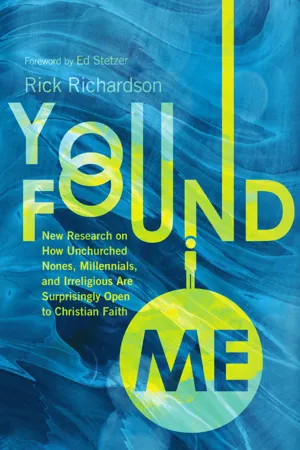
Many bemoan the decline of the church. We hear a steady stream of reports about how droves of people, especially younger generations, are abandoning Christianity. But new research shows that unchurched Americans are surprisingly more receptive and open to the Christian faith than is commonly assumed.
Researcher and practitioner Rick Richardson unveils the findings of the Billy Graham Center Institute's groundbreaking studies on the unchurched. A study of 2000 unchurched people across the country reveals that the unchurched are still remarkably open to faith conversations and the church. Even unchurched "nones" and millennials are quite receptiveif they are approached in particular ways.
In this book you will also find best practices from further research into the top ten percent of churches that most effectively reach the unchurched. People who were previously unchurched share what actually moved them to faith and Christian commitment. And the research shows that churches and organizations can be transformed to become places where conversion growth becomes the new normal.
If people tell you "the sky is falling," don't believe them. In today's troubled world, unchurched and unbelieving people are newly receptive to hearing good news. You can lead the change that will help your church reach people—who then reach others.
I love pastors and leaders of churches, and I also feel their pain and disappointment when things don’t go well. I have been a pastor at various churches for some years, and even when I have not been on staff, I have almost always served as a leader in my church in some capacity. I think of a few of the pastors and leaders for whom I am praying these days. Let me tell you about one of them.
Pastor Nate is a loved and effective pastor. He is there when people are in crisis. He is a good communicator with a warm heart and pastoral understanding in his sermons. He is really likable and liked, even loved.
Nate also has a big heart for reaching people who don’t know Jesus. He is Southern Baptist, after all. Part of why he went into ministry was his heart for neighbors and friends and family members who did not know Jesus. But over the years, the everyday demands of the church ministry he leads pushed out any time he might have had to reach out. He wasn’t sharing his faith with his friends much and had started to give up on even trying, but his church didn’t seem to mind. They liked having Nate all to themselves. Who wouldn’t? Nate would not have put it this way, but his life was a parable of gradual mission drift over years. He had lost some of his passion and almost all of his personal practice of reaching out to people outside the church. His church was not growing, and it was even shrinking some, though not a lot. The church would certainly be able to go on for years, but something central was missing from Nate’s life and ministry, and he knew it.
Lately Nate has been trying to make changes. He started reaching out himself to friends and neighbors. He is meeting with a few other pastors to share stories and keep himself accountable. He has told his elders he wants to change, and he has appointed a woman from his church, Shelley, to help him lead the change and get other people involved in reaching out.
There is a further problem that has derailed the effort. A few months after Nate began to make changes, he discovered that one of his church volunteers had abused kids in Sunday school. He and the church ended up in an article in the local newspaper. His church has had to pay legal fees. They have been caught up in controversy and pain. A few families have left. The staff person who headed the children’s ministry needed to be reassigned. All of Nate’s steps toward growing in outreach have now been swallowed up by the leadership crisis. And Shelley, who has so much passion to help Nate and the church make a difference, is frustrated and feeling helpless.
Nate and Shelley long to see friends and family members come to know God and to connect to a congregation. They long to see their church making an impact in the community. They long to grow as a church by reaching people who are unchurched, but presently these longings are going unfulfilled. Instead, the church is shrinking, the everyday business of the church consumes most of the energy of most of the leaders, and the additional crisis has consumed everything else.
Source: Billy Graham Center Institute and Lifeway Research, Measuring Evangelism in the Protestant Churches Study.
Figure 1.1. Protestant church growth in the United States
Nate and Shelley are not alone. As a whole, the church in America is struggling, and pastors and leaders and church people are feeling it. Eighty percent of all churches in America are plateaued and declining.1 For Protestant churches in America, the numbers are better but still not good. Over the last three years, 59 percent of Protestant churches in America are plateaued or declining.2
In addition, 31 percent are growing but primarily through transfers, which come at the expense of the churches that are declining. Only 10 percent are growing primarily through reaching new people and therefore fit our definition of a conversion community.3
These healthy and vibrant churches are growing; attracting new, unchurched people; and making a difference in their communities. But for most churches, if trends and business as usual continue to characterize the American church context, churches will decline, people will drift away from any congregational involvement, and communities will experience increasing moral and social decline.
What can be done? Is the culture’s drift away from church congregations inevitable?
A Few Good People
There is an intriguing interaction between Abraham and God in Genesis 18:20-33 that has a bearing on the decline of churches in America and what could be done about it. In the passage, the writer reports how God tells Abraham he is going to destroy the cities of Sodom and Gomorrah. Apparently, both cities have become so morally and socially degenerate and so devoid of any redeeming people that they are fit for nothing but destruction. Abraham takes issue with this and argues with God. Summoning his courage, Abraham asks whether God would spare the city if there were fifty righteous people. God says yes. In an odd scene, the two protagonists, God and Abraham, begin the Middle Eastern practice of bartering. Abraham slowly whittles God down to ten. If even ten righteous people can be found, would God spare the city? Yes.
Sadly, not even ten righteous people can be found.
It was not the presence of evil people, unjust relationships, or violence that doomed Sodom and Gomorrah. It was the lack of good people, bonded with one another, working for justice, compassion, and reconciliation. I will come back to this theme several times. The primary problem the church faces is not the shifting or hostile culture around us. The primary problem we face is us. Whenever the church recovers its quality of life and boldness of witness, it grows, even against immense cultural barriers. We can be the ten righteous who catalyze the sparing of Sodom and Gomorrah.
In 1867 British philosopher John Stuart Mill explained, “Bad men need nothing more to compass their ends, than that good men should look on and do nothing.”4 Almost one hundred years later, in 1963, Martin Luther King Jr. echoed that sentiment in his “Letter from a Birmingham Jail” when he wrote, “The ultimate tragedy of Birmingham was not the brutality of the bad people, but the silence of the good people.”5 When good people do nothing, communities deteriorate. Congregations, including Christian congregations, keep communities alive and healthy.
Healthy congregations create communal bonds that build social connections of caring between people. They contribute to their community through civic involvement, social service, and concern for the hurting. Healthy congregations can make significant cultural contributions to communities related to music, or art, or architecture, or practicing positive relational presence. Healthy congregations host volunteer organizations, and members often volunteer for nonprofit service organizations that meet the needs of underresourced people. Healthy congregations reach new people and provide meaning and direction in life to many individuals who otherwise might merely live for themselves.
Consequences of Ineffective Conversion Growth
But most congregations today in America are struggling to be healthy and vibrant, and many are missing the mark. There are numerous consequences.
Pastors and leaders often feel like failures, and their efforts to make a difference feel futile. Pastors often go into ministry to lead a healthy, vibrant congregation that could reach people and influence communities. Instead, too many are presiding over congregations that are shrinking in numbers and impact, and they are often expected to do what feels impossible: turn it all around. Carrying that weight and not achieving success burns out many good people.
I think of Gary, who is a more effective preacher than many and is more loved by his people than most. Despite his gifts and vision, and the work he did over ten years, he watched his congregation go from 900 to 650, losing many leaders and members to the hot new church nearby. Every December he was overwhelmed with a feeling of desperation to meet budget. He knew that if the church didn’t break even, he would have to cut church expenses and fire people, and he was always wondering when the axe might fall on him. Carrying this weight, his morale went down and his preaching suffered. He struggled to maintain his edge and freshness.
Then he entered a downward spiral in his relationship with the worship leader of the congregation. They didn’t see eye to eye. The worship leader had decided that worship needed to be intense and designed for the really strong believers, and he was resistant to making any allowances or adjustments for newer people who were still seeking and merely curious about faith. As a result, the church stopped reaching new people, and church members felt as if they had to choose between the vision of the two leaders. Gary was much more concerned with remaining vibrant through reaching newer people, and the worship leader did not value that effort. In response, Gary asked the board chair whether he could let the worship leader go, as the conflict was undermining trust in Gary’s leadership and unity in the direction of the church. The board chair said no, which left Gary feeling as if he had to choose between fighting and maybe even splitting the church or leaving on a good note, if that were still possible. He chose the latter. He left celebrated and thanked, but he was not interested in further congregational leadership opportunities. He took a different kind of job. Gary had lost hope and energy, and the congregation kept shrinking and turning inward.
Gary is certainly not an extreme example but a fairly typical one. This story represents so many who have lost hope and have left congregational leadership feeling like failures. Often lead pastors are judged on three main criteria: (1) Is the congregation growing? (2) Are we meeting budget? and (3) How was last week’s sermon? By two of the three, most pastors in America feel as though they are not making it. Some feel that they are struggling with all three. Others feel that the list is a lot longer than three!
People without direction and connection stay that way. Most churches are not reaching new people or bringing in fresh vision, gifts, and contributions to the life of the congregation. Most Americans are trending away from congregational involvement. As the papers and studies have touted, the “nones” are on the rise! Nones are people who tell us on surveys that they have no preference for any particular religion and no allegiance to any religious group or organization. They include atheists, agnostics, and “nothing in particulars” on surveys. They are such a significant and growing group of congregationally disconnected people that I devote a major part of a chapter to reaching out to them. They also appear as supporting actors in many other chapters. Pew Research, the gold standard in this kind of research, tells us after surveying thirty-five thousand Americans in 2007 and then again in 2014 that the nones have grown from 16 percent of the population in 2007 to 23 percent of the population in 2014.6 Even more alarming for the future of congregations, the percentage of nones from among older millennials (born 1981–1989) has risen from 25 percent to 34 percent in seven years, and for younger millennials (born 1990 to 1996) has risen to 36 percent.7 Nones are the fastest-growing religious identification in the nation.
Now, let me say, the word nones probably does not mean what you think it means. We will explore how people often misunderstand what nones represent. They are not necessarily antireligious, anti-Christian, or even antichurch. Many are very spiritual, and more of them than you might expect are receptive to congregations and faith conversations. Nevertheless, it is a startling statistic signifying a stunning trend in American society. Churches and congregations are losing their influence and social status for an increasing percentage of Americans, particularly where there are the most consequences for congregations of the future—that is, among emerging adults.
Although I will bring a counterbalancing perspective in this book, we still must face the reality that the number of increasingly alienated people from churches and congregations is growing. Can it be turned around? How much should we in congregations even value connecting with people who feel disinterested or alienated from religious institutions in America?
Jesus consistently valued the alienated and the disconnected most. That was his point in three stories he told about a lost sheep, a lost coin, and a prodigal son (Lk 15). The alienated, those “lost” to religious life in Jesus’ time, were profoundly valuable to Jesus, such that he sought them, loved them, healed them, and confronted every religious person who pushed them away. Congregations seeking to emulate Jesus and his values similarly have to be profoundly concerned at the loss of so many people and so much influence for good in their lives.
Congregations are feeling less and less successful in the mandate Jesus gave them, to make disciples ( followers of Jesus) who make disciples. In other words, at the heart of Christian faith is the generative impulse to develop reproducers, people who come to faith and then pass that faith on to others, who pass it on to additional others. That is the basic pattern for how Christian faith went from being a tiny minority in a backwater country to being the largest religious movement in the world.
Rodney Stark, as a sociologist of religion, documents that growth in his book The Rise of Christianity.8 His study of demographic growth and its cause led him to emphasize the combination of the messa...
Table of contents
Cover
Title Page
Dedication Page
Contents
Foreword - Ed Stetzer
1 Introduction: The Challenge Congregations Face in America
Part 1: Recovering a Missional Imagination for the Unchurched in America
Part 2: Developing Missional Leaders
Part 3: Cultivating a Missional Congregation
Acknowledgments
Appendix 1: Billy Graham Center Resources
Appendix 2: Contributing Research Projects
Notes
Praise for You Found Me
About the Author
More Titles from InterVarsity Press
Copyright
Trusted by 375,005 students
Access to over 1.5 million titles for a fair monthly price.
Study more efficiently using our study tools.
Frequently asked questions
Yes, you can cancel anytime from the Subscription tab in your account settings on the Perlego website. Your subscription will stay active until the end of your current billing period. Learn how to cancel your subscription
No, books cannot be downloaded as external files, such as PDFs, for use outside of Perlego. However, you can download books within the Perlego app for offline reading on mobile or tablet. Learn how to download books offline
Perlego offers two plans: Essential and Complete
Essential is ideal for learners and professionals who enjoy exploring a wide range of subjects. Access the Essential Library with 800,000+ trusted titles and best-sellers across business, personal growth, and the humanities. Includes unlimited reading time and Standard Read Aloud voice.
Complete: Perfect for advanced learners and researchers needing full, unrestricted access. Unlock 1.5M+ books across hundreds of subjects, including academic and specialized titles. The Complete Plan also includes advanced features like Premium Read Aloud and Research Assistant.
Both plans are available with monthly, semester, or annual billing cycles.
We are an online textbook subscription service, where you can get access to an entire online library for less than the price of a single book per month. With over 1.5 million books across 990+ topics, we’ve got you covered! Learn about our mission
Look out for the read-aloud symbol on your next book to see if you can listen to it. The read-aloud tool reads text aloud for you, highlighting the text as it is being read. You can pause it, speed it up and slow it down. Learn more about Read Aloud
Yes! You can use the Perlego app on both iOS and Android devices to read anytime, anywhere — even offline. Perfect for commutes or when you’re on the go. Please note we cannot support devices running on iOS 13 and Android 7 or earlier. Learn more about using the app
Yes, you can access You Found Me by Rick Richardson in PDF and/or ePUB format, as well as other popular books in Theology & Religion & Communication Studies. We have over 1.5 million books available in our catalogue for you to explore.