The Bible admonishes Christians to love God with the mind as well as with the heart.
Engaging God's World clearly links this scriptural mandate with the pursuit of academic life, extolling the crucial role of Christian higher education in the intellectual and spiritual formation of believers.
Chiefly intended to serve as a primer for students beginning college careers but valuable to thoughtful Christians at every stage of life, this volume spells out the central themes of the Christian faith from a Reformed perspective. More important, however, the book shows how Christian higher education fits inside a view of the world and of human life that is formed by these ideas.
"Learning," Cornelius Plantinga writes, "is a
spiritual calling; properly done, it attaches us to God." Approaching the topic of education from a variety of angles, Plantinga shows that Christ-centered learning teaches people to correctly see the world as God's creation, to see providence in history, to handle secular knowledge critically, to develop good judgment and, ultimately, to use faith-filled learning in the service of God's kingdom.
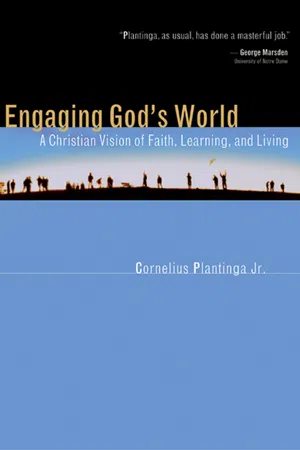
eBook - ePub
Engaging God's World
A Christian Vision of Faith, Learning, and Living
- 170 pages
- English
- ePUB (mobile friendly)
- Available on iOS & Android
eBook - ePub
About this book
Information
Topic
Theology & ReligionSubtopic
Christian Theology1
Longing and Hope

As a deer longs for flowing streams,
so my soul longs for you, O God.
O Israel, hope in the LORD!
Let justice roll down like waters,
and righteousness like an everflowing stream.
“In the last days it will be, God declares,
that I will pour out my Spirit upon all flesh,
and your sons and your daughters shall prophesy,
and your young men shall see visions,
and your old men shall dream dreams.”
In his novel entitled A Separate Peace, John Knowles gives us a memorable character by the name of Gene Forrester. In the summer of his sixteenth year Gene found that his soul was coming to life. During a stretch of glorious New Hampshire weather he would wake up each morning with a rush of feeling so profound that it overwhelmed him:
one summer day after another broke with a cool effulgence … and there was a breath of widening life in the morning air, something hard to describe — an oxygen intoxicant … some odor, some feeling so hopelessly promising that I would fall back in my bed on guard against it. … I wanted to break out crying from stabs of hopeless joy, or intolerable promise, or because those mornings were too full of beauty for me.1
Many people would admit that they have had experiences something like this, and that they have had them especially when they were young. I say people “admit” to their longings because they are often shy about them and don’t speak of them easily. And people have these longings especially when they are young because that is normally a time before we have become jaded.
Not everybody can report times of wanting to “break out crying from stabs of hopeless joy,” but many do know what it feels like to yearn. People yearn for a time gone by, perhaps when their family was still together or when their friends were still in town. Or they long for a certain season, or place, or sound. For example, certain people feel a kind of delicious sadness on what seems to be the last day of summer. In East of Eden John Steinbeck’s narrator says of the Gabilan Mountains that he wanted “to climb into their warm foothills almost as you want to climb into the lap of a beloved mother.”2 Many people know what it’s like to listen to a particular piece of music that, at a certain spot, makes them ache. Mozart and Schubert knew how to touch us in this way, but so do country and western singers, whose music is full of lonesome dreams and broken hearts.

“I have no idea to this day what those two Italian ladies were singin’ about …. I like to think they were singin’ about something so beautiful it can’t be expressed in words, and makes your heart ache because of it. I tell you those voices soared, higher and farther than anybody in a gray place dares to dream. It was like some beautiful bird flapped into our drab little cage and made these walls dissolve away … and for the briefest of moments, every last man at Shawshank felt free.”
Ellis Boyd “Red” Redding3

In several of his writings the Christian author C. S. Lewis explores this phenomenon of human longing or yearning — what the Germans call Sehnsucht (ZANE-zoocht), a word with strong overtones of seeking and searching.4 In thinking about Sehnsucht, Lewis observes that when we have it, we are seeking union with something from which we are separated. For example, we want to be reunited with a happy time or a lovely place or a good friend. We look at a green valley and want to crawl under its covers. We think of a happy home and want to dwell in its center. We keep wanting to “get back” or to “get in.”
What’s remarkable is that these longings are unfulfillable. We cannot merge with the music we love. Nor can we climb inside nature. Nature may delight us beyond telling, as Lewis says, but she cannot open her arms to receive us.5 The same is true of future situations in our lives. We may want a good career or a family or a particular kind of life, and these things may come to us. But if so, they will not fill all our niches because we want more than these things can give. Even if we fall deeply in love and marry another human being, we discover that our spiritual and sexual oneness isn’t final. It’s wonderful, but not final. It might even be as good as human oneness can be, but something in us keeps saying “not this” or “still beyond.” Nor can we go back into our past and steep ourselves in its joys. For one thing, some of its joys weren’t as good as we think. (It’s characteristically human, said Mark Twain, to remember a lot of things that never happened.) In any case, we cannot go back. Nostalgia is a yearning for what is over now. Places change. People change. In fact, we ourselves change enough between September and December of our first year in college that initial homecomings often go somewhat differently from what we might have expected.
“It would seem that Our Lord finds our desires not too strong, but too weak. We are half-hearted creatures, fooling about with drink and sex and ambition when infinite joy is offered us, like an ignorant child who wants to go on making mud pies in a slum because he cannot imagine what is meant by the offer of a holiday at the sea. We are far too easily pleased.”
C. S. Lewis6
The truth is that nothing in this earth can finally satisfy us. Much can make us content for a time, but nothing can fill us to the brim. The reason is that our final joy lies “beyond the walls of the world,” as J. R. R. Tolkien put it. Ultimate beauty comes not from a lover or a landscape or a home, but only through them.7 These earthly things are solid goods, and we naturally relish them. But they are not our final good. They point to what is “higher up” and “further back.”
Perhaps the most powerful thinker among the fathers of the Christian church, St. Augustine (354-430), spent years in search of the final target of human longing. He called it the summum bonum, the “supreme good.” Instructed by such Scripture as Psalm 42 and deeply moved by the tumult in his own soul, St. Augustine finally reached the end of his search. After years of lust (“Grant me chastity,” he had prayed, “but not yet”) and of philosophical exploration, he found the one good that would not fade away, the one good that would not crumble if he leaned on it with the full weight of his love. And so, in a famous prayer at the beginning of his Confessions, Augustine addressed the summum bonum of the world: “O Lord,” prayed Augustine, “you have made us for yourself, and our heart is restless until it rests in you.”8
What Augustine knew is that human beings want God. In fact, humans want union with God: they want to get “in” God, as Jesus prays in John 17:21. Until it’s suppressed, this longing for God arises in every human soul because it is part of the soul’s standard equipment. We have been endowed by our Creator with a sensus divinitatis (a “sense of divinity”), wrote John Calvin, and everywhere in the world, even when it expresses itself as idolatry, the sense of divinity is the seed of religion.9 God has made us for himself. Our sense of God runs in us like a stream, even though we divert it toward other objects. We human beings want God even when we think that what we really want is a green valley, or a good time from our past, or a loved one. Of course we do want these things and persons, but we also want what lies behind them. Our “inconsolable secret,” says C. S. Lewis, is that we are full of yearnings, sometimes shy and sometimes passionate, that point us beyond the things of earth to the ultimate reality of God.11 And summer mornings on which we awaken to “stabs of joy” are clues that this is so.
“Late have I loved you, beauty so old and so new: late have I loved you. … You were with me, and I was not with you.”
St. Augustine10
As a student you may have any of a number of goals for your education. Perhaps one of them should be to expand the number of things that excite your longing. Not just any things. Not just any longing. Not what corrupts or diminishes you as a person made in God’s image. I’m thinking instead of “whatever is true, … whatever is pure, [whatever is] worthy of praise” (Phil. 4:8). I’m thinking of the visual arts, music, drama, landscapes, poetry, and friendships that can arouse human desire for sheer goodness, and finally for the One who is its overflowing fountain.
Longing as an Ingredient of Hope
But does all this talk of longing, and of what it points to, sound a little too romantic or fantastic? Do you find such talk irrelevant to the daily business of studying, making friends, managing your freedom, and working to support yourself?
The answer will depend, I believe, on how much you are a person who hopes. This is because longing is an ingredient of hope. You can hope only for something you want, and if you really want it, you will long for it. It’s true that some of our longings are inarticulate, but others can be stated, especially when trouble intensifies them. Innocent prisoners who appeal their conviction, cancer patients who cling to rumors of experimental cures, persons who love but whose love i...
Table of contents
- Cover
- Title Page
- Copyright
- Dedication
- Contents
- Preface for Students
- 1. Longing and Hope
- 2. Creation
- 3. The Fall
- 4. Redemption
- 5. Vocation In The Kingdom Of God
- Epilogue
- Appendix: Talking Points for Chapters 1 through 5
Trusted by 375,005 students
Access to over 1.5 million titles for a fair monthly price.
Study more efficiently using our study tools.
Frequently asked questions
Yes, you can cancel anytime from the Subscription tab in your account settings on the Perlego website. Your subscription will stay active until the end of your current billing period. Learn how to cancel your subscription
No, books cannot be downloaded as external files, such as PDFs, for use outside of Perlego. However, you can download books within the Perlego app for offline reading on mobile or tablet. Learn how to download books offline
Perlego offers two plans: Essential and Complete
- Essential is ideal for learners and professionals who enjoy exploring a wide range of subjects. Access the Essential Library with 800,000+ trusted titles and best-sellers across business, personal growth, and the humanities. Includes unlimited reading time and Standard Read Aloud voice.
- Complete: Perfect for advanced learners and researchers needing full, unrestricted access. Unlock 1.5M+ books across hundreds of subjects, including academic and specialized titles. The Complete Plan also includes advanced features like Premium Read Aloud and Research Assistant.
We are an online textbook subscription service, where you can get access to an entire online library for less than the price of a single book per month. With over 1.5 million books across 990+ topics, we’ve got you covered! Learn about our mission
Look out for the read-aloud symbol on your next book to see if you can listen to it. The read-aloud tool reads text aloud for you, highlighting the text as it is being read. You can pause it, speed it up and slow it down. Learn more about Read Aloud
Yes! You can use the Perlego app on both iOS and Android devices to read anytime, anywhere — even offline. Perfect for commutes or when you’re on the go.
Please note we cannot support devices running on iOS 13 and Android 7 or earlier. Learn more about using the app
Please note we cannot support devices running on iOS 13 and Android 7 or earlier. Learn more about using the app
Yes, you can access Engaging God's World by Cornelius Plantinga in PDF and/or ePUB format, as well as other popular books in Theology & Religion & Christian Theology. We have over 1.5 million books available in our catalogue for you to explore.