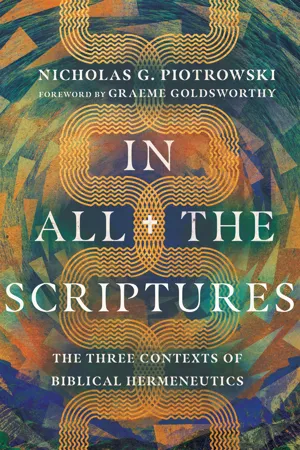
No one reads the Bible without some interpretive principles, or hermeneutics, in place. The question every student of Scripture needs to ask, then, is this: Are yourinterpretive principles and methods legitimate and ethical?
In this accessible introduction to biblical hermeneutics, Nicholas G. Piotrowski presents an approach that explores three layers of context: literary, historical, and christological.Because no text exists in the abstract, interpreters must seek to understand a passage's ecology: the flow and argument of the entire biblical book, the world of the original author and audience, and the movement of redemptive history that culminates in the person and work of Jesus Christ.
Careful interpretation is both a science and an art, Piotrowski argues, and it has powerful implications for what we believe and how we apply God's Word. Featuring numerous examples, further reading lists, and a glossary,
In All the Scriptures equips students, pastors, and thoughtful readers to build a solid foundation for interpreting the Bible.
READING THE BIBLE IS LIKE looking into water. If you have ever stood on the bank of a pond and looked down, you surely noticed two things. For one, you could dimly see into the water and vaguely make out the plants and fish. But also, you saw yourself and the luminous sky above. That combination of the contents of the pond together with the reflection of you and your world delivers this poignant message: you are a part of this ecosystem now. Your presence impacts it. And that affects what you see. It is hard to see past your reflection. But it is possible.
In this chapter I will lay out a concise history of biblical hermeneutics with particular attention to the way interpreters have tried to move from the meaning in the text to its relevance and application in their times. William Yarchin comments that “much of the history of biblical interpretation concerns the question of referentiality in the Bible: to what extent are the texts of Scripture to be read for what they plainly state, and to what extent as figures of something other than their plain reference?” (emphasis original).1
It is at that point that various hermeneutical approaches have been employed to navigate how such figures work, and whether that “something other than their plain reference” is still in line with the plain reference or something truly other. In the end, we will see that there are surer paths to legitimate and ethical interpretation, and the others are distractions. Some provide a clear scope for peering into the pond; others predominantly see the sky above.
If you are not a history buff, please do not be tempted to skip this chapter. I will conclude this historical survey with a very relevant application: an understanding of something called the “hermeneutical spiral.” So hang in there. History will tell us a lot about today. As Gerald Bray puts it, “The Bible has shaped the life of the church in a way that nothing else has done, and Christians today are the product of the history of its interpretation.”2
Alexandria and Antioch (Second–Fifth Centuries)
It might seem logical to start with Jesus or even before Jesus. But I want to save Jesus and his world for the next chapter. Let us begin with the first generation of readers that had a full Bible, after the New Testament had been completed and compiled.3
Jesus’ apostles, who penned the New Testament, seem to have had quite a consistent hermeneutic.4 And the church recognized that the apostles’ authority now resided in their writings (e.g., 2 Pet 1:12-21).5 But by the time they passed from history the church had spread over wonderfully vast distances. By the end of the first century there were Christian communities across North Africa, Asia Minor, and Greece, stretching as far west as Rome and even eastward beyond Roman territory. As would be expected, over such a large area there were different convictions about how to approach interpretation. Sometimes these different convictions were motivated by the varying theological concerns and pressures felt from the surrounding cultures.
Apologists like Justin Martyr (ca. 100–165) were too engaged in speaking up in the face of persecution to give much attention to hermeneutics.6 We see, therefore, in the earliest Fathers a mixed methodology.7 Much was simply literal, but it also had a “Christocentric bias” to it because that is what they saw in the New Testament.8 The result was two approaches to move beyond literal interpretation to transcendent meanings: allegory and typology. In simplest terms, allegory attempts to dig under the straightforward and historical sense of texts to find hidden, mystical meanings. Typology, on the other hand, starts from the historical sense and perceives the way persons, events, and institutions in the Old Testament prefigure the person and work of Christ.
It is not uncommon to see the Fathers blend allegory and typology in an unsystematic way, though Irenaeus of Lyon (ca. 135–200) and Tertullian (ca. 160–220) did recognize the difference and speak against allegory.9 Irenaeus wrote, “By transferring passages, and dressing them up anew, and making one thing out of another, they succeed in deluding many.”10 Instead, “If anyone, therefore, reads the Scriptures with attention, he will find in them an account of Christ, and a foreshadowing of the new calling. . . . He was pointed out by means of types and parables.”11 The coming of the Son provides, therefore, “the explanation of all things” where anything that was hidden is now “brought to light by the cross of Christ.”12 And Melito of Sardis (d. ca. 180) calls Isaac “a type of Him who should suffer”13 and in the exodus and Passover “a preliminary sketch is made of what is to be.”14 But the underdevelopment of hermeneutics in this first generation is evident in the way one interpreter can lean toward one approach and then switch to the other.15
For example, in a book called The Epistle of Barnabas (likely written as early as AD 100–130) the author asks in 6:10, “What, therefore, does ‘into the good land, a land flowing with milk and honey’ mean?”16 He answers his own question: entering into the good land is a reference to the Christian understanding of regeneration or being born again (6:11-16), and the milk and honey—the food of infants—has to do with our need to be “nourished by faith” (6:17). This would be an example of allegory; there is nothing specifically in the text to point this way. But the author goes on with what appears to be a rather sophisticated—and quite intriguing—theological understanding of the relationship between Adam’s role in the creation, Israel’s call, redemption in Christ, and the final blessed state of humanity. This feels like typology, Adam and Israel prefiguring later realities in Christ.
It was not long before these two approaches were distinguished, however, and the two main schools of thought that finally emerged were associated with Alexandria and Antioch.
Figure 1.1. Alexandria and Antioch were about five hundred miles apart by boat.
Alexandria, located at the mouth of the Nile, had been a center of learning and philosophy for centuries before the New Testament was written. Thus, by the time the church grew in Alexandria, it was already primed to have an influence beyond its borders. Additionally, Alexandria’s tradition of Greek philosophy was very influential on church leaders. Interpreters of the Alexandrian school felt both an appreciation for the Greek philosophy that gave the city its renown, and also the need to make an apologetic to the world that Christianity was not a philosophically regressive system. They wanted to show the world that Christianity not only spoke intelligently into the philosophical climate, but even eclipsed the best of Greek philosophy.17
The Alexandrians reached for a hermeneutic to accomplish this task, therefore, and allegory was ready made for it. Thus, accounts like the calling of Abraham, the events of the exodus, or the temple cult were less important to the Alexandrians than an immediately applicable philosophical interpretation that could speak directly into the Greco-Roman world around them. Their appreciation for Greek philosophy had turned into the application of Greek philosophy.
Clement of Alexandria (ca. 150–215) and Origen (ca. 185–253) are the conduits of this interpretive tradition into the wider Christian movement. Clement wrote, “I seek after God, not the works of God. Whom shall I take as a helper in my inquiry? . . . How, then, is God to be searched out, O Plato?”18 While Origen was deeply concerned with historical matters, the literal historical meaning was only a starting point to move into the important matters of interpretation: getting to the allegorical meaning (developed in his On First Principles). For example, Origen believed in the historicity of the flood, but moved quickly to allegorical speculations on the meaning of the dimensions of the ark.19 At other times, however, Origen simply rejected the historical claims of the text in favor of an entirely allegorical interpretation.20 It suited his goal of combating heretics and reaching the Hellenized world, but it also fit his philosophical Platonism: if the objects and events of this world all have a deeper spiritual meaning, then so too the Bible. It is “everywhere sprinkled with riddles and dark sayings.”21
To be sure, however, Origen believed that the passages that could be taken historically and literally made up the greater proportion than those that had to be taken allegorically. All the same, it was his Greek philosophical construct that swayed his hermeneutical tendencies.22
We see in this how easy it is that the pressing philosophical concerns of the day can float the interpretive boat. Either intentionally (because the exegete has the desire to speak into such a philosophical environment) or accidentally (because the exegete may not know to what extent they are influenced by their philosophical environment) interpretations are easily shaped by the cultural context of the reader. This is to be expected in a lot of ways, and I will return to this culture-reader-text dynamic below. For now, I point this out to show how the goal and result of exegesis can become lines for retrieving preset philosophical ideals.23 I call this eisegesis of the reigning Zeitgeist into the ancient biblical text.
Eisegesis is the opposite of exegesis. Exegesis, as discussed in the introduction, is the process of drawing the meaning out of the biblical text. Eisegesis is when we read foreign ideas into the biblical text. A Zeitgeist is the collection of ideas and feelings that predominate a culture in any given era. It literally translates as “the spirit of the age.” Many interpretations down the ages are the result of the reigning Zeitgeist—that collection of pervasive and dominant philosophical ideals of any culture—being read into biblical texts. In such cases we miss what is really in the text, and in turn simply pull out of the text what we ourselves read into it—the Zeitgeist—often enough not even knowing we are doing that.
The biblical interpreters of Antioch, however, approached things differently. They placed a lot more value on the historical locatedness of biblical texts, and found the meaning inherently bound to the actual events they describe. In turn, they reprimanded the allegorists for “depriv[ing] biblical history of its reality.”24 The creation account matters because it attests to God’s involvement in history. The exodus matters because it happened. Abraham’s life matters because God called him in space and time. History matters to the Old Testament writers, so the interpreter can find mean...
Table of contents
Cover
Title Page
Dedication Page
Contents
Foreword by Graeme Goldsworthy
Acknowledgments
Introduction
1 The Text as a Mirror
2 What Did Jesus Do?
3 In the Text
4 Around the Text
5 The Things Concerning Himself
6 Through the Text
7 In, Around, and Through the Text
8 Be Doers of the Word
Conclusion
Glossary of Hermeneutical Terms
Bibliography
Figure Credits
Scripture Index
Notes
Praise for In All the Scriptures
About the Author
More Titles from InterVarsity Press
Copyright
Trusted by 375,005 students
Access to over 1.5 million titles for a fair monthly price.
Study more efficiently using our study tools.
Frequently asked questions
Yes, you can cancel anytime from the Subscription tab in your account settings on the Perlego website. Your subscription will stay active until the end of your current billing period. Learn how to cancel your subscription
No, books cannot be downloaded as external files, such as PDFs, for use outside of Perlego. However, you can download books within the Perlego app for offline reading on mobile or tablet. Learn how to download books offline
Perlego offers two plans: Essential and Complete
Essential is ideal for learners and professionals who enjoy exploring a wide range of subjects. Access the Essential Library with 800,000+ trusted titles and best-sellers across business, personal growth, and the humanities. Includes unlimited reading time and Standard Read Aloud voice.
Complete: Perfect for advanced learners and researchers needing full, unrestricted access. Unlock 1.5M+ books across hundreds of subjects, including academic and specialized titles. The Complete Plan also includes advanced features like Premium Read Aloud and Research Assistant.
Both plans are available with monthly, semester, or annual billing cycles.
We are an online textbook subscription service, where you can get access to an entire online library for less than the price of a single book per month. With over 1.5 million books across 990+ topics, we’ve got you covered! Learn about our mission
Look out for the read-aloud symbol on your next book to see if you can listen to it. The read-aloud tool reads text aloud for you, highlighting the text as it is being read. You can pause it, speed it up and slow it down. Learn more about Read Aloud
Yes! You can use the Perlego app on both iOS and Android devices to read anytime, anywhere — even offline. Perfect for commutes or when you’re on the go. Please note we cannot support devices running on iOS 13 and Android 7 or earlier. Learn more about using the app
Yes, you can access In All the Scriptures by Nicholas G. Piotrowski in PDF and/or ePUB format, as well as other popular books in Theology & Religion & Biblical Criticism & Interpretation. We have over 1.5 million books available in our catalogue for you to explore.