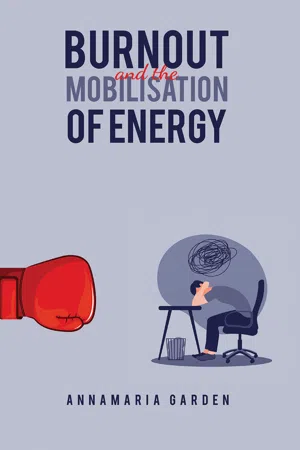
Burnout and the Mobilisation of Energy is a radical new book. Its main objective is to help working individuals or organisations to get out of burnout and keep out of it. Further, it helps them to activate or mobilise energy.
If you are burnt out or on the slippery slope to burnout, this book will transform you. If your organisation is blocked in terms of energy, this book can transform your organisation.
It is based on research, theory and practice. It clearly describes what burnout is and what it is not. It is not depression, stress, depersonalisation or anxiety. It is, however, based on a key symptom: an extreme form of energy depletion.
Two concepts explain the core findings: a Gestalt concept called an 'introject', and another that Carl Jung called 'enantiodromia'. These elaborate terms help us identify what burnout is, what causes it and how to get out of it.
The book also focuses on mobilisation of energy in the organisation. Using a psychological framework, it illustrates what happens when organisations get psychologically mixed up. This leads to a feeling of spinning wheels and crossed wires.
- 210 pages
- English
- ePUB (mobile friendly)
- Available on iOS & Android
eBook - ePub
Burnout and the Mobilisation of Energy
About this book
Trusted by 375,005 students
Access to over 1.5 million titles for a fair monthly price.
Study more efficiently using our study tools.
Information
Part 1: The Individual
Chapter One
Identifying What Burnout Is
We don’t actually know that burnout exists. No one knows. We assume and believe it exists based on the fact that the term and its descriptions are real in terms of our experience. But it is, in itself, invisible. Many medical conditions cannot be seen directly. They are inferred from commonly accepted symptoms. Burnout is not different. You can’t see it or touch it. You can’t prod at it to see if it is real. You have to infer burnout is present. I have come across many people who say to me “I’m burnt out” or “I am close to burnout”, or “Burnout, that’s me”. How do they know they are burnt out? Might it be something else? It is no wonder people make these statements. There are many books and articles that attest to the whys and wherefores of burnout and how to get out of it. In my mental health workers, they had a clear understanding of what burnout is, but it was miles away from the views of the academic literature. Who is right?
So, the first thing we need in this book is to get some clarity around what I mean by burnout: what it is and what it is not.
To some people, burnout is a serious and pervasive real problem. To others, it is the latest media-created fashionable neurosis. My belief is that burnout is a real and distressing problem, which is not simply an old ill with a new label.
The term itself has become part of the common lexicon in a matter of decades. Applied to the occupational sphere, the term burnout was first associated with the fields of professional athletics and the performing arts in the 1930s (Paine, 1982, p. 12) and has continued to be associated with them. Essayists such as Thomas Mann (in Buddenbrooks, 1922) and Graham Green’s A Burnout Case (1960) describe characters that mirror later descriptions of burnout in the ‘field’, as we know it. Burnout captures something meaningful in many people’s experiences of their jobs. The term itself conveys its own meaning: it rings true.
Elements
One day on my PhD, a friend rang from the UK to tell me about a dream he had had about my research on burnout. He said that some people burn out and some people ‘wash out’, depending on their personality. I didn’t include this idea in my PhD but we had part of a new vocabulary with his dream. I later built up a set of correspondences based on the idea. Table 1.1 illustrates this:
Table 1.1: Elements and types of burnout
| Element | Type of burnout |
|---|---|
Fire Air Water Earth | Flame out Spin out Wash out Wading in mud |
The fire element results in a burnout that can be called flame out. The flame has gone out and what is left is burnt. The air element is a chaotic and distracted type of burnout. There are no boundaries. The water element has a burnout that is swimming in vague and restless waters. This person is overwhelmed and drowning in it all. Finally, the earth element person is bogged down, wading in mud.
There is some usefulness to playing with the whole idea. It helps to understand that the way burnout may manifest may be different for different types of people. It helps to think of yourself as unique. My own version of this idea is depicted in terms of psychological types by Carl Jung. (See Chapters Five and Six.) The more individualised you make the study of burnout, the better.
Across different situations
When I was burnt out during my PhD, I discovered different versions of burnout by reading the academic and popular literature. Most writing was about burnout in the people professions or human services. This didn’t help me at all. The concept of burnout really took hold in the late 70s, mainly in a US context, and was used to describe a negative reaction of workers in client-centred occupations such as social workers. In particular, individuals who engaged in idealistic work were seen to react with fatigue and negative attitudes towards their clients.
The different versions I read at the time started with Ayala Pines and Christina Maslach. The former wrote (Pines et. al., 1982) of the various forms of exhaustion: physical, emotional and mental. Their definition of burnout was “a state of physical depletion marked by chronic fatigue, feelings of helplessness and hopelessness, and the development of a negative self-concept and negative attitudes toward work, life and other people” (p. 15). The latter (Christina Maslach, 1982) wrote of three aspects to burnout: exhaustion, depersonalisation and personal accomplishment. Maslach is the author most cited by others in the field. The measure of burnout she created at the time (the Maslach Burnout Inventory or MBI; Maslach and Jackson, 1981) has the same three dimensions: emotional exhaustion, depersonalisation and lack of personal accomplishment. The work of both these authors has concentrated on the human services arena.
My own research queried her concept of depersonalisation and found it did not seem to exist outside the people professions and, even in those professions, it did not represent burnout for certain kinds of people. I do not take depersonalisation to be a component of burnout (Garden, A. 1991).
The MBI was subsequently revised to be the MBI-GS, a general survey of burnout. The latter comprises three sub-scales: exhaustion, cynicism and decreased personal efficiency. Her new definition is, “Burnout is a psychological syndrome emerging as a prolonged response to chronic interpersonal stressors on the job. The three key dimensions are an overwhelming exhaustion, feelings of cynicism and detachment from the job and a sense of ineffectiveness and lack of accomplishment” (Maslach C. and Leiter, M. P. 2016, pp. 103-4).
Another interesting author was in the management as well as the human services field. H. J. Freudenberger was a psychoanalyst and drew up a conceptualisation of burnout that I, as a PHD student in management, could relate to. (Freudenberger, 1980)
As a psychiatrist, Freudenberger was employed in a healthcare agency. He observed that many of the volunteers experienced a “gradual emotional depletion and a loss of motivation and commitment…” To denote this particular state of exhaustion, Freudenberger used a word that was being used colloquially to refer to the effects of chronic drug abuse: ‘burnout’ (Maslach and Schaufeli, 1993, p. 2).
He describes the way he hit upon the particular term as: “In talking to some of the people… I began to use the term ‘burnout’ and each time I did, I got a profound reaction. Immediate identification” (Freudenberger, 1980, p. xvii). He defines burnout as: “To deplete oneself. To exhaust one’s physical and mental resources. To wear oneself out by excessively striving to reach some unrealistic expectation imposed by one’s self or by the values of society” (Freudenberger, 1980, p. 1). My own research and writing comes closest to Freudenberger’s definition.
Much of the work on burnout has continued to be done with people-oriented human service occupations, although the variety of these occupations has expanded. Although this is the general case, the burnout concept has also been extended to other types of occupations (Maslach and Schaufeli, 1993, p. 7).
The core symptom of burnout
My own research resolved this dilemma in several ways. First, I tried to challenge assumptions in the field. For example, that burnout was primarily associated with the people professions. Secondly, I separated the definition of burnout from the measure of burnout. How did I do this? I looked for the core symptom that was common across the different situations or occupations. Once this was found, I could measure burnout by measuring this symptom.
Putting all of these things together, my understanding was as follows. The core symptom of burnout is, undeniably, a particular form of extreme tiredness. This is identified by it not being easily relieved by rest or sleep. When you are truly burnt out, you cannot shake it off easily. Rest or sleep are not simple cures. The tiredness is also manifested in energy fluctuations—your energy goes up and down. Going on a holiday of less than two weeks’ duration doesn’t help. The person cannot really be bothered doing anything, even things that could help. In my research, I found also that the person feels overloaded by a range of things. Even listening to music could be too much for them.
These are the signs of burnout. Once you are this far into it, it is very hard to get out of it.
This form of exhaustion, or energy depletion, is the core symptom of burnout. Burnout doesn’t exist without it. It exists like this in any occupation. Looking at the burnout literature and talking to people, this much is about all we can be sure of.
Those high on energy depletion or burnout tend to describe themselves as extreme and intense, or driven and single-minded. In contrast, those who are low or without burnout symptoms describe themselves as being on an even keel. Sometimes those high on burnout or energy depletion need a buzz. Some state that along with the exhaustion is a feeling of exhilaration. This is when things can get complicated: they love the latter and are very wary of the former.
Those high in burnout will describe their tiredness as: “Sometimes I feel I’ve never woken up that day”, “I feel I have nothing left to give”, “I feel groggy and vague”, “Unless I feel exhausted, I feel I haven’t done enough”.
People low on burnout will describe tiredness in terms of being “unfocussed, needing to concentrate hard”. This is a simple tiredness; they can get out of it with a rest or by doing something different for a while.
| High on burnout measure | Low on burnout measure |
|---|---|
| “In the evening, I would often spend hours on one thing… Even if I am very tired, I just plug on… I can’t not do it all, leave it undone.” | “If I’m tired, I stop and go to bed. Then I get up half an hour earlier in the morning.” |
If you are feeling tired from a few days’ hard work, you are probably not experiencing burnout. Burnout’s tiredness is persistent and doesn’t easily go away. Just feeling tired isn’t burnout.
What you observe
Burnout is identified by, and can be measured by, this symptom of severe energy depletion. The symptoms of this are as follows:
- Overall assessment of tiredness
- Severe energy fluctuations
- Not relieved by rest, sleep
- Not relieved by short holiday
- Overloaded by music, work, people
- At one’s limit
If you have developed burnout, you must have ignored warning signs—early warning signs. These will certainly relate to the peculiar form of tiredness I have already described. You may begin to feel tired after you have rested or slept, for example. You find yourself turning off music because you feel too tired to listen to it. Once you start to feel these symptoms, you need to take emergency action to avoid slipping into the much more perilous true burnout state. The earl...
Table of contents
- Burnout and the Mobilisation of Energy
- About the Author
- Dedication
- Copyright Information ©
- Acknowledgement
- Introduction
- Part 1: The Individual
- Part 2: The Job
- Part 3: The Organisation
Frequently asked questions
Yes, you can cancel anytime from the Subscription tab in your account settings on the Perlego website. Your subscription will stay active until the end of your current billing period. Learn how to cancel your subscription
No, books cannot be downloaded as external files, such as PDFs, for use outside of Perlego. However, you can download books within the Perlego app for offline reading on mobile or tablet. Learn how to download books offline
Perlego offers two plans: Essential and Complete
- Essential is ideal for learners and professionals who enjoy exploring a wide range of subjects. Access the Essential Library with 800,000+ trusted titles and best-sellers across business, personal growth, and the humanities. Includes unlimited reading time and Standard Read Aloud voice.
- Complete: Perfect for advanced learners and researchers needing full, unrestricted access. Unlock 1.5M+ books across hundreds of subjects, including academic and specialized titles. The Complete Plan also includes advanced features like Premium Read Aloud and Research Assistant.
We are an online textbook subscription service, where you can get access to an entire online library for less than the price of a single book per month. With over 1.5 million books across 990+ topics, we’ve got you covered! Learn about our mission
Look out for the read-aloud symbol on your next book to see if you can listen to it. The read-aloud tool reads text aloud for you, highlighting the text as it is being read. You can pause it, speed it up and slow it down. Learn more about Read Aloud
Yes! You can use the Perlego app on both iOS and Android devices to read anytime, anywhere — even offline. Perfect for commutes or when you’re on the go.
Please note we cannot support devices running on iOS 13 and Android 7 or earlier. Learn more about using the app
Please note we cannot support devices running on iOS 13 and Android 7 or earlier. Learn more about using the app
Yes, you can access Burnout and the Mobilisation of Energy by Annamaria Garden in PDF and/or ePUB format, as well as other popular books in Business & Management. We have over 1.5 million books available in our catalogue for you to explore.