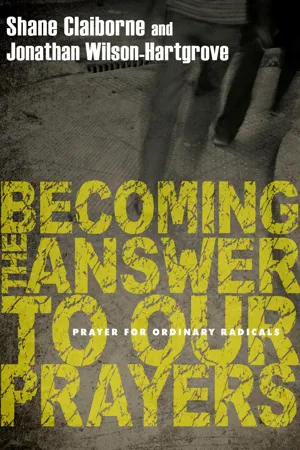
"Prayer is not so much about convincing God to do what we want God to do as it is about convincing ourselves to do what God wants us to do." —from the IntroductionActivists Shane Claiborne and Jonathan Wilson-Hartgrove show how prayer and action must go together. Their exposition of key Bible passages provides concrete examples of how a life of prayer fuels social engagement and the work of justice. Phrases like "give us this day our daily bread" and "forgive us our debts as we forgive our debtors" take on new meaning when applied to feeding the hungry or advocating for international debt relief.If you hope to see God change society, you must be an ordinary radical who prays—and then is ready to become the answer to your own prayers.
Evidently Jesus didn’t have a set curriculum for the 101 course he taught the first disciples. Jesus never said, “Sign up for my course on prayer and I’ll teach you how to talk to God.” Instead, Jesus announced a new kingdom with words and signs. Despite his lack of a military or political power, Jesus insisted that his ministry was about a new social order that was good news to the poor and downtrodden. To anyone who would listen, Jesus said, “Follow me.” Those who did found themselves caught up in an adventure.
Not far into the journey, though, those first disciples realized their need for prayer. Jesus didn’t have to tell them. They saw Jesus praying, and they knew they needed some of what he had. “One day Jesus was praying in a certain place. When he finished, one of his disciples said to him, “Lord, teach us to pray” (Luke 11:1).
We feel a little bit like those first disciples. By God’s grace, we stumbled into the adventure of God’s kingdom and gave our lives to Jesus. We were eager to learn the Scriptures and even more enthusiastic about living them out with our whole lives. Not long into this journey, though, we realized that faithfulness requires something we just don’t have on our own. The people who did seem to have it were our elders and mentors who knew how to pray. The disciples’ desire was ours, and their question drove us to pay attention to Jesus’ response. We started saying the Lord’s Prayer every day.
The first word of the Lord’s Prayer is Our. That’s important. The prayer Jesus taught us is a prayer of community and reconciliation, belonging to a new kind of people who have left the land of “me.” This new humanity is an exodus people who have entered a promised land of “we,” to whom “I” and “mine” and “my” are things of the past. Here our God teaches us the interconnectedness of grace and liberation in a new social order. Here we are judged inasmuch as we judge, and forgiven as we forgive.
The disciples ask Jesus to teach them to pray, and he begins with “Our Father.” The Son is calling out to the Father, and the Spirit is interceding for us—a brilliant image of the divine community that declared, “Let us make human beings in our image” (Genesis 1:26). And so we too are made in the image of community. It’s our deepest thirst. We are created to love and to be loved. The biblical story begins and ends with community.
When humanity is created, it is not good for one human to be alone, but it is good for humans to help each other. It was community that Jesus taught and lived with his disciples, never sending them out alone. His longest prayer (John 17) is that we would be one as the Father and Son are one. And his promise to us is that the Spirit will be among us, whenever two or three of us gather together. When the Spirit fell upon the early church at Pentecost, there was a divine harmony of foreign tongues and a reconciled community that shared all their possessions in common. The biblical narrative ends with the coming of the New Jerusalem, the City of God, a new heaven and a new earth where all of creation is reconciled, and the lion and the lamb lie down together. Our God is a communal God.
And yet so much in the world tries to rob us of this divine gift, seducing us to settle for independence over interdependence—security over sacrifice—to the point that community looks idealistic and spectacular. We express our deep hunger for belonging through such forms of community as nationalism, biological family, marriage or small group Bible study. And there is some good in all of these. Like appetizers, they give us little glimpses of community. But we often don’t make it to the feast. We stop short of the great community that God has invited us into.
ST. PATRICK’S BREASTPLATE
I arise today Through a mighty strength, the invocation of the Trinity, Through the belief in the threeness, Through confession of the oneness Of the Creator of Creation.
This book is an invitation to join the feast already taking place at the table of our Lord—by becoming the answer to the prayers Scripture teaches us to pray. Jesus established a community in his resurrected body. “This is my body, broken for you” is a physical reminder that we have been baptized into Christ’s body. As living members of that body, we speak Christ’s words. Praying the Lord’s Prayer as members of the church is inviting God to make us what we already are—the beloved community of a new humanity.
Our Father in Heaven
Jesus’ prayer does not begin with us or our needs—not even our confessions or our big dreams for the kingdom (though all of these are important and will follow). The prayer begins with a transcendent God beyond the boundaries of this world, whose name is so hallowed that it is not even mentioned. Instead of a name for God, we are given a characteristic of God. God is Father—our Father.[1]
For the young disciples, father was a role loaded with meaning—not just a person but a social construct. Fathers were the authorities, the providers and the sustainers of life in a male-dominated culture. But the words Jesus dares to teach us also retain an element of intimacy, love and admiration, especially when Jesus uses the familiar Abba. We cannot keep God at a safe distance as “King” or “Lord.” The One whose name cannot be spoken is drawing close to us. Jesus dares to call the transcendent one “Papa.” What is more, Jesus teaches us to do the same.
There’s a beautiful place in the Gospels where Jesus lets the disciples in on a family secret:
“Truly I tell you,” Jesus replied, “no one who has left home or brothers or sisters or mother or father or children or fields for me and the gospel will fail to receive a hundred times as much in this present age: homes, brothers, sisters, mothers, children and fields—along with persecutions—and in the age to come eternal life. But many who are first will be last, and the last first.” (Mark 10:29-31)
Jesus assures us that as we leave our possessions and family in allegiance to God’s kingdom, we will enter a new household of abundance. But when you look closely, there is a difference between the two nearly identical lists. First, there is an additional “bonus” in the second list—persecutions! Persecutions will come to us when we choose an economic order different from the pattern of the world.
But there is also an omission from the second list—fathers.As we are reborn, we leave our biological families. Now we have sisters and brothers and mothers all over the world. And yet Mark’s omission of fathers is very intentional, consistent with Christ’s teaching: “do not call anyone on earth ‘father,’ for you have one Father, and he is in heaven” (Matthew 23:9). In an age when fathers were seen as the lifeline of the family, the seemingly indispensable authority and providential center-piece, Jesus suggests that we have one Father. Only God is worthy to be seen as Father, the Provider and Authority (and, of course, King).
Here’s the incredible clincher in these verses: the multiplication is not just in the age to come—crowns, streets of gold and mansions in heaven. The multiplication of resources begins “in this present age.” Jesus had homes everywhere he went. He taught the disciples this reality as he commanded them not to take anything for their journey—no bag, no extra food, no clothes, no money, no shoes. By ordering them not to take their stuff, Jesus was implying that they could have taken it—that some of them had access to those things. The disciples were not sent out in the simple poverty of an ascetic life but with a new vision of interdependence, trusting that God would provide for them. One of the early Christians wrote, “We have no house, but we have homes.” As the disciples entered a town, others would open their homes. And if not, they were to shake the dust off their feet and move on. This made clear that the church was not only to practice hospitality, but to be dependent on hospitality also. The line between “us” and “them” was dissolved.
In the beloved community of God’s kingdom, we have come to see that the family of our Father is a reality in this world. A married couple in England who were unable to have children happened to meet Jane, who had found herself six months pregnant and homeless. So they invited Jane into their home. It proved to be such a beautiful experience that they decided to continue living together and help raise the new baby girl while Jane pursued her dream of going back to school and becoming a nurse.
Some fifteen years later I (Shane) was able to stay with this family on a visit to England. They were indeed a family. The baby was a teenager, and Jane had become a nurse. The woman who took Jane in was ill with multiple sclerosis. But she had a nurse (Jane) living in her home to care for her just as Jane was once cared for. This is the gift of providence and radical interdependence in the beloved community.
The echoes of Jesus’ new vision of family are scattered throughout the Scriptures. When a guy from reputable lineage comes and asks Jesus what he needs to do to enter the kingdom, Jesus tells him he needs to be born again (John 3). When Jesus’ own mother and brothers come looking for him, he asks, “who are my mother and brothers, but those who do the will of God?” (see Mark 3:31-35). And of course there’s the time Jesus says that unless you “hate” your own family you are not ready to be his disciple (Luke 14:26). Jesus is not shunning love for one’s own family; he...
Table of contents
Cover
Copyright
Contents
Introduction
Part One
1. An Invitation to Beloved Community
2. Begging for God's Economy
3. Temptations Along the Way
Part Two
4. Love and Unity for the Sake of the World
5. Praying as a Peculiar Peopl
Part Three
6. Growing Deeper in Spiritual Wisdom
7. Receiving Our Inheritance
Epilogue
Notes
About the Authors (and Their Communities)
Endorsements
Trusted by 375,005 students
Access to over 1.5 million titles for a fair monthly price.
Study more efficiently using our study tools.
Frequently asked questions
Yes, you can cancel anytime from the Subscription tab in your account settings on the Perlego website. Your subscription will stay active until the end of your current billing period. Learn how to cancel your subscription
No, books cannot be downloaded as external files, such as PDFs, for use outside of Perlego. However, you can download books within the Perlego app for offline reading on mobile or tablet. Learn how to download books offline
Perlego offers two plans: Essential and Complete
Essential is ideal for learners and professionals who enjoy exploring a wide range of subjects. Access the Essential Library with 800,000+ trusted titles and best-sellers across business, personal growth, and the humanities. Includes unlimited reading time and Standard Read Aloud voice.
Complete: Perfect for advanced learners and researchers needing full, unrestricted access. Unlock 1.5M+ books across hundreds of subjects, including academic and specialized titles. The Complete Plan also includes advanced features like Premium Read Aloud and Research Assistant.
Both plans are available with monthly, semester, or annual billing cycles.
We are an online textbook subscription service, where you can get access to an entire online library for less than the price of a single book per month. With over 1.5 million books across 990+ topics, we’ve got you covered! Learn about our mission
Look out for the read-aloud symbol on your next book to see if you can listen to it. The read-aloud tool reads text aloud for you, highlighting the text as it is being read. You can pause it, speed it up and slow it down. Learn more about Read Aloud
Yes! You can use the Perlego app on both iOS and Android devices to read anytime, anywhere — even offline. Perfect for commutes or when you’re on the go. Please note we cannot support devices running on iOS 13 and Android 7 or earlier. Learn more about using the app
Yes, you can access Becoming the Answer to Our Prayers by Shane Claiborne,Jonathan Wilson-Hartgrove in PDF and/or ePUB format, as well as other popular books in Theology & Religion & Religion. We have over 1.5 million books available in our catalogue for you to explore.