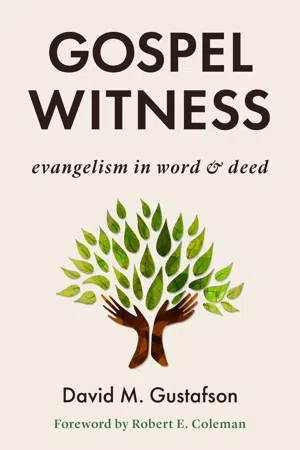
In light of our increasingly post-Christian Western contexts, David Gustafson offers a mission-oriented ecclesiology that moves from missional theory to practices of missional engagement. Introducing “God’s human drama” as a way to explain the gospel within God’s redemptive story, he outlines specific ways for pastors and church leaders to shape a “gospeling” culture within their congregations. Gustafson expertly lays the foundations of and approaches to evangelism that are seminal and apt for the church today.
- 304 pages
- English
- ePUB (mobile friendly)
- Available on iOS & Android
eBook - ePub
About this book
Information
Topic
Theology & ReligionSubtopic
Christian Ministry1
Introduction to Gospel Witness

Gospel witness is about more than sharing the gospel with others. It is about whom we worship, who we are, what we receive, what we say, and what we do. Books about gospel proclamation run risks of imbalance. This is particularly true when gospel proclamation is separated from the whole life of a Christ-follower, as well as the life of a local congregation. The act of sharing the gospel with others is not an isolated part of the Christian life but one of multiple, interconnected activities.1 Worship of the triune God, hospitality, reconciliation, service, study of the Scriptures, forgiveness, prayer, compassion, sharing resources, justice, and friendship all come together to inform and shape this practice. Only through such integral practices of Christian faith and life does gospel proclamation or “gospeling” retain its integrity in praxis.2
God calls every Christian to witness to the gospel, to speak of his saving acts in redemptive history, and to love one’s neighbor.3 Christ sends the church, corporately, to engage others with this message in word and to demonstrate it in deed.4 The Spirit enables us to live out our baptismal identity, our union with Jesus Christ in his death and resurrection, and to follow as members of his body and servants of his community in the world.
Nevertheless, we find ourselves today in a world fundamentally different from that of previous generations. This raises the question, How can we be faithful witnesses in our contemporary context?
Gospel Praxis in Western Contexts
For Christians in the West, our context is increasingly secular. Christianity has been displaced from its earlier place of prominence and influence, which it held during Christendom as a majority, if not an official state-sponsored religion.5 For centuries, state and church worked closely together whether in government or society. However, secularism has led hundreds of millions of people in Europe—Christianity’s heartland for more than a thousand years—to its present spiritual condition where only a small percentage are practicing Christians.6 Less than 5 percent attend church every Sunday in Denmark, Germany, France, and Sweden.7
In the second half of the twentieth century, missiologist Lesslie Newbigin (1909–1998) observed as he returned to his native England, having served as a missionary in India, that the West had become “post-Christian.”8 Thus, he issued a clarion call to the church in the West to reengage its context as a mission field.9 In today’s late- or post-Christendom world, one can neither assume nor expect people in the broader society to have any sense of obligation to attend worship services as was the case during the heights of political and cultural Christendom.10 With the shift toward post-Christendom, the West is again a mission field.11
While the United States has boasted of separation of church and state since the founding of the new republic, Christianity has been treated generally as the de facto faith of Americans.12 However, this cultural Christendom is collapsing.13 A growing percentage of Americans no longer share a Christian worldview, hold to Christian beliefs and values, or identify with America’s Christian heritage. The Christian faith no longer has the cultural clout of previous decades, nor can one assume that people are familiar with Christian theological concepts like sin, faith, prayer, repentance, and a personal God. Instead, these are (mis)understood as bad deeds, wishful thinking, meditation, moral expectations, and a moldable deity.14 Theologian and missiologist Darrell L. Guder states:
Of all the Western developed nations, the United States is probably the most religiously active: higher church attendance than in other Western nations, public attention to religion especially in politics, obvious practices of “civil religion” (prayers at public events, the singing of “God Bless America”), and enormous interest in diverse forms of religiosity as evidenced in the publication and sale of books on all kinds of religion. At the same time, mainline denominations are, across the board, losing members and income. The cultural and legal privileging of churches is rapidly disappearing (e.g. repeal of blue laws, increasingly restrictive zoning regulation of churches, loss of the “protected Sunday morning”). The interpretation of the Christendom history and legacy in public educational institutions is, when addressed at all, allegedly neutral but often negative. Biblical illiteracy is rampant inside the churches and endemic in the society at large. The separation of facts (scientific truth) and values (including religious convictions) has become dogma, with the public marketplace and the public conversation largely devoid of religious interaction, while religious activity in congregations is viewed as private, voluntaristic, and thus insular, inward, and member-oriented. The proportion of the population that is truly non-Christian, not just post-Christian, is rapidly growing, although with regional variations.15
In this setting, Christian teachings are questioned by many. Previously held assumptions such as absolute truth and the existence of heaven and hell have been jettisoned and may be considered politically incorrect. Whereas the church was once at the center of Western civilization and had a voice in society, it now finds itself on the margins with a culturally disenfranchised and sometimes politically disestablished status. This is post-Christendom.
One cannot assume that the church and its leaders have adjusted to the new situation. Some leaders continue to operate according to the bygone era. They hold assumptions of political or cultural Christendom, expecting people to attend worship services out of a sense of personal, social, or civil obligation.16 For churches long established in Western Christendom, the readjustment is difficult. Attitudes of ecclesial and cultural hegemony, along with entitlement to some claim of definitive Christianity, die hard.17 As some congregations and denominations find themselves in survival mode, they redouble their efforts to grow, yet do so with little or no results to show for it.
Today’s post-Christendom context resembles in some ways the pre-Christendom of the first centuries of the early Christian communities: marginalized as a minority and confronted with religious pluralism. The Roman Empire consisted of a blend of religions and worldviews in a political system that gave them more or less equal status. Similarly, Western societies today are pluralistic, characterized by acceptance of diversity and moral alternatives.18 Communications technology makes accessible multiple choices of political and religious views. People hold to a plurality of sexual expressions, identities, and experiences. Our culture promotes a social code of permissiveness and a politically correct tolerance—or, as professor D. A. Carson describes it, a “new tolerance” that is selective.19 In the current context, absolute truth has been replaced by “local narratives” in which people claim, “Only those within our community or tribe have the right to comment or criticize our truth,” and “If you want to believe this stuff about Jesus, that’s okay for you, but don’t try to foist your beliefs on us.”20 Organized religion has lost its relevance in society, and in some instances is blamed for social ills and oppression that violates the contemporary social code. Such post-Christian perceptions cast doubt on the relevance and place of the church in the West.
In some ways, as Newbigin observed, the post-Christian West seems more like a foreign mission field. However, the West is not the same as a cultural context that has never encountered the gospel of Jesus Christ. Those living in post-Christendom contexts may know very little of the Christian faith but assume they know more than they do. Their limited perceptions inoculate them against biblical Christianity.21 While some people still self-identify as Christians as a statement of cultural or national identity, others reject Christian faith because of negative associations, hearing, for example, what Christians stand against rather than what we stand for. In the end, many see the Christian faith, or a caricature of it, as something they already know and to be rejected.
Nevertheless, people in the West retain spiritual interest, and Christians have the biblical warrant to proclaim the gospel and to make disciples of all nations (Matt. 28:19–20; Mark 16:15; Luke 24:45–49; John 20:21–23; Acts 1:8).22 This requires that Christian leaders in the West relearn and implement means that lead to missional or missionary-like engagement in their contexts.23 Such engagement requires rethinking paradigms that previously shaped the church’s gospel proclamation and practice. Since the West is a mission field, we must adopt a missionary stance and approach that takes seriously the shifting cultural context.24
This means that Christ-followers must consider what it means to think and live within a mission field. Christian leaders need to rediscover redemptive analogies and identify ways to communicate the gospel in their local contexts.25 The church must consider how to engage society from the margins and how to announce the good news of Jesus Christ to the world from a position of political weakness and social humility.26 Such a disenfranchised status like early Christians experienced may lead us to rely equally on the Holy Spirit to proclaim and practice the gospel in our day.
To engage in witness, local churches must equip Christ-followers to live as disciples sent by God to their neighborhoods, workplaces, and broader communities. God’s purpose in history is not simply to redeem people from sin and offer them heavenly life but to create a new humanity that exists in the world as a sign, witness, and foretaste of God’s kingdom, participating in his mission in the world.27
The church lives its identity through participation in the sending activity of the triune God.28 The church’s nature is rooted in the theology of the missio Dei, the mission of God.29 God sends us as believers in and followers of Jesus Christ to proclaim, serve, a...
Table of contents
- Title Page
- Copyright
- Dedication
- Contents
- Foreword by Robert E. Coleman
- Preface
- 1. Introduction to Gospel Witness
- 2. God’s Mission and Evangelism
- 3. Gospel Clarity
- 4. Always Ready
- 5. Engaging Relationships
- 6. Witness in Word and Deed
- 7. Conversion to Christ-Follower
- 8. Gospel Praxis in a Pluralistic Society
- 9. Witness through Community
- 10. Baptism and Discipleship
- 11. Shaping a Gospel-Sharing Church
- 12. Sending Disciples on Mission
- Epilogue: Faithful Presence and Urgency
- Appendix: God’s Human Drama Illustrated
- Bibliography
- Index
Trusted by 375,005 students
Access to over 1.5 million titles for a fair monthly price.
Study more efficiently using our study tools.
Frequently asked questions
Yes, you can cancel anytime from the Subscription tab in your account settings on the Perlego website. Your subscription will stay active until the end of your current billing period. Learn how to cancel your subscription
No, books cannot be downloaded as external files, such as PDFs, for use outside of Perlego. However, you can download books within the Perlego app for offline reading on mobile or tablet. Learn how to download books offline
Perlego offers two plans: Essential and Complete
- Essential is ideal for learners and professionals who enjoy exploring a wide range of subjects. Access the Essential Library with 800,000+ trusted titles and best-sellers across business, personal growth, and the humanities. Includes unlimited reading time and Standard Read Aloud voice.
- Complete: Perfect for advanced learners and researchers needing full, unrestricted access. Unlock 1.5M+ books across hundreds of subjects, including academic and specialized titles. The Complete Plan also includes advanced features like Premium Read Aloud and Research Assistant.
We are an online textbook subscription service, where you can get access to an entire online library for less than the price of a single book per month. With over 1.5 million books across 990+ topics, we’ve got you covered! Learn about our mission
Look out for the read-aloud symbol on your next book to see if you can listen to it. The read-aloud tool reads text aloud for you, highlighting the text as it is being read. You can pause it, speed it up and slow it down. Learn more about Read Aloud
Yes! You can use the Perlego app on both iOS and Android devices to read anytime, anywhere — even offline. Perfect for commutes or when you’re on the go.
Please note we cannot support devices running on iOS 13 and Android 7 or earlier. Learn more about using the app
Please note we cannot support devices running on iOS 13 and Android 7 or earlier. Learn more about using the app
Yes, you can access Gospel Witness by David M. Gustafson in PDF and/or ePUB format, as well as other popular books in Theology & Religion & Christian Ministry. We have over 1.5 million books available in our catalogue for you to explore.