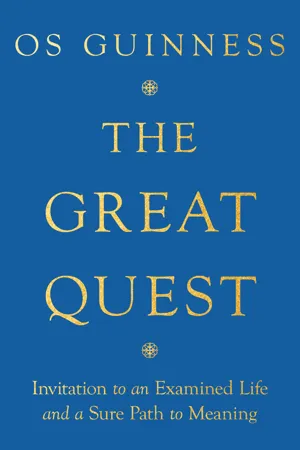
"The unexamined life is not worth living." —SocratesWhat is life all about? What are we here for? Is there any meaning or purpose to our existence? Thinkers throughout the centuries have pondered these questions. While the distractions of the modern world prevent many from grappling seriously with such matters, the truth is that humans cannot live without meaning any more than we can live without breathing or eating. Os Guinness invites us to examine our lives and join the great quest for meaning and a life well lived. For those who are up to Socrates' challenge, it is a search that is indispensable to making the most of life. Guinness charts the course of the thinking person's journey toward faith and meaning, callingfor a firm grasp of reason, an honest awareness of conscience, and a living sense of wonder. He affirms that there is a time for questions, and that following those questions can indeed lead us to answers, evidence, and commitment.When life becomes aquestion, the search is on for an answer. Come find yourself on a sure path to meaning.
- 125 pages
- English
- ePUB (mobile friendly)
- Available on iOS & Android
eBook - ePub
About this book
Information
Topic
Theology & ReligionSubtopic
Christian Theology1
Invitation to an Examined Life
DO YOU HAVE A MIND THAT is always seeking to make sense of things? Does your heart have a deep longing for a sense of order and belonging? Have you ever experienced a sense of wonder that thrills to the beauty of the world and the mystery of existence? Or are you uninterested in questions like these? For those who are willing to pursue an examined life, there is a sure path to exploring such desires. Come and let’s consider the questions themselves and the great quest for faith and meaning that they spur. The prize offered by such a quest is nothing less than a life that is worthy of life.
“Forget the opinion polls. Think for yourself.” That old maxim needs reviving today in an other-obsessed age. Many people have little interest in such issues as the meaning of life. They are interested only when the questions are popular with others too. They have hardly given a thought to what life is all about, and they have zero curiosity as to why they exist at all. Press them with questions, and all that matters is that they are alive and well, and enjoying life from day to day—and under the bountiful conditions of the modern world, that is surely not so bad. The best course, we are told, is to do the next thing that we need to do and to make the most of life while we can. After all, we are said to be entering the most irreligious era in human history, when seriousness about faith and meaning is irrelevant to more people than ever. We have enough to live with. Why should we concern ourselves with impossibly big questions about what we should live for?
We are often pointed to the religious “nones,” the “none of the aboves” as the exemplars of this fashionable indifference. They are the rising tide of those with receding faith, Matthew Arnold’s “Dover Beach” for our times. To be sure, what the nones say they no longer believe, and what they say is important for anyone to believe, often amounts to very little and seems to matter even less. The result is an easy-going nihilism, often masked under a wise-guy bravado. Many of the nones sound as if they are as knowledgeable as Plato even when they spout nonsense. (“I am an atheist who believes in God,” one pronounced solemnly. Another tweeted an equal non sequitur to his million followers with pseudoprofundity: “If there were ultimate meaning in the universe, your life would be pointless.”)
Compared with most people in most previous times, many in today’s generation are not only disinterested but unschooled in knowing how to search for the meaning of life. The situation is as confusing and chaotic as it is over sure paths to lasting relationships. Many of today’s elites dismiss the very idea of the meaning of life as meaningless itself. As a result, the paths for the search are cordoned off, overgrown, and increasingly uncharted and unexplored. For any who are still determined to break with the crowd and set off by themselves, the quest is often haphazard and ad hoc—a matter of everyone for themselves.
But is our generation really so incurious that we no longer wonder about the meaning of life? What does it say of us and our view of our own existence that we are content to assume there is no more to life than muddling along as best as we can? Why are we here? What can we know? What is a good life? What should be our relationship to the cosmos in which we live? Are we to be content with clichés and consensus thinking? If the mounting incidence of suicide opens our eyes to the fact that far too many people do not want to go on existing, then the collapsing birth rate across the modern world raises a similar question at a different level: What will it take for humanity to desire to go on existing fruitfully?
For many generations, it would have been considered a time-tested statement to say that faith in God is an essential part of human experience. Carl Gustav Jung used to say that the ultimate question in human life is whether or not we are related to the infinite. But in today’s cultural conversation that statement no longer sounds self-evident. Is it in fact outdated, is it arrogant, or is it just plain absurd? “The simple fact is,” a famous American radio host announced bluntly, “religion must die for mankind to live.” Many people today say they don’t want God, others say they don’t need God, and some now say that with biogenetics and ultraintelligence they can replace God. And who is to say they are wrong, they add, if they appear to get by so easily without God?
How would you set out the basic options for thinking through the meaning of life? Would it improve things for you, or make them worse, to say that our ultimate trust in life should not be in God or in any religion but only in human reason, in science, in technology, in management, in nature, and in history? Do you agree with Bertrand Russell’s famous dictum that “what science cannot discover, man cannot know”? Are you content to live in what Plato called a “cave” in which the sun is not allowed to penetrate, and Peter Berger described as “the world without windows”? Are you confident that, between us, we human beings will somehow figure out the mysteries and challenges of life and the universe, and be able to live well together on our little blue ball of a home?
The truth is that the urgent need of our times is a fresh seriousness about human existence and a renewed openness to ultimate questions. Answers to ultimate questions are not only vital to each of us as individuals but to whole societies and civilizations. Indeed, there are no great societies or civilizations without confident answers to ultimate questions, and such answers need to become vital again in our schools, our universities, and our public discussion as well as in our families. “Man” cannot live on cynicism alone. Knowing what life is about is essential for finding happiness in life. The gap between the reality of a human being and the ideal of being human is now alarmingly wide, and we are closer to C. S. Lewis’s warning of a master generation that, through its genetic and psychological engineering, is capable of deciding the course of all future generations—and all without their consent.
Yet many people have grown complacent through the deceptions and delusions of our advanced modern world. We have too much to live with and too little to live for. We have fallen for the illusion of our own mastery and control, and even of our own human omnipotence. Many people live as if, in Heinrich Heine’s famous dismissal of Karl Marx, they were “godless self-gods” who think they have it all together. But after a global pandemic, can we really believe we are in control of ourselves and our world, and in control of history and the future? What if that is a naivety, if not a hubris, we can no longer afford?
The essential first step for us all is to explore what we believe is the meaning of life and, in light of it, to learn to live well together, even with others who have very different views of what life is about.
HOW DO WE SEE LIFE?
We can surely all begin the quest with the simple truth that the first and greatest gift we have in life is life itself. But how do we each see life and our own lives? Life is brief, life is fragile, and life is overshadowed by death at the end. You are going to die, I am going to die, and death makes a mockery of much of the way we are both thinking and acting today. (Author Philip Roth at his eightieth birthday, quoting Franz Kafka: “The meaning of life is that it stops.”) So, the very fact of a short life, lived toward a certain death, raises the question of the meaning of human existence. What does life mean? Do we only live once and there is no rehearsal for our single entry on the stage, or do we go around and around with the “eternal recurrence” of endless appearances and reappearances (or reincarnations)? How are we to understand life in order to make the most of it and live it well together?
We humans, it would appear, are the only life form that raises the question why. We are the only ones who can range backward in time through memory and history, as well as forward in time through imagination and vision. It would seem we are the only species that is aware of life as widely as we are or inquires about the meaning of things. So, not surprisingly, life raises foundational questions for us. The meaning of anything can only be understood within the wider meaning of everything. What are we alive for? How do we make the most of the lives we have been given? To whom or to what are we answerable for these lives of ours? What does it mean to lead a life well lived and a life worthy of life?
Obviously, none of us willed ourselves into being. We didn’t choose our parents, and we didn’t choose when or where we were born, so it would be absurd to think we owe life to ourselves. And it’s surely preposterous and more than a little prideful to think that life is only about us, if only because there are so many billions of others alive at the same time as we are. Plus, the fact is that the time is coming when we won’t be here, and before too long life will go on as if we never had been here.
To whom, then, or to what do we owe life, and what is it all about? Do we owe life to our parents, to society, to nature, to evolution, to the universe, to God or gods—if there are any? What does it mean for us to exist or to be? How are we supposed to respond to or even repay the gift of life? And how are we to make the most of the amazing gift of time, so at least we know we have made the best use of our days?
This book is for those who care about such questions. Let me start with three stories of different responses to such issues. Salvador Dalí, the Spanish painter, was a flamboyant showman in real life as well as in his art. He loved to be the impresario of his own public image, and he produced paintings and orchestrated a lifestyle that flouted convention and delighted in catching public expectations on the wrong foot. This drive to defiance had its deepest roots in Dalí’s own story. His relationship to his father had been turbulent. Once, after a tempestuous scene between father and son, the young Dalí stormed out of his father’s home. Going back to his own house, he masturbated, put his semen in an envelope, addressed the envelope to his father, and—as if paying a gas or electricity bill—wrote on the envelope: “Paid in full.”
Very different was the high-flying world of a New York businessman who was so busy that he had no time to be at the hospital when his wife gave birth to their son. His first chance to see the baby was when mother and baby came home. Finally, he took time off from work, went home and crossed the room to the crib, and looked down at his newborn son. A look of startled amazement came over his face. A friend asked him what had struck him, and he answered, “I can’t understand how they can make such a crib for only $29.50.”
Few people could be more different from the artist and the businessman than the great Jewish philosopher Abraham Joshua Heschel. Born in Warsaw, Poland, and educated in Hitler’s Berlin in the 1930s, he described himself as “a brand plucked from the burning.” He arrived in the United States just weeks before the invasion of Poland, not realizing he would lose his mother, sisters, and many other family members in Auschwitz-Birkenau. In New York, where he lived the rest of his life, he became not only a great Jewish leader, but a philosopher and scholar, a civil rights activist alongside Dr. Martin Luther King Jr., a poet, and a widely respected public intellectual. Felled by a near-fatal heart attack toward the end of his life, he told a friend: “When I regained consciousness, my first feelings were not of despair or anger. I felt only gratitude to God for my life, for every moment I had lived. . . . That is what I meant when I wrote, ‘I did not ask for success; I asked for wonder. And You gave it to me.’”
We might well ask which was worse: Dalí’s gross ingratitude toward his parents who gave him life, or the crass reductionism of the businessman who overlooked the miracle of life for the dividends of the market economy? Equally, we might ask how Heschel, in spite of Auschwitz and the liquidation of his family and so many of his people in Eastern Europe, and in spite of the racism and the evils he protested against so fiercely in America, still came to see wonder as the source of wisdom and gratitude and the only proper response to the gift of life by which he believed he had been graced.
How would our responses measure up against these three? Have you thought through how you see life? Stories like those could be expanded endlessly, but the real point is how each of us sees our lives, and how we are trying to make the most of life, and live life well and wisely.
INCURIOUS AND UNQUESTIONING
The truth is that many people never raise the question, Why are we here? They show little interest in the meaning of their existence. They just take life and time for granted. After all, they are breathing, eating, working, sleeping, talking, and laughing today just as they were yesterday. For most people, most of the time, tomorrow looks like more of the same. It’s easy to live like that because most people just accept themselves and their existence, and never ask questions about the customs and ways of life around them. All too often, we stop asking questions as we become adults, and we lose the curiosity we had as children. So we never stop to wonder at how astonishing life is—and not just our little lives, but the existence of the universe itself, the sun, the moon, the stars, and the galaxies, as well as the marvel of simple things around us such as dewdrops, dandelions, and dogs.
Yet existence itself is amazing. If you do stop to think, questions flash out in a thousand directions. Why is there something rather than nothing? What brought existence into existence? Why is each of us here? What are we here for? If we didn’t come from ourselves, why do we think we have a complete right to ourselves, but to whom then are we responsible? How are we supposed to relate to the world around us and to other people, and decide what is true or false, right or wrong, fair or unfair? How do we make the most of what is really a very fleeting time on the earth? Is this little life all that is, or is there anything after it?
Before long, you find yourself raising questions that echo those that humans like us have asked for centuries. Mere existence, simply being alive, is one thing, but life and a whole universe with meaning, purpose, and appreciation is another. How did everything get to be the way it is? What does it mean to live a good life? How are we to find a solid foundation for our purpose in life, for our loves, our friendships, our work, and our membership in the communities in which we live? Is it important to live what the great Greek philosopher Socrates called an examined life—a thoughtfully responsible life? It’s odd that once you start thinking about it, life prompts more questions than it offers answers, yet somehow, we don’t often bother with the questions. It’s as if we have all the answers we need.
WE NEED MEANING AS WE NEED OXYGEN
Do questions like that really matter, or are they only for philosophers? Oddly, there are many real philosophers today who pooh-pooh the very idea of the meaning of life. The search for meaning, one book says, is a task fit only for mystics, comedians, and madmen. Legend has it that a London cabbie once asked the eminent mathematician and philosopher Bertrand Russell what he thought was the meaning of life. (“What’s it all about, Bertie?”) The greatest philosopher of his day was flummoxed. Only precise questions deserve precise answers, philosophers answer primly. The question itself would need to be questioned rigorously before it could be answered properly. “The universe is just there, and that’s all,” Russell used to say, incuriously for a philosopher.
Comedians like to joke about the question too. For Monty Python, life is absurd, so questions...
Table of contents
- Cover
- Title Page
- Dedication Page
- Contents
- 1 ◆ Invitation to an Examined Life
- 2 ◆ Launch Out for Yourself
- 3 ◆ An Adventure More Than an Argument
- 4 ◆ It All Begins with a Question: Phase One—A Time for Questions
- 5 ◆ Jump-Starting the Journey
- 6 ◆ A World of Difference: Phase Two—A Time for Answers
- 7 ◆ Checking It Out: Phase Three—A Time for Evidences
- 8 ◆ The Step Toward Home: Phase Four—A Time for Commitment
- Name Index
- About the Author
- Also by Os Guinness
- More Titles from InterVarsity Press
- Copyright
Trusted by 375,005 students
Access to over 1.5 million titles for a fair monthly price.
Study more efficiently using our study tools.
Frequently asked questions
Yes, you can cancel anytime from the Subscription tab in your account settings on the Perlego website. Your subscription will stay active until the end of your current billing period. Learn how to cancel your subscription
No, books cannot be downloaded as external files, such as PDFs, for use outside of Perlego. However, you can download books within the Perlego app for offline reading on mobile or tablet. Learn how to download books offline
Perlego offers two plans: Essential and Complete
- Essential is ideal for learners and professionals who enjoy exploring a wide range of subjects. Access the Essential Library with 800,000+ trusted titles and best-sellers across business, personal growth, and the humanities. Includes unlimited reading time and Standard Read Aloud voice.
- Complete: Perfect for advanced learners and researchers needing full, unrestricted access. Unlock 1.5M+ books across hundreds of subjects, including academic and specialized titles. The Complete Plan also includes advanced features like Premium Read Aloud and Research Assistant.
We are an online textbook subscription service, where you can get access to an entire online library for less than the price of a single book per month. With over 1.5 million books across 990+ topics, we’ve got you covered! Learn about our mission
Look out for the read-aloud symbol on your next book to see if you can listen to it. The read-aloud tool reads text aloud for you, highlighting the text as it is being read. You can pause it, speed it up and slow it down. Learn more about Read Aloud
Yes! You can use the Perlego app on both iOS and Android devices to read anytime, anywhere — even offline. Perfect for commutes or when you’re on the go.
Please note we cannot support devices running on iOS 13 and Android 7 or earlier. Learn more about using the app
Please note we cannot support devices running on iOS 13 and Android 7 or earlier. Learn more about using the app
Yes, you can access The Great Quest by Os Guinness in PDF and/or ePUB format, as well as other popular books in Theology & Religion & Christian Theology. We have over 1.5 million books available in our catalogue for you to explore.