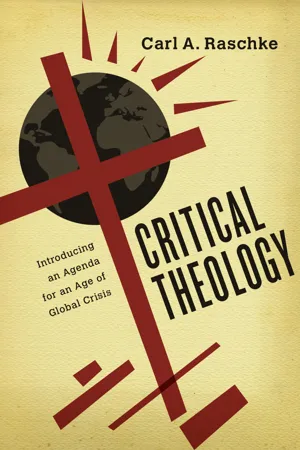
What is the future of theology in the midst of rapid geopolitical and economic change?Carl A. Raschke contends that two options from the last century—crisis theology and critical theory—do not provide the resources needed to address the current global crisis. Both of these perspectives remained distant from the messiness and unpredictability of life. Crisis theology spoke of the wholly other God, while critical theory spoke of universal reason. These ideas aren't tenable after postmodernism and the return of religion, which both call for a dialogical approach to God and the world. Rashke's new critical theology takes as its starting point the biblical claim that the Word became flesh—a flesh that includes the cultural, political and religious phenomena that shape contemporary existence.Drawing on recent reformulations of critical theory by Slavoj Zizek, Alain Badiou and post-secularists such as Jürgen Habermas, Raschke introduces an agenda for theological thinking accessible to readers unfamiliar with this literature. In addition, the book explores the relationship between a new critical theology and current forms of political theology. Written with the passion of a manifesto, Critical Theology presents the critical and theological resources for thinking responsibly about the present global situation.
- 175 pages
- English
- ePUB (mobile friendly)
- Available on iOS & Android
eBook - ePub
About this book
Information
Topic
Teología y religiónSubtopic
Teología cristiana1
Globalization and the Emergence of a New Critical Theory for the Age of Crisis
What can oppose the decline of the west is not a resurrected culture but the utopia that is silently contained in the image of its decline.
Theodor Adorno
The New World Disorder
We are living in a time of profound global crisis in the Western world—one that is all at once economic, institutional, cultural, political and most of all religious. The crisis is visible everywhere around us. The abject failure of the Arab Spring as a political movement has fueled the sudden emergence of radical and ruthless Islamist ideologies like the Islamic State, bent on conquest, expansion and the genocidal extermination of its many enemies whom it lumps together as kuffar, or “unbelievers,” which in turn have thrown the strategic assumptions of Western foreign policy into disarray. Within the Islamic world itself the “internationalization” of the long-standing Sunni-Shia antagonism and America’s ambivalent, if not pusillanimous, role in shaping the conflict, has certainly added to the chaos. New geopolitical battles, or complex nationalist conflicts such as we find in Eastern Europe, are springing up everywhere and throwing into question the meaning and mettle of the Western democracies. Meanwhile, the ever-deepening and toxifying chaos in countries like Syria and Libya, prompted initially by well-meaning, ineffective half-measures on the part of Western governments to stave off genocide, have spawned even worse nightmares that now threaten the very structures of stable and prosperous nations, as the European refugee influx and the accelerating threat of terrorist attacks from the so-called Islamic State attests.
The prospects for a new global democratic order that seemed so promising in the 1990s now, as democracies wink out like decrepit stars from South America to Eurasia, seem at this point to have become something of a cruel joke. The lingering effects of the global financial crisis of 2008, which constantly threatens to break out again somewhere in the world in new and metastatic guises, cast an economic pall over what has become a deteriorating condition of the societies of the world everywhere we look. Between the moment this manuscript goes to press and its eventual publication we should not be at all surprised if some new and uncalculated dimension, if not dimensions, of the global crisis will have emerged. As the long-brewing “existential” threat to the European Union of Greece’s debt default during the summer of 2015 showed, seemingly minor dislocations in the social and economic order can have massive potential repercussions. What a quarter century ago after the collapse of the Soviet Union seemed unmistakably to be the promise of what then President George H. W. Bush called the “new world order” is now the new world disorder. Although the Soviet Union is long gone, Russia has flexed its muscles aggressively once more. Civil society is fraying at the edges. In the United States, long considered the global signal fire for social progress and the hope of humanity, a combination of economic decline, toxic partisan division, a mood of religious apathy and moral rudderlessness, growing ethnic divisions, and isolationism when it comes to global leadership have accentuated the feeling that things are coming unglued.
It is not the first time in not-too-distant historical memory that the nations have teetered at the edge of unrivaled global crisis. During the late 1920s, as the world economy careened headlong toward economic disaster, a group of European thinkers and critics steeped in both German idealism and Marxist activism converged on Germany, at the University of Frankfurt, to provide identity and notoriety for the recently established Institute for Social Research. Within time, the assemblage of now famous philosophers and cultural theorists associated with the institute, such as Jürgen Habermas,1 Max Horkheimer,2 Walter Benjamin,3 Herbert Marcuse4 and Erich Fromm,5 came to be known as the Frankfurter Schule (Frankfurt school). The school, which in actuality was the epicenter of a worldwide intellectual movement that leveraged a broad, interdisciplinary method combining the humanities with the antipositivist social sciences and known as “critical theory,” had a slow but powerful transformative impact on Western culture. Challenging every one of the dominant orthodoxies of its day, including fascism, Stalinist Marxism and corporate capitalism, critical theory was both directly and indirectly responsible for the various “cultural revolutions” of the 1960s that, in turn, profoundly reshaped the current Western academic and sociopolitical landscape.6
Critical theory embodied the age-old desire to combine thought with action, theory with practice. The Frankfurt school insisted that if any theory was to be deemed “critical,” it had to insinuate a normative and potentially transfigurative constituency into its procedural apparatus. The Frankfurt school, in effect, traced its origins back to Kant’s declaration that all critiques of knowledge must lead to the affirmation of human freedom, echoing of course Rousseau’s celebrated manifesto for the age of revolution itself: “Man is born free; and everywhere he is in chains.”7 Thus Max Horkheimer proclaimed that the purpose of critical theory is “to liberate human beings from all circumstances that enslave them.”8
The young Marx had demanded that philosophy must move from interpreting the world to changing it, but the Frankfurt school recognized that interpretation and change could not be easily disentangled from each other. Critical theory enlarged the domain of world-transforming praxis from political economy to a penetrating critique of culture itself, encompassing everything from an exposure of hidden structures of domination perpetuated by popular ideologies, to the analysis of the forms of communication and prevailing sign systems. The assumption was that effective political movements were impossible without a radical overhaul of the cognitive and moral frameworks within which every social agent operated.
The Frankfurt school became famous for its understanding of how communications media enslaves as well as emancipates. But with the exception of the ad hoc radical activism of students in the sixties with their tacit connections to its major theorists, it tended to avoid any deep-penetrating analysis of the role of educational institutions. Perhaps the oversight can be attributed simply to the relatively marginal role higher education in particular played as late as the 1950s in the formation of broader ideological commitments. But in the 2010s, when the Western economies were totally dependent on well-educated “cognitive workers,” especially in the United States, with their astronomical amounts of student-loan debt threatening the sustainability of the entire system, a new burst of critical theory zeroed in on the increasingly dysfunctional interplay between the production of knowledge and the global hegemonies of the new corporate elites, while the importance of higher learning in such an equation at last seemed to be on everyone’s radar. Various seminars and publications on what is coming to be known as the “new critical theory”9 have sprung up, not to mention new forms of interdisciplinary curricula at colleges and universities.10
These emergent instances of both high-level theory and committed praxis resemble to a certain degree what the influential contemporary French philosopher Alain Badiou has termed the “event.” The “event,” for Badiou, signifies a powerful disruption in the business-as-usual procedures within the corporate production of knowledge by the state-controlled educational apparatus. The event pushes open a horizon for something wholly unanticipated and fraught with creative possibility that for the first time generates genuine “subjects,” as Badiou says in his Logics of Worlds, who are fired with a sense of “destination,” a vision of truth.11 L’ événtement is a singularity disclosing the threshold of powerful and irresistible historical forces, like the Arab Spring itself (on which Badiou has written)12 that are ready to break forth and transmogrify—perhaps almost overnight—a vast terrain. But before we venture into more detail about the new critical theory and its possibilities for engendering a new “critical theology” that might speak to the turmoil of our times, we might reflect on the historical circumstances the spawned the first iteration of such a critical theory as well as what might well count as the historical antecedents to the theological task, what was once known as “crisis theology.”
World War I and Its Consequences
A little over a century ago in the summer of 1914, the murder of an Austrian archduke and his pregnant wife, by a teenage Serbian assassin, in the streets of Sarajevo in what was then the dual provinces of Bosnia and Herzegovina, set off an unexpected chain of events that led to the greatest social, military and political catastrophe the Western world had ever previously experienced. What we remember today as World War I was actually referred to at the time by many in Europe and America as “Armageddon,” the long-prophesied climactic battle between God and the forces of darkness. It was the first truly global war, and in its deadly aftermath, there arose, for the first time in history, an awareness that a historical threshold had been crossed, that we had entered an epoch in which the efforts to identify and include vastly different peoples within a dawning planetary ethos amounted to something entirely new, something we now term globalization.
Historians are now slowly coming to realize that the magnitude and brutality of the four-year conflict, in which 17 million people perished, resulted not only from a sustained military gridlock manifested in the horrors of trench warfare but also from the crusading passions of both soldiers on the field and the civilian populations that waved flags in support while enthusiastically sending their youth to die en masse on distant battlefields. A violent clash of parochial and particularized passions generated an unprecedented debacle that left many questioning the old, familiar ways of knowledge and gave impetus to a profound sense of overarching crisis that Europe, and the rest of the world, had not experienced before. The lubricant for these lethal passions was by and large religious convictions that could not be disentangled from nationalist impulses.
The vast, mobilized militaries of Germany, England, France, Austria, Italy, America and Turkey all marched off into battle with an unassailable conviction that God was on their side and wanted them to emerge victorious in a war that, in the end, nobody really won. As Philip Jenkins writes, “Enthusiasm for the war was much greater than we might imagine,” because the vast majority of combatants in each of the myriad armies that fought each other were all convinced that they “engaged in a war for righteousness’ sake.” Jenkins adds, “Contrary to secular legend, religious and supernatural themes pervaded the rhetoric surrounding the war. . . . If the war represented the historic triumph of modernity, the rise of countries ‘ruled by scientific principles,’ then that modernity included copious lashings of the religious, mystical, millenarian, and even magical.”13
Once the war was finally concluded with an armistice in November 1918, however, the earlier “holy war” mentality gave way, both in Europe and America, to a profound disillusionment and cynicism. A year earlier the legions of peasant soldiers in the Russian army, who had sworn allegiance to “faith, Tsar and Fatherland,” had been decimated on the Eastern front, only to return home to a revolution in the streets of Moscow. There they encountered a surprise seizure of power by a disciplined cadre of atheist, materialist “Bolsheviks,” who declared the end of all nation-states and called for a worldwide uprising of the working classes as Karl Marx and Friedrich Engels had envisioned in The Communist Manifesto of 1848.
Vanquished, Germany itself alm...
Table of contents
- Cover
- Title Page
- Dedication
- Contents
- Preface
- Acknowledgments
- 1 Globalization and the Emergence of a New Critical Theory for the Age of Crisis
- 2 The Need for a New Critical Theology
- 3 From Political Theology to a Global Critical Theology
- 4 The Question of Religion
- 5 Toward a Theology of the “Religious”
- 6 What Faith Really Means in a Time of Global Crisis
- Notes
- Author Index
- Subject Index
- Praise for Critical Theology
- About the Author
- More Titles from InterVarsity Press
- Copyright
Trusted by 375,005 students
Access to over 1.5 million titles for a fair monthly price.
Study more efficiently using our study tools.
Frequently asked questions
Yes, you can cancel anytime from the Subscription tab in your account settings on the Perlego website. Your subscription will stay active until the end of your current billing period. Learn how to cancel your subscription
No, books cannot be downloaded as external files, such as PDFs, for use outside of Perlego. However, you can download books within the Perlego app for offline reading on mobile or tablet. Learn how to download books offline
Perlego offers two plans: Essential and Complete
- Essential is ideal for learners and professionals who enjoy exploring a wide range of subjects. Access the Essential Library with 800,000+ trusted titles and best-sellers across business, personal growth, and the humanities. Includes unlimited reading time and Standard Read Aloud voice.
- Complete: Perfect for advanced learners and researchers needing full, unrestricted access. Unlock 1.5M+ books across hundreds of subjects, including academic and specialized titles. The Complete Plan also includes advanced features like Premium Read Aloud and Research Assistant.
We are an online textbook subscription service, where you can get access to an entire online library for less than the price of a single book per month. With over 1.5 million books across 990+ topics, we’ve got you covered! Learn about our mission
Look out for the read-aloud symbol on your next book to see if you can listen to it. The read-aloud tool reads text aloud for you, highlighting the text as it is being read. You can pause it, speed it up and slow it down. Learn more about Read Aloud
Yes! You can use the Perlego app on both iOS and Android devices to read anytime, anywhere — even offline. Perfect for commutes or when you’re on the go.
Please note we cannot support devices running on iOS 13 and Android 7 or earlier. Learn more about using the app
Please note we cannot support devices running on iOS 13 and Android 7 or earlier. Learn more about using the app
Yes, you can access Critical Theology by Carl A. Raschke in PDF and/or ePUB format, as well as other popular books in Teología y religión & Teología cristiana. We have over 1.5 million books available in our catalogue for you to explore.