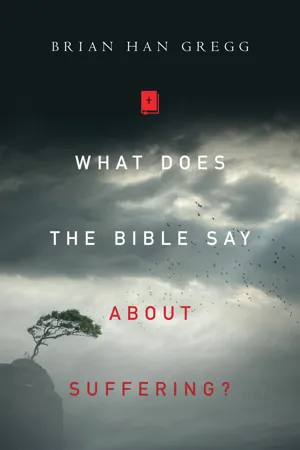
The quest for an answer to the problem of suffering is universal.People often treat Scripture like a manual, looking for a single clear response that explains the presence of evil and suffering. Brian Han Gregg thinks we should take a different approach. The Bible does not have one but many responses to suffering. To pick out one theme is to hear the sopranos but miss the choir. We need to listen to the whole biblical narrative to appreciate its multifaceted handling of the problem. What Does the Bible Say About Suffering? explores twelve themes related to the issue of human suffering and reflects on what we can learn from the diversity of the biblical witness. Readable and informed by biblical scholarship, this book is a timely resource for students, small groups and anyone looking for a fresh approach to a topic of perennial interest.
- 176 pages
- English
- ePUB (mobile friendly)
- Available on iOS & Android
eBook - ePub
What Does the Bible Say About Suffering?
About this book
Trusted by 375,005 students
Access to over 1.5 million titles for a fair monthly price.
Study more efficiently using our study tools.
Information
Topic
Theology & ReligionSubtopic
Biblical Studies- 1 -
Introduction

Elizabeth was playing with her two young children on a beautiful summer’s day when the doctor called with the results of her test, his voice steady but somber: they had found cancer in her lymph nodes. It was moving aggressively and there was no telling whether treatment would help.
Jennifer was thirteen years old when the visits began. She would lie in bed at night, straining her ears for the sound of footsteps on the creaky wood of the upstairs hall. On the nights that her father came, her blood would run cold. Her body went limp and her mind numb when he pulled back the sheet.
Eric could count on one hand the number of days that had passed in the last three years without the sights and sounds of war filling his mind. The battlefield was long gone but he could still hear the whir of bullets and see the faces of the dead. He couldn’t imagine life without anxiety, fear and confusion.
Justin could see quiet desperation when he looked into the eyes of his children. The school year was beginning, and he still did not have a job. There was no money for new shoes, backpacks, pens or folders. The unemployment checks had stopped coming; he wasn’t even sure how they would handle lunches.

Suffering is one of the great universals of human life. It can strike rich and poor, old and young, strong and weak, good and wicked—no one is immune from suffering. If suffering doesn’t play favorites, then everyone must grapple with it personally at some point. For a Christian, the grief, pain and loss associated with suffering are entwined with a pressing question: Why has my God, who is both wholly good and completely powerful, allowed this to unfold? How one answers this question, and the manner in which it is answered, can have important ramifications for the life of faith.
In my first years as a professor of biblical studies at a Christian liberal arts university in the Midwest, I have had the opportunity to hear and share many stories. In hearing those stories, I became profoundly aware of two things: First, no single question emerged as often or with as much raw urgency as the question of God’s relation to our suffering. Second, very few of my students had any concrete notion of how they might approach such a question. I have seen many of my students adopt one of three responses: losing faith, having an attitude of resentment or fear toward God or coming to believe that God is impotent over the evil in the world.
Bart Ehrman, a noted New Testament scholar, began his 2008 book God’s Problem by detailing the sad results of his own wrestling with the problem of God and suffering: “The problem of suffering has haunted me for a very long time. It was what made me begin to think about religion when I was young, and it was what led me to question my faith when I was older. Ultimately, it was the reason I lost my faith.” Ehrman is by no means alone. Many men and women of faith have surrendered their commitment to the gospel in the face of inexplicable suffering, finding it easier to rid themselves of God than to navigate the mystery of suffering.
Even if we continue to believe in God, there are dangers. If we are unable to reconcile suffering with belief in a good and powerful God, then perhaps God is less good or powerful than we thought! C. S. Lewis records something of his own struggles to come to grips with the problem of suffering as it relates to God’s goodness in his book A Grief Observed. Shortly after losing his wife to cancer, Lewis writes, “Not that I am (I think) in much real danger of ceasing to believe in God. The real danger is of coming to believe such dreadful things about him. The conclusion I dread is not, ‘So there’s no God after all,’ but, ‘So this is what God’s really like. Deceive yourself no longer.’” Fortunately, Lewis found his way out of despair.
Process theologians, on the other hand, have dealt with the problem by reducing God’s power. God may not be able to do anything about the suffering in the world, but at least he is not responsible for it. Rabbi Harold Kushner’s book When Bad Things Happen to Good People is a classic example of limiting God’s power in order to preserve God’s character. At the conclusion of the book, Kushner exhorts his readers to come to terms with God’s limitations.
Are you capable of forgiving and loving God even when you have found out that He is not perfect, even when He has let you down and disappointed you by permitting bad luck and sickness and cruelty in His world, and permitting some of those things to happen to you? Can you learn to love and forgive Him despite his limitations, as Job does, and as you once learned to love and forgive your parents even though they were not as wise, as strong, or as perfect as you needed them to be?
How then is the committed Christian to understand the relationship between God and suffering? Where is one to look for guidance, insight and wisdom? Any hope of grappling with suffering must begin and end with the biblical witness. Christians are people of the Word. We are convinced that God has disclosed important truths to us through the Scripture. Scripture reveals what God wants his people to know while making it clear that there are limits to our knowledge. It provides the believing community with boundaries of right understanding, guiding us into God’s truth. Ironically, many Christians who value the Bible often fail to search out the fullness of its wisdom when faced with the dilemma of suffering. This book seeks to remedy this problem. If God reveals truth through his Scripture, then we should search out what the Bible has to say about suffering.
When we do turn to the Bible, what do we find? The first thing worth noting is how often the theme of suffering emerges. From the Garden of Eden in Genesis to the new creation in Revelation, we find attempts to understand the cause of suffering, find deliverance from suffering, remain faithful in the midst of suffering and understand the mystery of suffering. We may not like the answers we find in Scripture, but we may never accuse it of turning a blind eye to the problem.
Second, there is no easy answer to the problem of suffering. This is hardly surprising given the difficulties already discussed, but it is an important point to make. In some Christian circles there appears to be an expectation that Scripture must always speak clearly with a single, straightforward voice. In fact, an exploration of the theme of suffering in the Bible will require nuance, complexity and mystery. Attempts to flatten the biblical response to suffering, reducing it to a slogan or proof text, only serve to distort the biblical witness.
Third, there is no single way forward. The Bible includes a number of different responses to the problem of suffering, and we do ourselves and the Bible a great disservice by adopting a one-size-fits-all approach. Imagine that the biblical witness is a talented choir. Members of a traditional choir are assigned one of at least four parts: soprano, alto, tenor and bass. When the choir performs, some songs are sung in unison—a powerful melody that moves and grows in momentum. The proclamation of the good news of Jesus is such a melody. When it comes to suffering, however, the Scriptures’ approach is more like a complex harmony. The convergence of voices weaves a pattern greater than any single melody. There are even moments of dissonance—adding to the complexity and mystery of the music. Certainly we have the ability to pick out a particular line in the music. We can focus in on the altos, for instance, in order to appreciate their contribution; in fact, a full appreciation of the music demands that we isolate and consider the various lines. However, it would be disastrously misguided to assess the music solely on the basis of any single line.
It is critical that we understand this point. Time after time, I have had conversations with people trying to come to grips with the problem of suffering who are stuck on one biblical response to the problem: they are only listening to the sopranos! This may simply reflect our desire for simplicity. We often find it easier (and perhaps safer) to internalize a particular explanation of suffering and apply it to the circumstances of our lives and world. However, I am increasingly convinced that there are other factors involved in the inclination to adopt one approach at the expense of others.
Having taught several courses on suffering in the Bible, at the university and at my church, I have noticed that most people naturally gravitate toward one or two biblical responses to the problem of suffering. I found this so intriguing that I began to take surveys at the end of courses. I would list the twelve biblical approaches discussed in class and have individuals identify which of the approaches they found compelling. Several interesting patterns emerged:
- Nearly everybody focused in on one or two of the biblical approaches.
- The chosen approaches spanned the various possibilities, with at least one person identifying each of the twelve.
- When asked to identify why they were attracted to a particular approach, a variety of motivations were provided. Favorite approaches were described as comforting, logical, reasonable, suitably mysterious, hopeful and redemptive.
- Perhaps most interestingly, they almost exclusively gravitated toward the same approach that they would have identified as their favorite at the beginning of the course.
These patterns indicate that our personality, upbringing and life circumstances seem to predispose each of us to appreciate some approaches to suffering more than others.
To return to our analogy of the choir, it would appear that, much like real singers, we are all attuned to sing and hear certain parts more naturally. While there is nothing wrong with having a predisposition, it underscores the need to understand and appreciate the full scope of the biblical witness about suffering. If we fail to grasp the full extent of the “music,” it will lead to two negative consequences.
First, it is likely that we will be confronted with suffering that cannot be adequately understood through a single approach. When the complexity of suffering rears its head, we will find ourselves ill- equipped to deal with the ramifications. We will be robbed of the hope, peace or logic in which we found solace, left to flounder in uncharted waters. A fuller understanding of what the Bible has to say about suffering can be a much-needed lifeline in such situations—broadening our perspective and enabling us to make theological sense of our circumstances in a new way.
Second, if we cling to the notion that our own particular conception of suffering represents the fullness of truth, we will be inclined to judge those around us. We will be like Job’s friends: certain that our answers are sufficient, unable or unwilling to grasp the mysterious complexity of God and suffering. This would be like thinking that a single tool is effective for every task. We may be convinced that the chainsaw is the perfect tool for every job, but we still look silly trying to hammer a nail with it. Worse, someone might get hurt in the process! This happens in the church over and over again when we jump to dispense “wisdom” and “advice” to those in crisis. Often, we do more damage than good simply because we have failed to consider the crisis in light of the full biblical witness. Instead, we resort to our favorite slogans:
“God is punishing you for your sin. Repent and he will restore you.”
“It’s all part of his plan. Just wait and you will see his purpose in this.”
“Satan is attacking you. You need to pray for spiritual protection against him.”
“You just need to let go and let God take care of it. Trust him.”
The Bible’s approach to the problem of suffering makes it clear that discernment is necessary every step of the way. If the Bible offers a range of perspectives on God and suffering, then we must be willing to sort and weigh them when we are faced with difficulty. While it is true that several of these perspectives might be relevant in a particular scenario, it is also true that some of them will not apply. Some of the biblical options are mutually exclusive. This makes it even more obvious that we must spend time with Scripture, in prayer and in conversation in order to discern the best way to interpret the suffering involved in a given situation.
A survey of the various biblical approaches to suffering makes it clear that the biblical authors seek to do more than help us understand the why of suffering. In fact, in many instances answering the question Why? seems to be of secondary concern to the biblical authors. Rather, the focus seems to lie on God’s various responses to suffering. What is God doing through suffering? What is God doing to address suffering? What is God doing to defeat suffering? If these are points of emphasis in the Bible, we would be wise to pay attention to them. The reality is that the Bible doesn’t tell us everything we might wish to know about suffering, but it doesn’t set us adrift either. The Bible simply keeps God front and center. God knows about suffering. God cares about suffering. God is at work in the midst of suffering. God is at work against suffering. God reigns over suffering. God suffers. God will one day declare final victory over suffering.
This book presents twelve biblical approaches to suffering. Each chapter begins with a small “appetizer,” a brief reflection or anecdote that introduces the subject. The main course of each chapter comes in two parts. The first is an exploration of a single text from the Old or New Testament. This Scripture will help us stay grounded in actual biblical text—and keep us from seeking answers where the text doesn’t lead. We will examine the context and background of the text, assess its meaning and significance, and most importantly, listen to what it has to say about suffering. A second section will be devoted to practical reflections on important questions that emerge from a contemplation of suffering in the text. As we proceed, remember that each chapter needs to be read as part of a larger conversation. Since the Bible contains a variety of different responses to suffering, we must be patient, content to let the complex harmony unfold.
Two final words of advice: First, even as we explore the unique contribution of each approach, we must...
Table of contents
- Cover
- Title Page
- Dedication
- Contents
- Acknowledgments
- 1 Introduction
- 2 The Two Ways: Suffering and the God of Justice
- 3 Sin Is Lurking at the Door: Suffering and Choice
- 4 The Purposes of God: Suffering and the Sovereignty of God
- 5 The Accuser: Suffering and the Devil
- 6 I Am: The Mystery of Suffering
- 7 God Wins: Suffering and the Future
- 8 Running the Race: Suffering as Training
- 9 Confronting the Truth: Suffering as Testing
- 10 Jars of Clay: Suffering and the Power of Weakness
- 11 Pass It On: Suffering and the Comfort of God
- 12 The Cruciform Path to Glory: Following God into Suffering
- 13 To Suffer for Another: Participation in the Suffering of God
- 14 Conclusion
- Notes
- Subject Index
- Scripture Index
- Praise for What Does the Bible Say About Suffering?
- About the Author
- More Titles from InterVarsity Press
- Copyright
Frequently asked questions
Yes, you can cancel anytime from the Subscription tab in your account settings on the Perlego website. Your subscription will stay active until the end of your current billing period. Learn how to cancel your subscription
No, books cannot be downloaded as external files, such as PDFs, for use outside of Perlego. However, you can download books within the Perlego app for offline reading on mobile or tablet. Learn how to download books offline
Perlego offers two plans: Essential and Complete
- Essential is ideal for learners and professionals who enjoy exploring a wide range of subjects. Access the Essential Library with 800,000+ trusted titles and best-sellers across business, personal growth, and the humanities. Includes unlimited reading time and Standard Read Aloud voice.
- Complete: Perfect for advanced learners and researchers needing full, unrestricted access. Unlock 1.5M+ books across hundreds of subjects, including academic and specialized titles. The Complete Plan also includes advanced features like Premium Read Aloud and Research Assistant.
We are an online textbook subscription service, where you can get access to an entire online library for less than the price of a single book per month. With over 1.5 million books across 990+ topics, we’ve got you covered! Learn about our mission
Look out for the read-aloud symbol on your next book to see if you can listen to it. The read-aloud tool reads text aloud for you, highlighting the text as it is being read. You can pause it, speed it up and slow it down. Learn more about Read Aloud
Yes! You can use the Perlego app on both iOS and Android devices to read anytime, anywhere — even offline. Perfect for commutes or when you’re on the go.
Please note we cannot support devices running on iOS 13 and Android 7 or earlier. Learn more about using the app
Please note we cannot support devices running on iOS 13 and Android 7 or earlier. Learn more about using the app
Yes, you can access What Does the Bible Say About Suffering? by Brian Han Gregg in PDF and/or ePUB format, as well as other popular books in Theology & Religion & Biblical Studies. We have over 1.5 million books available in our catalogue for you to explore.