Compilation of little-known and never-before-published apocryphal Christian texts in English translation
This anthology of ancient nonbiblical Christian literature presents informed introductions to and readable translations of a wide range of little-known apocryphal texts, most of which have never before been translated into any modern language.
An introduction to the volume as a whole addresses the most significant features of the writings included and contextualizes them within the contemporary study of the Christian Apocrypha. The body of the book comprises thirty texts that have been carefully introduced, copiously annotated, and translated into English by eminent scholars. With dates of composition ranging from the second century CE to early in the second millennium, these fascinating texts provide a more complete picture of Christian thought and expression than canonical texts alone can offer.
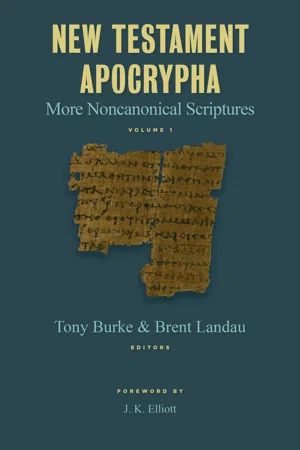
eBook - ePub
New Testament Apocrypha, vol. 1
More Noncanonical Scriptures
- 635 pages
- English
- ePUB (mobile friendly)
- Available on iOS & Android
eBook - ePub
New Testament Apocrypha, vol. 1
More Noncanonical Scriptures
About this book
Information
The Legend of Aphroditianus
A new translation and introduction
by Katharina Heyden
The Legend of Aphroditianus (Leg. Aphr.; CANT 55) is a supplement to the pericope of the adoration of the Magi in Matthew 2:1–12. It first explains how the Magi knew about the birth of the Messiah in Bethlehem and then describes their journey and their encounter with Christ and Mary in more detail than the canonical account. In the Slavic cultures, especially in medieval Russia, Leg. Aphr. was a popular text that was read during the Christmas liturgy. In consequence, all modern Russian collections of Christian apocrypha contain Leg. Aphr.1 In the West, however, the legend has remained almost completely unknown, for in Greek manuscripts it is rarely transmitted on its own,2 but is usually embedded in larger literary works that were themselves long-neglected by scholars, even though they are preserved in many manuscripts. Leg. Aphr. is also known in scholarship as the “Narrative of Events Happening in Persia on the Birth of Christ,” falsely attributed to Julius Africanus.
Contents
In its first part (chaps. 1–6), Leg. Aphr. describes a miracle in the temple of Hera in Persia (1) at the time of Christ’s birth. In the presence of the Persian king and a priest, the statues of the temple dance and sing, announcing that Hera has been made pregnant by Zeus and will give birth to a child (2). Then a star appears above the statue of Hera. A voice proclaims the birth, and all the other statues fall down upon their faces (3). The wise men of Persia interpret the miracle as an announcement of the birth of the Messiah in Judah (4). In the evening, the god Dionysus appears to confirm this interpretation and to proclaim the end of the worship of the pagan gods (5). Then the king sends the Magi to Judea with gifts, the star pointing them along their way (6). The second part of Leg. Aphr. (chaps. 7–9) is a report of the Magi about their journey to Jerusalem and Bethlehem, including a discussion between the Magi and the Jewish leaders (7), and their meeting and encounter with Mary and the two-year-old Jesus (8). Of interest here are the precise description of Mary’s appearance (8:4) and the remark that the Magi brought back to Persia a likeness of the mother and child, which they placed in the temple where the star originally appeared. The report of the Magi concludes with the appearance of an angel who, warning the Magi of a plot against them, advises them to return home (9).
Transmission and Editions
Leg. Aphr. has a complex and fascinating history of transmission. The oldest written version is found in an anonymous Greek work entitled De gestis in Perside (Pers.), a fifth- or sixth-century fictional religious dispute between pagans, Christians, Jews, and a Persian magus at the court of the Sasanian Empire,3 in which Leg. Aphr. plays an important part. In Pers., Aphroditianus is a pagan philosopher appointed by the king of Persia as an independent arbitrator in the dispute, but Aphroditianus turns out to be a defender of the Christian position, quoting Leg. Aphr. as the main argument in favor of the Christian truth.
Traces of Leg. Aphr. can be found in later literature, though these hint too of an earlier origin for the text. In the eighth century, John of Damascus included the legend in a Homily on the Incarnation of Christ (Homilia in nativitatem Domini),4 presenting it to the audience as a pagan oracle explaining why the Magi knew about the birth of Christ. Inserting biblical texts, omitting certain passages, and altering some formulations, John modified the text of Leg. Aphr. to harmonize the legend with the Gospels. Two illustrated Byzantine manuscripts of this homily from the second half of the eleventh century (Jerusalem, Greek Orthodox Patriarchate, Taphou 14 and Mount Athos, Esphigmenou 14) contain splendid miniatures accompanying the homily, bearing witness to the popularity of Leg. Aphr. at the time of the Macedonian dynasty of the Byzantine Empire (867–1056).5
The Slavonic versions of Leg. Aphr. are excerpts of the legend from Pers. translated from Greek. The first of these translations (Slav I) was made, probably in Bulgaria, in the tenth century.6 Through the southern Slavs, Leg. Aphr. was transmitted to Russia during the twelfth century, where it became very popular and was revised several times.7 In the sixteenth century, Aphroditianus was regarded as one among other pagan figures—such as the Sibyl, Hermes, Homer, and Plato—who are said to have announced the coming of Christ; this association is reflected in Aphroditianus’s representation on the bronze portals of Kremlin cathedrals.8 The second Slavonic translation (Slav II) was made in the fourteenth century, probably by Serbian monks of Mount Athos, but based on a different Greek text.9 This version was translated later into Romanian.10 It differs from Slav I in some respects, two details being especially remarkable. First, the names of the Magi are given—Elimelech, Elisur, and Eliav—together with etymological explanations (see the note to Leg. Aphr. 6). Second, in the title of this version the legend is attributed to “the presbyter Philippus who was syncellus of the great John Chrysostom.” This attribution deserves attention because it provides clues as to how Leg. Aphr. came to be incorporated into Pers.
The title of Slav II corresponds to an addendum to Pers. that clarifies the identity of the historian Philippus whose History, according to the initial sentences of Pers., caused the dispute between pagans and Christians in the Sasanian kingdom. The note reads:
This Philippus was a presbyter and syncellus of John, the archbishop of Constantinople. He wrote the whole [history] organizing it in periods in such an admirable way that no other of the historiographers can compare with him. The same presbyter narrated that from the day on which the star appeared in the temple, every year on the same day until the ascension of the Lord, all statues were uttering their own characteristic voices so that the whole city remained there to watch the great miracles and the annual appearance of the star.11
This note identifies the Philippus of Pers. with Philip of Side, a Christian historian who, in the fifth century, compiled a monumental Historia Christianae in Constantinople, of which only a few fragments have survived.12 Moreover, mentioning the report of the annual repetition of the miracle in the temple of Hera, the addendum shows that Leg. Aphr. was a part of Philip’s Hist. Christ., possibly of a book entitled “Hellenic Oracles.”13 But was Philip the author of the legend? This seems improbable for two reasons. First, his Hist. Christ. is a monumental work composed of many sources.14 Second, Leg. Aphr. contains some elements that point to a place of origin other than Constantinople and to a time earlier than the fifth century.15
In 1804, the German scholar Johann Freiherr von Aretin published for the first time a Greek text of Leg. Aphr. using two manuscripts from Munich (Bayerische Staatsbibliothek, Monac. gr. 61 and 199); the text was accompanied by a translation into Latin.16 Athanasius Vassiliev published the entire text of Pers. in 1893 from two manuscripts: Moscow, State Historical Museum, Synod. gr. 252 (11th cent.) and Vatican, Biblioteca apostolica, Palat. gr. 364 (14th/15th cent.).17 This manuscript base was expanded dramatically by Eduard Bratke in 1899,18 and Pauline Bringel in her unpublished thesis from 2007.19 Bratke compared 29 manuscripts of Pers. and chose Paris, Bibliothèque nationale de France, gr. 1084 (11th cent.) as the base text for his edition. Bratke mentioned also an Armenian version of the text, but this has not yet been published.20 Bringel included 14 more manuscripts and divided the evidence into two redactions: a short one that is preserved in Vatican, Biblioteca apostolica, Palat. gr. 4 (10th/11th cent.) and a long one found in all other manuscripts, of which Bringel favored Munich, Bayerische Staatsbibliothek, Ms. gr. 467 (11th cent.) as the best witness. In 2009, Katharina Heyden published a monograph on the transmission of Leg. Aphr. in the East and the West, discussing the literary, theological, and historical aspects for every stage of the text’s transmission as well as the origin of the legend.21 In this study, Leg. Aphr. was presented as an independent apocryphal writing for the first time to readers in the Western world.
Date and Provenance
The miracle in the temple of Hera that is narrated in the first part of Leg. Aphr. (chaps. 1–6) has its parallels in the cult of the Syrian g...
Table of contents
- Cover
- Title Page
- Copyright
- Dedication
- Contents
- Foreword: The Endurance of the Christian Apocrypha—J. K. Elliott
- Preface
- Introduction
- Abbreviations
- I. Gospels and Related Traditions of New Testament Figures
- II. Apocryphal Acts and Related Traditions
- III. Epistles
- IV. Apocalypses
Trusted by 375,005 students
Access to over 1.5 million titles for a fair monthly price.
Study more efficiently using our study tools.
Frequently asked questions
Yes, you can cancel anytime from the Subscription tab in your account settings on the Perlego website. Your subscription will stay active until the end of your current billing period. Learn how to cancel your subscription
No, books cannot be downloaded as external files, such as PDFs, for use outside of Perlego. However, you can download books within the Perlego app for offline reading on mobile or tablet. Learn how to download books offline
Perlego offers two plans: Essential and Complete
- Essential is ideal for learners and professionals who enjoy exploring a wide range of subjects. Access the Essential Library with 800,000+ trusted titles and best-sellers across business, personal growth, and the humanities. Includes unlimited reading time and Standard Read Aloud voice.
- Complete: Perfect for advanced learners and researchers needing full, unrestricted access. Unlock 1.5M+ books across hundreds of subjects, including academic and specialized titles. The Complete Plan also includes advanced features like Premium Read Aloud and Research Assistant.
We are an online textbook subscription service, where you can get access to an entire online library for less than the price of a single book per month. With over 1.5 million books across 990+ topics, we’ve got you covered! Learn about our mission
Look out for the read-aloud symbol on your next book to see if you can listen to it. The read-aloud tool reads text aloud for you, highlighting the text as it is being read. You can pause it, speed it up and slow it down. Learn more about Read Aloud
Yes! You can use the Perlego app on both iOS and Android devices to read anytime, anywhere — even offline. Perfect for commutes or when you’re on the go.
Please note we cannot support devices running on iOS 13 and Android 7 or earlier. Learn more about using the app
Please note we cannot support devices running on iOS 13 and Android 7 or earlier. Learn more about using the app
Yes, you can access New Testament Apocrypha, vol. 1 by Tony Burke, Brent Landau, Tony Burke,Brent Landau in PDF and/or ePUB format, as well as other popular books in Theology & Religion & Biblical Criticism & Interpretation. We have over 1.5 million books available in our catalogue for you to explore.