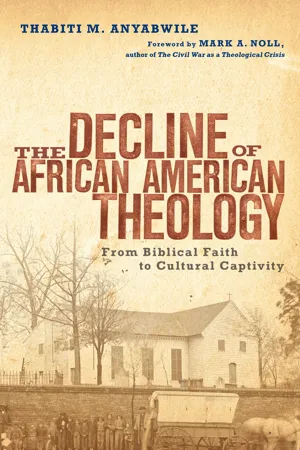
Who were Jupiter Hammon, Lemuel Haynes and Daniel Alexander Payne? And what do they have in common with Martin Luther King Jr., Howard Thurman and James Cone? All of these were African American Christian theologians, yet their theologies are, in many ways, worlds apart.In this book, Thabiti Anyabwile offers a challenging and provocative assessment of the history of African American Christian theology, from its earliest beginnings to the present. He argues trenchantly that the modern fruit ofAfrican American theology has fallen far from the tree of its early predecessors. In doing so, Anyabwile closely examines the theological commitments of prominent African American theologians throughout American history. Chapter by chapter, he traceswhat he sees as the theological decline of African American theology from one generation to the next, concluding with an unflinching examination of several contemporary figures. Replete with primary texts and illustrations, this book is a gold minefor any reader interested in the history of African American Christianity. With a foreword by Mark Noll.
eBook - ePub
The Decline of African American Theology
From Biblical Faith to Cultural Captivity
- 255 pages
- English
- ePUB (mobile friendly)
- Available on iOS & Android
eBook - ePub
The Decline of African American Theology
From Biblical Faith to Cultural Captivity
About this book
Information
Topic
Theology & ReligionSubtopic
Christian Theology1
“I Once Was Blind, but Now I See”
The Doctrine of Revelation in the African American Experience
But can mortal man behold him? The eagle veils his eyes
before he can gaze upon the unclouded sun.
Who then can gaze upon the visage of that God
whose shadow illumines the sun, and who covers
himself with light, as with a garment?
Nevertheless the pure in heart shall see God.
They shall see him in all his works of nature, providence, and grace.
They see him alike
in the minute insect, and huge elephant;
in the sagacious mocking bird and the stupid ostrich.
They see him sprinkling the earth with flowers,
and gilding the firmament with stars!
They see him walking with Shadrack, Meshack, and Abednego,
in the fiery furnace, and sitting with Daniel in the lion’s den.
They see him while a babe in the manger, and a man
quelling the raging sea amid the howling storm!
They see him amid the lightnings and thunders of Sinai,
and amid the tears, the groans, and the blood of Calvary!
BISHOP DANIEL ALEXANDER PAYNE
GENERAL INTRODUCTION AND CONTEXT
How does one know God? How can his divine will be apprehended and followed? Is it possible to truly know something of the character of the divine Creator? Can we know God in any way other than through sacred writings and traditions?
These questions are not new, neither were they new at the dawning of African American religious history. Every people and culture in human history struggled to find satisfactory answers to this epistemological problem—how does one know? And more specifically, how does one know God?
General revelation: God revealed in nature and conscience. Historically, Protestant Christianity resolved the problem of knowing, particularly knowing God, by considering two sources: general and special revelation. The doctrine of general revelation held that God left his imprimatur on the design of the universe and in the conscience and moral laws of humanity. So, the psalmist proclaimed that “the heavens declare the glory of God” (Ps 19:1), and the apostle Paul asserted, “since the creation of the world God’s invisible qualities—his eternal power and divine nature—have been clearly seen, being understood from what has been made” (Rom 1:20). According to the doctrine of general revelation, the Creator communicated something of his person and divine will through the created order, including the conscience and moral laws ingrained in the individual and human society. With application of reason, then, the natural order reveals God in a real and true sense.
However, Christian theologians through the ages taught that while general revelation was enough to apprehend God in some sense, to know that he exists, humanity needed another form of revelation to better comprehend God’s specific attributes and will. For example, Jonathan Edwards (1703-1758), opposing the Enlightenment’s emphasis on human reason, illustrated the limits of human reason by pointing to the inability of one person to know the unexpressed thoughts of another. “We find that the things of men cannot be known by other men any further than they reveal or declare them.” The same must be true, Edwards reasoned, of God. “So says the apostle it is with the things of God that we are told in the gospel. They are things that concern God himself, his secret counsels and sovereign will, and things in himself which he alone can be supposed to see and be conscious to immediately. And therefore, our reason will not help us to see them any further than God’s Spirit is pleased to reveal.”1Edwards argued that to make reason the final arbiter of divine truth was to subordinate God’s rule and make the fallacious claim that fallen human reason was a better guide in spiritual things. Reason had an important role in determining whether Scripture was divine in origin and infallible in content; however, once that was establi shed Edwards argued that “modesty and humility and reverence to God require that we allow that God is better able to declare to us what is agreeable to that perfection than we are to declare to him or ourselves. Reason tells us that God is just, but God is better able to tell what acts are agreeable to that justice than we are.”2
The typical view expressed by Edwards and others in the early Colonial era held sway through much of the country’s history. For example, Princeton theologian Archibald Alexander (1772-1851), refuting rationalist tendencies coming from Unitarians of his day, concluded, “we must unequivocally deny to reason the high office of deciding at her bar what doctrines of Scripture are to be received and what not” and “insist that all opinions, pretensions, experiences, and practices must be judged by the standard of the Word of God.”3 The Princeton theologians, from Alexander to B. B. Warfield (1851-1921), exalted the supremacy of divine revelation over human reason and natural revelation well into the 1900s.
Special revelation: God revealed most clearly in Scripture and in Jesus Christ. The doctrine of special revelation answered the church’s need for more particular or specific information regarding the character and plans of God, his commands for his people, and the way of salvation. The Bible, in both the Old and the New Testaments, contained this special revelation of God. It, the church held, recorded God’s work in history to redeem and save a covenant people for himself. The pages of Scripture unveiled the attributes of God—his wisdom, omnipotence, holiness, mercy, love, supremacy, sovereignty, justice, etc.—in sufficient clarity for human beings to know and relate to him with accuracy and for their eternal redemption. In the Bible, one observed God revealing himself in and through the history of his people. In the Bible, prophets and apostles spoke and wrote the very oracles of God as they heard “the word of the Lord” coming to them, interacted with angelic messengers, or received visions directly from God.
And ultimately, Jesus Christ embodied all the truth of divine revelation, and was himself the message of God to fallen humanity. Where general revelation provided an awareness of the existence of God as demonstrated by his creation, special revelation particularized who this God was in his triune character, what his intentions were vis-à-vis humanity and history, and how God and humanity could be joined in meaningful relationship. The pages of Scripture contained this message and provided the one sure means of knowing the person and mind of God. In these pages, God disclosed himself and crossed the epistemological chasm between his infinite existence and humanity’s finite reason.
The principal representatives of the main Protestant churches in the American colonies brought with them these formulations of general and special revelation, doctrines that served generations of Christians before them. This way of knowing—via Scripture and general revelation—provided the foundation for the ordering of society in matters religious, political, scientific, economic and social. Owing to a theological consensus forged over a nearly twohundred-year period by Reformation thinkers and European churchmen, the American colonies began their experiment “under the Puritan canopy,”4 which subscribed to this two-source view of revelation.
The African American church and its doctrine of revelation first emerged and developed in the shelter of this canopy, but it also fed on input from other sources. Eugene Genovese observed, “Afro-American religion arose from a conjuncture of many streams—African, European, classic Judeo-Christian, and Amerindian—but pre-eminently it emerged as a Christian faith both black and American.”5 How these “streams” shaped the African American doctrine of revelation is the subject of this chapter.
EARLY SLAVERY ERA THROUGH ABOLITION ERA (1600-1865)
African American Christians in the northern colonies stood as heirs of the Puritan and evangelical tradition of divine revelation. The orthodox consensus regarding special and general revelation reigned from the founding of African American literature in the works of Jupiter Hammon to the end of slavery in the essays of Bishop Daniel A. Payne.
Jupiter Hammon: A characteristic orthodox view of the Bible and its authority. Jupiter Hammon (1711-1806?), for example, expressed a cogent and characteristically orthodox view of the Bible and its authority. Hammon, at the age of forty-nine, became the first African American to publish a work of literature. A slave his entire life, Jupiter Hammon worked as a clerk and bookkeeper for the wealthy slave trading Lloyd family of Long Island, New York. Young Hammon probably benefited from Anglican missionary educational efforts established in the Oyster Bay area of Long Island. In addition, through the Lloyd family’s economic and cultural ties to Boston, Hartford, New York and London, Hammon had access to literature and works of theology.6
“A devout evangelical Christian, Hammon had been converted during the earliest stirrings of the Great Awakening.”7 His Christian convictions likely received reinforcements under the Quaker ministrations of William Burling (1678-1743) of Long Island and abolitionist John Woolman (1720-1772) who visited Oyster Bay on at least three occasions. The Quakers of Oyster Bay and Philadelphia published Hammon’s Address to the Negroes in the State of New York with a posthumous acknowledgment of close association with Hammon. Sondra O’Neale observes that “as a writer [Hammon] used Christianity and its foundation of biblical language, allusion, and imagery to mount a public assault against slavery. He left four poems, two essays, and a sermon, however that offering includes the first, and most comprehensive statement of black theology as well as the earliest antislavery protests by a black writer in all of American literature.” And yet, as O’Neale concludes, “Hammon’s dual commitment to Christianity and freedom has been either undervalued or ignored.”8 To recover a historical understanding of African American theology, then, the pattern of ignoring or undervaluing Jupiter Hammon must be reversed.
In An Address to the Negroes in the State of New York, Hammon wrote:
The Bible is the word of God and tells you what you must do to please God; it tells you how you may escape misery and be happy forever. If you see most people neglect the Bible, and many that can read never look into it, let it not harden you and make you think lightly of it and that it is a book of no worth. All those who are really good love the Bible and meditate on it day and night. In the Bible, God has told us everything it is necessary we should know in order to be happy here and hereafter. The Bible is the mind and will of God to men.9
Hammon’s contention that “the Bible is the word of God and everything in it is true” indicated his subscription to the orthodox view of inspiration and infallibility. The words of Scripture were, according to the orthodox view, literally God-breathed or inspired (2 Tim 3:16). And given that they originated with an omniscient God, they were also without error in all that they recorded. Accordingly, Hammon urged his hearers to devote themselves to learning to read so that they may “study it day and night.”10 Hammon’s views were characteristic of most African American Christians of the period. This view of the Bible as special revelation held sway among African American Christians during the antebellum period and would remain largely unchallenged until African Americans gained access to the liberal schools of theology that emerged in the late 1800s and prospered through the mid-1900s.
Daniel Alexander Payne. Daniel Alexander Payne (1811-1893) was born February 24, 1811, to London and Martha Payne, free blacks in Charleston, South Carolina, during the height of slavery. Immediately following his birth, the elder Paynes dedicated their son to the work of the Lord; however, neither Payne would live to see their hopes fulfilled. London Payne died when Daniel was just over four years old, and Martha followed her husband in death just five years later. Raised by his grandmother, Daniel became a voracious student, devouring every subject of learning he could find. Between the ages of eight and fifteen, young Daniel received educational instruction from the Minor’s Moralist Society and a popular Charleston schoolmaster named Thomas S. Bonneau. While employed as an apprentice to local shoe and carpentry merchants, Daniel taught himself Greek, Latin and Hebrew. By age nineteen, Daniel Alexander Payne opened and operated a school for both slave and free Africans in South Carolina until the South Carolina General Assembly forced the closure of the school in 1835.11
Sleepless, loaded with disappointment, failing in prayer and doubting the existence and justice of God, Payne closed the school on March 31, 1835, and shortly the...
Table of contents
- Cover
- Title Page
- Dedication Page
- Contents
- Foreword by Mark A. Noll
- Acknowledgments
- Figures
- Introduction
- 1 “I Once Was Blind, but Now I See”: The Doctrine of Revelation in the African American Experience
- 2 “A Father to the Fatherless”: The African American Doctrine of God
- 3 “Ain’t I a Man?”: African American Anthropology
- 4 “What a Friend We Have in Jesus”: The Christology of African Americans
- 5 “What Must I Do to Be Saved?”: African American Soteriology
- 6 “Gettin’ in de Spirit”: Pneumatology in the African American Experience
- Afterword
- Bibliography
- Subject Index
- Scripture Index
- Notes
- Praise for The Decline of African American Theology
- About the Author
- More Titles from InterVarsity Press
- Copyright
Trusted by 375,005 students
Access to over 1.5 million titles for a fair monthly price.
Study more efficiently using our study tools.
Frequently asked questions
Yes, you can cancel anytime from the Subscription tab in your account settings on the Perlego website. Your subscription will stay active until the end of your current billing period. Learn how to cancel your subscription
No, books cannot be downloaded as external files, such as PDFs, for use outside of Perlego. However, you can download books within the Perlego app for offline reading on mobile or tablet. Learn how to download books offline
Perlego offers two plans: Essential and Complete
- Essential is ideal for learners and professionals who enjoy exploring a wide range of subjects. Access the Essential Library with 800,000+ trusted titles and best-sellers across business, personal growth, and the humanities. Includes unlimited reading time and Standard Read Aloud voice.
- Complete: Perfect for advanced learners and researchers needing full, unrestricted access. Unlock 1.5M+ books across hundreds of subjects, including academic and specialized titles. The Complete Plan also includes advanced features like Premium Read Aloud and Research Assistant.
We are an online textbook subscription service, where you can get access to an entire online library for less than the price of a single book per month. With over 1.5 million books across 990+ topics, we’ve got you covered! Learn about our mission
Look out for the read-aloud symbol on your next book to see if you can listen to it. The read-aloud tool reads text aloud for you, highlighting the text as it is being read. You can pause it, speed it up and slow it down. Learn more about Read Aloud
Yes! You can use the Perlego app on both iOS and Android devices to read anytime, anywhere — even offline. Perfect for commutes or when you’re on the go.
Please note we cannot support devices running on iOS 13 and Android 7 or earlier. Learn more about using the app
Please note we cannot support devices running on iOS 13 and Android 7 or earlier. Learn more about using the app
Yes, you can access The Decline of African American Theology by Thabiti M. Anyabwile in PDF and/or ePUB format, as well as other popular books in Theology & Religion & Christian Theology. We have over 1.5 million books available in our catalogue for you to explore.