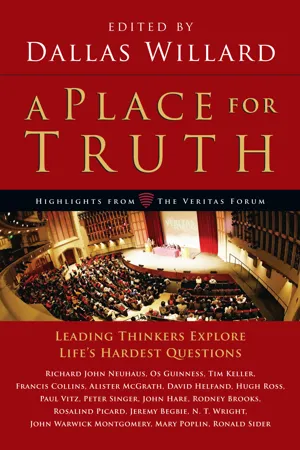
Many today pursue knowledge and even wisdom. But what about truth? In an age that disputes whether truth can be universalized beyond one's own personal experience, it seems quaint to speak of finding truth. But whether in the ivory towers of the academy or in the midst of our everyday lives, we continue to seek after the true, the beautiful and the good.Since its founding at Harvard in 1992, The Veritas Forum has provided a place for the university world to explore the deepest questions of truth and life. What does it mean to be human? Does history have a purpose? Is life meaningful? Can rational people believe in God? Now gathered in one volume are some of The Veritas Forum's most notable presentations, with contributions from Francis Collins, Tim Keller, N. T. Wright, Mary Poplin and more. Volume editor Dallas Willard introduces each presentation, highlighting its significance and putting it in context for us today. Also included are selected question and answer sessions with thespeakers from the original forum experiences.Come eavesdrop on some of today's leading Christian thinkers and their dialogue partners. And consider how truth might find a place in your own life.
- 323 pages
- English
- ePUB (mobile friendly)
- Available on iOS & Android
eBook - ePub
About this book
Information
Topic
Theology & ReligionSubtopic
Christian Theology1
Is There Life After Truth?
Richard John Neuhaus
The Veritas Forum at Yale University, 1996
It’s a great privilege to be here, and the earnestness and sense of expectation that I know marks this gathering, Lux et Veritas at Yale. Lux et Veritas—“Light and Truth.” I mean, they really narrowed the subject down, didn’t they? You know, it’s this passion for specialization in the academy today, you know? Nobody wants to take on a big question. So we just got light and truth.
Now, the title for my talk is “Is There Life After Truth?” I didn’t want to keep you in suspense about this title; I wanted to answer the title question right away and say that, yes, there is life after truth, but it’s not a life that’s really worthy of human beings.
Truth as a Conversation Stopper?
And yet, the extraordinary thing (every time is an extraordinary time marked by much that is unprecedented, but our time is marked by something that I think we can truly say is quite astonishing) is that, at least at certain levels of intellectual discourse and conversation in American life, and particularly in the academy, it has been concluded that we do not need to deal with the question of truth. That somehow, the question of truth itself is beyond the purview of serious intellectual discourse. That the only truth, if you must use the word, is that there is no truth, at least, no truth that has any obliging force for anybody other than yourself.
When our Lord stood before Pilate and said, “For this reason I came into the world, to testify to the truth” (John 18:37), and Pilate’s famous, or infamous, answer, depending on your view—I certainly don’t want to suggest there’s one truth about this that I’d want to impose on you—was, “What is truth?” You can take that as a cynical answer, as many interpreters do—a kind of jaded, nihilistic response on Pilate’s part. He was a disillusioned, world-weary man, perhaps, who simply couldn’t be bothered by it, especially when truth within the context of the world he was involved in, with all these crazy Jews, was an impossibly perplexing and conflict-ridden thing. “Who has time for truth?” Maybe that’s how he said it.
Today, there are many who ask Pilate’s question, “What is truth?” and take it to be the mark of sophistication. It is assumed that we can’t get into the question of truth and still keep our society and our relationships going, because once you get into the question of truth, you’re going to come into conflict. Truth is a conversation stopper, it is suggested.
I want to explore with you whether exactly the opposite is not the case—whether, in fact, the only conversation starter, and the only conversation sustainer that is worthy of human beings, is the question of truth.
The Search for Truth
Certainly, that is a proposition supported by a very venerable tradition of reflection on these matters. It is supported, I would suggest, by the Christian tradition in all of its variety. To be human is to seek the truth, and the quest for truth is a kind of open-ended adventure. It really is an excitement, and yes, a kind of delight, into an exploration that is never ended in this life. It’ll be ended at the time in which, as Saint Paul says in 1 Corinthians 13, “then I will know fully, even as I have been fully known” and “we see in a mirror, dimly, but then we will see face to face.”
Until then, this truth is something that more possesses us than we possess it. It is much more a matter of being possessed by the truth than possessing the truth. It is a matter of walking along a certain way, the way of the One who said, “I am the way, and the truth, and the life” (John 14:6). “Follow me.”
The Christian understanding is that truth is found only in following, in a faithful, trusting following. It’s a following in which we can’t see where the next step is, where we really do say with Cardinal Newman, “O, lead, kindly light.” We do not need to see the distant destination, we need to know only the company. We need to know only the One who travels with us, who says, “I am the way, the truth, and the life. And wherever the honest quest for truth is going to take you, it’s going to take you to where I am.”
This is not a truth we need fear. To know this truth is to be wondrously freed. The same Person said, of course, in John 8, “You will know the truth, and the truth will make you free.”
This is very countercultural, isn’t it? It’s very much against the grain of the way people think about truth today. In our conversation, we bring up the question of truth and say, “Well, this is true,” meaning that in some sense it’s binding on all of us.
“Hey, whoa, hold on there, that’s heavy. You know, don’t lay this on me, you know. I wanna be free.”
But we get this weird way of turning it all around in someone saying, “ ‘You will know the truth, and you will be free,’ and you’re not free until you know the truth.”
We’re not free until we’re bound to be free, until there’s something that has a claim upon us other than ourself, our aspirations, our psychological and intellectual and sexual tics and yearnings and desires for community. When all of that is somehow brought into a constellation of obedience to something other than ourself, we start to become, to taste, what it means to be free.
It’s really against the grain, that obedience. Talk about a word that doesn’t have a lot of appeal or cachet today. It’s a lovely word; it’s from the Latin, oboedire—“to listen attentively, responsively; to be alert to the other.” To be bound to be free: you will know the truth, and the truth will make you free.
In most of our discourse today, and certainly in most academic settings, talk about truth makes people very uneasy, and especially if the truth turns to religion and questions of moral truth. “Moral truth? Surely that’s an oxymoron.” This is because morality in the minds of many people is simply that on which we turn up the motive dial very high. A moral issue is a gut issue. A moral issue is an issue that we feel powerfully about. So you have your moral truth, and I my moral truth: whatever works for you.
But that there could be a truth about the way human beings are made to be, built-in ends and destinations and directions, and right orderings of the human life, in such a way that some ways of living and some ways of being are true, and others are false—it’s hard to make this case today, especially when people suspect us of coming from a religious commitment. To speak of moral truth is almost to throw open our jacket and expose the T-shirt that says, “Beware—fanatic!”
An Antifoundationalist View of Truth
We have to try to understand why. This is a moment in history in which the question not only of moral truth, not only of religious truth, but of truth itself has, in very many circles of powerful culture-forming influence, been very determinedly bracketed off. What has brought us to this pass?
We can call it antifoundationalism, deconstructionism, postmodernism; it goes by many different names and appears in many different variations. But it’s certainly in the academy today, and not only in the academy, for the influence of the academy is insinuated throughout society. As Richard Weaver says, “ideas have consequences,” and also, very bad ideas have consequences. The idea is insinuated that what we call truth is but social convention, historically contingent, culturally conditioned, or as it’s more commonly said, socially constructed.
As Richard Rorty (one could argue, at least in America, that he is the single most influential philosopher, at least in the academy) says, “It’s constructed all the way down.” So then, maybe there is no foundation, there’s no layer. Once you start unpeeling all the things that have shaped your mind and constructed socially what you call truth, and you take off one layer after another—psychological, family influence, all the other stuff—and find there is no foundation anywhere. There is no basis on which you can say that one thing is “more true” than another. All you can say is what you prefer.
And this radical antifoundationalism, not only bracketing of the question of truth, but a very systematic and sophisticated demolition job on the concept of truth, leads to (though not necessarily immediately) Hobbes’s war of all against all, and return to barbarity in its most vulgar and extravagant and sensational forms, for some of the nicest people in the world think this way, beginning with Richard Rorty—an eminently nice person.
“What then,” you say to Richard Rorty, “is to prevent anything of which human capacities and ambitions and aspirations are capable?” You don’t have to go immediately to the Holocaust, but you’d certainly want to ask about that as well. What is to prevent slavery? What is to prevent rape? What is to prevent my simply taking advantage of you in whatever way it would seem to me to be in my interest to do so?
The answer is, “Well, we’re not that kind of people. We’re not the kind of people who do those kind of things.” And the tag that is put on this answer is a style of ironic liberalism, that we ironic liberals believe in certain liberal values about how we ought to be decent to one another, but with a profound sense of irony, knowing that none of them are true. There’s no way of demonstrating that they’re any better, or that they’re superior to anybody else’s values. But those are the ones that we, and people like us, “prefer.”
And if other people come along and say, “Well, you know, actually, the nice way you guys live is possible because it’s true”—if someone comes along and starts talking about truth that way, says Richard Rorty, or if they come along and start talking about truth in a way that contradicts the way we live, well, we’ll just have to understand that they’re not part of our circle of ironic liberalism. They’ll just have to be declared crazy and kept somehow safely confined, where they cannot do public damage, cannot cause mischief by raising the question of truth.
There are many religious folk in the world today, some theologians of considerable intelligence, who welcome this (what’s called) postmodernist, deconstructionist, antifoundationalist turn. They say—and there’s some truth to this—“You know, this is really good, because now in the academy, all kinds of things can be discussed.”
“Once we’ve decided that the old eighteenth-century secular rationalists—with their narrow, reductionist, stifling, little notions of what constitutes truth on the basis of very scientistic testing of everything by values and by procedures that cannot begin to understand what they, in fact, are dealing with—are no longer in control, and now that we’ve all decided that there is really no truth—there’s simply your truth and my truth and her truth and his truth, and there’s simply the truth of this community and of a body defined by some experience of suffering or victimhood or exclusion or marginalization—so that there are just all these different truths, well, that’s great for us Christians,” some Christian thinkers say. We can understand why some Christian theologians and thinkers are talking that way, welcoming this kind of antifoundationalism, this kind of rejection of the very notion of truth. It gives them an opportunity to insert their particular Christian truth.
Christian Responsibility Toward Truth
But I think it is a great mistake. We Christians have an inescapable obligation to contend that there is truth, and that all truths finally serve the one truth. There is one truth because there is one God, and one revelation of God in Jesus Christ. And as much as we may find certain tactical advantages in this world of antifoundationalist, postmodernist chaos, we ought to be extremely careful not to sup with the devil, or else we undermine exactly what it is that we, as Christians, have to propose.
It’s not only for the sake of the Christian gospel, it’s for the sake of our responsibility in our society. It’s a socially disastrous, community destroying thing to deny that there is a truth that binds us together—Christian and Jew and Muslim and believer and nonbeliever and atheist and secular and black and white and Asian. To believe that there is a truth, however elusive, however difficult for us to articulate it, however much we may frequently discern it in manners that are sharply in conflict, and to nonetheless insist that there is a truth to discern and articulate is part of our responsibility as human beings, and as Christians. “I am the way, and the truth, and the life—I’m not simply the way, the truth, and the life for people who happen to believe that I am the way, the truth, and the life.” It’s not just a truth for Christians.
The very heart of the Christian faith is caught up in what sounds like the very esoteric, strange, academic, philosophical discussions that I was talking about, about postmodernism and antifoundationalism and all of that.
You say, “Well, that’s just all academic buzz. That’s just the way in which the leisure of the classes is consumed. That’s just what academics do, because they don’t have anything else to do.”
No, it’s very important to believe that we are part of one world that is brought into being and is directed toward—from eternity to eternity, from alpha to omega—the One who said, “I am the way, and the truth, and the life.”
It’s publicly important. Aristotle said that our public responsibility as citizens—as people who accept some responsibility for our part in the polis, the city of man, the earthly city—is that we are always to be engaging one another and deliberating the question of how we ought to order our life together.
The “ought” there clearly signals that it’s a moral question. The fact that we are to be deliberating it as rational, reasonable beings means that there must be something to deliberate; there must be a truth. There must be a right answer or many right answers in various ways, and different ways of putting the question, and many wrong answers. But it is not a futile deliberation.
In a world in which people have stopped talking about truth or have despaired of truth or have agreed with those who say that Pontius Pilate’s question was a conversation stopper and not a conversation starter—in such a world there is no way to deliberate the question how we ought to order our life together. There’s only power and propaganda and grievance and anger and caucuses and anticaucuses and special interest groups and victims and vengeance. That’s the kind of world we increasingly live in, because we’ve stopped believing, or so many have stopped believing, that there is a truth that we can deliberate together.
At this time in world history, at the end of the twentieth century, the bloodiest and most horrible century in all of human history, we’ve piled up more corpses and loosed more rivers of blood than any century in human history. Incidentally, it’s also the century that produced the great ideologies that denied the Christian and the classic Aristotelian understanding of truth, and denied our obligation as reasonable persons to engage that truth and to engage one another in our quest to engage that truth more fully.
Christians have a great obligation for God’s world. This is the world of God’s creating and of God’s redeeming love. God so loved the world that he gave his only begotten Son. We have a great obligation to defend the humanum, to defend the unity of humankind at a time when there are so many powerful, destructive, satanic forces posited against it.
This is a time, as we prepare to cross the threshold into the third millennium, to reassert a genuine, a Christian, biblical, humane humanism that can, with the whole of our tradition, in the spirit of Psalm 8, stand in awe and wonder at what is man: What is this humanum? A little less than the angels. Why should God have become humanum, to become one of us? To assert truth in public. It’s the great task of our generation, to learn how to do it persuasively and winsomely and in a manner that does not violate, but strengthens the bonds of civility.
The American experiment within the humanum has been both blessing and curse in so many different ways, but to the extent it has been blessing (and that it has been in a...
Table of contents
- Cover
- Title Page
- Copyright
- Contents
- Foreword
- Preface
- Veritas Forum
- Introduction
- 1: Is There Life After Truth?
- 2: Time for Truth
- 3: Reason for God
- 4: The Language of God
- 5: The New Atheists and the Meaning of Life
- 6: A Scientist Who Looked and Was Found
- 7: The Psychology of Atheism
- 8: Nietzsche Versus Jesus Christ
- 9: Moral Mammals
- 10: Living Machines
- 11: The Sense of an Ending
- 12: Simply Christian
- 13: Why Human Rights Are Impossible Without Religion
- 14: Radical Marxist, Radical Womanist, Radical Love
- 15: The Whole Gospel for the Whole Person
- Notes
- Contributors
- Photo Credits
- Veritas Books
- Other Books in This Series
- About the Editor
- More Titles from InterVarsity Press
Trusted by 375,005 students
Access to over 1.5 million titles for a fair monthly price.
Study more efficiently using our study tools.
Frequently asked questions
Yes, you can cancel anytime from the Subscription tab in your account settings on the Perlego website. Your subscription will stay active until the end of your current billing period. Learn how to cancel your subscription
No, books cannot be downloaded as external files, such as PDFs, for use outside of Perlego. However, you can download books within the Perlego app for offline reading on mobile or tablet. Learn how to download books offline
Perlego offers two plans: Essential and Complete
- Essential is ideal for learners and professionals who enjoy exploring a wide range of subjects. Access the Essential Library with 800,000+ trusted titles and best-sellers across business, personal growth, and the humanities. Includes unlimited reading time and Standard Read Aloud voice.
- Complete: Perfect for advanced learners and researchers needing full, unrestricted access. Unlock 1.5M+ books across hundreds of subjects, including academic and specialized titles. The Complete Plan also includes advanced features like Premium Read Aloud and Research Assistant.
We are an online textbook subscription service, where you can get access to an entire online library for less than the price of a single book per month. With over 1.5 million books across 990+ topics, we’ve got you covered! Learn about our mission
Look out for the read-aloud symbol on your next book to see if you can listen to it. The read-aloud tool reads text aloud for you, highlighting the text as it is being read. You can pause it, speed it up and slow it down. Learn more about Read Aloud
Yes! You can use the Perlego app on both iOS and Android devices to read anytime, anywhere — even offline. Perfect for commutes or when you’re on the go.
Please note we cannot support devices running on iOS 13 and Android 7 or earlier. Learn more about using the app
Please note we cannot support devices running on iOS 13 and Android 7 or earlier. Learn more about using the app
Yes, you can access A Place for Truth by Dallas Willard in PDF and/or ePUB format, as well as other popular books in Theology & Religion & Christian Theology. We have over 1.5 million books available in our catalogue for you to explore.