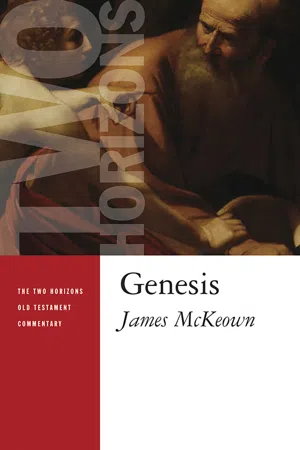
In this commentary James McKeown treats Genesis as a book of beginnings and a foundational sourcebook for biblical theology. He begins with exegesis of the Hebrew text, highlighting the recurrence of key words, phrases, and themes throughout the book. He also draws attention to passages particularly pertinent to earlier readers either facing or returning from exile, offering a historical context outside a solely Christian perspective.
The second half of the book unpacks the numerous theological horizons of Genesis -- main unifying themes (descendants, blessing, land); key theological teachings of Genesis (creation, fall, character and image of God, life of faith); and the contribution of Genesis to theology today, including its impact on science, ecology, and feminist theology.
McKeown's
Genesis provides a solid examination of a scriptural book that reflects the struggles and hopes of its readers -- ancient and modern -- and offers encouragement for their walk with God.
eBook - ePub
Genesis
About this book
Information
Print ISBN
9780802827050
Theological Horizons of Genesis
THEOLOGICAL MESSAGE OF THE BOOK
MAIN UNIFYING THEMES
The book of Genesis, as indeed the Pentateuch, is a collection of fairly diverse materials including narratives and genealogies that may have circulated independently of each other at one time. A great deal of work has been done to analyze the Pentateuch with a view to discovering the sources underlying the finished work. The results of this approach may be seen, for example, in Westermann’s detailed three-volume commentary on Genesis. This approach allowed scholars analytically to examine and critically to evaluate passages in microscopic detail in order to understand their provenance, interrelationship, and respective theological perspectives.1 One of the main drawbacks was that it was not an appropriate method for understanding the overall message of a book. It was more suited to discovering the “Kerygma of the Yahwist” or the theology of the Priestly writer than the theological message of an entire book such as Genesis.
One of the legacies of the analytical approach to the study of the Pentateuch is the consensus that books such as Genesis were not written in the way that a modern author would write a book from cover to cover. Genealogical data, stories, and poetic passages have been brought together with an overall purpose and particular readership in mind to produce a finished work. This does not imply, however, that Genesis, is just a collection of ancient documents or a scrapbook of religious memorabilia. The book has an overall purpose and a logical sequence of events that lead towards a conclusion and denouement. The present chapter seeks to answer the questions “What was this overall purpose?” and “How do we discover it?” More specifically, how do the books of the Pentateuch and Genesis in particular hang together as we now have them; what unifies them and makes them readable as a whole?
In this chapter I argue that there are unifying themes in Genesis that can be identified in every major narrative. These themes provide an explanation for the structure, content, and main emphasis of the work, and they also provide continuity between Genesis and the other books of the Pentateuch. Unifying themes are not just important topics such as “covenant,” for example. No one can deny that “covenant” is important, but it is an event related to a theme rather than a theme in its own right. Unifying themes will not simply be recurring motifs but will easily be identified as the continual emphasis of the book woven into the woof and fabric of every passage. If we can identify themes that affect the structure and content of Genesis to the extent that they are essential for the cohesion and coherence of the work, then we will have identified the interpretative key to the message and significance of the text. If we fail to identify these themes, then we risk misunderstanding the book. We can never know even what a modern author’s intention is for writing a particular book because we cannot access the writer’s inner mind to discover his or her motivation; and in this sense it seems futile to attempt to understand the overall purpose of an author of an ancient book such as Genesis. Nevertheless, at a functional level, the themes that unite diverse material and give a book its final form will be invaluable in shedding light on the raison d’être and theological purpose that gave the book its final form. These themes will also have a bearing on the overall message of the Pentateuch and will show the significance of the message of Genesis in its canonical setting of the Torah and of the Hebrew Bible.
Genesis does not stand on its own but is a component of the Pentateuch. The book ends with the placing of Joseph’s embalmed body in a coffin in Egypt. This ending anticipates the book of Exodus and the story of the return of Joseph’s body to the land of Canaan. In order to identify the unifying themes of Genesis we should, therefore, study the book in its wider context of the Pentateuch and inquire about the themes that provide cohesion for all five books and not just Genesis.
One of the best known attempts to identify the unifying themes of the Pentateuch is provided by Clines in The Theme of the Pentateuch.2 According to Clines, the single theme that enables the Pentateuch to be read as a unity is the partial fulfillment of God’s promises to the ancestors. Clines divides these promises into three groups: land, a relationship with God, and descendants.
These three groups of promises are clearly significant for the book of Genesis as well, and I suggest that they should be identified as the unifying themes of the book. The second theme, a relationship with God, is best approached through the concept of blessing. As we shall see, blessing is God’s way of showing his favor to those who are in a harmonious relationship with him. I intend to deal with these themes in the following order:
- Descendants
- Blessing
- Land
These are not to be understood as independent or parallel concepts running through Genesis but as interrelated and interdependent themes that are part of the rhetorical, theological, and structural distinctiveness of the work. Nor are these themes equal in status and significance. The theme of descendants is the foundational or key theme, since the others, blessing and land, can only be recognized by their relational function to those who benefit from them — the descendants. Therefore, the order in which these themes are studied should be first descendants and then blessing and land.
Descendants
The identification of descendants as, not just a theme, but the key unifying theme of Genesis relies on a number of factors. One obvious indication is the frequent occurrence of the Hebrew word “seed.” It is not just the number of occurrences that is important, but the fact that they occur in all the main narratives. Another unique feature of Genesis is the occurrence of the toledot formula. This will be discussed in more detail below, but it is a formula that is linked to the theme of bearing children and is integral to the structure of Genesis, dividing the book into 10 sections. Another obvious indication of the importance of the theme of descendants is the genealogical material in Genesis. We shall see that these lists are not cosmetic in the book of Genesis, but that they contribute to its theological message and purpose. Moreover, the significance of the theme of descendants is clearly indicated by the way in which the theme is integrated into the story line and plot of every main story in the book. Finally, the theme of descendants provides continuity between Genesis and the other books of the Pentateuch in order to show that the Israelites in Exodus are heirs to the promises made to the patriarchs. The accumulative weight of this evidence is very strong and points unequivocally to the importance and significance of the theme of descendants in Genesis.
We shall now study this theme in more detail.
The frequent occurrences of the word “seed” in Genesis reveal its thematic importance.
Throughout Genesis descendants are referred to using the Hebrew word “seed,” ערַזֶ/zeraʿ. This word is used, first of all, in relation to the plants that are created by God with their seed to produce further plants after their kind. The idea that plants produce more plants of the same kind is repeated frequently in ch. 1. The seed of a specific fruit can be traced back to a parent tree of the same type. This emphasis on the generation of plants prepares the reader to recognize the importance of human genealogical data. Just as the seed of a particular fruit can be traced back to the parent tree, the seed of Abraham1 can be traced back to him and they are heirs of the promises he received.
Modern versions of the Bible often translate the word “seed” with alternatives such as “offspring” or “descendants.” As a result, the English reader may be unaware of the frequency with which the subject of seed occurs. Therefore, a brief survey of the occurrences of “seed” will be helpful to show how this concept is woven into the fabric of the entire book.
After the disobedience in Eden, God pronounces that there will be enmity between the woman’s seed and the serpent’s seed (3:15). Eve refers to Seth as “another seed instead of Abel” (4:25). Noah builds the ark “to keep seed alive on the earth” (7:3). When the flood has abated, God establishes a covenant with Noah and his seed (9:9). In the patriarchal narratives, God promises that Abraham’s seed will inherit the land (12:7; 13:15) and that his seed will be as difficult to number as particles of dust (13:16). However, because Sarah cannot have children, Abraham complains to God that he has no seed (15:3). Again, God confirms that Abraham’s seed will be as numerous and as difficult to number as the stars (15:5). In a vision, Abraham is warned that his seed will be enslaved (15:13). God establishes a covenant with Abraham; his seed will inherit the land (15:18). After Abraham’s relationship with Hagar, an angel tells her that her seed will be too numerous to count (16:10). In ch. 17 God establishes a covenant with Abraham and his seed (17:7), and as part of the proceedings he promises land to Abraham and to his seed (17:8). The text emphasizes that it is not only Abraham who is bound by God’s covenant but also his seed (17:9), and like Abraham his seed must observe circumcision (17:10). Moreover, males in Abraham’s household who are not his seed also must be circumcised (17:12). God promises that Isaac will be born and that he will establish his covenant with him and his seed (17:19). The subject of seed is important for others as well as Abraham, and we are informed that Lot’s daughters are anxious to have seed (19:32, 34). Although Ishmael will become a great nation (21:13), it is emphasized that Abraham’s seed will be reckoned through Isaac (21:12) and will be as difficult to number as the stars (22:17). All nations will be blessed through Abraham’s seed (22:18). The importance that Abraham places on the line of descent through Isaac is emphasized by his insistence on an endogamous marriage for his son; he reminds his servant that God has promised the land of Canaan to his seed (24:7). Seed is also an important issue for Rebekah’s relatives, who wish that her seed will dominate their enemies (24:60).
After the death of Abraham, God confirms the promise of land to Isaac and to his seed (26:3-4). God also promises that Isaac’s seed will be as numerous as the stars and that all nations will be blessed through his seed; to emphasize its importance, the word seed occurs three times in 26:4. God also promises Isaac that the number of his “seed” will be increased for Abraham’s sake (26:24). The concept of seed is also emphasized in connection with Jacob. Isaac wishes for Jacob and his seed the blessing of Abraham (28:4). Furthermore, Jacob receives promises at Bethel; the land will be for him and for his seed (28:13). Indeed, God promises that Jacob’s seed will be like the dust of the earth and that all peoples will be blessed through him and his seed (28:14). Later, when he is afraid, Jacob recalls that God promised that his seed would be as numerous as grains of sand (32:12). When Jacob returns to Canaan and eventually to Bethel, God renews the promise of land to him and to his seed (35:12).
Three interesting occurrences of the word “seed” that English readers may easily miss relate to Onan, who was responsible for raising seed for his dead brother. The Hebrew contains an evocative wordplay, since the word for both offspring and semen is “seed.” So Onan, unwilling to raise seed for his brother, spills his seed on the ground (38:8-9).
In the Joseph narrative, Jacob and all his seed go to Egypt (46:6-7). There are also several references to seed in relation to the crops in Egypt related to the famine (47:19-24). When Jacob is dying, he recounts the promise of land to him and to his seed (48:4). When Joseph brings his sons to Jacob, the old man rejoices that, not only has he seen Joseph alive, but also his seed (48:11). Jacob prophesies that Ephraim’s seed will become a group of nations (48:19).
This survey of the use of the word “seed” in Genesis shows how the term is found in every major narrative, highlighting the importance of the subject of family and, in particular, of lines of descent throughout the book. These occurrences are one of the distinguishing aspects of Genesis and contribute to its overall message.
The toledot formula underlines the structural significance of seed.
Modern readers have the benefit of reading Genesis in a well-structured format with the work clearly divided into chapters and verses, so that with the aid of modern lexical tools we can find any given word or phrase in seconds. Ancient readers did not have the advantage of chapters and verses, but there is evidence that the text was originally divided into 10 sections by a phrase, often called the “toledot formula.” This is usually translated in English as “these are the genera...
Table of contents
- Cover
- Title Page
- Copyright
- Contents
- Acknowledgements
- Abbreviations
- Introduction to Genesis
- Commentary on Genesis
- Theological Horizons of Genesis
- Bibliography
Trusted by 375,005 students
Access to over 1.5 million titles for a fair monthly price.
Study more efficiently using our study tools.
Frequently asked questions
Yes, you can cancel anytime from the Subscription tab in your account settings on the Perlego website. Your subscription will stay active until the end of your current billing period. Learn how to cancel your subscription
No, books cannot be downloaded as external files, such as PDFs, for use outside of Perlego. However, you can download books within the Perlego app for offline reading on mobile or tablet. Learn how to download books offline
Perlego offers two plans: Essential and Complete
- Essential is ideal for learners and professionals who enjoy exploring a wide range of subjects. Access the Essential Library with 800,000+ trusted titles and best-sellers across business, personal growth, and the humanities. Includes unlimited reading time and Standard Read Aloud voice.
- Complete: Perfect for advanced learners and researchers needing full, unrestricted access. Unlock 1.5M+ books across hundreds of subjects, including academic and specialized titles. The Complete Plan also includes advanced features like Premium Read Aloud and Research Assistant.
We are an online textbook subscription service, where you can get access to an entire online library for less than the price of a single book per month. With over 1.5 million books across 990+ topics, we’ve got you covered! Learn about our mission
Look out for the read-aloud symbol on your next book to see if you can listen to it. The read-aloud tool reads text aloud for you, highlighting the text as it is being read. You can pause it, speed it up and slow it down. Learn more about Read Aloud
Yes! You can use the Perlego app on both iOS and Android devices to read anytime, anywhere — even offline. Perfect for commutes or when you’re on the go.
Please note we cannot support devices running on iOS 13 and Android 7 or earlier. Learn more about using the app
Please note we cannot support devices running on iOS 13 and Android 7 or earlier. Learn more about using the app
Yes, you can access Genesis by James McKeown in PDF and/or ePUB format. We have over 1.5 million books available in our catalogue for you to explore.