Theology needs to engage what recent developments in the study of evolution mean for how we understand moral behavior. How does the theological concept of holiness connect to contemporary understandings of evolution? If genetic explanations of altruism fall short, what role should we give to environmental explanations and free will? Likewise, how do genetic explanations relate to theological accounts of human goodness and holiness?In this groundbreaking work, Matthew Hill uses the lens of Wesleyan ethics to offer a fresh assessment of the intersection of evolution and theology. He shows that what is at stake in this conversation is not only the future of the church but also the fine-tuning of human evolution.
eBook - ePub
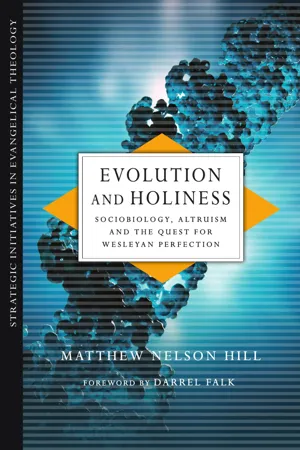
Evolution and Holiness
Sociobiology, Altruism and the Quest for Wesleyan Perfection
- 251 pages
- English
- ePUB (mobile friendly)
- Available on iOS & Android
eBook - ePub
Evolution and Holiness
Sociobiology, Altruism and the Quest for Wesleyan Perfection
About this book
Information
Topic
Theology & ReligionSubtopic
Christian Theology1
INTRODUCTION

1.1 The Aim of This Study
A man lives in a rural part of the Ontario Province in Canada in a community of low socioeconomic status.1 Everyone around him drinks excessively, and so does he; the difference between this man and his peers, however, is that he happens to be a First Nations Canadian compared to his European-descended friends. Unfortunately for this man, he has a genetic disadvantage that his friends do not have: he is lacking an enzyme that quickly breaks down alcohol, making him more predisposed to alcoholism than non–First Nations people.2 Is he less morally responsible for his actions than his friends? Are there ways he might overcome the biological roulette that led to his disease? Questions like this are never easy to answer. Yet genetic predispositions like this are quite common. Perhaps the broader and more interesting question concerns how moral behavior is constrained by our biological makeup. If one can locate these influences, it might be possible to understand the environmental conditions that contribute to moral behavior.
In recent years, new research in evolutionary biology and sociobiology has made the above scenario more intelligible, leading to the knowledge that humans possess numerous behavioral traits that directly link to genetics. Yet, despite much innovative research in sociobiology—a field that applies evolutionary theory to social behavior—theological ethics is still coming to terms with what this new knowledge means for how we understand moral behavior. Therefore, this book finds itself at the intersection of theological ethics and the sciences and seeks, in part, to address questions such as these: (1) How much does sociobiology fully explain moral traits such as human altruism? (2) If genetic explanations do not fully explain human altruism, what role should we give to environmental explanations and free will? (3) How do genetic explanations of altruism relate to theological accounts of human goodness?3 To move toward answers for these questions, I will be reading them through the lens of Wesleyan theology and ethics, offering a unique perspective within the interface of sociobiology and ethics. To propose such a reading, however, the following concerns must be considered: Can Wesleyan bands and classes provide the environmental conditions within which people may develop holiness, beyond their genetic proclivities? If so, how are we to understand Wesleyan holiness against a background of evolutionary biology? Consequently, it is the central aim of this book to explore the significance of human evolutionary theory for Wesleyan holiness.
For the sake of clarity, the reader should note that I purposely use a Wesleyan understanding of holiness throughout this book for two primary reasons. First, John Wesley’s view of holiness was particularly stringent. While Keswickian, Reformed and even Eastern Orthodox notions of sanctification and holiness have their own interactions with human evolution (addressed later in the book), Wesleyan holiness is by far the most rigorous and extreme. I do not mention this caveat to imply any negative connotations attached to either Wesley’s concept of holiness or other formulations from various parts of Christianity. Instead, I use Wesley’s holiness as a lens because, if this demanding concept of holiness can connect to human evolution, then so too can the others. Second, it would simply be beyond the scope of this book to fully address all notions of holiness in every tradition. By focusing on Wesley’s view, while still bringing in concepts from Reformed, Orthodox and other traditions, I hope to connect the disparate fields of holiness and sociobiology in a cogent and orderly way.
Through the process of connecting Wesleyan holiness to sociobiology, there are several other important issues on which I hope to elaborate. I will establish the connection between the sociobiological understanding of human nature, which places human behavior somewhere on a spectrum between egoism and altruism, and accountability groups that have the potential to engender generosity and altruism. I will also articulate how John Wesley, in particular, uniquely approached communicating and transmitting his social ethic. One of his primary modes was the organized bands that held members answerable to a high standard. In regard to the social context of the time, the small groups formed by Wesley, called bands and classes, encouraged people to live out a more altruistic social ethic through accountability.
What is more, from the rise of sociobiology as a self-conscious enterprise, the assumption of sociobiologists has been to explain behavior by the “selfishness” of genes, which gave rise to the problem of altruism. Altruism has been a puzzling phenomenon within sociobiology and has created problems for those who solely appeal to genetic explanations.4 Yet, even within the field of biology, recent studies by Frans de Waal, among others, suggest that their biological “make up” puts humans more to the center of the selfish/selfless spectrum. The ability for change along the spectrum makes it possible for intentional community—structured by environmental constraints on behavior—to shift humans who are genetically inclined to both selfish and altruistic inclinations to favor either the former or latter. This type of intentional community was at the heart of the early Methodist movement. When individuals dwell within community, they learn traits and qualities that are characteristic of altruism, as can be observed in Wesley’s bands and classes, which were powerful vehicles for the communal lifestyle of altruism toward the poor.5 To such a degree, sociobiology confirms what Wesley knew to be true of human nature: humans who dwell within a system of constraints motivated by Christian perfection can cultivate altruistic behavior.
Still, within the context of these highly structured groups there are left open numerous theological and ethical puzzles that need solving. If certain individuals who are cultivating a lifestyle of holiness are more or less inclined to selfish behavior, an adequate theological explanation is necessary in order to account for these genetic differences and how they relate to the Christian call to move toward holiness. One should not separate humans into dualistic categories of body and spirit such that attention focuses only on sociobiological traits, which are inherently material. Instead, I will develop a fuller account of how Wesleyan groups function with the dual concepts of genetic/environmental constraints and ideas of Christian perfection. Although it may seem a contradiction, these concepts can form a cohesive and holistic account of the Christian person.
To be sure, the relationship between morality and holiness can sometimes seem blurry. While I recognize the differences between acts of altruism, morality and the spiritual process of becoming holy, I do not hold the position that these are unrelated activities. In much the same way as the book of James discusses the connection between works and faith, altruism and morality can be linked with holiness. As I will expound upon this throughout the book, one cannot become holy without seeing the fruit of altruism and moral development along the way. Similarly, those practicing altruism and positive moral behavior are in some sense heading in the direction of holiness. As I will discuss later, this process does not happen without the intervention of God. We can see an analogy of this from Wesley himself: when struggling with his faith, his friend Peter Böhler charged him to “preach faith till you have it and then because you have it, you will preach faith.”6 In a similar way, while practicing altruism is not tantamount to practicing holiness, they are never very far from one another.
1.2 Brief Summary of Main Chapters
I intend to begin with a sociobiological look at altruism and conclude with how Wesleyan ethics might express its own account of altruistic behavior as a theological concept of Christian perfection.
The intention of chapter two, “Sociobiological Explanations of Altruism,” is to address the main sociobiological narrative that altruism is a “problem” that needs explanation and solving. Within sociobiology in particular, this behavior has always been considered problematic because it seems to go against the idea of individual selection. How can something that, by definition, reduces individual gene fitness end up being a behavior trait?7 To answer this question, and to set the tone for the following chapters, I explain sociobiological theories of altruism while showing the possibility of biological unselfishness—drawing upon concepts such as kin and reciprocal altruism as well as game theory. Lastly, I investigate the contemporary conversation and the implications of such a discussion within sociobiology.
In chapter three I will discuss how sociobiological explanations of altruistic human action, especially on the basis of genetic evolution alone, are not fully satisfying. I will establish in this third chapter that, although biological explanations account for some of our understanding of altruism, they do not define the phenomena of altruism in its totality. There are also serious environmental influences that impact human action. I will also explain how habitual dimensions factor into altruistic action. Here, any action by an individual creates new behavioral patterns and norms. In other words, what biologists decipher from our genetic past does not prescribe what our future action will necessarily be, or what our moral behavior should be. There is much in the study of human action that we do not understand, even for those in the community of sociobiologists.8
This chapter has three major critiques of sociobiological explanations of altruism. The first criticism addresses the role of culture and its influence on learned human behavior, showing that we are not merely the products of our genes. The second critique discusses sociobiological invocations of problematic language when explaining altruism, which exposes numerous inconsistencies. The third criticism revolves around the inability of sociobiology to explain altruistic behavior without resorting to reductionism. The main issue with such oversimplification is that sociobiologists do not acknowledge the whole human person.9 The last major section in this chapter builds off the former criticisms and shows how a false opposition is developed by sociobiologists between philosophy/theology and sociobiology. This false opposition causes sociobiologists to moralize outside the bounds of science as well as commit a naturalistic fallacy.
One important obstacle to understanding the proper relation between Christian ethics and human evolution lies in the inappropriate forms of reductionism presumed by sociobiology and evolutionary psychology.10 Simon Conway Morris argues that sociobiology is “not so much wrong, as seriously incomplete” when it comes to explanations for altruistic behavior.11 Accounting for genes does not suffice for a total explanation.12 Stephen Pope speaks to this with clarity:
Even on the micro-level, it makes no sense to assume a genetic determinism according to which genes by themselves somehow cause behavior. Genes never function as isolated cases of behavior but, as Rose emphasizes, rather as essential components of complex networks. Behavior, moreover, reflects the influence of a multitude of genes (they are “polygenic”). Genes play an important role in the cluster of causes that lie behind behavior, but are not “the” cause of behavior.13
What Pope describes here is one of the fundamental errors of reductionist thinking. To be fair, most sociobiologists do not believe traits are the result of single genes. When they talk of a “gene for altruism” or a “gene for egoism” it can sometimes be done for linguistic convenience. Still, although sociobiologists like Dawkins are not gene “fatalists”—Dawkins specifically acknowledges that genetic causes and environmental causes are in principle no different from each other14—the line is often considerably ...
Table of contents
- Cover
- Title Page
- Dedication
- Contents
- Foreword by Darrel R. Falk
- Acknowledgments
- Epigraph
- 1 Introduction
- 2 Sociobiological Explanations of Altruism
- 3 Altruism and the Explanatory Limitations of Evolution
- 4 Overcoming Genetic and Environmental Constraints on Altruism
- 5 Wesleyan Holiness Against a Backdrop of Evolution
- 6 How Wesley Nurtured Altruism Despite Biological Constraints
- 7 A Lifestyle of Holiness
- Appendix 1: Excerpt from “Principles of a Methodist” on the Topic of Christian Perfection
- Appendix 2: Excerpt from “A Plain Account of Christian Perfection”
- Appendix 3: Rules of the Band Societies—Drawn Up Dec. 25, 1738
- Notes
- Bibliography
- General Index
- Praise for Evolution and Holiness
- About the Author
- Strategic Initiatives in Evangelical Theology
- More Titles from InterVarsity Press
- Copyright
Trusted by 375,005 students
Access to over 1.5 million titles for a fair monthly price.
Study more efficiently using our study tools.
Frequently asked questions
Yes, you can cancel anytime from the Subscription tab in your account settings on the Perlego website. Your subscription will stay active until the end of your current billing period. Learn how to cancel your subscription
No, books cannot be downloaded as external files, such as PDFs, for use outside of Perlego. However, you can download books within the Perlego app for offline reading on mobile or tablet. Learn how to download books offline
Perlego offers two plans: Essential and Complete
- Essential is ideal for learners and professionals who enjoy exploring a wide range of subjects. Access the Essential Library with 800,000+ trusted titles and best-sellers across business, personal growth, and the humanities. Includes unlimited reading time and Standard Read Aloud voice.
- Complete: Perfect for advanced learners and researchers needing full, unrestricted access. Unlock 1.5M+ books across hundreds of subjects, including academic and specialized titles. The Complete Plan also includes advanced features like Premium Read Aloud and Research Assistant.
We are an online textbook subscription service, where you can get access to an entire online library for less than the price of a single book per month. With over 1.5 million books across 990+ topics, we’ve got you covered! Learn about our mission
Look out for the read-aloud symbol on your next book to see if you can listen to it. The read-aloud tool reads text aloud for you, highlighting the text as it is being read. You can pause it, speed it up and slow it down. Learn more about Read Aloud
Yes! You can use the Perlego app on both iOS and Android devices to read anytime, anywhere — even offline. Perfect for commutes or when you’re on the go.
Please note we cannot support devices running on iOS 13 and Android 7 or earlier. Learn more about using the app
Please note we cannot support devices running on iOS 13 and Android 7 or earlier. Learn more about using the app
Yes, you can access Evolution and Holiness by Matthew Nelson Hill in PDF and/or ePUB format, as well as other popular books in Theology & Religion & Christian Theology. We have over 1.5 million books available in our catalogue for you to explore.