In Delivered from the Elements of the World Peter Leithart reframes Anselm's question, "Why the God Man?" Instead he asks, "How can the death and resurrection of a Jewish rabbi of the first century . . . be the decisive event in the history of humanity, the hinge and crux and crossroads for everything?" With the question reframed for the wide screen, Leithart pursues the cultural and public settings and consequences of the cross and resurrection. He writes, "I hope to show that atonement theology must be social theory if it is going to have any coherence, relevance or comprehensibility at all."There are no small thoughts or cramped plot lines in this vision of the deep-down things of cross and culture.While much is recognizable as biblical theology projected along Pauline vectors, Leithart marshals a stunning array of discourse to crack open one of the big questions of Christian theology. This is a book on the atonement that eludes conventional categories, prods our theological imaginations and is sure to spark conversation and debate.
eBook - ePub
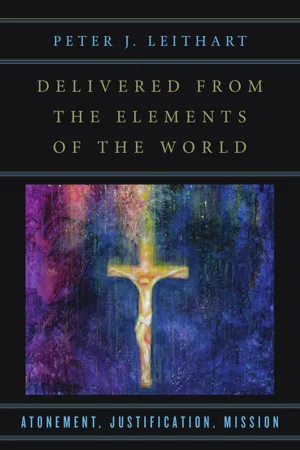
Delivered from the Elements of the World
Atonement, Justification, Mission
- 368 pages
- English
- ePUB (mobile friendly)
- Available on iOS & Android
eBook - ePub
About this book
Information
Topic
Theology & ReligionSubtopic
Biblical Studies- one -
ATONEMENT AS SOCIAL THEORY

No purely secular society exists or has ever existed. Define religion how you will: As a matter of ultimate concern, as belief in something transcendent, as the organizing master narrative for history and human lives, as a set of practices. However religion is defined, all institutions, structures and patterns of behavior have religious features. All cultures are infused with values and actions that have religious dimensions and overtones. Whether they name the name of a known God or not, societies and cultures are always patterned by some ultimate inspiration and aspiration.
By the same token, all religions have social aspects; they all are embedded in and rely on patterns of interaction among persons. Even the retreat of a solitary ascetic into the desert is a social act, since it is a retreat from social relation. And all religions deal with artifacts, symbols and rituals that might as well be called “cultural.”
Religion is not the “soul” of culture, nor culture the “body” of religion. Religions have bodies, and cultures have souls. It is rather the case that in dealing with any group of human beings, we are always dealing with socioreligious or religio-cultural entities. The common contemporary rhetoric of conflicts between religion and politics obscures the reality. Conflicts are never between politics and religion. Conflicts are always between rivals that are both religious and both political.
Islamic terrorists kill themselves and innocent bystanders for overtly religious reasons. In response, the United States sends troops to the Middle East to make the world safe from terrorism, but also to sacrifice themselves to preserve and advance America’s values, freedom and democracy. To say that the terrorist and the Marine are both motivated by religious values is not to make a moral equivalence. But we misread the times unless we recognize that the war on terror is a religious war on both sides.
We think ourselves all secular, all grown-up, but we have our taboos, our pollution avoidances, our instincts of recoil and disgust. Not so long ago, many found homosexual sodomy disgusting. In a matter of decades, the disgust has turned inside out, and now those who consider homosexual conduct sinful and unnatural are outcasts, treated with contempt. The freedom to engage in any form of consensual sex is now considered a right, and a sacred one, as inviolable as the sacred precincts of an ancient temple.
When the religious character of society is stressed, the emphasis is often placed more or less exclusively on beliefs. It is thought that societies and cultures are religious because they express religious ideas. Contemporary American culture is religious because it is founded on a belief system that Christian Smith has labeled “Moralistic Therapeutic Deism.” That emphasis on ideas is misplaced, not because beliefs are insignificant, but because beliefs and practices are inseparable. Exclusive focus on beliefs misses the habitual, often instinctive actions that form the stuff of social relationships. Rules of etiquette are, deep down, based on a set of beliefs, but few mothers teach their children those beliefs. What they teach is, “Say thank you” and “Shake hands with the nice man” and “Don’t pick your nose!”
My references to purity and holiness are not accidental. I will argue in this book that the fundamental physics of every socioreligious, cultural-religious formation consists of practices concerning holiness, purity and sacrifice. Locate the sacred center of a group; its boundaries of tolerable and intolerable persons, objects and behavior; its rituals of sacrifice—discover all this and you have got down to the elementary particles that determine the group’s chemical composition. Relocate the sacred, rearrange the boundaries of purity and pollution, revise its sacrificial procedures, and you have changed the fundamental physics of the society. A revolution here is the most profound of social revolutions, and it is the revolution achieved by Jesus in his cross and resurrection.
Cur Deus Homo
Delivered from the Elements of the World addresses questions internal to Christian theology. That is not a limitation. Christians believe the gospel encompasses everything, and so all Christian theology that is worthy of the name strains beyond the confines of “theology” to the ends of the earth.
The main questions I attempt to answer can be posed in several complementary ways.
They can be posed as a variation on the interrogative form of Anselm’s classic treatise on the atonement, Cur Deus Homo? At one level, my aim is the same as Anselm’s. It is an attempt to unravel the rationality of the central claims of the Christian gospel: Jesus died and rose again to save us from our sins. Like Anselm, I assume that the gospel is true and probe to discover how it happened. How can the death and resurrection of a Jewish rabbi of the first century, an event in the putative backwaters of the Roman Empire, be the decisive event in the history of humanity, the hinge and crux and crossroads for everything? Even here we can assume a partial that: because of the history of the church founded by Jesus, it is clear that his death and resurrection changed a great deal, perhaps everything. Again, my question is about the mechanics: How did that happen?
Unlike Anselm, however, I have self-consciously asked Cur Deus Homo as a question of social and political theology, as an exploration of the cultural and public settings and consequences of the event of the cross and resurrection. We are social and political creatures. If humanity is going to achieve a state of health (what Christians call salvation), we are going to have to be saved in our social and political situations; our social structures and political institutions are going to have to become conducive to harmony and justice, peace and human flourishing. For Christians, the health of the human race turns on the work done by Jesus, and that means that the good of social life must somehow have its source there, on Calvary and at the empty tomb. Ultimately Jesus died and rose again to bring the human race to its final end in glory, to gather a people who will one day be a spotless bride, without blemish or wrinkle or any such thing, a perfected humanity to be presented to the Father. While I keep that eschatological qualification in mind throughout, my focus is on the already of the eschatological dualism. Cur Deus Homo for the salvation of human society in history? What need do we have of a God-man, or of the death and resurrection of a God-man, to restore human culture and society? Why can we not simply establish institutions that promote peace and justice? Why can we not found our common life on our common humanity?1
That is one way to ask the question. Another is in terms of sacramental theology: the church cannot exist without rites, any more than any society. For there is no religious society, Augustine insists, whether true or false, whose separate members are not “coagulated” into common life by sacraments and signs. According to Augustine, old figural and prophetic sacraments are fulfilled in new sacraments, more powerful, easier and fewer than the sacraments of old (virtute maiora, utilitate meliora, actu faciliora, numero pauciora; Contra Faustum 19.13). Fine. I agree. But again my question is, Why do we need a dead and risen Christ to accomplish this? When Moses instituted the sacraments of the old law, there was opposition, occasional threats on his life, but in the end he survived to see Torah established. Why could Jesus not be another Moses? Why could he not be a teacher and founder of a new cultus and a new sect? Why does he need to die in order to institute new signs and sacraments for the new society he forms? Why the cross if the task is simply to relocate the sacred and change the rules of purity and sacrifice?
The question can be posed in another way. Old Testament acts of judgment and redemption were inescapably acts of social and political salvation, and if Christian faith takes the Old Testament as canon, and if Jesus and his body fulfill Israel’s history, then judgment and redemption in Christian theology must take social and political form. It must at least coagulate that new society around those new sacraments, but, beyond that, if the gospel is about the salvation of humanity it must carry a message of hope for the salvation of human society.
The problem is this: Old Testament acts of judgment and redemption were comprehensibly acts of judgment and redemption. Many today will think the story of Adam’s sin in Eden’s garden to be a bit of implausible mythology. But it is comprehensible mythology: Adam is put in a garden and told not to eat the fruit of the tree on pain of death. Yahweh forms Eve to be a helper suited to him. We know what will happen: Satan tempts Eve, she and Adam eat, and they are expelled from the garden, exiled from the tree of life. Many regard it as a children’s story; even the skeptic can agree that it has at least one virtue: it possesses the bright clarity of a fairy tale.
So too do the other stories of judgment and deliverance throughout the Old Testament. Seeing his world ruined by violent heroism, Yahweh regrets having created in the first place, so he wipes out the world in the flood. Yet he rescues Noah by disclosing the threat ahead of time and giving him instructions for an ark. Again, many sniff out mythology here, but it is not a difficult myth to understand. Catastrophe falls on wrongdoers (yay!), and the one righteous man is delivered (yay! again). It happens in the exodus (oppressive Egypt and Pharaoh decimated, Israel delivered); it happens again and again in the time of the judges; it happens in David’s battles with Goliath and with Philistines; it happens on a national scale when Israel is handed over to exile and then brought back to the land. The Old Testament records a long and complex history, but throughout judgment and salvation are perfectly clear: Judgment means that bad things happen to bad people; salvation means that God rescues the righteous, those who trust and walk with him.
Not only are these judgments and rescues comprehensible, but they are comprehensible as historical events, events in the political history of nations, even if one does not believe they happened. Yahweh devastates Egypt and brings Israel to Sinai to give them a tabernacle and a constitution for their national life: a clearly political rescue. So too for the battles of judges, the deliverance of Jerusalem from Assyrians, the return from exile.
It is not at all clear that the death and resurrection of Jesus is an act of judgment and salvation on anything like the same scale. If God wanted to save the whole world, why not another global flood—or, failing that, since he promised not to flood the world again, a Stoic conflagration that surgically targets bad guys? Why not, at least, a David with a sword (or five stones), a Gideon, a Jehu? Why not a freedom fighter to liberate Israel from Rome? That would be comprehensible, and comprehensibly political.
Yet Christians say that this event of Jesus’ crucifixion and resurrection—not the flood, exodus or return from exile—is the decisive moment for the salvation of the world. If it is comprehensible at all, the death of a supposed Messiah is not immediately comprehensible as a saving act, though resurrection is certainly good news for the dead Messiah himself. The problem is intensified when we add that this event is supposed to be the source of social, economic and political justice and peace. The problem becomes nearly impossible when Christians say, as we often have over the years (starting with Jesus, Lk 24), that these events form the fitting, even the inevitable climax, to that comprehensible history of political judgment and deliverance we read about in the Old Testament. This is what Israel’s history was all aiming at?
So: God destroys the world with water and rescues Noah; he demolishes Egypt and leads Israel through the sea to Sinai and to the land; he raises David and Solomon to glorify Israel among the nations; in his wrath, he casts Israel into exile, but then draws them back in love—he does all this, and the key to what this means is the life of a Galilean teacher crucified on a Roman cross, raised from the dead on the third day. This is the concluding chapter that ties up all the loose ends of the Bible’s story?
Something very odd is going on here. Christianity’s claim has become domesticated by its success, but to grasp the logic we need to undomesticate it and recover a sense of the word made strange. Either Christianity’s good news is incomprehensible delusion, or it operates by a logic that violates much of the logic we believe explains the world. It is either irrational, or it reveals that the world itself has a rationality quite different, more subtle and certainly odder, than we believe.
This is not a book of apologetics, nor a history of theologies of the atonement. But in writing it I have been conscious that skepticism about the atonement found in Kant and, behind him, Faustus Socinius, has been central to modern assaults on the rationality of Christian faith. The attack on the rationality of the cross was an attack on the rationality of Christianity and the Bible. For Kant and many moderns, atonement theology was an invention of priests. Real atonement is self-help, repentant turning from evil and doing right. That, like the story of the fall, is perfectly comprehensible. It has all the clarity of, though less plausibility than, a fairy tale.
This has direct bearing on the social and political questions that animate this book, for if we can correct ourselves by our own natural powers, surely we are also capable of establishing social and political structures that embody the kingdom of God. Kant’s Pelagian atonement is intimately linked to Kant’s advocacy of liberal political order. If, by contrast, Christians say that individuals can be put back on the track of justice only by the death and resurrection of Jesus, then we also raise fundamental questions about the adequacy of liberalism to achieve our political ends.
Satisfaction theories came under special criticism from Socinians and others, and penal substitution makes an appearance in what follows. I affirm it, with appropriate cautions and qualifications. More than cautions, I offer context, because we cannot make sense of Jesus’ suffering the penalty for others’ wrongs unless we see it as a summary of the plot of the gospel story. Jesus’ substitutionary death is one moment in a sequence of redemptive acts, in a complex sacrificial movement, and without the other moments before and after, it is no redemption at all. Isolating the moment of substitutionary death does havoc to our theology of atonement and our soteriology generally, not to mention our ecclesiology and sacramental theology and practice.
Thus, though I focus on the sociopolitical dimensions of the atonement, I hope that this focus illuminates traditional questions about the atonement. Indeed, I hope to show that atonement theology must be social theory if it is going to have any coherence, relevance or comprehensibility at all.
How This Book Proceeds
Methodological excursions are boring, and I do not want to bore the reader. But I do want to sketch out the framework in which this book operates and the criteria that I have used to test the success of the venture.
I have described Delivered from the Elements of the World as my Big Red Book About Everything, and its scope is evident in the variety of “discourses” that make appearance in the following pages: anthropological studies, especially of sacrifice and ritual; postmodern “cultural studies,” especially the theories of René Girard; research on ancient Near Eastern religion (chapter three); classics, especially studies of Greek religion and sacrifice (chapter three); Old Testament studies, particularly on Leviticus and the Levitical system of temple, purity and sacrifice (chapter four); historical Jesus studies, studies of the Gospels as narrative and political studies of the gospel (chapters five a...
Table of contents
- Cover
- Title Page
- Dedication
- Contents
- Acknowledgments
- 1 Atonement as Social Theory
- PART 1: Under the Elements of the World
- PART 2: Good News of God’s Justice
- PART 3: Justification
- PART 4: Contributions to a Theology of Mission
- Appendix 1: The Metaphysics of Atonement: Natural and Supernatural
- Appendix 2: Nature, the Supernatural and Justification
- Appendix 3: Atonement by Deliverdict: Romans
- Notes
- Author Index
- Subject Index
- Scripture Index
- Praise for Delivered from the Elements of the World
- About the Author
- More Titles from InterVarsity Press
- Copyright
Trusted by 375,005 students
Access to over 1.5 million titles for a fair monthly price.
Study more efficiently using our study tools.
Frequently asked questions
Yes, you can cancel anytime from the Subscription tab in your account settings on the Perlego website. Your subscription will stay active until the end of your current billing period. Learn how to cancel your subscription
No, books cannot be downloaded as external files, such as PDFs, for use outside of Perlego. However, you can download books within the Perlego app for offline reading on mobile or tablet. Learn how to download books offline
Perlego offers two plans: Essential and Complete
- Essential is ideal for learners and professionals who enjoy exploring a wide range of subjects. Access the Essential Library with 800,000+ trusted titles and best-sellers across business, personal growth, and the humanities. Includes unlimited reading time and Standard Read Aloud voice.
- Complete: Perfect for advanced learners and researchers needing full, unrestricted access. Unlock 1.5M+ books across hundreds of subjects, including academic and specialized titles. The Complete Plan also includes advanced features like Premium Read Aloud and Research Assistant.
We are an online textbook subscription service, where you can get access to an entire online library for less than the price of a single book per month. With over 1.5 million books across 990+ topics, we’ve got you covered! Learn about our mission
Look out for the read-aloud symbol on your next book to see if you can listen to it. The read-aloud tool reads text aloud for you, highlighting the text as it is being read. You can pause it, speed it up and slow it down. Learn more about Read Aloud
Yes! You can use the Perlego app on both iOS and Android devices to read anytime, anywhere — even offline. Perfect for commutes or when you’re on the go.
Please note we cannot support devices running on iOS 13 and Android 7 or earlier. Learn more about using the app
Please note we cannot support devices running on iOS 13 and Android 7 or earlier. Learn more about using the app
Yes, you can access Delivered from the Elements of the World by Peter J. Leithart in PDF and/or ePUB format, as well as other popular books in Theology & Religion & Biblical Studies. We have over 1.5 million books available in our catalogue for you to explore.