Whether on the printed page, the television screen or the digital app, we live in a world saturated with images.Some images help shape our understanding of ourselves and the world around us in positive ways, while others lead us astray and distortour relationships. Christians confess that human beings have been created in the image of God, yet we chose to rebel against that God and so became unfaithful bearers of God's image. The good news of the gospel is that Jesus, who is the image of God, restores the divine image in us, partially now and fully in the day to come.The essays collected in The Image of God in an Image Driven Age explore the intersection of theology and culture. With topics ranging across biblical exegesis, theart gallery, Cormac McCarthy, racism, sexuality and theosis, the contributors to this volume offer a unified vision—ecumenical in nature and catholic in spirit—of what it means to be truly human and created in the divine image in the worldtoday.This collection from the 2015 Wheaton Theology Conference includes contributions by Daniela C. Augustine, Craig L. Blomberg, William A. Dyrness, Timothy R. Gaines and Shawna Songer Gaines, Phillip Jenkins, Beth Felker Jones, Christina Bieber Lake, Catherine McDowell, Ian A. McFarland, Matthew J. Milliner, Soong-Chan Rah and Janet Soskice, as well as original poems by Jill Peláez Baumgaertner and Brett Foster.
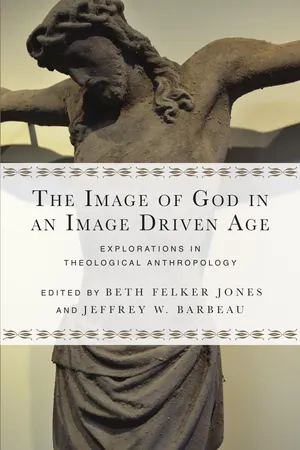
eBook - ePub
The Image of God in an Image Driven Age
Explorations in Theological Anthropology
- 272 pages
- English
- ePUB (mobile friendly)
- Available on iOS & Android
eBook - ePub
The Image of God in an Image Driven Age
Explorations in Theological Anthropology
About this book
Information
Topic
Theology & ReligionSubtopic
Christian TheologyPart One

CANON
1
“In the Image of God He Created Them”
How Genesis 1:26-27 Defines the Divine-Human Relationship and Why It Matters1
Catherine McDowell

Introduction
Genesis 1:26-27 has long generated a tremendous amount of lay and scholarly interest, and rightly so. Not only does it hold pride of place, with the rest of Genesis 1, as the introduction to the Bible, but it also describes the creation of the first humans in relation to God himself using the unexpected terms image (ṣelem) and likeness (dəmût):
God said, “Let us create humanity2 in our image, according to our likeness. Let them rule over the fish of the sea and the birds of the sky and over the beasts, and over all the earth, and over everything that creeps on the earth.” So God created humanity3 in his image. In the image of God he created them.4 Male and female he created them. (author’s translation)
What the terms image and likeness mean has been debated for centuries. In this chapter I will suggest that to be created in God’s image is to be God’s kin, specifically, “son,” with all the responsibilities and privileges sonship entails. I will then examine how Israel’s status as “created in the image” was embodied in the law and what this can teach us about bearing the image of God in our world today.
Interpretations of Genesis 15
The dominant view throughout the history of interpretation has been that these terms refer to a spiritual or mental similarity to God with which humans were endowed at creation. One early proponent of this view is the first-century Jewish philosopher Philo of Alexandria. Philo argued that because God is a spiritual, nonmaterial being, to be created in his image and according to his likeness must refer to an immaterial, spiritual correspondence. This was the prevailing view during the first two centuries of the church. It continued in popularity with Augustine, who claimed that human likeness to God consists in human memory, intelligence (or understanding) and will, all of which are necessary for knowing, understanding and loving God.6
Martin Luther agreed. He concluded, “When Moses says that man was created also in the similitude of God, he indicates that man is not only like God in this respect that he has the ability to reason, or an intellect, and a will, but also that he has a likeness of God, that is, a will and intellect by which he understands God and by which he desires what God desires.”7
This was also a common understanding among German scholars during the late nineteenth and early twentieth centuries. August Dillmann argued that because God is spirit, image and likeness simply could not refer to a corporeal resemblance. The likeness, he inferred, must consist in humanity’s mental capacity and desire for the eternal, true and good.8 Samuel Rolles Driver agreed, claiming that the image of and likeness to God was manifest in the human ability to reason and to comprehend moral and religious truth.9 Although there are many nuanced views within the broader category of a nonmaterialistic interpretation of the imago, it has been and remains the most popular category for explaining image and likeness in Genesis 1:26-27.
There is much to commend this interpretation. Although God has appeared in anthropomorphic form, both in theophanies and visions of the Old Testament and in Christ himself (Col 1:5; 2 Cor 4:4), many argue that the incorporeality of God is implied by the fact that God exists as Spirit (Gen 1:2; Num 24:2; 1 Sam 10:10; 19:20; Ezek 11:24; Mt 3:16; Rom 8:9; 1 Cor 2:11), by prohibitions against image making (Ex 20:4; Deut 5:8), by direct references to divine formlessness (Deut 4:12, 15; Jn 5:37) and, perhaps most overtly, by John 4:24 (“God is spirit”).10 I argue, however, that God’s spiritual nature does not preclude divine self-revelation in other forms. While commands in Exodus 20:4 and Deuteronomy 5:8 forbid the creation of idols, they do not claim that God has no form. Similarly, Deuteronomy 4:12, 15 (compare Jn 5:37) states that Israel saw no form of God at Horeb, not that God is formless. Finally, the statement in John 4:24 does not mean that God is manifest only as Spirit. As noted above, the incarnation belies this conclusion. And while it is true that human beings are endowed with godly qualities and capacities and with gifts of reason, these should be understood as results of being created in God’s image and likeness rather than as definitions of the terms. In sum, I suspect the nonmaterial interpretations of image and likeness have more to do with Philo and Greek philosophy than with Genesis 1 and the biblical and ancient Near Eastern contexts, which are crucial for understanding these terms.
Despite the popularity of nonmaterial views of image and likeness, the idea that God has a form, and that the human body resembles it, is a prominent idea in rabbinic theology. The premier work on the subject remains Arthur Marmorstein’s Essays in Anthropomorphism (1927), in which Marmorstein credits the followers of Rabbi Akiva and their literal reading of the biblical text with the development of an anthropomorphic understanding of God.11 The argument, in short, is that God has a body because the Bible says so. At many points in the Old Testament, God is described in anthropomorphic terms: he redeems Israel with his outstretched arm (Ex 6:6), he smells the pleasing aroma of a sacrifice (Gen 8:21), his eyes run to and fro throughout the earth (2 Chron 16:9), the cry of the afflicted reaches his ears (Ps 22:24; Job 34:28), and so on. Further, the Old Testament reports theophanies in which God appears in human form. Ezekiel describes the Ancient of Days as having “a likeness with a human appearance” (Ezek 1:26 ESV). Daniel refers to God’s clothing, the hair of his head and his being seated on a throne (Dan 7:9). In Daniel 7:13, the prophet describes the glorified Christ, ruler of God’s kingdom, as “one like a son of man”—that is, with a human form.
Building on the idea that image and likeness refer to corporeality, Nöldeke relates the Hebrew term image (ṣelem) to its Arabic cognate (ṣalama), which means “to cut” or “to cut off” in reference to sculpture. He concludes that image in Genesis 1 thus refers to physical representation. This idea seems to be supported by Genesis 5:3, where Adam’s fathering of Seth in his own likeness and after his image is analogous to God’s creation of humanity in God’s likeness (dəmût).12 The German form critic Hermann Gunkel commented, “God created Adam in his image; Adam begot Seth in his image. The second statement is very clear: the son looks like the father; he resembles him in form and appearance. The first statement is to be interpreted accordingly: the first human resembles God in form and appearance.”13
This material interpretation of image and likeness may seem far-fetched to those of us accustomed to thinking of God only in spiritual terms. Is not anthropomorphic language applied to God simply a poetic way of rendering, within the limits of human language, an indescribable reality? Can we reasonably conclude from these texts that God has a physical form? The proponents of the material view are right, however, to insist that we interpret Genesis 1:26-27 in light of Genesis 5:1-3. Image and likeness in Genesis 5 must have something to do with these same terms in Genesis 1. The primary weakness of the material view is that it interprets the terms too narrowly. Indeed, image and likeness can refer to physical similarity, but they are not limited to it.
A third view is that of interpreting image and likeness in terms of relationship. The Swiss theologian Karl Barth perhaps best represents this idea.14 This view notices that, when contrasted with the animals, humans are unique in their capacity to relate and respond to God, and, unlike the animals, they can enter into a covenant relationship with God. Two features of the creation account define this relationship. The first is the plural in Genesis 1:26, “Let us make,” which Barth—following many others before him—interprets as a reference to the triune plurality of the one God. The second feature is the creation of humanity in two distinct genders (Gen 1:27). In being created male and female, humanity is both plural and differentiated and thus reflects relationship within the godhead.15 In short, according to Barth, image in Genesis 1 does not refer to qualities or characteristics; neither is it about physical form. Rather, it consists in the “analogy of relation”: the relationship between male and female is in some way analogous to the relationship among the persons of the Trinity.16
One strength of this view is that it recognizes the relational component that the terms image and likeness imply. However, it falls short in that it fails to ground its case in the text and within its biblical and ancient Near Eastern contexts. The result is that implications (i.e., an intimate relationship that humans enjoy with God but that animals do not) are mistaken for meaning.
A fourth and final view of the image is that of the “royal representative.” In 1915, Johannes Hehn published an article explaining image and likeness in Genesis 1 in light of Babylonian and Egyptian parallels, which defined the king as the image of the god.17 He concluded that, like their Babylonian and Egyptian counterparts, these terms in Genesis are royal designations for humanity—that is, human beings are God’s royal representatives on the earth. Hehn’s work and the work of those who have developed his ideas18 have had a powerful influence in imago Dei studies. This view now prevails among biblical scholars,19 although regrettably it does not seem to have made its way into the church in any significant measure.
The strength of the “royal representative” view is that it seeks to interpret the terms in their ancient Near Eastern context. I suggest, however, that this is another case of mistaking implication for meaning. Humanity’s royal status is, rather, derived from its identity as defined by image and likeness—that is, humans are endowed with royal status because they are created in the image and according to the likeness of God. Thus, while understanding these terms in their ancient Near Eastern context was certainly an interpretive breakthrough, the royal status and representative function result from—rather than define—the image of God. The primary question of what it means that humanity is created in God’s image remains unanswered.
Image as Correspondence, Kind and Kin
Genesis 5:1-3. In Genesis 5, image and likeness express correspondence:20
This is the book of the generations of humanity. When God created humanity, he made it in the likeness of God.21 Male and female he created them, and he blessed them and named them humanity when they were created. When Adam had lived 130 years, he fathered a son in his own likeness, after his image, and named him Seth. (Gen 5:1-3, author’s translation)
Seth is in some way similar to his father, yet he is not Adam, just as Adam and Eve are like God in some way, yet they are not God. The author gives no explanation of what constitutes the likeness, but the plain reading of the text suggests that Seth resembles his father simply because his father begat him. By analogy, humans correspond to God because God creates them. Thus, this correspondence is intrinsic to the relationship between Creator and created.22 When read in light of Genesis 1:26-27, to which Genesis 5:1-3 refers, the correspondence the author may have had in mind seems to be that of class. Seth is a human being, not a fish or a sheep, because his father is a human being. In short, to be created in Adam’s likeness and according to his image means that Seth was created according to Adam’s kind.
Genesis 9:5-6. In Genesis 9, the imago Dei appears as justification for the punishment of those who shed human blood:
And for your lifeblood I will require a reckoning [demand an accounting]: from every beast I will require it. And from each human being I will require a reckoning for the life of another human being. Whoever sheds human blood, by humans shall their blood be shed, because in the image of God he [God] made...
Table of contents
- Cover
- Title Page
- Dedication
- Contents
- Acknowledgments
- Introduction
- Zola, Imago Dei, on Her First Birthday
- Whiteout
- Part One: Canon
- Part Two: Culture
- Part Three: Vision
- Part Four: Witness
- Epilogue
- Notes
- List of Contributors
- Name and Subject Index
- Scripture Index
- Praise for The Image of God in an Image Driven Age
- About the Authors
- More Titles from InterVarsity Press
- Copyright
Trusted by 375,005 students
Access to over 1.5 million titles for a fair monthly price.
Study more efficiently using our study tools.
Frequently asked questions
Yes, you can cancel anytime from the Subscription tab in your account settings on the Perlego website. Your subscription will stay active until the end of your current billing period. Learn how to cancel your subscription
No, books cannot be downloaded as external files, such as PDFs, for use outside of Perlego. However, you can download books within the Perlego app for offline reading on mobile or tablet. Learn how to download books offline
Perlego offers two plans: Essential and Complete
- Essential is ideal for learners and professionals who enjoy exploring a wide range of subjects. Access the Essential Library with 800,000+ trusted titles and best-sellers across business, personal growth, and the humanities. Includes unlimited reading time and Standard Read Aloud voice.
- Complete: Perfect for advanced learners and researchers needing full, unrestricted access. Unlock 1.5M+ books across hundreds of subjects, including academic and specialized titles. The Complete Plan also includes advanced features like Premium Read Aloud and Research Assistant.
We are an online textbook subscription service, where you can get access to an entire online library for less than the price of a single book per month. With over 1.5 million books across 990+ topics, we’ve got you covered! Learn about our mission
Look out for the read-aloud symbol on your next book to see if you can listen to it. The read-aloud tool reads text aloud for you, highlighting the text as it is being read. You can pause it, speed it up and slow it down. Learn more about Read Aloud
Yes! You can use the Perlego app on both iOS and Android devices to read anytime, anywhere — even offline. Perfect for commutes or when you’re on the go.
Please note we cannot support devices running on iOS 13 and Android 7 or earlier. Learn more about using the app
Please note we cannot support devices running on iOS 13 and Android 7 or earlier. Learn more about using the app
Yes, you can access The Image of God in an Image Driven Age by Beth Felker Jones, Jeffrey W. Barbeau, Beth Felker Jones,Jeffrey W. Barbeau in PDF and/or ePUB format, as well as other popular books in Theology & Religion & Christian Theology. We have over 1.5 million books available in our catalogue for you to explore.