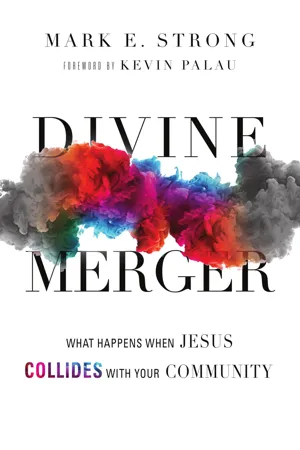
What would happen if your community had a head-on collision with Jesus? Pastor and community leader Mark Strong says, "You would have exactly what God wants: a divine merger!" He continues: "A divine merger is when the church intentionally integrates with its community. . . . The result is a kingdom transformation."This book is designed to give you the vision and tools you need to fulfill your own God-given mission in your community and church. Ranging from single-person sponsored ministries to church-wide and even multi-church regional ministries, these pages are packed full of ideas. The practical wisdom here will help any follower of Christ, pastor or church leader engage their community. Each chapter concludes with questions for reflection appropriate for either individuals or groups. Are you ready to plan your divine merger?
- 176 pages
- English
- ePUB (mobile friendly)
- Available on iOS & Android
eBook - ePub
About this book
Information
Topic
Theology & ReligionSubtopic
Christian Ministryone
Strategic Positioning
I’m sure you’ve heard this before: “I was in the right place at the right time.” Or maybe your ear has caught wind of another version: “I was in the wrong place at the wrong time.” Note that in both cases, the speakers attribute the outcomes to chance.
Divine mergers require deliberate and strategic positioning. Meaning, by choice and by God’s grace, you intentionally align yourself in a missional space between your church and your community. In other words, you constantly have one foot in the church and one foot in your community. When it comes to the church, you’re all in; when it comes to the community, you’re all in.
By living in this space, you can harness the capacity to facilitate a Jesus collision in your community. A vivid example that clearly defines the importance of strategic positioning is the life of Abraham.
Between Bethel and Ai
One verse has been extremely helpful to me and to our church regarding positioning: Genesis 12:8. The imagery in the verse illustrates the necessity of being in the right position. Not only that, it implies powerful prophetic possibilities and implications for our churches and communities. It says, “From there he went on toward the hills east of Bethel and pitched his tent, with Bethel on the west and Ai on the east. There he built an altar to the LORD and called on the name of the LORD.”
Abram was having a fresh, life-changing encounter with God—an encounter that moved him out of his comfort zone and launched him on a God-guided journey into Canaan. The second stop of his journey is where Genesis 12:8 picks up. Since no Marriott or Hilton hotels are available, Abram has to pitch a tent. Where he pitches his tent is all-important. The location where he chooses to live for a season places him in a very strategic position.
The site of his lodging is between Bethel and Ai. To the west is Bethel, and to the east lies Ai. Absent from this verse are a few pieces of information that would be helpful to know. For one, it would be nice to know a bit about some of Abraham’s interactions with the Canaanite people who were living in Bethel and Ai at the time. Also, it would be nice to have a footnote or two as to how Bethel and Ai acquired their names.
Many times in Scripture the names of individuals and places are based on their attributes. Bethel literally means “the house of God,” and Ai is, by definition, “the heap of ruins.” According to the literal meanings of these two cities’ names, Abraham is living between the house of God and a heap of ruins. What a great snapshot of how to be positioned for a divine merger—living life between God’s house and a heap of ruins!
You may not live in Canaan, but there is a Bethel and Ai near you. For us, Bethel is our local church. It is the place where we are in community with other Christ-followers. It is the place where Jesus Christ is celebrated and honored. It is the place where we grow in God’s Word and in grace with others. Our Ai, on the other hand, is the community outside the walls of our local church. It is where the ruins of addiction, brokenness and hopelessness abound. It is the places where people who need Jesus live.
When we live life between our church and our community, we forge a unique paradox of missional tension. This tension from both sides creates a fulcrum that allows us to have a balanced ministry to our church and our community. That hallowed ground allows us the opportunity to feel the pull and calling of the church on one side and the pull of a community in need on the other side. That central position allows you to give each side equal value and equal commitment. Preferential allegiance to one side or the other is not a part of the equation. It is a package deal that calls you to live in a place where divine mergers can happen.
Jesus Builds and Loves the Church
The missional footprint Abraham leaves in the dirt is a great place for you to step into if you hope to position yourself to make a Jesus collision where you live. To make that step, it’s crucial that you understand the importance of your local church. Jesus said to the apostle Peter, “I tell you that you are Peter, and on this rock I will build my church, and the gates of Hades will not overcome it” (Matthew 16:18). If nothing else, the church is important and has high priority because it is the single entity on earth that Jesus says he is building. Jesus doesn’t say he’s building a mall, a corporation or even a ministry; he’s building his church. He’s building the church to the degree that he will not allow the opposing forces of Hades to overcome it. The church will be built, and no force in the universe can stop it!
Jesus is building his church to fulfill his mission and purpose on the earth and, more specifically, in your community. The church is the instrument God is using to expand his kingdom on earth. That means if you are a part of the church, you are a part of the movement God is using to expand his kingdom where you live.
Jesus is not only the builder of the church; he is also the lover of the church. Sometimes I think we have no idea of the incredible love he has for his church. With all the church’s imperfections, faults and quirks, Jesus is still madly in love with her. Unfortunately, people fall in and out of love with the local church all the time. The reasons for that lost love are as varied as the different types of cars on the road. Bureaucracy, egomaniac leaders, money issues, irrelevant values, broken trust, boring services, hypocrites—the reasons go on and on.
Let’s be honest; no local church is a ten. I frequently say to our congregation, “No church is perfect. If our church used to be perfect, it was wrecked when I became the pastor and some of you became members.” Everybody laughs and shakes their heads, but the statement is true. Our Redeemer is perfect, but the church still has a ways to go. The church is not Cinderella at the ball; we’re more like Cinderella at home, living in the attic among the cinders, waiting in hope and expectation of her prince coming.
Yet you and I are still called to love what Jesus loves. He loves his church, and so should you and I. Living life in your local community of faith is necessary—even essential—and Jesus expects it of you.
Included in the missional footprint are not only your local church but your community as well. Let me float a claim here: No matter where you live—uptown, midtown or way downtown—your community is in need of a Jesus collision. As long as a community isn’t located in heaven, ruins are present somewhere.
Our church is in one of the hottest and fastest-growing stretches of real estate in the city of Portland. Phenomenal new buildings are being constructed around us, and fantastic new restaurants line the streets. Our community was listed as the number one destination for hipsters in the country. And the prediction is that thousands more will move in during the next few years.
As great as all that may be, we are still surrounded by ruins: broken families, violence, abuse, educational struggles, hunger and homelessness, isolation, mental illness—just to name a few. Where people abound, ruins abound.
All you have to do is take a good look; the ruins are present where you live. We can’t bury our heads in the holy sand of church life and act as if broken people do not surround us. We have to be present. Like Abraham, we have to be in a location where the ruins of our community are in plain view.
The Challenge
Strategic positioning is easier said than done, because our natural tendency is to gravitate to one side or the other—the church or the community. While serving as a lead pastor since 1988, I’ve seen church leaders and laypeople alike become so absorbed in the community that they lose their focus and footing when it comes to life in the local church. Their loss of traction isn’t intentional, nor are they church haters. Rather, they unknowingly fall into the vortex of community need and become consumed.
Sadly, I’ve seen many, though not all, suffer greatly in their spiritual lives due to being out of alignment. Their spiritual lives wane, and they become jaded and cynical toward the church. The church’s lack of community concern and involvement doesn’t sit well in their stomachs. The truth of the matter is that exposure to the ruins in one’s community can be overwhelming, and the desire to make a difference can be all consuming, making it easy to get lost and drift away from the faith community.
I’ve seen others—myself included—become so entrenched in church life that our view of the community is eclipsed. The driving passion to fix and beautify Bethel makes it difficult to give attention to the community. We tell ourselves we’ll get around to helping repair a few of the ruins in the community pretty soon. However, if we are out of position, there’s a good chance that a divine merger will be only a passing thought and not a reality. The proverbial “I’m gonna . . .” never gets followed through on. Sometimes it seems like we need an earthquake to dislodge both feet out of our churches so that we can get one foot into the community.
However, to move into the right position, you don’t need an earthquake to jar you. All you need is an altar.
A Tent and an Altar
Abraham not only pitched a tent between Bethel and Ai, he also built an altar (Genesis 12:8). In Abraham’s day, altars were significant and influential. The InterVarsity Press commentary on the Old Testament says this regarding altars:
Altars function as sacrificial platforms. Their construction can also mark the introduction of the worship of a particular god in a new land. Abram’s setting up of altars in each place where he camped defines areas to be occupied in the “Promised Land” and establishes these places as religious centers in later periods.1
In addition to these purposes, I want to emphasize here that an altar is a place of interaction between the God of heaven and a man or woman on earth. It’s the meeting place where a merger is forged between the heart of God and the heart of the worshiper. The fact that Abraham pitched his tent between Bethel and Ai speaks powerfully of his geographical and physical positioning, but the altar shows that his heart is in the game as well.
Strategic positioning requires you to have your heart in the right place. Like Abraham, you can build an altar that gives a faithful testimony of Jesus Christ to your church and to your community. It goes without saying that your altar is not going to be made out of wood, stone and earth. It will be built with the materials found in a redeemed heart that is filled with God’s love for his church and your community. Here are a few ways you can create an altar in your heart to anchor yourself in the right strategic place:
Allow God to capture your heart for your community. One of the most impactful stories I’ve heard of God capturing someone’s heart for a community was told at a women’s luncheon. I’m not sure why I was invited, but after hearing the message, I knew God wanted me to be there.
The speaker that day (I’ll call him Joe) shared about how he ended up spending years serving in a small community in Mexico. An elderly missionary who served in that community had tried to convince him, almost to the point of nagging, that he should come and serve there. Joe refused the missionary’s aggravating requests almost to the point of being rude.
However, after several months of going back and forth, they came to an agreement. The elderly missionary agreed to stop badgering Joe if he would just spend two weeks in the community. Joe agreed and made his way there. When he arrived, the only thought occupying his mind was How can I make these two weeks go by fast so I can hurry up and get out of here?
Nothing eventful happened during those weeks. Joe helped with a little work around the church, walked up and down the streets, talked with the people, ate a few tortillas and prayed a bit, and that was about the extent of it. Finally, it was time for him to leave. To say that he was thrilled to leave would be a whale of an understatement. He was extremely glad to be returning home and relieved that the days of harassment by the elderly missionary would cease.
When the missionary came to pick him up and take him to his bus, he said, “Why don’t you ride in the back of the pickup so that you can say goodbye to everyone as you’re leaving?” Joe obliged, and from then on it was “Home, James!”
As they drove down the road, he waved goodbye to the kids playing in the street and shouted, “See you later,” to the men at the barbershop. He called out a few names of people he had met as he saw them walking down the street. He gave a hearty wave to the little grandma that had made him delicious tortillas. Finally, the community was no longer in his view.
As they left that little community, a God moment happened. Joe began to build an altar in the back of the pickup. Without warning, he began to sob uncontrollably, lamenting, “I cannot leave these people!” In those two weeks of exposure, unbeknownst to Joe, God had captured his heart for that community. He couldn’t leave, because leaving those people would mean leaving his heart—and more importantly, God’s heart.
He had built his altar between the church and the community. His position was secured, and he spent years serving and impacting that community for Jesus Christ.
You may not have an altar-building experience in the back of a pickup, but God can capture your heart for your community if you ask him and allow him to do it. God, in his wonderful mercy, can so fill your heart with love and compassion that you can’t stay away from your community. Your miracle of heart is attainable! He will meet you right where you are now, pickup or no pickup.
Embrace a theology that requires a community witness. Jesus makes it unmistakably clear that the church is called to be a witness to its community. The call is grounded in what he says we are: the salt of the earth and the light of the world. In Jesus’ mind, the essence of who we are determines our function, opportunity and responsibility. He says,
You are the salt of the earth. But if the salt loses its saltiness, how can it be made salty again? It is no longer good for anything, except to be thrown out and trampled by men.
You are the light of the world. A city on a hill cannot be hidden. Neither do people light a lamp and put it under a bowl. Instead they put it on its stand, and it gives light to everyone in the house. In the same way, let your light shine before men, that they may see your good deeds and praise your Father in heaven. (Matthew 5:13-16)
Both salt and light in this context are powerful metaphors of how the church influences the world, which includes your community.
Salt and light combat the decay and darkness prevalent in all communities. As salt, we are God’s preservative in places where lives are being ravished by the decay and erosion of sin. Being salt, we are also an antiseptic to be applied to the painful wounds inflicted by injustice, the hands of careless individuals and the adversary. We are also flavor enhancers, gifts of God’s grace to souls who dine continuously on the bitter herbs of sorrow.
We are light, emissaries of radiant hope who declare to a dark world that there is a God who loves them. We are light, illuminating the way for others to find life and life more abundant in Jesus Christ. We are light, purifying beams of God’s love that expose sin—not to shame but to redeem and restore. We are light, desperately needed to expel the darkness in our communities.
To paraphrase, Matthew 5:16 concludes with Jesus saying, “Be what you are and do what you have been created to do.” Be the salt in your community and let your light shine brightly so that people can see an expression of God through your life and glorify him as a result.
If we are followers of Jesus, adherence to this truth is not open for negotiation. We are a city on a hill for everyone to see, and our lights are not to be hidden. Our resp...
Table of contents
- Cover
- Title Page
- Contents
- Foreword by Kevin Palau
- Introduction
- 1 Strategic Positioning
- 2 Break Out
- 3 Capturing Passion
- 4 Presenting an Authentic Jesus
- 5 Community Navigation
- 6 A Towel or a Title
- 7 Praying for Your Community
- 8 Depending on the Spirit
- 9 Finding Balance
- 10 Super-Simple Plan
- Notes
- Praise for Divine Merger
- About the Author
- More from InterVarsity Press
- Copyright
Trusted by 375,005 students
Access to over 1.5 million titles for a fair monthly price.
Study more efficiently using our study tools.
Frequently asked questions
Yes, you can cancel anytime from the Subscription tab in your account settings on the Perlego website. Your subscription will stay active until the end of your current billing period. Learn how to cancel your subscription
No, books cannot be downloaded as external files, such as PDFs, for use outside of Perlego. However, you can download books within the Perlego app for offline reading on mobile or tablet. Learn how to download books offline
Perlego offers two plans: Essential and Complete
- Essential is ideal for learners and professionals who enjoy exploring a wide range of subjects. Access the Essential Library with 800,000+ trusted titles and best-sellers across business, personal growth, and the humanities. Includes unlimited reading time and Standard Read Aloud voice.
- Complete: Perfect for advanced learners and researchers needing full, unrestricted access. Unlock 1.5M+ books across hundreds of subjects, including academic and specialized titles. The Complete Plan also includes advanced features like Premium Read Aloud and Research Assistant.
We are an online textbook subscription service, where you can get access to an entire online library for less than the price of a single book per month. With over 1.5 million books across 990+ topics, we’ve got you covered! Learn about our mission
Look out for the read-aloud symbol on your next book to see if you can listen to it. The read-aloud tool reads text aloud for you, highlighting the text as it is being read. You can pause it, speed it up and slow it down. Learn more about Read Aloud
Yes! You can use the Perlego app on both iOS and Android devices to read anytime, anywhere — even offline. Perfect for commutes or when you’re on the go.
Please note we cannot support devices running on iOS 13 and Android 7 or earlier. Learn more about using the app
Please note we cannot support devices running on iOS 13 and Android 7 or earlier. Learn more about using the app
Yes, you can access Divine Merger by Mark E. Strong in PDF and/or ePUB format, as well as other popular books in Theology & Religion & Christian Ministry. We have over 1.5 million books available in our catalogue for you to explore.