The second century was a religious and cultural crucible for early Christian Christology. Was Christ a man, temporarily inhabited by the divine? Was he a spirit, only apparently cloaked in flesh? Or was he the Logos, truly incarnate? Between varieties of adoptionism on the one hand and brands of gnosticism on the other, the church's understanding took shape.In this clear and concise introduction, James Papandrea sets out five of the principal images of Christ that dominated belief and debatein the postapostolic age. While beliefs on the ground were likely more tangled and less defined than we can know, Papandrea helps us see how Logos Christology was forged as the beginning of the church's orthodox confession.This informative and clarifying study of early Christology provides a solid ground for students to begin to explore the early church and its Christologies.
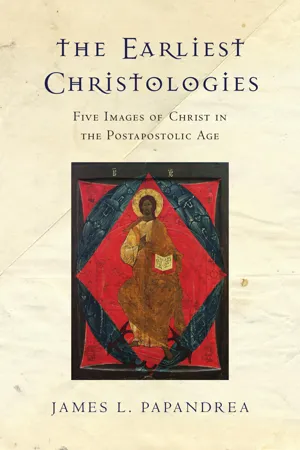
eBook - ePub
The Earliest Christologies
Five Images of Christ in the Postapostolic Age
- 144 pages
- English
- ePUB (mobile friendly)
- Available on iOS & Android
eBook - ePub
The Earliest Christologies
Five Images of Christ in the Postapostolic Age
About this book
Information
Topic
Theology & ReligionSubtopic
Social History1
Five Images of Christ in the Postapostolic Age

As long as the apostles were alive, they were the ultimate authorities in the church, primarily because they had been disciples of Jesus, or in the case of Paul, they could at least claim to have been commissioned and sent by Jesus himself (Gal 1:1; cf. Acts 9:1-19). The apostles, along with their own disciples, were the world’s leading experts on who Jesus was because they had known him personally or because they were there in Jerusalem when the Holy Spirit proceeded to the church on Pentecost. And when they wrote the documents that became the New Testament, they were (and still are) believed to have been inspired by God. According to tradition, John lived the longest, living into the early second century. But by the late first century, any apostles still alive functioned like bishops with itinerant ministries of oversight and regional authority. This means that the beginning of the “postapostolic age” (the age right after the apostles) began at different times in different places.1 In Rome it had begun after the deaths of Peter and Paul in the mid-60s of the first century. In Asia Minor it did not begin until the death of John.
Therefore, while admitting that there is no clear or uniform beginning to the postapostolic age, we can still define it as the earliest time in the church’s history when there were no living apostles to give a definitive answer to the question that Jesus had asked: “Who do you say that I am?” (Mt 16:13-18). Human nature being what it is, the emergence of the postapostolic age meant that it was probably inevitable that there would be disagreements among the remaining Christians over even the most important aspects of Christian belief.
Although they had the New Testament writings, the church was still coming to a consensus on which of the early documents would be included in the canon.2 This means that certain teachers or factions within the church could gain followers by ignoring or excluding those books of our Bible with which they did not agree. Some even edited the documents, cutting whole sections out of individual documents, including the Gospels. And even when there was agreement on the acceptance and authority of a particular text, there was often disagreement on the interpretation of that text—a phenomenon that continues to this day, as anyone who has ever had an argument over theology knows. In other words, two people can be reading the same passage of Scripture and understand its message differently. For example, what did Paul mean when he wrote to the Christians in Colossae that Christ was “the firstborn of all creation” (Col 1:15)?3 Did he mean that Christ was the first created being? Or that Christ was the agent of creation, as we read in the first chapter of John’s Gospel? Questions like these led to disagreements about the person of Christ in the early church. These disagreements can be categorized as five distinct views of who Jesus Christ was and is.
The Aim and Scope of This Book
“Christology” is the name we give to what we believe about Christ. It includes beliefs about his personhood, his nature (divine? human? both?) and in what way he is a Savior or mediator between humanity and the divine. In an apocryphal document known as the Apocalypse of Adam, there is a description of thirteen kingdoms, which are allegories for thirteen different theories of who the Savior is—thirteen christologies.4 The point that the author of this document was making is that all thirteen theories were wrong and only the fringe group that produced the document had the right answer. But the truth is that most of these christologies are variations of the same few or misunderstandings of the beliefs of other factions within, or on the edges of, the church. There were, in reality, five main christologies in the postapostolic age.
Most studies of early heresies, especially gnosticism, focus much of their attention on their speculative cosmologies, that is, their elaborate systems of many deities and angelic beings inhabiting ever-increasing numbers of “layers” within the heavens. The teachings of the excommunicated heretics are then described as salad-bar composites of paganism and astrology with elements of Christianity. This is because the primary sources that are available to us describe them that way, and there is no good reason to believe that their descriptions are not accurate. However, the early Christian writers who describe the heresies focus so much on the speculative and superstitious nature of their paganized version of Christianity (or their Christianized version of paganism) that they often don’t tell us a lot about what they believed about Christ specifically. This book will set aside the cosmologies, and even the theologies (whether they were polytheistic, for example), of the early factions within the church and focus on their christologies—drawing out what they believed about the person of Jesus Christ, as far as we can know. Then we will address the relationship of christology with soteriology (salvation) and also its relation to lifestyle.5
We will limit our study to the postapostolic age, which for our purposes means primarily the second century, though with some overlap into the first century. And because we will not venture very far into the third century, I am not including modalism (“modalistic monarchianism”) among the early views of Christ in the subapostolic age. Modalism is more a phenomenon of the third century, and it is also technically more of a trinitarian heresy than a christological one.6 However, I will address it briefly in the concluding chapter in a section on the later legacies of the early christologies.
Before going on, a word on the concept of heresy is in order. The terms heresy and heretic come from a Greek word that implies a faction—a person or group that departs from the majority or the accepted norm. Therefore, by definition, the heresies are those views of Christ that deviated from, and opposed, the view of the “mainstream” or majority of the church. It is true that often in the course of history it is only after a debate is settled or an ecumenical council is held that the heresy can be defined in contrast to the approved interpretation. It is also true that the interpretation of the majority of church leaders is usually the one that wins the day. However, this is not the same thing as simply saying that the story is written by the winners. There was a “mainstream” or majority church in every generation, and the heresies were those teachings that moved far enough away from the mainstream to catch the attention of the ecclesiastical authorities and generate a debate. We also have to remember that all of Christianity was an illegal, persecuted religion in the postapostolic age, so this is not a time when imperial power was used to discriminate against heretics, nor was it a time when heretics were executed for their teachings. That did not happen for another thousand years.
Having said that, I will use the terms heresy and heretic as little as possible in recognition of the fact that the “heretics” were probably sincere believers who thought souls would be at stake if their opponents won the day. And this is precisely what all of the proponents of every christology believed. They could not take a “live and let live” approach to christology because they all believed that the wrong christology would not save its believers.
We have to keep in mind that all five of these approaches to the person of Jesus Christ were options within the church in the postapostolic age. Even those that deviated from the majority were still within the church. If they were not, they would have been considered completely different religions rather than heresies. In any case, we can assume that people with different christologies worshiped together in the house churches of the late first and second centuries. And although there were certainly some “heretics,” teachers of alternative christologies, who gained a following and created their own factions, the existence of different christologies does not necessarily point to completely separate communities.7 In other words, we should not imagine these five christologies as representing five different “denominations” within Christianity.
In most cases, the alternative christologies probably grew up rather organically or around certain early teachers (whom we will meet below). At some time they attracted attention and sparked debate within the church, and if there was a faction leader, that person often got excommunicated by the bishop of the area in question. At some point, the factions made more of a separation from the mainstream and became, in effect, a separate sect. We may remember the words of John when he wrote, “They went out from us, but they did not belong to us; for if they had belonged to us, they would have remained with us” (1 Jn 2:19). When a faction moves far enough from the mainstream, it either leaves the church voluntarily or is kicked out—either way, it has gone beyond the boundary of what is considered acceptable by the majority, and therefore, by definition, it has left the church. This was especially the case with gnosticism as its syncretism moved it farther from Christianity until it finally became something other than Christian.
The Dilemma
The experience of the New Testament church, seeing the miracles of Jesus (and apostles who healed in his name) and especially seeing him after his resurrection, led to the worship of Jesus right from the beginning. Jesus was considered divine. However, the Gospels clearly attest to his humanity. He was born as a baby, grew up, felt emotions, suffered and died. This means that when it came to defining what Christians believed about the person of Christ, those who wanted to emphasize his divinity had to at least address his apparent humanity, not to mention his suffering and death (even if to deny it), and those who wanted to emphasize his humanity had to address his apparent divinity and his unique relationship with God (again, even if only to deny it).
There were good reasons for being on both sides of this dilemma. Those who wanted to emphasize his humanity saw him as one of us and realized that if he were not one of us then it might mean that following his example was really impossible. Those who wanted to emphasize his divinity believed that people cannot follow his example perfectly enough to reconcile themselves to God and that salvation requires divine intervention.
Both sides—in fact every one of the five views of Christ—could agree that what humanity needs is a mediator to reconcile humanity and the divine and that Christ is that mediator. But they disagreed on exactly what it meant for Christ to be a mediator and how he would reconcile. This is in fact what creates the five views—five different ways of understanding how Christ is (or relates to) humanity and divinity.
Different Philosophical Assumptions
Part of what drives the five different answers to the question, “Who do you say that I am?” is that the different answers begin with different assumptions about what divinity is. If we were to ask the question, “Must divinity be uncreated?” a person of the He...
Table of contents
- Cover
- Title Page
- Dedication
- Contents
- Acknowledgments
- 1 Five Images of Christ in the Postapostolic Age
- 2 Christ as Angel: Angel Adoptionism
- 3 Christ as Prophet: Spirit Adoptionism
- 4 Christ as Phantom: Docetism and Docetic Gnosticism
- 5 Christ as Cosmic Mind: Hybrid Gnosticism
- 6 Christ as Word: Logos Christology
- 7 What, Then, Is Orthodoxy?
- Notes
- Subject Index
- Scripture Index
- Praise for The Earliest Christologies
- About the Author
- Other Books by James Papandrea
- More Titles from InterVarsity Press
- Copyright
Trusted by 375,005 students
Access to over 1.5 million titles for a fair monthly price.
Study more efficiently using our study tools.
Frequently asked questions
Yes, you can cancel anytime from the Subscription tab in your account settings on the Perlego website. Your subscription will stay active until the end of your current billing period. Learn how to cancel your subscription
No, books cannot be downloaded as external files, such as PDFs, for use outside of Perlego. However, you can download books within the Perlego app for offline reading on mobile or tablet. Learn how to download books offline
Perlego offers two plans: Essential and Complete
- Essential is ideal for learners and professionals who enjoy exploring a wide range of subjects. Access the Essential Library with 800,000+ trusted titles and best-sellers across business, personal growth, and the humanities. Includes unlimited reading time and Standard Read Aloud voice.
- Complete: Perfect for advanced learners and researchers needing full, unrestricted access. Unlock 1.5M+ books across hundreds of subjects, including academic and specialized titles. The Complete Plan also includes advanced features like Premium Read Aloud and Research Assistant.
We are an online textbook subscription service, where you can get access to an entire online library for less than the price of a single book per month. With over 1.5 million books across 990+ topics, we’ve got you covered! Learn about our mission
Look out for the read-aloud symbol on your next book to see if you can listen to it. The read-aloud tool reads text aloud for you, highlighting the text as it is being read. You can pause it, speed it up and slow it down. Learn more about Read Aloud
Yes! You can use the Perlego app on both iOS and Android devices to read anytime, anywhere — even offline. Perfect for commutes or when you’re on the go.
Please note we cannot support devices running on iOS 13 and Android 7 or earlier. Learn more about using the app
Please note we cannot support devices running on iOS 13 and Android 7 or earlier. Learn more about using the app
Yes, you can access The Earliest Christologies by James L. Papandrea,James L Papandrea in PDF and/or ePUB format, as well as other popular books in Theology & Religion & Social History. We have over 1.5 million books available in our catalogue for you to explore.