- 176 pages
- English
- ePUB (mobile friendly)
- Available on iOS & Android
eBook - ePub
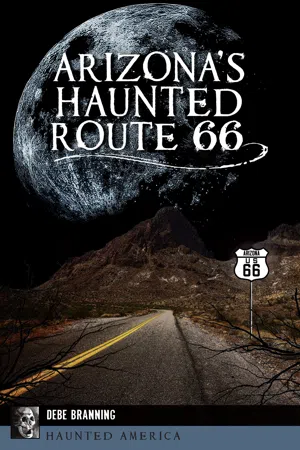
Arizona's Haunted Route 66
About this book
Arizona claims one of the longest segments of the famous Route 66. Along the nearly four hundred miles of road are stops filled with legends, history, superstitions and spirits of travelers who experienced untimely accidents and murders. Meet Leorena Shipley, an aspiring actress whose career was cut short by tragedy. Discover how the Apache Death Cave became the haunted site of a mass grave. Visit the Monte Vista Hotel, one of the most haunted hotels in Arizona. Learn how the Grand Canyon Caverns were discovered and became a favorite attraction. Travel to Oatman, a ghost town with a multitude of spirits. Join author and paranormal historian Debe Branning on a haunted road trip across Arizona and discover the spooky history of the Mother Road.
Information
Subtopic
North American HistoryIndex
HistoryCHAPTER 1
LUPTON
CHIEF YELLOWHORSE TRADING POST
Lupton is a tiny hamlet in Apache County adjacent to the Arizona/New Mexico state line along Route 66. This area of Arizona has been inhabited for at least ten thousand years. In more recent times, the Anasazis, or Ancestral Puebloans, lived in this area. Their homeland covered the Colorado Plateau, a vast part of southern Utah, Colorado, western New Mexico and Arizona west of the Colorado River and north of the Little Colorado and Puerco Rivers. Apache County was created in 1879, and in 1895, Navajo County was split from its western half. The Atlantic & Pacific Railroad, which later became a part of the Atchison, Topeka & Santa Fe (AT&SF), built its rails westward from Gallup and extended its tracks in 1883 following the Rio Puerco to the West River.
The town was named after the 1905 Winslow train master, G.W. Lupton. Another source indicates that G.W. Lupton owned the first trading post in the area. A small post office opened in 1917, and shortly after, in 1926, Route 66 was aligned through Lupton following the National Old Trails Highway, which had been created in the early 1910s. Lupton figured in the 1927 Rand McNally Map, along U.S. 66, as being twelve miles east of Houck, Arizona, on an unpaved but “graded road” that would be realigned once again in 1930.
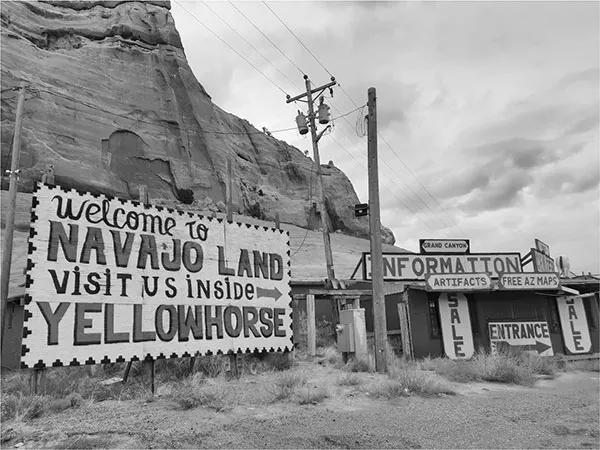
Chief Yellowhorse Trading Post near Lupton. Author’s collection.
Lupton is also known as “Painted Cliffs” for its soaring sandstone cliffs, formed between 60 and 200 million years ago. Statues of bear, deer and eagles adorn the top of the cliffs and welcome weary travelers to the deserts of Arizona. The 1940 Hollywood epic The Grapes of Wrath used the stop as a film location. Moviegoers may remember it as the spot where the Joad family enters Arizona beneath the colorful red cliffs. A state inspection booth once stood where Tom Joad reassures the inspector that they “don’t intend to stay in the state any longer than it takes to cross it.”
The Yellowhorse family has welcomed traveling tourists from their Navajo-owned trading post on the Navajo reservation for decades. They began their legacy as traders in the 1950s from a roadside stand, where the enterprising family sold Navajo rugs and petrified wood to vacationers. Traveling Route 66 was a great adventure, and stops were few and far between. Resources for gas, restrooms and food were greatly needed, so they created a traveler stop the entire family could enjoy.
Earlier in the 1940s, Harry “Indian” Miller left Two Guns, Arizona, and brought a portion of his famed desert zoo and Native American artifacts to the cave-like formation in Lupton. Here he proclaimed that he was an amateur archaeologist. Miller believed that he had discovered the “real” route to Coronado and the Seven Cities of Cibola in the Lupton area. Miller was quite the storyteller, and his accounts of the killings predating his arrival were rarely questioned. He opened a trading post in the “Cave of the Seven Devils,” adorned with relics and wigwams to create an early Indian village. The name was painted in huge letters over the cave entrance and was visible from the highway. Some say that he resided at the cave until his death in February 1952, while others proclaim that Miller was banished from Arizona due to his unorthodox business practices. We will speak more of the infamous Harry “Indian” Miller in a future chapter.
In the 1960s, Juan and Frank Yellowhorse bought the site where Harry Miller’s former “mystical” trading post stood and turned it into a modern trading center not far from their first primitive rug stand. The large cave still lends an aura of mystique and attracts Route 66 travelers as they enter the colorful deserts of Arizona.
Chief Yellowhorse Trading Post
Exit 359, I-40
Lupton, AZ 86508
CHAPTER 2
ALLENTOWN
CRONEMEYER TRADING POST
Allantown had its start around 1900 after the Atlantic & Pacific Railroad was extended to reach that point in 1881 and 1882. The community was named after Allan Johnson, a cattleman. The town post office was later renamed Allentown, changing the spelling, and established in 1924. It remained in operation until 1930. The town was long inhabited by the Navajo people of the area but never grew very large. When Route 66 came bustling through town, it boasted a gas station, grocery store, curio shop and café. For many years, travelers along this stretch of the road associated Allentown with a large dome-like structure that housed a curio shop called Indian City. Although the dome structure is gone, visitors can now visit a new modernized version of the famed site.
One of the first businessmen of the area was a man of German descent named Curt Cronemeyer. Some believed that he was a wealthy man and owned a large estate in Germany. Cronemeyer owned several trading establishments and erected a trading post a short distance south of the railroad tracks. Cronemeyer had two Navajo wives and built his trading business on land that was said to have been allotted to one of his wives by her family. He had two children: a son named Hoska Cronemeyer and a daughter named Edith Cronemeyer Murphy.
Cronemeyer had a reputation of being an eccentric character and somewhat of a flirtatious ladies’ man. He often left a questionable impression on his traders and customers but was known to be an honest man and respected by those who knew him well. He was widely known throughout western New Mexico and eastern Arizona and had many friends among the Native American tribes.
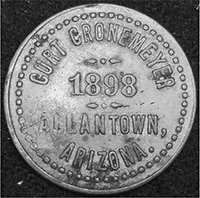
Cronemeyer Trading Post token. Courtesy of Pinterest/eBay.
On June 27, 1915, he and his employee, C.A. “Red” McDonald, were robbed, shot and killed at the trading post. At first, rumors began to circulate that the fifty-nine-year-old trader was confronted by Navajo tribesmen. However, newspaper articles later revealed that Gallup, New Mexico sheriff Bob Roberts tracked a group of Mexican bandits to El Paso, Texas, where they confessed to the murders when captured.
Victor Wezer and Blas Lozano, along with two other men, M. Nuanez and Delbino Rosales, secured five dollars in money from Cronemeyer and spent the entire amount for food. They rode out to their camp in the hills, where they cooked and ate what they had purchased.
Later, around six o’clock, they went back to the store, where they got into an argument with Red McDonald. Lozano whipped out his six-shooter, a .44-caliber, and shot McDonald dead, putting two bullets in his body. Lozano later stated that it was not their intention to kill either of the men in the store when they returned, but a quarrel came up over an old watch that they were trying to pawn for more money. After McDonald was shot by Lozano, Wezer pulled out his revolver, a .38-caliber, and opened fire on Cronemeyer.
As he stated it, they “had to kill Cronemeyer so he could not tell the story of the killing of McDonald.” Six shots in all were fired, according to his testimony. Wezer shot Cronemeyer twice, he said, once through the hand and once through the body. A third shot was fired, but this bullet went wild and struck the wall of the store.
Cronemeyer was not instantly killed and was able to get to the telephone and call for help. At about 8:00 p.m., a telephone call was received at Houck, Arizona, and a voice believed to have been Cronemeyer cried into the receiver, “We are shot! Send help quick, quick, quick!” The Santa Fe Railroad pumper and section foreman went at once on horseback, and upon arrival at the trading store, they found McDonald dead behind the counter of the store and Cronemeyer lifeless on the bed. McDonald was shot through the eye and breast. Trading checks and a box of crackers lay on the counter, indicating that the murdered man had been waiting on a customer at the time of the shooting. A Winchester rifle with one empty shell, covered with blood, lay beside him.
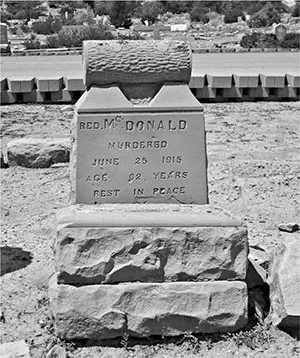
Grave of “Red” McDonald at Hillcrest Cemetery, Gallup, New Mexico. Author’s collection.
Footprints and drops of blood show that Cronemeyer ran around the house two or three times, either chasing or being chased by someone. A bloody handprint on the mirror in the living room indicated that he stopped to look at his reflection in the mirror. There was another bloody handprint on the floor of the kitchen, where he either fell or stooped.
For days, there was absolutely no clue to the identities of the perpetrators of the double murder. Shortly after the crime, two Mexicans were arrested but were later released for lack of evidence. An Indian was arrested, but he was released as well. An overcoat labeled with the name Ned Nuanez and found in the house offered a clue. Cronemeyer was known to have had several enemies, and it is said that threats had been made against him in the past. The bodies were brought to Gallup, New Mexico, and buried at the cemetery.
For three days, the bandits hid out in the hills. Wezer became tired and hungry and rode to Gallup, where he stayed for a day and then headed to a lumber camp. Rosales soon followed, and the two men began to argue— each accusing the other of the murders. They rode a freight train from Albuquerque to El Paso, according to their confession. Blas Lozano was arrested in August by Deputy Sheriff Pipkin of McKinley County, who took his prisoner back to Gallup on Santa Fe train no. 1.
Sheriff Roberts of nearby Gallup was credited for tracking the group of Mexican bandits, who had ridden down to El Paso, Texas. The men eventually confessed to the murder and were apprehended. The four men implicated in the murders were refugees from Old Mexico, and it was the fear of being caught by Pancho Villa and hanged for treason that prevented them from crossing back into Mexico after the killing spree.
Curt Cronemeyer was buried at Hillcrest Cemetery in Gallup, New Mexico.
CHAPTER 3
HOUCK
FORT COURAGE
Houck was founded by James D. Houck (1848–1921), a mail carrier working a route from Prescott, Arizona, to Fort Wingate, New Mexico. In 1874, he established a trading post called Houck’s Tank. The original structure was built using sandstone and held together with mud and mortar. He also ran a herd of sheep in the same area (a trade he learned from the nearby Navajos) in addition to operating the trading post. In 1880, William Walker and William Smith were murdered by Native Americans at the trading post. Violence seemed to follow James Houck wherever roamed, and his reputation grew more deadly through the years.
Houck left the post in 1885 and moved to the Mogollon Mountains, where he had large cattle and sheep interests. He served as a representative in the Arizona Territorial Legislature. Houck became an Apache County deputy sheriff under the notorious Commodore Perry Owens when the deadly Pleasant Valley War between sheepherders and cattlemen erupted in 1887. During the ongoing conflict, William Graham was shot and killed on August 17, 1887. Graham lived long enough to identify Ed Tewksbury as the assailant. But later, James D. Houck would publicly declare that it was he who fired the shot that killed the man. In the following years, he became involved in the lynching of three cattle rustlers. He soon felt that it was time to move his sheepherding operation to Cave Creek—just north of Phoenix.
Nicknamed the “Cave Creek King,” Houck operated a shearing camp for the local sheep men. He established a boardinghouse and saloon for the herdsmen from the northern mountains during the winter months. The boardinghouse served as a community center, hosting many local events. The Houcks advertised their homestead as a health resort and rented houses along the stream to folks with tuberculosis.
James Houck committed suicide at his home in Cave Creek, Arizona, by taking a lethal dose of strychnine in 1921. Earlier, before committing the act, Houck told friends that he was tired of living. Houck went into the house after feeding his chickens and stated that he had taken the strychnine. He lay down on a bed and requested that his shoes be removed, as he did not care to die with them on. Efforts to counteract the poison failed. He was seventy-four years old and had been a part of Arizona history for more than forty-five years. He is buried at Greenwood Cemetery in Phoenix.
The old trading post in Houck went through several hands and was operated until 1922. About that time, the highway was moved farther north of the railroad. Unlike many of the other small towns located on Route 66, the passing traffic had little or no effect on the small town of Houck—that is, of course, until Interstate 40 turned Route 66 into a “ghost highway.”
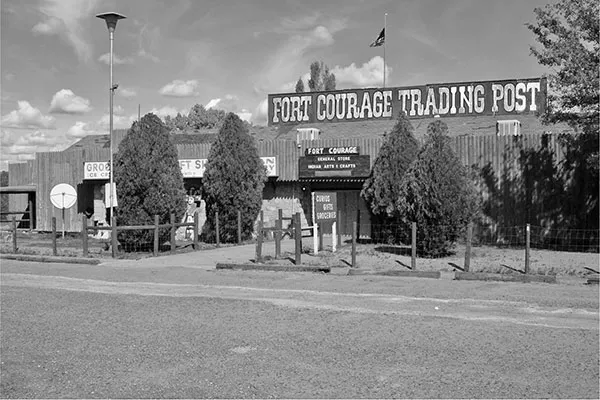
Vintage Fort Courage Trading Post postcard. Courtesy of Route 66 Postcards.
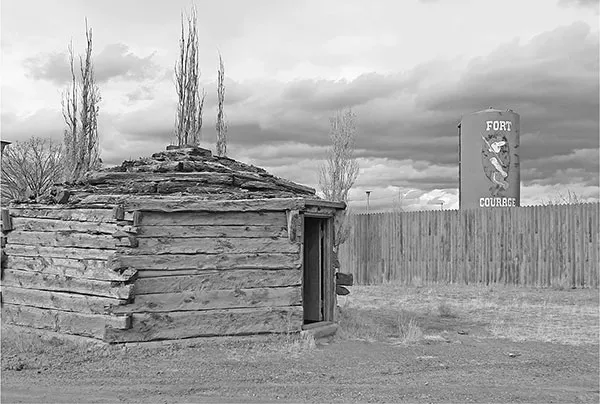
Fort Courage Trading Post in Houck. Author’s collection.
Today, it is the site of a large modern ghost town—Fort Courage—a replica of the fort seen in the TV series F Troop. The series was not filmed here, but somehow it became a favorite touri...
Table of contents
- Front Cover
- Half-Title Page
- Title Page
- Copyright
- Contents
- Acknowledgements
- Introduction
- 1.Lupton
- 2. Allentown
- 3. Houck
- 4. Sanders
- 5. Holbrook
- 6. Joseph City
- 7. Winslow
- 8. Meteor City
- 9. Two Guns
- 10. Winona
- 11. Flagstaff
- 12. Bellemont
- 13. Williams
- 14. Ash Fork
- 15. Seligman
- 16. Peach Springs
- 17. Truxton
- 18. Valentine
- 19. Hackberry
- 20. Kingman
- 21. Oatman
- 22. Topock
- Paranormal Resources: Teams and Tours
- Bibliography
- About the Author
Trusted by 375,005 students
Access to over 1.5 million titles for a fair monthly price.
Study more efficiently using our study tools.
Frequently asked questions
Yes, you can cancel anytime from the Subscription tab in your account settings on the Perlego website. Your subscription will stay active until the end of your current billing period. Learn how to cancel your subscription
No, books cannot be downloaded as external files, such as PDFs, for use outside of Perlego. However, you can download books within the Perlego app for offline reading on mobile or tablet. Learn how to download books offline
Perlego offers two plans: Essential and Complete
- Essential is ideal for learners and professionals who enjoy exploring a wide range of subjects. Access the Essential Library with 800,000+ trusted titles and best-sellers across business, personal growth, and the humanities. Includes unlimited reading time and Standard Read Aloud voice.
- Complete: Perfect for advanced learners and researchers needing full, unrestricted access. Unlock 1.5M+ books across hundreds of subjects, including academic and specialized titles. The Complete Plan also includes advanced features like Premium Read Aloud and Research Assistant.
We are an online textbook subscription service, where you can get access to an entire online library for less than the price of a single book per month. With over 1.5 million books across 990+ topics, we’ve got you covered! Learn about our mission
Look out for the read-aloud symbol on your next book to see if you can listen to it. The read-aloud tool reads text aloud for you, highlighting the text as it is being read. You can pause it, speed it up and slow it down. Learn more about Read Aloud
Yes! You can use the Perlego app on both iOS and Android devices to read anytime, anywhere — even offline. Perfect for commutes or when you’re on the go.
Please note we cannot support devices running on iOS 13 and Android 7 or earlier. Learn more about using the app
Please note we cannot support devices running on iOS 13 and Android 7 or earlier. Learn more about using the app
Yes, you can access Arizona's Haunted Route 66 by Debe Branning in PDF and/or ePUB format, as well as other popular books in History & North American History. We have over 1.5 million books available in our catalogue for you to explore.