Andrew Purves, the author of many works in pastoral theology, has spent his life exploring the significance of Jesus Christ for the life of the church. As a professor of historical theology, he has also investigated the significance of patristic and Reformed theology for understanding Christ. In Exploring Christology and Atonement, Purves brings these concerns together. If pastoral theology is about the person and work of Christ, then the study of Christology and atonement is essential to the ministry of the church.Drawing on his own Scottish heritage, Purves engages in a critical conversation about Christ?s person and work with three eminent Scottish theologians whose legacy stretches over two hundred years: John McLeod Campbell, Hugh Ross Mackintosh and Thomas Forsyth Torrance. Purves shows how their respective contributions to our understanding of Jesus Christ shape and inform the practice of the faith. The ministry of the church is rooted first and foremost in the ministry of God.
eBook - ePub
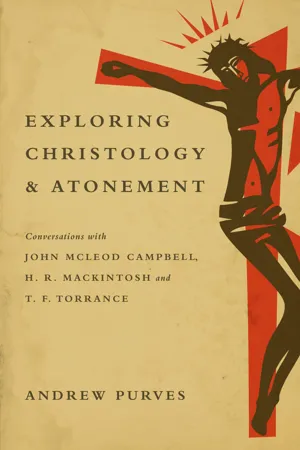
Exploring Christology and Atonement
Conversations with John McLeod Campbell, H. R. Mackintosh and T. F. Torrance
- 272 pages
- English
- ePUB (mobile friendly)
- Available on iOS & Android
eBook - ePub
Exploring Christology and Atonement
Conversations with John McLeod Campbell, H. R. Mackintosh and T. F. Torrance
About this book
Information
Topic
Theology & ReligionSubtopic
Christian Theology1
CHRISTOLOGY
Who Is the Incarnate Savior of the World?
A Preface to the Next Three Chapters
John McLeod Campbell’s axiom marks out the parameters for our consideration: “The faith of atonement presupposes the faith of the incarnation.”1 That is to say, the atonement is to be seen in the light of the incarnation and the fulfillment of God’s purpose for humankind that the incarnation intends. The meaning of the incarnation unfolds as the atonement insofar as we look at the atonement as the revealing of God’s goal for humankind. On the one hand, the atonement makes it necessary that we should have a Christology, while on the other hand, Christology seeks to bear witness to the ontological ground for the atonement in Jesus Christ himself. St. Anselm’s question, “Why did God become human?” is answered in reference to the light that the person of Jesus Christ shines upon it, for he is the hilasmos, the atoning exchange or atoning sacrifice (1 Jn 2:2; 4:10). Atonement is not so much a work of Christ apart from who he is, but rather Christ himself in his work.2 The nature of the atonement is Jesus Christ himself working out our reconciliation with God, not just in his body, but, as Calvin says, also in his soul.3
It is immediately striking that this proposition—the atonement is the meaning of the incarnation, and the reference is to the person of Jesus Christ himself—implies that forgiveness must be more than the application of God’s will to forgive. If forgiveness, the covering of sin, involved the personal cost to God that we find in the life and death of Jesus, then two points arise. First, we must suppose something in God that required the venture of the Son into the far country of our human condition; second, we must suppose something in our human condition, at least in its state in relation to God, that required such remedial action as incarnation and atonement. To take incarnation and atonement seriously immediately points us to the mystery of God’s love and holiness, such that we at least catch a glimpse, however dimly, of a gracious purpose within the divine incomprehensibility, as well as the depth of human need and awfulness in our broken communion with God that must bring us to a point of near terror when we contemplate our situation otherwise.4 Says McLeod Campbell, “It is that God is contemplated as manifesting clemency and goodness at great cost, and not by a simple act of will that costs nothing, that gives the atonement its great power over the heart of man.”5
The path to be taken in our inquiry, therefore, is determined by who God is for us in Jesus Christ, and what it is that God wills that we should be,6 in contradistinction to what we are. That is, we understand the need addressed by the incarnation and the atonement in terms of what it is that God has done for us in Christ, and not by any sense of our own need.7 We learn from the atonement why it was needed.8 This is the way of realism in theology, by which we come to some degree of understanding regarding God and us, when incarnation and atonement are seen in their own light, to borrow McLeod Campbell’s phrase. “Less than our being alive in that eternal life which is sonship, could not satisfy the Father of our spirits; nor as orphan spirits, as in our alienation from God we are, would less than the gift of that life have met our need.”9 “The fact of sin,” McLeod Campbell insists, “is a discovery to the awakened sinner.”10
Our starting point, then, must be the incarnation, and the approach will be to reflect on the Savior as person. Our exploration will be with an eye constantly fixed upon what it is that God wills for us in him: in McLeod Campbell’s terms, that through Christ we know God as the Father of our spirits, who asks for a filial response from us.11 This approach, I believe, will allow us in due course to look in wonder upon the extent of the atonement—that is, whether it is a limited or a universal atonement—and to come to an answer when the question is seen in the light of the incarnation. We will not drive back, as it were, into the secret councils of God to find an answer to the question of God’s intention. We will, rather, attend to Jesus Christ and seek out the requested answer from the one who is himself the atonement. The plain statement of intent, then, that we will not try to peek behind the back of Christ to a God not known in Christ, but rather will look unto him at all points, seems self-evidently legitimate for a Christian perspective on redemption.
This approach is to be contrasted with the approach that is determined by the work of Christ when that work is seen instrumentally—that is, as something external to his person. Such a view need not but will likely tend toward a perspective on the atonement in which God needs to be propitiated in order to be gracious toward us. In such a view the love and forgiveness of God may be seen as the effects of the atonement. Further, an instrumental perspective on the atonement as an external work of Christ, as something that he does rather than having its ground in who he is, implies a corresponding view of our relation to Christ that is developed in terms of an external arrangement. In the scholastic Protestant tradition this is conventionally developed in terms of an imputed righteousness, in which, while we are and remain sinners, God, for Christ’s sake, regards us otherwise, lending the doctrine an air of legal fiction, to use McLeod Campbell’s arresting image. Starting there, says McLeod Campbell, amounts to an “axiomatic deficit” that undercuts the light that shines from the life of Christ.12
On the other hand, it is precisely the union of the incarnation and the atonement that excludes the view that the atonement is reducible to (though it may include) a forensic transaction as the fulfilling of a legal contract,13 or to Christ propitiatingly bearing the cost construed as divinely meted punishment upon Jesus in view of our failing to keep to our human side of the divine-human arrangement. That is, an ontological rather than an instrumental connection must be made between the Christ who makes the atonement and the atonement that he makes. Or, in a different set of images, we look for an organic and personal rather than a mechanical and legal connection between Christ and his atonement and ourselves. According to McLeod Campbell, “by himself He purged our sins—by the virtue that is in what He is.”14 The ontic and noetic aspects of Christology and atonement that we are reaching for here may be put in this way: Christ does who he is. In which case, the problem with the human condition before God, it would appear, is more than our breaking of the divine law, and the atoning work of Christ is more than the amelioration of the consequences. The atonement, it is suggested, must be worked out in terms of our being in an internal relation with Christ, to share in his life and thus to receive adoption as sons (Gal 4:5: tēn huiothesian apolabōmen; not, as the NRSV translates, “that we might receive adoption as children,” thereby missing the play on words). In this way, the atonement drives in an eschatological direction. We share in the Father-Son relationship, bearing witness to what McLeod Campbell called the “all-including necessity that is revealed to us by the atonement,” as expressed in John 14:6, “No one comes to the Father except through me.”15
The approach we will take perceives that God is not the object of the atonement. God, rather, is the subject who performs the act of forgiveness or atonement.16 “But if God provides the atonement,” argues McLeod Campbell in a stunning insight, “then forgiveness must precede atonement; and the atonement must be the form of the manifestation of the forgiving love of God, not the cause.”17 We find a similar understanding in H. R. Mackintosh: “All that went to the death of Christ, constituting it the definitive self-expression of God towards the sinful, not merely reveals God’s antecedent forgiving love; it actually conveys forgiveness and renders it effective.”18 Understanding the nature of the atonement, what it is in itself as the person and life of the Savior as the God who forgives us, as that is unfolded through the filial relationship of the Son to the Father, into which we are incorporated by adoption, leads to an understanding of the universality of the atonement.19
Over the next three chapters we will reflect on the relation between Christology and atonement mainly from the perspective of Christology. We will proceed by way of discussions with John McLeod Campbell, H. R. Mackintosh and T. F. Torrance. Our process will lead to a number of interlocking circles that allow for some degree of overlap. The remainder of this chapter will consider aspects of the doctrine of the person of Jesus Christ by asking the question, “Who is the incarnate Savior of the world?” The issue before us is the person of the Son. We will move on from there in the following chapter to reflect on the mystery of Jesus Christ through examination of the relation of the Father and the Son, and the hypostatic union, in which in the unity of his person Jesus was wholly God and fully human. This reflection will point us forward to see that understanding the atonement, from an incarnationalist christological perspective, requires a trinitarian doctrine of God.20 The third chapter will consider substitution and union under the headings of the doctrines of the magnificent exchange and of our union with Christ. We will see that we must allow the objective orientation of Christology and atonement to call forth an exploration of the relation between Christ and us if we would move successfully beyond McLeod Campbell’s critique of too much atonement theory being a “legal fiction.”
Who Is the Incarnate Savior of the World?
Consideration of the relation between Christology and the atonement means first of all that we begin with the incarnation, with who was born of Mary, and not with discussion of so-called eternal decrees of God, with the divine reign or covenant of law,21 or with a predetermined set of assumptions concerning God’s holiness and righteousness, for example. The question “Who is the incarnate Savior of the world?” immediately and rapidly takes us away from consideration of any form of abstract philosophical theism, as well as from a speculative account of human nature as a kind of “something” that the Son adopted as his own. This operating question opens up the doctrine of God in view of Jesus Christ in a manner that allows light to shine on the understanding of the atonement, and it also invites us into critical reflection on the doctrine of the two natures of Christ in traditional doctrine. In other words, the primary concern for our understanding of the atonement is the doctrine of God that arises out of the incarnation, out of God’s actual saving event that gives content to who God is as the God who saves in, through and as the man Jesus of Nazareth.
The priority of the “Who?” question in Christology. The basic fact of Christian theology is the person of Jesus Christ, God with us, the incarnate, crucified and risen Lord who in his ascension reigns over all things and who will come again. According to Luther, “To this man thou shalt point and say, Here is God.”22 And again, “I have no God, whether in heaven or in earth, and I know of none outside the flesh that lies in the bosom of the Virgin Mary. For elsewhere God is utterly incomprehensible, but comprehensible in the flesh of Christ alone.”23 And from Calvin: “God is comprehended in Christ alone.”24 Or again, more directly relating to the atonement, “If, then, we would be assured that God is pleased with and kindly disposed toward us, we must fix our eyes and minds on Christ alone.”25 And from Barth: “We start out from the fact that through His Word God is actually known and will be known again.”26 And again, “Christology . . . is the touchstone of all knowledge of God, in the Christian sense, the touchstone of all theology.”27
In Christian faith everything depends on knowing who Jesus Christ is, on what it means that he is confessed as Lord and Savior. If we go astray right here at the beginning by asking the wrong question, we will never grasp the radical heart and significance of the gospel. Christianity’s central doctrine—Jesus is Lord!—is given as the answer to the question “Who is the incarnate Savior of the world?” Biblically, this question comes in a number of forms. John the Baptizer asks, “Are you the one who is to come?” To this Matthew has Jesus immediately reply, “Go and tell John what you hear and see” (Mt 11:3-4). This question is set in terms of the inauguration of the reign of God in and as Jesus. Then there is Jesus’ question “Who do you say that I am?” (Mt 16:15), in which the messianic categories are transformed. Finally, Saul of Tarsus asks, “Who are you, Lord?” (Acts 9:5). The struggle behind these questions is the birthing of the movement from Jesus who preached to Jesus who is preached. Here is the origin of Christology.28
Brunner and Bonhoeffer on the “Who?” question. The priority of the “Who?” question in Christology is set forth in the work of two twentieth-century theologians, Emil Brunner and Dietrich Bonhoeffer. In his landmark book The Mediator, published in English in 1927, Brunner put the issue in this way:
The question, “Who is He?” means the same as the other question: “What has God to say to us in Him?” The one cannot be answered without the other. The first answer to the question: “Who is He?” was this: “He is the Divine Word.” Rightly understood, this reply contained the whole truth. . . . When you know who He is, you know who God is. . . . Christ, Who is He? The doctrine of the Church replies: “He is true God and true Man, and for this reason He is the Mediator.”29
Brunner goes on to note that the church has largely set aside the “Who?” question and replaced it with another: “How does He come to be what He is?” “Thus the question of the being of Christ is replaced by one which concerns His appearance in history.30 This means that we have quitted the plane of revelation for that of phenomena within history, both moral and religious,” comments Brunner.31 The danger for Christology in asking the wrong questions is that a speculative agenda is imposed. Is the eternal God in Jesus Christ? This question may move us in a Docetic direction, suggesting a divinity that cannot bear flesh. Or, can this man really be God? This question may move us in an Ebionite direction, suggesting that the human person Jesus cannot be God.
“Who is the incarnate Savior of the world?” In setting out the priority of the “Who?” question we are instructed even more fully on this point by Dietrich Bonhoeffer. In Christ the Center Bonhoeffer opens up for us in a remarkably insightful way the core methodological issues that we deal with in Christology. Because the method of inquiry in theology must be appropriate to its subject, Bonhoeffer’s starting point is the required beginning for what today we call a “nonfoundationalist” Christology. That is to say, the Enlightenment philosophers do not set the boundaries for Christian reflections on the identity of Jesus Christ. They do not allocate for us what is ...
Table of contents
- Cover
- Title Page
- Dedication
- Contents
- Preface: Christology and Atonement
- Introduction: Locating Theology
- 1 Christology: Who Is the Incarnate Savior of the World?
- 2 Christology: The Mystery of Christ—the Homoousion and the Hypostatic Union
- 3 Christology: The Magnificent Exchange and Union with Christ
- 4 Atonement: John McLeod Campbell’s Theology of Satisfaction
- 5 Atonement: Hugh Ross Mackintosh and the Experience of Forgiveness
- 6 Atonement: Thomas F. Torrance on the Atonement as Ransom, Priestly Atonement, Justification, Reconciliation and Redemption
- 7 Christology and Atonement: Faith and Ministry
- Notes
- Author Index
- Subject Index
- Praise for Exploring Christology & Atonement
- About the Author
- More Titles from InterVarsity Press
- Copyright
Trusted by 375,005 students
Access to over 1.5 million titles for a fair monthly price.
Study more efficiently using our study tools.
Frequently asked questions
Yes, you can cancel anytime from the Subscription tab in your account settings on the Perlego website. Your subscription will stay active until the end of your current billing period. Learn how to cancel your subscription
No, books cannot be downloaded as external files, such as PDFs, for use outside of Perlego. However, you can download books within the Perlego app for offline reading on mobile or tablet. Learn how to download books offline
Perlego offers two plans: Essential and Complete
- Essential is ideal for learners and professionals who enjoy exploring a wide range of subjects. Access the Essential Library with 800,000+ trusted titles and best-sellers across business, personal growth, and the humanities. Includes unlimited reading time and Standard Read Aloud voice.
- Complete: Perfect for advanced learners and researchers needing full, unrestricted access. Unlock 1.5M+ books across hundreds of subjects, including academic and specialized titles. The Complete Plan also includes advanced features like Premium Read Aloud and Research Assistant.
We are an online textbook subscription service, where you can get access to an entire online library for less than the price of a single book per month. With over 1.5 million books across 990+ topics, we’ve got you covered! Learn about our mission
Look out for the read-aloud symbol on your next book to see if you can listen to it. The read-aloud tool reads text aloud for you, highlighting the text as it is being read. You can pause it, speed it up and slow it down. Learn more about Read Aloud
Yes! You can use the Perlego app on both iOS and Android devices to read anytime, anywhere — even offline. Perfect for commutes or when you’re on the go.
Please note we cannot support devices running on iOS 13 and Android 7 or earlier. Learn more about using the app
Please note we cannot support devices running on iOS 13 and Android 7 or earlier. Learn more about using the app
Yes, you can access Exploring Christology and Atonement by Andrew Purves in PDF and/or ePUB format, as well as other popular books in Theology & Religion & Christian Theology. We have over 1.5 million books available in our catalogue for you to explore.