You can be a missionary by crossing an ocean or by crossing the street.We now have unprecedented opportunities to meet people from every culture and nation. International study and global migration allow us to build relationships with Buddhists and Muslims, students from Singapore and workers from the Middle East. But how do we share the gospel with people from different cultures and worldviews?Crosscultural evangelism can be scary. But veteran crosscultural minister Katie Rawson shows how wecan witness the way Jesus did, entering into people's worlds and drawing them into God-centered community. She equips readers to evangelize Jesus' way, depending on him as companion and guide and venturing out in joy to be and share good news.Filledwith compelling stories, practical resources and relational tools, this guide gives crosscultural training and shows how you can share the gospel through story and diagram, with clear communication and authentic community.
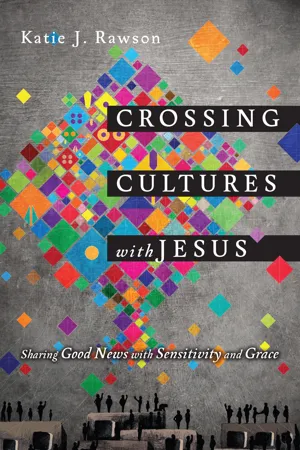
eBook - ePub
Crossing Cultures with Jesus
Sharing Good News with Sensitivity and Grace
- 208 pages
- English
- ePUB (mobile friendly)
- Available on iOS & Android
eBook - ePub
About this book
Information
one
Love at the Heart of the Universe
A Completely Good and Beautiful God

Corrie approached the international residence hall at North Carolina State University on a late summer day. She had just returned from a summer mission to Taiwan and had a letter written in Chinese that she couldn’t read. Corrie climbed the steps to the women’s floor; about halfway down the hall there was an open door. Seeing a petite Asian woman, she entered the room and said, “Can you read Chinese?” About three weeks earlier Shao-Leng had come from Taiwan to study accounting, and she certainly knew Chinese. She took the letter and started translating. Toward the end of the letter Shao-Leng read a reference to buying sweets in the market of her hometown. This mention of a place so dear to her was too much for the homesick young woman, and she started to cry. Corrie, touched by her new acquaintance’s tears, began crying with her. So a friendship between the two women began.
Corrie visited Shao-Leng in the dorm regularly and listened nonjudgmentally as she shared about her background. If Shao-Leng wasn’t home when Corrie came by, she would slip a note with an encouraging Bible verse under the door. Having lost her mother at the age of seventeen, Shao-Leng was yearning for love. She believed that the gods and ancestral spirits could bring bad luck and death if one displeased them; in her mind, thoughts of God were associated with fear. But Corrie loved Shao-Leng and spoke of a God who was 100 percent love. Corrie made a deep impression on Shao-Leng. “She was the happiest person I had ever met,” Shao-Leng commented later. When Corrie’s parents came for a visit later that fall, she introduced them to Shao-Leng. They were happy people too, and Shao-Leng enjoyed cooking a big Chinese meal for them.
When Thanksgiving came Corrie invited her new friend to come home with her for the weekend. There Shao-Leng encountered something she had never experienced before: a Christian family. The interactions among family members were so beautiful that Shao-Leng could only admire and wonder. She felt included and had a strong sense of belonging and blessing. She appreciated the easy laughter and spiritual strength she sensed in Corrie’s mom. Shao-Leng realized that this was the kind of family she would like to have one day. The love she received from Corrie and her family was already beginning to heal Shao-Leng, and she wanted what they had. So Shao-Leng decided to become a follower of Jesus. Corrie had entered her world; she and her family had drawn Shao-Leng into their world and then into the family of Father, Son and Spirit. The words James Bryan Smith uses to describe God in his book The Good and Beautiful God became real to her.1 Unlike the gods she grew up fearing in Taiwan, the God revealed by Jesus—and by Corrie’s family—was completely good, loving and beautiful.
The Priority of Relationship
People in every society place a high value on relationships. We seek to honor and care for parents, children, brothers, sisters, uncles, aunts, nieces, nephews and cousins. We long for husbands or wives, boyfriends or girlfriends. We desire good, trustworthy friends. Shao-Leng understood that loving relationships are crucial to life, and Corrie’s family had them. The loving interactions in that family showed her how life was meant to be lived. We were created for relationships, and Shao-Leng had seen relationships that worked. Genesis 1–3 reveals that God designed humanity for relationships, and the Bible provides the first example of entering and drawing in. Delving deeply into these chapters will provide new understandings of the gospel and help us see why it is such good news in every culture.
Love at the center. Relationship—the love relationship between Father, Son and Spirit—lies at the heart of the universe. Genesis 1:1-2 shows all three persons of the Trinity active in creation: the Spirit was hovering over the waters (v. 2) and the Father spoke repeatedly, bringing forth the various elements of creation through his word. John 1:1-17 identifies God’s Word, through whom he made the world, as Jesus. Building on this truth that the world was made through Jesus, Colossians 1:17 teaches that all things are sustained in him: “He is before all things, and in him all things hold together.” Where Jesus is, the other two persons are also. John Ortberg describes the Trinity as “a community of greater humility, servanthood, mutual submission and delight than you and I can possibly imagine.”2 The perfect love for which all humans yearn exists in the Trinity, and it holds the universe together. The love at the heart of the universe manifests itself as honor. Frontier missiologist Steve Hawthorne observes that a bookload of truth is contained in the title of Fawn Parish’s book Honor: What Love Looks Like.”3 This mutually honoring love of Father, Son and Spirit flowed into the creation of people capable of loving God because they were made like him. Human beings are personal, created in the image of the three divine persons. God’s personhood includes the relatedness of the Trinity.4 To be a person—to be human—is to be in relationship.
God’s original intent: Shalom. Genesis 1–2 picture God’s intent for humans and the earth: shalom, the reign of right relationships.5 God’s love for Adam and Eve enabled them to love him back. He allowed his creatures to know him personally, revealing his love by entering into an intimate relationship with them. Receiving honor from relationship with God, they were at peace with themselves and with each other. They ruled over creation. The shalom—peace and wholeness—we see in Eden shows us the good news of the gospel. In Ephesians 6:15 Paul refers to the gospel as the gospel of peace; the sidebar on shalom explains more about that peace.
Later on, the Old Testament gives us another picture of shalom. In Numbers 6:24-26 God instructs the high priest Aaron and his sons to speak a certain blessing over the Hebrew people:
The LORD bless youand keep you;the LORD make his face shine on youand be gracious to you;the LORD turn his face toward youand give you peace.
The highest blessing one can receive is to see the face of the Lord; that kind of intimacy gives shalom. Just as God blessed and honored Adam and Eve in Genesis 1, Aaron and his sons were to bless the people. Shalom received in the presence of God spills over into peace and harmony in other relationships. The promise of true shalom makes the gospel powerfully attractive. Murad Lazar surveyed over thirteen hundred Muslims to discover the deepest desires of their hearts, and he wrote gospel stories based on their answers. The desire for true peace ranked highest in the surveys, and Lazar’s first booklet addresses that yearning.6
Intimate relationship with God. Christian apologist Jay Smith believes that Genesis 3:8-9, which refers to God walking in the garden in search of the first couple, is a “hermeneutical key” or secret to understanding crucial truths about God: “The man and his wife heard the sound of the LORD God as he was walking in the garden in the cool of the day, and they hid from the LORD God among the trees of the garden. But the LORD God called to the man, ‘Where are you?’” Smith notes that God lowers and limits himself to search for Adam and Eve. God calls out even though he knows where they are. But these verses also remind us that Adam and Eve were used to being in God’s presence. The idea that the Creator of the universe would enter into intimate relationship with his creatures—an act of amazing humility—seems shameful and shocking to the Muslims Smith interacts with.7 The intimacy God offered Adam and Eve is unlike anything the gods of other religions can give. Here is love that does not hesitate to enter the world of creatures in order to draw them into the love and joy God has in himself as Father, Son and Spirit.
Shalom shattered. Adam and Eve broke the perfect relationship they had with God, and the image of God in them was marred but not destroyed. Shalom was shattered: relationships between people and God, within human hearts, among human beings and with creation were all broken. God desires to restore shalom to individuals, groups and all creation, and his method is entering and drawing in. The entering and drawing in of Eden foreshadow the incarnation of Jesus and model crosscultural ministry. Theologian James Torrance uses the image of a hug, the Father in the center using his two arms, the Word (Jesus) and the Spirit, to draw us into his embrace:
When we hug somebody whom we love, there is a double movement. We give ourselves to the beloved, and in the same act, by putting our arms around the other, we draw that person close to our heart! That is a parable of the double movement of grace, the God-humanward and the human-Godward movement in the priesthood of Christ and the ministry of the Spirit.8
In Jesus, who is both divine and human, we receive the Father’s embrace. Having been drawn in to the fellowship of the Trinity, we then extend the hug to others. We embody the Father, Son and Spirit as the Spirit enables us to love with his love, to be good news to others and to bring shalom wherever we go.
Repeated entering and drawing in. Genesis 1–2 show us how entering and drawing in work together to reveal the true nature of God. As God interacted with the first couple, entering and drawing in happened repeatedly. The same can be true in our relationships. As we enter the worlds of our friends by listening and asking questions, we begin to see the world through their lenses. Our desire to understand their contexts often elicits a similar desire in them. I have seen many relationships with international friends deepen as we explored cultural differences and similarities together.
Groups can also enter the lives of other groups and draw them in. Some Myanmar Christians who were formerly Buddhists were appalled at the treatment of the Muslim minorities living near them. A few of them chose to enter some nearby Muslim villages in order to share Jesus. They built relationships and provided relief. Because Muslims are at the bottom of the totem pole in Myanmar society, the villagers felt honored by these Christians, and some of them came to Jesus. These new believers joined other converts from Islam already in the villages, and the formerly Buddhist Christians discipled leaders for a growing community from both sets of converts.9 The Buddhist-background Christians took risks and made sacrifices to enter the Muslim villages, but their actions enabled the formation of an attractive community of Jesus-followers. Entering led to drawing in. Although we examine entering...
Table of contents
- Cover
- Title Page
- Dedication
- Contents
- Introduction: The Challenge and Opportunity of Crosscultural Evangelism
- 1 Love at the Heart of the Universe: A Completely Good and Beautiful God
- Part One: Entering
- Part Two: Drawing In
- Conclusion
- Acknowledgments
- Notes
- List of Figures, Tables and Sidebars
- About InterVarsity ISM
- Praise for Crossing Cultures with Jesus
- About the Author
- More Titles from InterVarsity Press
- Copyright
Trusted by 375,005 students
Access to over 1.5 million titles for a fair monthly price.
Study more efficiently using our study tools.
Frequently asked questions
Yes, you can cancel anytime from the Subscription tab in your account settings on the Perlego website. Your subscription will stay active until the end of your current billing period. Learn how to cancel your subscription
No, books cannot be downloaded as external files, such as PDFs, for use outside of Perlego. However, you can download books within the Perlego app for offline reading on mobile or tablet. Learn how to download books offline
Perlego offers two plans: Essential and Complete
- Essential is ideal for learners and professionals who enjoy exploring a wide range of subjects. Access the Essential Library with 800,000+ trusted titles and best-sellers across business, personal growth, and the humanities. Includes unlimited reading time and Standard Read Aloud voice.
- Complete: Perfect for advanced learners and researchers needing full, unrestricted access. Unlock 1.5M+ books across hundreds of subjects, including academic and specialized titles. The Complete Plan also includes advanced features like Premium Read Aloud and Research Assistant.
We are an online textbook subscription service, where you can get access to an entire online library for less than the price of a single book per month. With over 1.5 million books across 990+ topics, we’ve got you covered! Learn about our mission
Look out for the read-aloud symbol on your next book to see if you can listen to it. The read-aloud tool reads text aloud for you, highlighting the text as it is being read. You can pause it, speed it up and slow it down. Learn more about Read Aloud
Yes! You can use the Perlego app on both iOS and Android devices to read anytime, anywhere — even offline. Perfect for commutes or when you’re on the go.
Please note we cannot support devices running on iOS 13 and Android 7 or earlier. Learn more about using the app
Please note we cannot support devices running on iOS 13 and Android 7 or earlier. Learn more about using the app
Yes, you can access Crossing Cultures with Jesus by Katie J. Rawson in PDF and/or ePUB format, as well as other popular books in Théologie et religion & Relations interpersonnelles en psychologie. We have over 1.5 million books available in our catalogue for you to explore.