Did the Protestant Reformers understand Paul correctly? Has the church today been unduly influenced by Reformation-era misreadings of the Pauline epistles? These questions—especially as they pertain to Martin Luther's interpretation of the Paulinedoctrine of justification—have been at the forefront of much discussion within biblical studies and theology in light of the New Perspective on Paul.But that leads to another question: Have we understood the Reformers correctly? With that in mind, these essays seek to enable a more careful reading of the Reformers' exegesis of Pauline texts. Each chapter pairs a Reformer with a Pauline letter and then brings together a historical theologian and a biblical scholar to examine these Reformation-era readings of Paul. In doing so, this volume seeks a better understanding of the Reformers and the true meaning of the biblical text.
eBook - ePub
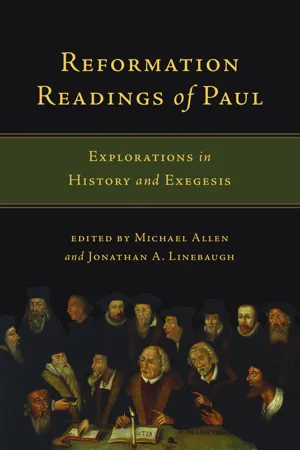
Reformation Readings of Paul
Explorations in History and Exegesis
- 280 pages
- English
- ePUB (mobile friendly)
- Available on iOS & Android
eBook - ePub
Reformation Readings of Paul
Explorations in History and Exegesis
About this book
Information
1 & 2 CORINTHIANS
and JOHN CALVIN
and JOHN CALVIN

7
JOHN CALVIN’S READING of the
CORINTHIAN EPISTLES
Michael Allen

Calvin’s Geneva may be viewed now as a reformational hub, and it did receive praise in its time as paradise, but Calvin’s own testimony shows the multipronged challenges faced there. Comparison to Corinth in the time of Paul can be fertile for reflecting on ways in which the Reformed movement was generated by Paul’s own reforming efforts. Corinth required discipline in several ways—theological, moral, liturgical, economic, and ecumenical or ecclesial polity. Calvin’s study of these reforms illumines his own commitments and therefore warrants our attention.
This chapter investigates John Calvin’s practice of reading Paul as a Reformational theologian-pastor.1 In so doing, I will consider three things. First, I will survey Calvin’s corpus and show the place of his reading of Paul’s epistles. Second, I will describe the shape of his commentaries on 1 and 2 Corinthians, noting his view of their themes as well as key features of his interpretation. Third, I will focus on a central theme—the theology of the cross—that flows from Calvin’s exegesis of the Corinthian writings and shapes much of his theological and pastoral reflection in those commentaries and elsewhere.
Calvin as Reader of Paul
To this day, John Calvin is perhaps the most respected Reformation-era interpreter of the Bible. While Luther’s 1535 Lectures on Galatians are surely the most famous biblical interpretation of this period, Calvin’s exegetical writings still garner a wider and more straightforward respect than those of his forerunner from Wittenberg or any other Reformational figure. Yet respect is not the same thing as recognition. Calvin’s writings are viewed highly, but they are rarely located in their intended rhetorical and pastoral place and thus are somewhat frequently misunderstood. So, a few words concerning the nature of Calvin’s literary works serve as a wise introduction to any study of a particular part of that wider output.
Calvin’s calling was twofold. Though technically never ordained, Calvin trained laypeople and pastors for decades in Geneva. His work in the church and in the academy involved biblical interpretation in the form of both sermons and commentaries.2 Yet Calvin remains most famous for his Institutes of the Christian Religion, which in its various editions (from 1536 to 1559) rivals Luther’s Lectures on Galatians as perhaps the most noted book to arise from the Protestant Reformation. Most accounts of Calvin’s thought or studies of his theology fix on this specific text alone (and typically the final 1559 edition) as the full summary of what he believed.3
Calvin had a different perspective, however, and viewed his Institutes as but one aspect of a two-pronged theological program. He intended that text to serve as a guide to prepare pastors for the reading and preaching of the Bible. As he famously states in his “Letter to the Reader”: “Moreover, it has been my purpose in this labor to prepare and instruct candidates in sacred theology for the reading of the divine Word, in order that they may be able both to have easy access to it and to advance in it without stumbling.”4 But he then expected those same pastors to make use of his many biblical commentaries for specific guidance in interpreting scriptural passages.
Calvin’s commentarial approach is marked by what has become a well-known phrase in biblical hermeneutics: “lucid brevity.” In the dedicatory letter to Simon Gryneé, found in his first commentary (on Romans), he stated: “Both of us felt that lucid brevity constituted the particular virtue of an interpreter. Since it is almost his only task to unfold the mind of the writer whom he has undertaken to expound, he misses his mark, or at least strays outside his limits, by the extent to which he leads his readers away from the meaning of the author.”5 He believed that the writings of his good friend Philipp Melanchthon lacked lucidity inasmuch as Melanchthon’s selective expositions did not address or clarify every verse of the Bible. Yet the more prolix writings of Martin Bucer, which certainly dealt with every verse, were so profuse as to overwhelm the reader. Calvin aimed for—and to a remarkable extent succeeded in attaining—“lucid brevity,” by addressing the specifics of any given verse without being compelled to unpack all its theological implications and doctrinal connections in its every occurrence. He intended the Institutes to serve as that gathering of common places (loci communes) wherein each doctrine would be addressed in a full, orderly manner.
So the wise reader is instructed to move backwards and forward. When Calvin notes a biblical passage in the Institutes, he is typically intending his reader to search out greater exegetical reflections on that portion of Scripture in his commentary on that text.6 And when a specific paragraph or verse of Scripture seems to imply a particular doctrinal claim, Calvin will only briefly mention it in the commentary but will unfold the topic on a grander scale in the Institutes. As he said of his 1539 Institutes,
If, after this road has, as it were, been paved, I shall publish any interpretations of Scripture, I shall always condense them, because I shall have no need to undertake long doctrinal discussions, and to digress into commonplaces. In this way the godly reader will be spared great annoyance and boredom, provided he approach Scripture armed with a knowledge of the present work, as a necessary tool.7
In light of this rhetorical and pastoral strategy, how do we inquire about Calvin’s reading of Paul? We must address both the Institutes and the commentaries. Furthermore, we must consider their interplay and the way in which they point to each other.
Calvin comments on and preaches through the whole Pauline corpus. Not only does he cover the whole terrain, but he also begins his commentary work with this material. It holds a position of obvious prestige in his career. T. H. L. Parker has argued that the historical primacy of the Pauline epistles in Calvin’s work mirrors that of the epistles within the New Testament itself, and that Calvin viewed this literary history of the biblical writings as pivotal for his own ministry.8 By the end of the 1540s, Calvin had commented on the entirety of the Pauline epistles.9 The prestige of Paul is not mere historical happenstance, though, for Calvin also shapes his theological structure according to a specifically Pauline architecture. Richard Muller has observed that the early shaping of the Institutes was generated by engagement with Paul’s theology. In particular, Calvin’s budding friendship with Philipp Melanchthon convinced him that this remarkable Lutheran theologian was right to structure his own theological text, the Loci communes, around the order of Paul’s epistle to the Romans.10 Calvin believed that this epistle was an entry point to the whole Bible; as he said, “If we have gained a true understanding of this epistle, we have an open door to all the most profound treasures of scripture.”11 Beginning in 1539, Calvin adopts this pathway: the basic order of the Institutes follows the doctrinal sequence of Romans. Paul’s influence is clearly crucial.
Calvin, however, was not exclusively dependent on Romans as a template, and this is true in at least two respects. First, he moves toward a more explicitly creedal structure in the 1559 Institutes, where the four books follow the four parts of the creed (Father, Son, Spirit, church). The order still follows much the same course as Romans (doctrine of revelation, God, humanity, sin, Christ, salvation, Spirit, church, etc.), yet it is framed in a slightly different style. Second, he adds other elements that are not features of Romans into the Institutes. Such a maneuver cannot be avoided, of course, but it does show that Calvin’s dependence on Paul and Romans is surely not a restrictive or exclusive focus. Even so, a survey of Calvin’s works shows the remarkable place of Paul in his theology, in terms of both scope and sequence.
Calvin as Reader of the Corinthian Epistles
Calvin devotes serious attention not only to Paul in general but to the Corinthian epistles in particular. After commenting on Romans and writing a short treatise on Jude, Calvin next turned to 1–2 Corinthians. These commentaries appeared six years after the famed volume on Romans, a delay likely due to the stresses and demands of his pastoral vocation. We will consider the shape of his commentaries, each in turn, before pointing to some key features and notable facets of his interpretive work present here.
In his typical fashion, Calvin begins his work on 1 Corinthians by charting the “theme of the epistle.”12 He notes the nature of Corinth, indeed, that there are particular dangers of living in “rich, commercial cities.”13 The attentive reader, of course, will wonder in what ways Calvin presents Corinth as an ancient analogue for his Geneva. He describes the false apostles who have settled there: devaluing Paul’s rhetoric, dividing the church and seeking to enhance their own reputations.14 Their error appeared pastoral and not overtly doctrinal: “They did not detract from the substance of the Gospel in any respect; but since they were burning with a misguided and passionate desire for prominence, I think that they had devised a new method of teaching, that was not consistent with the simplicity of Christ; and they hoped that it would make them the objects of people’s admiration.”15 The congregation in Corinth apparently suffered from this infusion of false teaching, earning the title “babes in Christ” from Calvin: “Although they were not entirely without grace, yet they had more of the flesh than of the Spirit in their lives.”16
Calvin then traces the order of Paul’s argument, as is his standard practice in beginning a commentary.17 Paul begins with words of congratulation but quickly turns to exhortations that the Corinthians flee pride and return to a posture of humility (1 Cor 1). He then reflects on the way that preaching is seemingly foolish, when viewed against the backdrop of worldly wisdom (1 Cor 2); “he points out that the distaste for the Word, which was so strong in them, did not come from any defect in the Word itself, but from their ignorance” (1 Cor 3).18 He must address the nature of the apostolic office, says Calvin, arguing that his sufferings demonstrate the genuine calling he has been given by the risen Lord (1 Cor 4).
Paul then turns to other exhortations, according to Calvin. Paul strongly berates the Corinthians for tolerating incestuous relations between a man and his stepmother (1 Cor 5). He rebukes their willingness to run to court to settle internal matters as well as their overindulgent sexual behaviors (1 Cor 6). Because sex has proven a debilitating stumbling block, Paul then reflects at some length on virginity, marriage and celibacy (1 Cor 7). He also must address the practice of joining in idol worship, a practice that the Corinthians seem to have accepted, provided they did not intend to offer genuine worship to idols in their hearts; again, Paul emphasizes that bodily and social actions matter, for they are God’s temple (1 Cor 8).
Motivation proves important, believes Calvin, so he says that Paul offers two key arguments for obeying his commands. First, Paul describes his own willingness to use his Christian freedom for the sake of others (1 Cor 9). Second, he points backwards to the example of the faltering Israelites in the wilderness, suggesting that they are a negative example of a people who believed for a time yet fell away due to unbelief (1 Cor 10). He then turns to ways that they ought to receive grace and power for perseverance: worship, sacraments, community and spiritual gifts. Paul suggests that, unfortunately, the Corinthians’ embodiment of each of these callings has taken a tur...
Table of contents
- Cover
- Title Page
- Dedication
- Contents
- Abbreviations
- Introduction
- Galatians and Martin Luther
- Romans and Philipp Melanchthon
- Ephesians and Martin Bucer
- 1 & 2 Corinthians and John Calvin
- The Letters of Paul and Thomas Cranmer
- In Conclusion: The Story of Reformation Readings
- Notes
- Contributors
- Scripture Index
- Praise for Reformation Readings of Paul
- About the Editors
- More Titles from InterVarsity Press
- Copyright
Trusted by 375,005 students
Access to over 1.5 million titles for a fair monthly price.
Study more efficiently using our study tools.
Frequently asked questions
Yes, you can cancel anytime from the Subscription tab in your account settings on the Perlego website. Your subscription will stay active until the end of your current billing period. Learn how to cancel your subscription
No, books cannot be downloaded as external files, such as PDFs, for use outside of Perlego. However, you can download books within the Perlego app for offline reading on mobile or tablet. Learn how to download books offline
We are an online textbook subscription service, where you can get access to an entire online library for less than the price of a single book per month. With over 1.5 million books across 990+ topics, we’ve got you covered! Learn about our mission
Look out for the read-aloud symbol on your next book to see if you can listen to it. The read-aloud tool reads text aloud for you, highlighting the text as it is being read. You can pause it, speed it up and slow it down. Learn more about Read Aloud
Yes! You can use the Perlego app on both iOS and Android devices to read anytime, anywhere — even offline. Perfect for commutes or when you’re on the go.
Please note we cannot support devices running on iOS 13 and Android 7 or earlier. Learn more about using the app
Please note we cannot support devices running on iOS 13 and Android 7 or earlier. Learn more about using the app
Yes, you can access Reformation Readings of Paul by Michael Allen, Jonathan A. Linebaugh, Michael Allen,Jonathan A. Linebaugh in PDF and/or ePUB format, as well as other popular books in Theology & Religion & Biblical Criticism & Interpretation. We have over 1.5 million books available in our catalogue for you to explore.