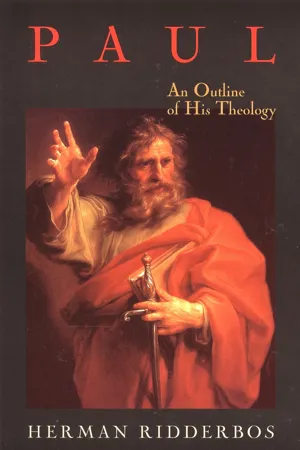
Now back in print in a beautiful new paperback edition, this study by one of Europe's foremost New Testament scholars provides a comprehensive exposition of the teaching of the apostle Paul.
Firmly grounded in a careful exegesis of the biblical text and crafted with constant reference to the wealth of scholarly study of Paul's writings, this volume is a standard for interpreters of Paul's thought and all students of the New Testament.
- 587 pages
- English
- ePUB (mobile friendly)
- Available on iOS & Android
eBook - ePub
About this book
Information
Print ISBN
9780802844699
XII
THE FUTURE OF THE LORD
SECTION 74. THE LIFE OF EXPECTATION. THE “NEARNESS”
In the preceding study it has been apparent time and again how much the whole of Paul’s preaching is determined by the all-important fact that in Christ’s advent and work, especially in his death and resurrection, the divine work of redemption in history has reached its fulfillment and the redemptive dispensation of the great future promised by God and foretold by prophecy has become present time: “Behold, now is the acceptable time; behold, now is the day of salvation” (2 Cor. 6:2). We have been able to trace how all the central subjects of Paul’s proclamation of redemption—the revelation of the righteousness of God, the new life of believers, the gift of the Holy Spirit, the church as the new people of God and as the body of Christ—must be understood in the light of this central motif of fulfillment and thus in their fundamentally eschatological and redemptive-historical determination. Along with that, however, we have been able to observe repeatedly that this promise of redemption fulfilled in Christ and the great day of salvation that has dawned with his death and exaltation as yet bear a character that is only in principle and provisional. They do not yet signify the end of the expectation of redemption and do not yet render the Christian hope superfluous. For this reason the “already” and the triumphant “but now” of the fulfillment are always coupled with the “not yet.” The revelation of the righteousness of God does indeed guarantee the hope of the glory of God (Rom. 5:2), but does not yet signify the obtaining of this glory in the present time. Nor does the redemptive indicative of having died and having been raised with Christ make the necessity of the imperative in the struggle against sin superfluous. And the Spirit, however much the evidence of deliverance given in Christ from slavery under the law and sin, is still only the earnest and the firstfruits of the perfect redemption. In a word: the certainty that in Christ the day of salvation, the acceptable time, has dawned does not mean the end of redemptive expectation, but only makes it increase in intensity.
This expectation of the coming of the Lord and what accompanies it is one of the most central and powerful motifs of Paul’s preaching. There are passages in which, in discussing specific questions or conditions in the church, he devotes deliberate and detailed attention to it—especially in 1 and 2 Thessalonians, but also in 1 Corinthians 15. We shall have to return to them. But in addition to these passages, the extent to which Christ’s parousia determines his attention and preaching appears in many ways. He can define the content of conversion and of the Christian life as “waiting for his [God’s] Son from heaven, whom he raised from the dead, Jesus who delivers us from the wrath to come” (1 Thess. 1:10), or as “a godly life in this world, in expectation of the blessed hope and the appearing of the glory of our great God and Savior, Christ Jesus” (Tit. 2:13). In 1 Corinthians 1:7 he further defines the confirmation of the gospel in the church as “not lacking in any spiritual gift,” and as “waiting for the revelation of our Lord Jesus Christ” (cf. Phil. 3:20). This expectation, which can be called the content of the apostolic testimony (2 Thess. 1:10), is also a powerful motive for the Christian life (1 Thess. 2:12). Again and again the apostle confronts the church with the day of Christ, on which it will have to appear before its Lord pure and blameless (Phil. 1:10; 1 Thess. 3:13; 5:23; 1 Cor. 1:8). This motive is the more urgent because by this church Paul evidently does not mean the church in its already glorified mode of existence after the resurrection, but simply in its historical appearance, directed toward the parousia. Its calling to holiness and blamelessness he places in the very concrete light of the expected coming of the Lord, and it is the church with whom as his glorying he hopes to enter into the presence of the Lord at his coming (2 Cor. 1:14; Phil. 2:16), indeed it is his hope, his joy, and crown of honor before his Lord (1 Thess. 2:19, 20). It is with a view to that approaching day that believers are to cast off the works of darkness and to put on the armor of light. It is now time to awaken out of sleep; salvation is already nearer than when they first believed. The night is far spent, and the day is at hand. One is therefore to walk becomingly as in the day and no longer in the sins of darkness (Rom. 13:11–13). One meets with the same motifs in 1 Thessalonians 5:2–8. It is clear both that the motif of fulfillment, of already belonging to the day, finds expression here, and on the other hand that, as the great day of the Lord, this day is coming and with its beams is illuminating the present.
The coming of the Lord can for this reason not only be a motive for sanctification, but also a source and ground of comfort in the present “affliction,” a word that does not merely refer to an incidental setback or difficulty, but very definitely characterizes the last phase of the present world preceding the coming of Christ.1 Therefore the revelation of the Lord Jesus from heaven also signifies rest for those who are now in that distress (2 Thess. 1:6ff.). Because of this hope of the glory of God the church may glory in this affliction (Rom. 5:2–5). Affliction, suffering, and glory frequently occur in one context (Rom. 8:18), indeed in the former lie the announcement and proof of the latter (Rom. 8:19–23). Hope in the appearing of Christ (Tit. 2:13) is accordingly the distinguishing mark of the Christian life (Rom. 8:24; Gal. 5:5). As the one who will appear, Christ is the hope of glory (Col. 1:27), or in the absolute sense “our hope” (1 Tim. 1:1), with whose manifestation the church, too, will be manifested in glory (Col. 3:4). It is this glory which is time and again held out in prospect to the church that now finds itself in distress and suffering (1 Cor. 15:43; 2 Cor. 3:18; 4:17; Eph. 1:18; Phil. 3:4; 2 Thess. 2:14; 2 Tim. 1:10), and on which its hope is set (Col. 1:5; 1 Thess. 5:8; Tit. 1:2; 2:13; 3:7). And with what intensity this expectation is charged all those passages prove in which the apostle strongly accentuates the “not yet” of the present. There the sparks shoot, as it were, to and fro between the two poles (Rom. 8:18ff.; 2 Cor. 4:16–18); there it is evident what a living and fervent longing supports and glows through all the preaching of the apostle (cf. Rom. 7:24, 25; 8:23, et al.).2
In view of the important place the future expectation occupies in Paul’s preaching and the actual significance he ascribes to it, it is no wonder that the query as to the eschatological perspective in a temporal respect has frequently been raised. In so doing the question in particular that has been dealt with repeatedly is whether he considered the parousia of the Lord as an event still to be experienced by him, or by his generation, and proceeds from that idea in his epistles. It is not a matter of a simple yes or no answer to this specific question, but above all of that which is closely bound up with it as to how Paul viewed the present life and its development in the light of the coming parousia.
Now in our opinion it is difficult to doubt that not only the ancient Christian church, but Paul, too, in the epistles that have come down to us, did not make allowance for a centuries-long continuing development of the present world order. The manner in which he speaks, for example, in Romans 13:11ff., of the approaching of salvation (that is to say, the parousia of Christ—“salvation is nearer to us now than when we first believed”) points to the fact that the apostle did not expect Christ’s coming to be in the distant future.3 This may also appear from the words of Philippians 4:5, likewise to be understood to a temporal effect: “The Lord is at hand.” Further, reference is to be made to the pronouncement in 1 Corinthians 7:29: “I mean this, brethren, the time is short.”4 In view of what follows this, in which the church is exhorted not to cling to the present life, because “the outward form of this world”5 is passing away (vv. 29ff.), the “shortness” of the time is to be taken as the remaining temporal duration of this world and not merely of the individual life of believers.6 Although the qualification “short” (compressed) does not any more than “at hand” give a precise definition and can be taken more or less broadly, it is nevertheless clear that Paul sees in this “shortness” an urgent motive even for his readers of that day. The shortness of the time, the nearness of salvation, is a matter of great relevance, which heightens the earnestness of the paraenesis (cf. Phil. 4:5ff.).
And not only does the apostle see the life of the church from this point of view, when he warns it not to continue to cleave to the present life and to be holy in view of the nearness of the day of the Lord (Phil. 1:10; 1 Thess. 3:13; 5:23; 1 Cor. 1:8), but it also determines his view of the world around him. He hears in the whole creation a groaning for redemption, which has the character of an eager longing7 of the creature8 subjected to death and perishableness, of being already in travail, reaching out in pain toward a new birth (Rom. 8:19, 20, 22). He also sees in all this the approaching end of the power of darkness, which still appears as the world-ruling principle (Eph. 6:12). For God will soon (en tachei) crush Satan under the feet of the church, in accordance with the promise given at the ejection of man from Paradise (Rom. 16:20).
Interpreters frequently go further and suppose that Paul counted on himself still living to see the parousia of Christ, and that he awakened that expectation in the church. Appeal is made to two passages in particular for that purpose, namely, 1 Thessalonians 4:13ff. and 1 Corinthians 15:51. In 1 Thessalonians 4:13 Paul goes into the anxiety that has arisen in the church concerning those among them who have died and had thus not lived to see the coming of Christ. This is said to point to the fact that during his time in Thessalonica he had not spoken of this possibility, that Christians should die before the parousia. It is also supposed to be clearly evident, when in 1 Thessalonians 4:13 he attempts to remove this anxiety, that neither he himself nor his readers have thought of their own dying before the parousia. Appeal is then made especially to the “we” in the words: “we who are alive, who are left until the coming of the Lord [or: we who continue to live until the coming of the Lord], shall in no case precede those who have fallen asleep” (1 Thess. 4:15; cf. v. 17).9 And a similar conclusion is attached to 1 Corinthians 15:51: “Behold, I tell you a mystery: we all shall not sleep, but we shall be changed.” Paul is said to have declared herewith that not all Christians of his time, nor he himself, would die before the parousia. And it is alleged that this cannot be set aside, for example, by referring the fact that all shall not sleep, not to Paul and those whom he addresses themselves, but just to those who are alive at the parousia.10
Now in the light of the “nearness” pronouncements that have already been cited, one can hardly contend that personally living to see the parousia was a thought that was far removed from Paul’s mind; rather, the reverse seems to be the case. Likewise the fact that the church at Thessalonica could place the death of believers before Christ’s coming only with difficulty points out how relevant it had found the announcement of the parousia in the apostolic preaching and how much that event had come, as it were, to fill its whole horizon (cf. 1 Thess. 1:9, 10). It is something else again, however, whether Paul, either in his preaching or in his epistles, may be said to have left no place for another possibility, so that one would be permitted to take the words “we who are left alive,” etc., in 1 Thessalonians 4:15, 17, only in a positive and not in a hypothetical or at least a facultative sense (“so far as we,” etc.). And this is, on further reflection, surely a contention that is difficult to maintain. First of all, it is not in any sense apparent from Paul’s answer to the church that the death of members of the congregation before the parousia constituted a problem for him. Rather his answer is evidence to the contrary. He is able indeed to appeal to a word of the Lord in which the fate of those who died (before the parousia) as well as that of survivors had been foreseen. In addition, if it had been the presupposition of Paul’s preaching that believers continue to live till the parousia, he would already have attributed a certain immortality to himself and his fellow believers, something that is altogether in conflict with the manner in which he generally speaks of his own life and death and that of his fellow-believers (cf., e.g., 1 Thess. 5:10; Rom. 14:7–9; 8:10, 11, to say nothing of such passages as Phil. 1:22ff.; 2:17; 2 Cor. 4:11; 5:1ff.; 2 Tim. 4:6, in which the possibility, in part even the expectation, of dying before the coming of Christ is explicitly posited).
This scarcely deniable fact has accordingly given rise to the theory that a certain contradiction exists in Paul’s pronouncements on death; there is said to be a juxtaposition of the eschatological expectation of the parousia and an individual hope in the period after death, which would in a sense give expression to the peculiarity of Paul’s faith.11 More radical and in a certain respect more plausible is the view that as time went on Paul changed his mind.12 Inasmuch, however, as the “old” standpoint is seen to emerge in 1 Corinthians 15 and the “new” in 2 Corinthians 5:1ff., one is surely obliged to reach the bold assertion that that change came about in the one- or two-year interval between the first and second epistles to the Corinthians.13 But all these theories are untenable. How could Paul have been able to “introduce” these sweeping “alterations” in his epistles to Corinth, written in such rapid succession, without speaking so much as one word of justification concerning them, while both in 1 Corinthians 15 and 2 Corinthians 5 he deals with death explicitly and at length? But then, how could he persist so long (up to the writing of 2 Cor.) in this “old” conception? How many believers had he, who wrote his epistles twenty years and more after his conversion, already seen pass away? And how could he...
Table of contents
- Cover
- Title Page
- Copyright
- Author’s Preface
- Translator’s Preface
- Contents
- Abbreviations
- I. Main Lines in the History of Pauline Interpretation
- II. Fundamental Structures
- III. The Life in Sin
- IV. The Revelation of the Righteousness of God
- V. Reconciliation
- VI. The New Life
- VII. The New Obedience
- VIII. The Church as the People of God
- IX. The Church as the Body of Christ
- X. Baptism and the Lord’s Supper
- XI. The Upbuilding of the Church
- XII. The Future of the Lord
Trusted by 375,005 students
Access to over 1.5 million titles for a fair monthly price.
Study more efficiently using our study tools.
Frequently asked questions
Yes, you can cancel anytime from the Subscription tab in your account settings on the Perlego website. Your subscription will stay active until the end of your current billing period. Learn how to cancel your subscription
No, books cannot be downloaded as external files, such as PDFs, for use outside of Perlego. However, you can download books within the Perlego app for offline reading on mobile or tablet. Learn how to download books offline
Perlego offers two plans: Essential and Complete
- Essential is ideal for learners and professionals who enjoy exploring a wide range of subjects. Access the Essential Library with 800,000+ trusted titles and best-sellers across business, personal growth, and the humanities. Includes unlimited reading time and Standard Read Aloud voice.
- Complete: Perfect for advanced learners and researchers needing full, unrestricted access. Unlock 1.5M+ books across hundreds of subjects, including academic and specialized titles. The Complete Plan also includes advanced features like Premium Read Aloud and Research Assistant.
We are an online textbook subscription service, where you can get access to an entire online library for less than the price of a single book per month. With over 1.5 million books across 990+ topics, we’ve got you covered! Learn about our mission
Look out for the read-aloud symbol on your next book to see if you can listen to it. The read-aloud tool reads text aloud for you, highlighting the text as it is being read. You can pause it, speed it up and slow it down. Learn more about Read Aloud
Yes! You can use the Perlego app on both iOS and Android devices to read anytime, anywhere — even offline. Perfect for commutes or when you’re on the go.
Please note we cannot support devices running on iOS 13 and Android 7 or earlier. Learn more about using the app
Please note we cannot support devices running on iOS 13 and Android 7 or earlier. Learn more about using the app
Yes, you can access Paul by Herman Ridderbos in PDF and/or ePUB format. We have over 1.5 million books available in our catalogue for you to explore.