
- 192 pages
- English
- ePUB (mobile friendly)
- Available on iOS & Android
eBook - ePub
Vanished Denver Landmarks
About this book
From its 1858 birth, the Mile High City has undergone continuous change, with each successive generation putting its stamp on Denver's architectural character. Along the way, landmarks initially considered first class were later deemed disposable by those who had different visions of what Denver should be. Beloved buildings like the Tabor Grand Opera House, the Windsor Hotel and the Republic Building vanished. Historian Mark A. Barnhouse revisits these lost treasures along with the lesser known and rarely explored, including an apartment building dubbed "Denver's Bohemia," the humble abode of one of the early twentieth century's most successful novelists and the opulent mansion of a man who gave Denver three consecutive baseball championships.
Trusted by 375,005 students
Access to over 1 million titles for a fair monthly price.
Study more efficiently using our study tools.
Information
Chapter 1
RESIDENTIAL LANDMARKS
ANDERSON HOUSE
The name “Anderson House” was in general use only during this dwelling’s final years; for most of its history, it was simply 2329 Eliot Street. The fight to save it symbolized the losses of many similar houses—built for the middle and upper middle classes when Denver was young—demolished by developers, but this particular house had a great backstory. Attorney William W. Anderson did not build the two-story Queen Anne home but rented it between 1897 and 1904. In 1915, he bought it, living here until his 1930 death. In Rediscovering Northwest Denver (1976), Ruth Eloise Wiberg referred to it as “a tall house on a tall hill,” a neighborhood landmark.
Anderson’s claim to fame was brief, but it involved some of the best-known Denverites of his day: Denver Post publishers Frederick Gilmer Bonfils and Harry Heye Tammen, their star “sob sister” reporter “Polly Pry” (Leonel Ross O’Bryan) and a famous Cañon City penitentiary inmate, Alfred Packer, the “Colorado Cannibal.” Bonfils and Tammen had made the Post into Denver’s leading daily by emphasizing emotional, sometimes lurid stories, often using red ink on front-page headlines to add shock value. Their shared office, painted crimson, was called the “Red Room” officially and the “Bucket of Blood” by their enemies.
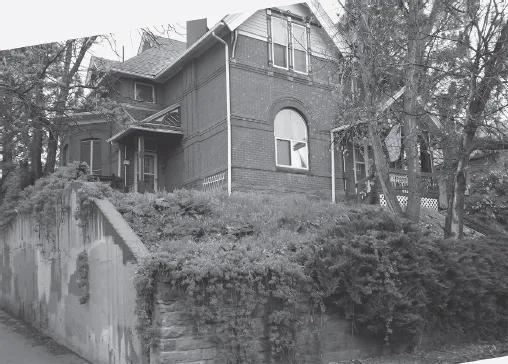
The Anderson House, 2015. Tom Simmons collection; photograph by Tom Simmons.
In 1900, Pry wrote a series of articles about Packer, who in 1874 had guided a hunting party in isolated Lake County. After several months, Packer emerged alone, and a rescue party found unmistakable signs that some of his companions had been eaten. Packer admitted consuming their flesh after their deaths from starvation but denied killing them. Nevertheless, he was given a long sentence. Pry focused on injustice done to Packer, and her employers made freeing him a cause celèbre. Anderson, sensing potential glory and profit, announced he would meet with Packer. Traveling to Cañon City, he told Packer he was acting as Bonfils’s and Tammen’s personal representative (he was not) and persuaded him to pay twenty-five dollars as a “docket fee.” The publishers were incensed by Anderson’s unauthorized initiative and summoned him to their office. There, with Pry present, the men argued, with Pry attempting to mediate. Anderson reached inside his coat, pulled a gun and shot Bonfils several times. He left the room, returned, cornered Tammen and shot him several times. The blood was real now; while both men survived, Bonfils’s wounds were nearly fatal. Not everyone thought of Anderson as the villain—Bonfils and Tammen had alienated many in their crusades—and after two mistrials, he was acquitted in a third trial.
In 2015, the house’s owner accepted an offer from a developer who planned to replace it with eighteen townhomes. Aware of the history, neighborhood activist Rafael Espinoza, then running for city council, filed with the DLPC to preserve it, joined by neighbor Jerry Olson and others. One DLPC commissioner, architectural historian Kathy Corbett, favored preservation: “If history isn’t stories, what else do we have? The history of Denver, this kind of rough-and-tumble Western mythos, is a lot of what makes Denver what it is.” City council disagreed, judging Anderson’s connections to Bonfils, Tammen, Pry and Packer unimportant. The house came down.4
BELMAR
Depression-era Denver saw two superlative, similarly named mansions erected, providing jobs to unemployed artisans. In 1932, Senator Lawrence Cowle Phipps built Belcaro, Italian for “beautiful, dear one,” in southeast Denver, centerpiece of its eponymous neighborhood. In 1936–37, May Bonfils built Belmar in then-unincorporated Lakewood, near South Wadsworth Boulevard and West Alameda Avenue, but its name was not Italian. She was the daughter of Denver Post publisher Frederick Bonfils and his wife, Belle, and when May built her country palace, she named it for her mother, combining “Bel” with “Mar,” a shortened form of Mary. Devoutly Catholic, she may have been honoring the Virgin Mother, but more likely, it was for herself, May being a form of Mary. Today, Belcaro remains Denver’s finest mansion, while Belmar is lost, thanks to one unfortunate decision.
May suffered from extreme sibling rivalry with her six-years-younger sister, Helen. Perhaps that competitiveness led May to commission Denver’s premier domestic architect, the École des Beaux-Arts–trained Jules Jacques Benoit Benedict, for her twenty-room manse while her sister remained in their parents’ Humboldt Street home. May had enraged her father in 1904 when she married, at the age of twenty-one, Knight-Campbell piano salesman Clyde Berryman. He was not of their social class—but far worse, he was Protestant. From then on, Helen was clearly favored. When their father died in 1933, his will not only gave Helen a greater share of his estate and control of the newspaper but also promised that if May divorced Berryman, she could receive a larger annuity. The sisters fought in court and clashed again after Belle died, who also shorted May in favor of Helen. The hearing was noisy, but justice prevailed, splitting Belle’s estate fifty-fifty and providing May more income. The estranged sisters let familial bonds wither. Helen forbade any mention of May in The Post’s pages, and May turned her attention to creating Belmar.
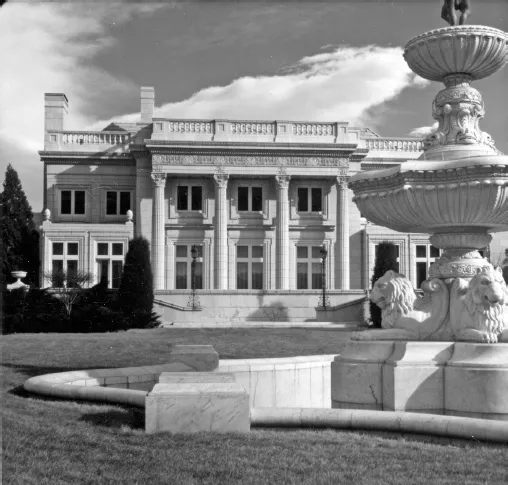
Belmar’s western façade with the fountain now located in Hungarian Freedom Park. Thomas J. Noel collection/Lakewood Heritage Center.
With a budget topping $1 million, Benedict was given free rein. Guests drove down a long, tree-lined lane, encountering an elaborate iron gate trimmed in gilt and embellished with round medallions presenting the estate’s name, with support columns topped by statues of Pan. Passing through, a statuary-bedecked circular drive brought guests to the door. Louis XVI would have admired the perfectly symmetrical neoclassical glazed terra-cotta façade inspired by the Petit Trianon at Versailles. The interior, while not quite as ornate as the French original, was stately nonetheless. Large, well-proportioned rooms boasted sparkling chandeliers illuminating priceless antiques, including a piano said to have been played by Frédéric Chopin, a chair sat in by Queen Victoria and a bed owned by Queen Marie Antoinette. A 1941 Burnham Hoyt–designed art gallery addition showcased works by old masters Holbein, Correggio and van Dyck, as well as pieces by newer artists including Corot, Modigliani and Picasso. West-facing windows looked out to an expansive lawn graced by a white marble fountain designed by Benedict. The rest of the 250-acre property, which spanned both sides of Wadsworth Boulevard, was used agriculturally, for raising cattle, sheep and chickens, and as a nature preserve, centered on the fifty-acre Kountze Lake.
By this time, Bonfils and Berryman were living apart, and she, despite church doctrine, divorced him in 1943. She later became involved with Charles Edwin Stanton, an architect and designer whom she had met at Central City Opera—she was a benefactor, and he was redecorating the adjacent Teller House. He was much younger, just forty-six to her seventy-three, when they married at Belmar in 1956, and until her 1962 death, she relied on him to manage her affairs. He lived on, selling the property east of Wadsworth to mall developer Gerri Von Frellick, who opened the Villa Italia center there in 1966. May would have undoubtedly appreciated the mall’s collection of classical statuary reproductions, as she had filled her own home with similar baubles. In 1970, Stanton donated Belmar to the Denver Archdiocese, stipulating that it be used for religious purposes, but the diocese could not afford maintenance and sold it to a developer. Intending to replace the house and immediate grounds with an office complex, the developer allowed the archdiocese to open Belmar to the public for the first and last time, and in the fall of 1970, thousands came to gawk, marvel and mourn the impending loss of one of Colorado’s finest mansions. Stanton, for his part, unsentimentally believed that once a house’s builder dies, it becomes a “meaningless shell.”
Today, the only remnants of Belmar on site are its ornate gate, a neoclassical boathouse and a wooden barn incorporated into the Lakewood Heritage Center. The marble fountain sparkles in Denver’s Hungarian Freedom Park on Speer Boulevard at Emerson Street. The Belmar name lives on in the mixed-use development that replaced the outmoded Villa Italia. While some mourn the mall’s passing, the bigger loss by far is May Bonfils’s dream house.5
BETHELL-PHIPPS MANSION
Impossible to imagine now, East Colfax Avenue from Sherman to York Streets was once a prestigious mansion-lined thoroughfare. One of the finest, at the southwestern corner of Colfax and Marion Street, was built for Captain William Decatur Bethell. A resident of Maury County southwest of Nashville and from a slaveholding family, Bethell joined the Confederate Twenty-Second Tennessee Infantry in 1861 as a twenty-one-year-old. He was wounded in the Hornet’s Nest stage of the Battle of Shiloh in April 1862 and served out the war as a staff officer under Brigadier General Gideon Pillow, his wife Cynthia’s relative. In 1882, he and his Pillow relations pooled funds to build Bethell House, a luxury hotel in Columbia, Tennessee. In 1891, he became president of the Taxing District, or de facto mayor, of disincorporated Memphis, Tennessee, but later that year, he left Memphis, came to Denver for his health and established the Southern Investment Company, headquartered in the Ernest and Cranmer Building (later relocating to the Mining Exchange Building). In September 1892, he bought struggling Manhattan Beach amusement park at Sloan’s Lake, leasing it to a succession of management companies. How sound this investment was is unknown, but, beset by fires, drownings and other disasters, it likely broke even at best.
Bethell clearly had money, both inherited wealth and investment income, as he could engage young Theodore Davis Boal, who became a society favorite, to design a mansion in the Châteauesque style inspired by Loire Valley French Renaissance palaces. This aesthetic, with steeply pitched roofs, round towers, spires and other exotic elements, was highly fashionable in the 1890s; its best-known American example is Asheville, North Carolina’s Biltmore, built contemporaneously with Bethell’s mansion. Bethell’s home was finished by mid-1893, when the Bethells held a ball honoring his cousin Louise Bethel Sneed, who met her future husband, Crawford Hill, at the event. It was built of white stone, and its red-tiled roof sheltered twenty-six rooms. Some were large, designed for lavish entertaining; the entry hall measured twenty-five feet square. Rooms were paneled in oak or mahogany and decorated with antique furniture and Persian carpets. An 1894 party hosted over seven hundred guests under electric chandeliers. The Bethells lived at 1154 East Colfax Avenue for seven years, departing in 1901. Bethell moved to California for its climate. He later returned to Denver, dying in 1906 at his daughter’s home. Cynthia lived another fourteen years, residing at 850 Pearl Street.
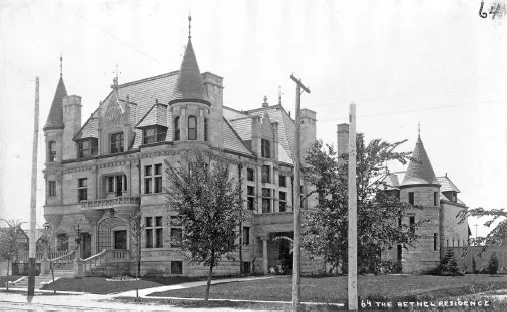
The Bethell-Phipps Mansion, Colfax façade. Denver Public Library, Western History Collection, H-582; photograph by Rose & Hopkins.
In 1901, Lawrence Cowle Phipps, recently arrived from Pittsburgh, bought the home for $75,000 and spent a similar amount on renovations and redecorating. Phipps, nephew of industrialist Henry Phipps Jr., the second-largest shareholder in Carnegie Steel, had spent his adult working life there, rising to first vice president. In 1901, John Pierpont Morgan purchased Carnegie and merged it with other companies to form United States Steel; the resulting financial payoff allowed Phipps to retire from business and move out west, retaining a significant stake in U.S. Steel. On the cusp of forty when he arrived, he chose Denver after a hunting trip introduced him to Colorado’s charms. With Phipps came his second wife, Genevieve Chandler Phipps, and their two young daughters, Dorothy and Helen. Phipps’s two older children by his deceased first wife remained back east, son Lawrence at Yale and daughter Emma at school in Dobbs Ferry, New York. Genevieve was fifteen years younger than Lawrence, whom she had married in 1897.
This immensely rich couple captivated society reporters, who chronicled every detail, true or not. Red-haired Genevieve was a “beautiful woman of the Titianesque type and with her personal attractions she possesses a cultivated mind and many accomplishments,” one gushed. Her wardrobe and jewelry provided endless fascination. For a $100 daily fee, she retained designer Hubert De Rossi, who had decorated the Phippses’ Pittsburgh mansion, Grand View, and had worked for “the Vanderbilts and other millionaires in the East.” In January 1903, seven large paintings from the Phipps collection, insured for $35,000, hung at the R.L. Boutwell Art Gallery at 415 16th Street, where thousands viewed them prior to their installation in the mansion. Even for the girls, no expense was spared: Phipps’s contractor built a children’s playhouse of cement, twenty feet square and fifteen high. Phipps also erected a four-car garage.
The doting coverage of everything Phipps took a more sensational turn in June 1904, undoubtedly benefiting The Denver Post’s circulation; nearly every day between June and October, the Phipps name appeared in that gossipy broadsheet in connection with the biggest Denver divorce since Horace Tabor left Augusta for Baby Doe. Shocking news came that Lawrence had “kidnapped” their daughters from his wife’s New York hotel suite to bring them home to Denver. Both sides retained counsel: friend Gerald Hughes for Lawrence, and for Genevieve, family friend Philander Chase Knox, who had served as attorney general for presidents William McKinley and Theodore Roosevelt. Locally, she hired former Denver mayor Platt Rogers. Lawrence, after engaging round-the-clock private security, filed for divorce on June 6, citing “incompatibility of temper and cruelty,” claiming the condition had existed since the marriage’s beginning. Genevieve instructed Rogers to file a writ of ejection against Lawrence: the Colfax mansion was in her name.
This would not do. Neither side relished publicity, but more importantly, the Phipps name was entwined with Carnegie and Morgan. The future of American capitalism was at stake, as revelations in court and in newspapers would show. Henry Phipps stepped in, strongly advising Lawrence to settle. Should the case proceed, the elder Phipps feared disaster, as not only did Genevieve’s name appear on the titles of the Denver and Pittsburgh mansions but also on enough shares (valued at $10 million) of U.S. Steel that, should she decide to sell them to anyone not named Phipps, Carnegie or Morgan, it would deprive those oligarchs of control. Later in the summer, it emerged that she had been communicating with brokers representing John D. Rockefeller and George Jay Gould. She ultimately did not sell to them, but she knew her shares provided the strongest possible leverage with Lawrence. To prevent Morgan from reissuing the shares in Lawrence’s name, she counter-sued for divorce in Pittsburgh, where she felt she could better control the outcome. She wanted custody of her daughters and the Pittsburgh house. Lawrence wanted custody too, but his uncle urged him to surrender to her demands.
After a summer filled with rumors—of reconciliation, of her plans to remarry, of Secret Service agents tracking Lawrence on Knox’s orders, of offers and counteroffers—Judge Peter L. Palmer of Denver District Court granted divorce on September 14. Genevieve conveyed title to both mansions, along with all U.S. Steel bonds. With other bonds, Lawrence set up a trust fund, its interest to be paid to her as long as she remained unmarried. Should she remarry, the trust would dissolve, but she would receive bonds worth $250,000. Custody was split, each getting the girls for six-month periods and on alternate Christmases. Neither could remove the girls from the country without written permission of the other.
Why did it come to this? The answer seemingly appeared in courtroom testimony:
Judge Palmer: “State whether prior to the filing of this complaint, June 6, 1904, your wife for more than one year deserted you, failed to live with you as your wife and failed to perform her wifely duties toward you, and whether or not she threatened to break off all marital relations with you?” Lawrence Cowle Phipps: “Such is the fact. That is what she did.”
But what caused Lawrence to remove the girls from Genevieve and rush them back to Denver? Cessation of physical relations is not uncommon; many couples live this way without divorce. If The Post is to be believed, Genevieve was planning to leave Lawrence, take the girls to Europe and marry Andrew Hartupee McKee (who styled his name A. Hart McKee), son of a Pittsburgh glass manufacturer. They had known each other for years and were related by marriage. Several years earlier “at a Virginia resort there was a scene between Mr. and Mrs. Phipps and Hart McKee.…This was followed a few months later by an encounter between the men in one of Pittsburg’s most exclusive clubs…where the combatants came to blows.” The day before the “kidnapping,” a personal advertisement appeared in a New York newspaper: “Hart—Meet me at the Manhattan, as usual. Monday at noon; important. ‘DIMPLES.’” This was Genevieve’s nickname. Lawrence, tipped off by the family’s governess and nurse, hired detectives and devised a plan for these servants to take the girls out for an “airing,” during which he would arrive and take custody.
After the divorce, The Post continued to s...
Table of contents
- Front Cover
- Half Title
- Title Page
- Copyright
- Contents
- Preface
- Introduction
- 1. Residential Landmarks
- 2. Commercial Landmarks
- 3. Retail Landmarks
- 4. Hospitality Landmarks
- 5. Institutional Landmarks
- Notes
- Bibliography
- About the Author
Frequently asked questions
Yes, you can cancel anytime from the Subscription tab in your account settings on the Perlego website. Your subscription will stay active until the end of your current billing period. Learn how to cancel your subscription
No, books cannot be downloaded as external files, such as PDFs, for use outside of Perlego. However, you can download books within the Perlego app for offline reading on mobile or tablet. Learn how to download books offline
Perlego offers two plans: Essential and Complete
- Essential is ideal for learners and professionals who enjoy exploring a wide range of subjects. Access the Essential Library with 800,000+ trusted titles and best-sellers across business, personal growth, and the humanities. Includes unlimited reading time and Standard Read Aloud voice.
- Complete: Perfect for advanced learners and researchers needing full, unrestricted access. Unlock 1.4M+ books across hundreds of subjects, including academic and specialized titles. The Complete Plan also includes advanced features like Premium Read Aloud and Research Assistant.
We are an online textbook subscription service, where you can get access to an entire online library for less than the price of a single book per month. With over 1 million books across 990+ topics, we’ve got you covered! Learn about our mission
Look out for the read-aloud symbol on your next book to see if you can listen to it. The read-aloud tool reads text aloud for you, highlighting the text as it is being read. You can pause it, speed it up and slow it down. Learn more about Read Aloud
Yes! You can use the Perlego app on both iOS and Android devices to read anytime, anywhere — even offline. Perfect for commutes or when you’re on the go.
Please note we cannot support devices running on iOS 13 and Android 7 or earlier. Learn more about using the app
Please note we cannot support devices running on iOS 13 and Android 7 or earlier. Learn more about using the app
Yes, you can access Vanished Denver Landmarks by Mark A. Barnhouse in PDF and/or ePUB format, as well as other popular books in History & Architecture General. We have over one million books available in our catalogue for you to explore.