ON SUNDAY, OCTOBER 26, 1924—a “perfect Indian summer day”—the cornerstone was laid for the facilities of the new campus of Concordia Seminary in Clayton, Missouri. Special trains brought enthusiastic Lutherans from around the Midwest to witness the celebratory afternoon, and to lift their voices in a rousing rendition of “A Mighty Fortress Is Our God.” Coinciding with this new birth of one of America’s largest seminaries that day was the maiden voyage on the nation’s airwaves of Lutheran radio station KFUO, which introduced itself to the listening public by broadcasting the seminary proceedings. Concordia’s sober, scholarly president, Francis Pieper, stood before newfangled microphones and began to address the physical and ethereal attendees in Latin.1 As the bowtie-clad churchman spoke of Christ’s status as the “true cornerstone of the church,” an “immense” biplane flew over the campus. Pieper paused his speech and raised his eyes, along with those of the thousands present, to marvel at the display of gravity-defying technology.2 The epiphanic confluence of ancient Scripture, medieval language, Reformation theology, and modern innovation was not lost on the terra firma–bound spectators. In recapping this moment, the lay periodical The Lutheran Witness observed, “A conjunction of a living past with the vibrant present . . . could not have been more perfectly symbolized.” The German language periodical, Der Lutheraner, provided this succinct summation: “Times change, and we change with them. But God’s Word remains forever.”3
While the observers comprehended the symbolic intersection of modernity and the “faith which was once delivered unto the saints” (Jude 3 KJV), they could not have known the impact this intersection was about to have. Radio and religion would soon emerge as a match seemingly made in heaven. The faith “once delivered unto the saints” could now be delivered to the living rooms of saints and sinners alike, over broadcast towers sprouting up across the land. And millions were ready to listen.
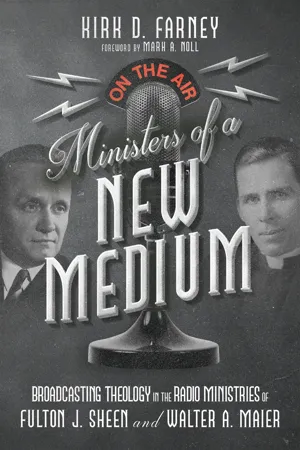
Two learned clergymen and academics, a Catholic priest and a Lutheran minister, led among those who embraced this opportunity to spread the Gospel of Jesus Christ over the airwaves. They did so with remarkable success. Through weekly broadcasts from coast to coast they attained household name status. Those names were Fulton J. Sheen and Walter A. Maier.
In February 1940, the diocesan newspaper of New Orleans, Catholic Action of the South, referred to Monsignor Fulton J. Sheen, the popular radio priest of the Catholic Hour (CH) radio program, as “the John Chrysostom of the US airwaves.”4 Three years later, Time magazine labeled Reverend Walter A. Maier, the dynamic radio preacher of The Lutheran Hour (TLH) broadcast, the “Chrysostom of American Lutheranism.” (As a courtesy to their less historically minded readers, Time’s editors did provide a footnote explaining who this renowned fourth-century Christian preacher was.5) Such praise was not uncommon for these two powerful preachers whose “golden mouths” spoke every week over the airwaves of the nation and much of the world.6 Through radio, both had gained considerable fame, rivaling not just that of other major religious leaders, but of entertainers and politicians as well. Both enjoyed the loyalty of millions of listeners, who formed audiences comparable in size to those of “popular” radio programs. While stylistically different, both preached with urgency and conviction. Both had attained uncommon erudition, yet delivered sermons that touched the common man and woman. Both saw Christian commitment as a central component of the American way of life and the key to the country’s well-being. And both espoused a version of Christianity that reflected conservative orthodoxy and tradition, yet with an ecumenical openness uncommon at the time in their respective denominations.
Those denominational affiliations are a key component in making the stories of Walter Maier and Fulton Sheen so noteworthy, and invite more thorough analysis. That Americans experiencing the Great Depression, then a world war, followed by the war’s aftermath and the rise of communism, would have listened to hopeful Christian messages on the radio is not difficult to understand. But that two of the most popular radio preachers would have come from the Roman Catholic Church and the Lutheran Church–Missouri Synod (LCMS) would have been less predictable, given the religious environment of the time.
When CH was launched in 1930, the Catholic Church represented the largest denomination in the United States, with over twenty million members. Yet anti-Catholic prejudice was widespread, as had been demonstrated by bitter opposition to Democratic Presidential Candidate Al Smith just two years earlier. What is more, many in the American non-Catholic majority viewed Catholicism as the religion of the suspect, ethnically disadvantaged, immigrant population that had come ashore in the latter nineteenth century. Historian Martin Marty has noted that in such an environment “moderates throughout the nation were no less disturbed than [Ku Klux] Klansmen about the threat that America would go Catholic.”7 Notwithstanding the uncharitable views non-Catholics expressed toward the less-than-fully American papists, many of them warmed quickly to Monsignor Sheen and tuned in just like their Catholic neighbors—much to the surprise of network executives and social observers.
The LCMS was one of several Lutheran bodies in America when TLH went on the air—also in 1930. At this time, there were roughly four million Lutherans in the United States, found in twenty-one different denominational bodies.8 With membership in excess of one million, the LCMS was one of the largest of these Lutheran groups. Yet it was obviously modest in relative size and resources, and even more modest in attracting attention. Though the Lutherans did not elicit the hostility that Catholics endured, they were often viewed as an aloof ethnic enclave, given their sectarian German and Scandinavian ways.9 Fellow citizens had displayed especially discomforting levels of distrust toward German-Americans, of which Lutherans were a sizable component, during World War I.10 Demonstrable German-American loyalty during that conflict and subsequent conscious efforts to “Americanize” had broken down some of the previous prejudices, bringing Lutherans more fully into the American mainstream. However, Missouri Synod Lutherans remained in a state of semi-isolation of their own construction, primarily because they doggedly maintained theological commitments that avoided any semblance of “unionism” (a form of ecumenism) or syncretism.11 Yet from this small, easily ignored denomination came Walter Maier and his engaging radio preaching. Like Sheen, he would enjoy the embrace of millions who tuned in. Like Sheen, he would attract listeners across the spectrum of denominational and religious affiliations. And, like Sheen, he would attain a level of recognition, and even celebrity, that many secular competitors within popular culture coveted.
In the anxiety-laden conditions of economic depression, war, and postbellum change, radio offered Americans a welcome escape. The antics of Lum and Abner, the adventures of the Lone Ranger, the wisecracks of Fred Allen, the tense sleuthing of the Shadow, all provided diversionary transport to fictional places for the masses tuning in. The round trip to such locales, however, took only thirty minutes or less, after which listeners again faced their daily realities. For millions, that task was made less arduous by having a relationship with the God who was the source of their reality. Fulton Sheen and Walter Maier went to their microphones to create and nurture these relationships. Both individual and communal religion flourished in the radio congregations they created. Historian Tona Hangen summarizes, “Religious radio, then, also served as a meeting place, a shared and sacred space that fulfilled the desire for personal connection.” It was “a vox populi in every sense of the word.”12 Maier’s and Sheen’s mastery at making these connections produced audiences that dwarfed many other religious broadcasts and rivaled those of the most popular secular programming. In short, religious radio and two of its most successful broadcasters are integral components of radio history; they belong anywhere but on the periphery.
The purpose of this book is to more fully understand their success and to argue for its significance. It will focus on the radio careers of Maier and Sheen, though with sufficient context provided for their respective Lutheran and Catholic identities. It will describe how they gained national airwave access and the challenges they faced in retaining that access. It will discuss the style and content of their preaching, while relating that preaching to the roles Sheen and Maier played in the emerging mass culture created by radio, especially network radio. It will endeavor to understand the receptivity of radio audiences to the messages of these two purveyors of divine wisdom. Finally, it will assess the impact of their radio ministries on their respective denominations and the broader Christian world.
Fulton Sheen and Walter Maier were extraordinary, gifted men. Both were “Type A” personalities, very busy in the vineyard of the Lord. While Maier was more proactive in pushing a gospel radio agenda in the 1920s, both men embraced the opportunities radio presented when they entered network airwaves in 1930. Before they excelled in radio, both had proven themselves as solid thinkers and effective communicators for other purposes. Though their speaking styles differed, each possessed eloquence that inspired listeners. Each drew on education, intellect, and wit. Both possessed firm theological convictions that they expressed forthrightly. Their ability to enlist respected language and thought from traditional Christianity in such a way as to engage contemporary issues proved enduringly popular.
Yet effective as they were personally in communicating a strong message, it is important in understanding their place in American cultural history to recognize that both Maier and Sheen were in the right place at the right time. The emergence of mass culture offered both opportunity and peril, and the stakes were high. As radio historian Jason Loviglio summarizes, “The struggle over the ideological valence of ‘the people’” played out in the “development of mass media in this dawning era of mass culture.”13 Historian David Kennedy has written that the medium of radio “swiftly developed into an electronic floodgate through which flowed a one-way tide of mass cultural products that began to swamp the values and manners and tastes of once-isolated localities.”14 As Americans experienced this deluge, the messages they heard and the intimacy they perceived while listening to Sheen’s and Maier’s “old-time religion” provided a degree of comfort and continuity that should be recognized by historians seeking a well-rounded understanding of this era. The Catholic priest from Peoria played well in Peoria. So did the Lutheran pastor from Boston. Their surprising success, in turn, lent an unexpected respect to their denominations. Such matters are difficult to quantify, but it is almost inconceivable that the acceptance of either Lutherans or Catholics in the broader American society would have advanced as rapidly as it did from the 1920s onward without the effectiveness of these radio preachers.
As the chairman of the Lutheran Laymen’s League (LLL) Radio Committee, H. J. Fitzpatrick, chirped at the beginning of his address to the 1943 LLL convention, “Nothing succeeds like success!”15 Both Sheen and Maier were walking and talking proofs of this axiom. They indeed succeeded in manifold ways. In their own minds and given their own religious commitments, Sheen and Maier, who would have disagreed between themselves on a number of theological points, nonetheless would have agreed on this one: that the only “success” of lasting worth was a soul won for Christ. Surprisingly, however, in the social turbulence of the 1930s and 1940s and the dawn of America’s radio culture, the religious success that both preachers sought translated also into an extraordinary and unexpected popular success with the American listening public.
IMPLICATIONS
In concentrating on these two figures, this book illuminates many broader features of American society in the 1930s and 1940s. One issue concerns how Walter Maier and Fulton Sheen fit in the radio landscape of that period. The book will examine how their listening audiences compared in size to other audiences for network radio programming, the nature of their program content, and how this compared to the content of other popular radio programs. It seeks clues as to whether the CH and TLH were perceived as entertainment or preaching and worship. Additionally, it will explore how the celebrity status att...