eBook - ePub
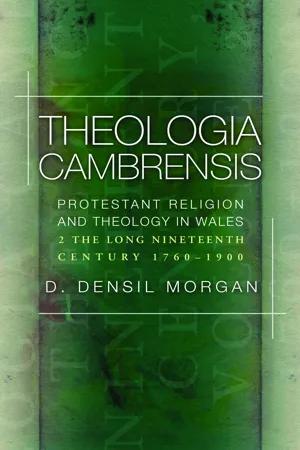
Theologia Cambrensis
Protestant Religion and Theology in Wales, Volume 1: From Reformation to Revival 1588-1760
- 416 pages
- English
- ePUB (mobile friendly)
- Available on iOS & Android
eBook - ePub
Theologia Cambrensis
Protestant Religion and Theology in Wales, Volume 1: From Reformation to Revival 1588-1760
About this book
As well as outlining the shape of Welsh religious history generally, this volume describes the development of Calvinistic Methodist thought up to and beyond the secession from the Established Church in 1811, and the way in which the Evangelical Revival impacted the Older Dissent to create a vibrant popular Nonconformity. Along with analysing aspects of theology and doctrine, the narrative assesses the contribution of such key personalities as William Williams Pantycelyn, Thomas Charles of Bala andThomas Jones of Denbigh, and the Nonconformists Titus Lewis, Joseph Harris 'Gomer', George Lewis, David Rees and Gwilym Hiraethog. Following the notorious 'Treachery of the Blue Books' of 1847 and the Religious Census of 1851, Anglicanism regained ground, and among the themes treated in the latter chapters are the influence of High Church Tractarianism and the Broad Church 'Lampeter Theology' in the parishes. The volume concludes by assessing the intellectual culture of evangelicalism personified by Lewis Edwards and Thomas Charles Edwards, and describes the challenges of Darwinism, philosophical Idealism and a more critical attitude to the biblical text.
Information
Topic
Theology & ReligionSubtopic
British History1
1760–1790
The theology of Calvinistic Methodism
On 27 April 1764, David Lloyd, minister of the Presbyterian church at Llwynrhydowen, Cardiganshire, informed his brother Posthumus of a spiritual awakening which had recently been experienced among the county’s Methodists:
The Methodists after having kept quiet for several years have of late been very active. Their number increases, and their wild pranks are beyond description. The worship of the day being over, they have kept together in the place whole nights singing, capering, bawling, fainting, thumping and a variety of other exercises. The whole country for many miles around have crowded to see such strange sights. For some months past they are less talked of, whether they have grown quieter or the thing is no longer a novelty I do not know, nor had I the curiosity to go near them at all.1
The awakening, which probably began early in 1762 and has been referred to by subsequent historians as the ‘Llangeitho Revival’,2 had been engendered by a fresh potency in the preaching of Daniel Rowland, curate of Llangeitho, some twenty miles north-east of Llwynrhydowen, and the publication of William Williams Pantycelyn’s hymn collection entitled Caniadau y Rhai sydd ar y Môr o Wydr (‘Songs of those who are on the Sea of Glass’), a reference to the words of John the Divine in Revelation 4:6 and 15:2, and the author’s finest hymn collection to date.3
Welsh Calvinistic Methodism had been in a fairly subdued state since the rupture between Howell Harris, the revivalist, and his colleagues a decade or so earlier,4 while the awakening with its twin emphases of exuberant praise (including singing) and hearty response to the preached Word, gave the whole movement new heart.
The sharp rise in the spiritual temperature coincided with Harris’s reconciliation, in February 1763, with his former partners, and he was pleased to be asked to resume his itinerancy at such a propitious time. ‘I heard of much awakening in the country’, he recorded in his diary on 6 April, ‘and am asked to go to all the old places again.’5 The central place which the converts gave to song struck Harris forcibly: ‘The Lord [has] awakened many in these parts by a spirit of singing’, he had written a week earlier, ‘who continue whole nights in that exercise’;6 and again on 1 April: ‘Such rejoicing and singing I never saw.’7 While at Llangeitho on 5 May, even his exhortation had to be curtailed: ‘There came such a spirit of singing, rejoicing, and leaping for joy as made me desist.’8 By then Harris was not only back in favour but contributing freely to the movement’s activities. Despite the tensions that had prevailed between them in 1752,9 Williams Pantycelyn readily admitted that his erstwhile colleague’s contribution to Welsh Methodism had been missed, and that in his absence, spirituality had waned. ‘Till the Lord did come with these late showers of revival’, Williams recorded in August, ‘all was gone to nothing.’10 In all, the movement’s leaders were relieved to welcome the revivalist back into the fold.
It was not only the liberal Arminians of Llwynrhydowen who were perturbed by the excesses of the new converts. The orthodox Calvinist Thomas Morgan, formerly minister among the Independents of Henllan Amgoed, Carmarthenshire, and an early convert of Howell Harris, was appalled by the physical manifestations which had come to characterize Methodist worship. The Methodists, he claimed on 13 March 1764, were ‘stark mad and given up to a spirit of delusion to the great disgrace and scandal of Christianity’.11 Along with the generational divide between Lloyd, Morgan and the young converts, Older Dissenting decorum prohibited any appreciation of the potentially positive aspects of the renewal. ‘May the Lord pity the poor Dissenters’, Morgan continued; ‘I am afraid some of them will fall away by that strong wind of temptation.’12 For all their support of these boisterous activities, the leaders of the movement were not blind to the problems they entailed. Indeed Williams Pantycelyn resorted to prose in order to justify the converts’ unrestrained vigour and to assess the validity of the revival as a whole. His twin volumes Llythyr Martha Philopur (‘A Letter from Martha Philopur’) (1762) and its reply Ateb Philo-Evangelius (‘Philo-Evangelius’ Reply’) (1763), constituted a new phase in Welsh theological literature.
Pantycelyn’s prose works (i): Llythyr Martha Philopur and Ateb Philo-Evangelius
Apart from his translation of a treatise by the Scots Calvinist Ebenezer Erskine in 1759, Williams was known as a hymnist and poet and not as a writer of prose, yet such was the need to defend the revival and to instruct its often overzealous converts, that he took up his pen to do both. Written in the form of a dialogue between Martha, a young convert, and her mentor Philo-Evangelius, this is the first time ever for the female experience to be portrayed in the narrative of Welsh religion. Although women had constituted much of the membership of the Older Dissenting churches and must have been well represented among the congregations of the parish churches as well, it took religious historians of the late twentieth century to begin to give them their due.13 What is striking in Martha’s letter is the description of the conversion experience, the agonies of conviction leading to the ecstasy of redemption, conveyed in terms so vivid as to be unprecedented in the literature of inward piety in Welsh:14
When my soul was in the direst distress, daytime dawned for me. There came to me in a moment the sensation that my sin had been forgiven, I received the Word with the utmost joy, even more than a prisoner would feel were he released from the very foot of the gallows. I could hardly believe that heaven itself contained anything of like nature that I now felt within myself. I know now that my needs have been fulfilled completely. My lot, yes, my everlasting lot, is with the living God.15
With consummate psychological perceptiveness, Williams shows that the exuberance of the young converts was not the result of hysteria or a matter of ‘wild pranks’ or ‘a spirit of delusion’, but the inevitable consequence of the working of the Holy Spirit, on the minds and emotions of impressionable people certainly, but those who had been stirred to the very depths of their soul. The dancing, crying and jumping that scandalized their more staid (and older) non-Methodist contemporaries was not a matter of superficial emotionalism but, as Martha explained, it touched the will, the conscience, the understanding as well as the passions:
My flesh and all that is in me rejoice in the living God. The first moment that I have the opportunity, with the love of the Lord burning within, and I give vent to my spiritual yearnings, it is natural for me to shout out the praises of the Lord, to bless and honour my God, to jump and leap in delight, in such a great salvation as this, the like of which I have never experienced before.16
Martha tells her mentor that thousands of her fellow youth had been touched by this spirit of praise, and she had heard that the older minsters had seen nothing like it before. Being conscious of the novelty of her experience and stung by the standoffishness of traditional religious professors, she craved the need for guidance and instruction. Did not the Bible itself call the faithful to rejoice? Having ransacked scripture she had seen that all Christian people had been commanded to worship God with heart, voice and song, that the Old Testament saints, the Psalmists, the prophets and not least King David who danced before the ark, and New Testament believers from the Day of Pentecost onwards, proved that the spirit of revival was no new thing. Novel it may have been in the context of mid-eighteenth-century Wales, but it was hardly unparalleled in the history of God’s people during Bible times.
In replying to Martha, Philo-Evangelius admitted readily that not all the excitement among the worshippers was genuinely spiritual, but that did not invalidate the revival as a whole: ‘Some disorder, the passions of nature being mixed with the stirrings of grace, does not disprove one whit that the Lord is in this work that began recently in the souls of so many young people, and is still spreading so successfully.’17 Scripture itself says that in each harvest there will be tares along with the wheat, and that when the wind of the Spirit blows so strongly it will affect hypocrites as well as the truly godly. However helpful pastorally Martha found these words, of greater significance was Williams’s theory of revivalism, for it was here that he first lays out what would become known as ‘the Methodist view of history’.18 ‘God …’, he claimed
had been a stranger in the land for many a long year. The Spirit of the Lord had forsaken whole congregations, ministers preached to the stones. Deadness of spirit, worldliness, barren debates, conceit, self-regard and a host of poisonous insects were like locusts laying the land to waste … Hatred, malice and prejudice reigned, it was night, night, night throughout the churches.19
Williams admitted that the gospel was being preached and that conscientious ministers did proclaim the Word, though the effect they had was practically nil: ‘Though there were trumpets among them, some of which were golden, virtually no-one listened to their voice, from Holyhead to Cardiff.’20 Hyperbole this may have been, and a grave injustice to the quiet, parish-based renewal connected with Griffith Jones and his circulating schools, and the undoubted if lower-key vitality which still characterized evangelical Dissent,21 yet for all those whose lives had been so dramatically transformed by the current awakening, this view did resonate: ‘O! Martha, Martha, the day now has dawned. The Lord has breathed on the dry bones, and they have come alive.’22
On the basis of his experience with the Methodist movement for decades, Williams developed a theory that revivalistic activity affected the churches in cycles. Well versed in both Protestant history and Puritan divinity, he already read the story of Christianity in terms of declension and renewal. For over two centuries after Pentecost the Church had flourished, but with the Constantinian pact of AD 313, decline had set in, religion had become formalized, unscriptural rites choked true spirituality and the Church of Rome had become anti-Christian. And so things had continued for nearly a millennium until the stirrings of renewal, first in thirteenth-century Italy with Peter Waldo, then with Jan Hus in Bohemia a century later, with Jerome of Prague in the Czech lands and with John Wycliffe in England. This led to rejuvenation under Luther and the Reformation, but by the seventeenth century decline had once more set in. Despite flickers of renewal, lethargy had undermined the witness of both the Church of England and Dissent though more recently a startling revitalization had occurred: ‘In the year 1738 or thereabouts the light of dawn broke out in many places throughout the world.’23 Having read the New England theologian Jonathan Edwards’s Faithful Narrative of the Surprising Work of God (1737), ‘the textbook for revivalists everywhere’,24 Williams applied his theory of cyclical renewal to the evangelical awakenings which had been experienced more recently in Scotland, England and the American colonies as well as in his native land, in order to provide his fellow Methodists with their own specific identity: ‘Then O, wondrous morning, the sun shone on Wales!’25 If regression had occurred during the 1750s with the withdrawal of Howell Harris (though his name is not mentioned), God had shown mercy once more with the present renewal through which ‘the whole place by now is suffused with the presence of the Lord’.26 It was this revival which had brought salvation to Martha and so many of her contemporaries, causing them to dance with joy.
Pantycelyn’s long poems: Golwg ar Deyrnas Crist and Theomemphus
As well as assuring the new converts of the validity of their experience, Williams provided them with what was, in effect, a systematic theology in verse. The year 1764 saw the publication of an expanded edition of his remarkable long poem Golwg ar Deyrnas Crist (‘A View of Christ’s Kingdom’) which had first appeared eight years earlier. Comprising 1,366 stanzas in six chapters each subdivided into different sections, the epic portrayed not only the creation of the world through Christ, the divine Logos, its maintenance in history through God’s good providence, the coming of the Son as the divine redeemer, his death and resurrection, leading to his return in glory when all things will be renewed, the kingdom being returned to the Father with God becoming all in all. As panoramic as Dante’s Divina Commedia and as comprehensive as Milton’s Paradise Lost, it was, according to the literary critic Saunders Lewis, a ‘summa theologica in verse’.27 The opening chapter describes the kingdom being presented to the pre-existent Son in eternity through whom all things will be made and, foreseeing the Fall in Adam, Christ being elected as saviour of humankind. Although the concept of election is well to the fore throughout the opening section’s sixty-nine stanzas, it occurs always and everywhere in the context of Christ’s all-embracing Person and Work. As with Pantycelyn’s hymns, the Christological emphasis is exceptional and in such an extended poetic treatise as this, quite unprecedented: ‘What gives the poem its particular flavour is the dramatic nature of the Son’s contribution. Our gaze is fixed constantly on him.’28 The second section’s seventy-three stanzas have to do with the covenant of redemption between the Father and the Son in eternity, while Williams, in a footnote, warns against the danger of tritheism or an overemphasis on the role of the three specific persons of the Trinity at the expense of the divine unity: ‘The doctrine of the Trinity is as obvious in the New Testament as that of the redemption of humankind, but it is very easy here to mix errors with the most momentous and clearest of truths.’29
Chapter Two invites the reader to observe Christ setting up his kingdom in which He is everything in creation including the creation of Adam or humankind in innocence:
Duw! help fy enaid egwan i ddringo fry i’r lan,
A rho fy nhraed sy’n crynu i sefyll ar ryw fan
Uwch bannau mwya’r ddaear, a rho ’sbienddrych mawr
I weld fy Iesu’n gosod seilfaenau’r byd i lawr.
A rho fy nhraed sy’n crynu i sefyll ar ryw fan
Uwch bannau mwya’r ddaear, a rho ’sbienddrych mawr
I weld fy Iesu’n gosod seilfaenau’r byd i lawr.
(Permit, O ...
Table of contents
- Cover
- Title Page
- Copyright Page
- Contents
- Preface
- Abbreviations
- Introduction: The Long Nineteenth Century
- Chapter 1: 1760–1790
- Chapter 2: 1790–1820 (i)
- Chapter 3: 1790–1820 (ii)
- Chapter 4: 1820–1859 (i)
- Chapter 5: 1820–1859 (ii)
- Chapter 6: 1860–1890
- Chapter 7: 1890–1900
- Theology in Wales: A Conclusion
- Notes
- Bibliography
Trusted by 375,005 students
Access to over 1.5 million titles for a fair monthly price.
Study more efficiently using our study tools.
Frequently asked questions
Yes, you can cancel anytime from the Subscription tab in your account settings on the Perlego website. Your subscription will stay active until the end of your current billing period. Learn how to cancel your subscription
No, books cannot be downloaded as external files, such as PDFs, for use outside of Perlego. However, you can download books within the Perlego app for offline reading on mobile or tablet. Learn how to download books offline
Perlego offers two plans: Essential and Complete
- Essential is ideal for learners and professionals who enjoy exploring a wide range of subjects. Access the Essential Library with 800,000+ trusted titles and best-sellers across business, personal growth, and the humanities. Includes unlimited reading time and Standard Read Aloud voice.
- Complete: Perfect for advanced learners and researchers needing full, unrestricted access. Unlock 1.5M+ books across hundreds of subjects, including academic and specialized titles. The Complete Plan also includes advanced features like Premium Read Aloud and Research Assistant.
We are an online textbook subscription service, where you can get access to an entire online library for less than the price of a single book per month. With over 1.5 million books across 990+ topics, we’ve got you covered! Learn about our mission
Look out for the read-aloud symbol on your next book to see if you can listen to it. The read-aloud tool reads text aloud for you, highlighting the text as it is being read. You can pause it, speed it up and slow it down. Learn more about Read Aloud
Yes! You can use the Perlego app on both iOS and Android devices to read anytime, anywhere — even offline. Perfect for commutes or when you’re on the go.
Please note we cannot support devices running on iOS 13 and Android 7 or earlier. Learn more about using the app
Please note we cannot support devices running on iOS 13 and Android 7 or earlier. Learn more about using the app
Yes, you can access Theologia Cambrensis by D. Densil Morgan in PDF and/or ePUB format, as well as other popular books in Theology & Religion & British History. We have over 1.5 million books available in our catalogue for you to explore.