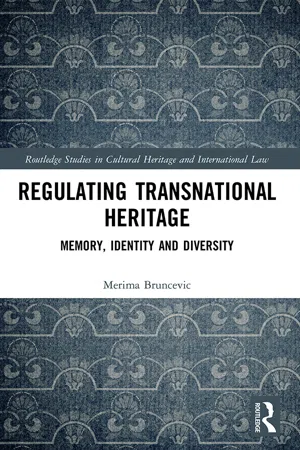
There is a vast body of international and national law that regulates cultural heritage. However, the current regulation remains quite blind to the so called "transnational heritage". This is heritage where there is no community recognized in law that it can be directly attributed to and that can be responsible for its safekeeping and preservation. It can also be items of heritage where the claim of ownership is disputed between two or more peoples or communities. Transnational heritage challenges the idea of monolithic, mono-cultural, ethno-national states. There are a number of examples of such cultural heritage, for instance the Buddhist Bamiyan statutes in Afghanistan, Palmyra in Syria, the Jewish heritage of Iraq, or various items that are currently housed in large, often Western, museums, as a result of colonial practices. This book explores the regulation of transnational heritage. By discussing many cases of transnational heritage and the problems that arise due to the lack of regulation the book analyses the manifestations of memories and constructions of communities through heritage. It focuses particularly on the concept of community. How are communities constructed in cultural heritage law and what falls outside of the definitions of community? The book underlines that the issues surrounding transnational heritage involve more than a communal right to culture. It is argued that transnational heritage also directly affects wider matters of law such as citizenship, human rights, sovereignty, as well as the movement of people and cultural goods.
- 156 pages
- English
- ePUB (mobile friendly)
- Available on iOS & Android
eBook - ePub
1 Introduction
DOI: 10.4324/9781003212683-1
Memories in transit
Memories make us who we are. Our identity, belonging and sense of self are derived from our past, from the remembrance of how the people we once were became the people who we are today. The past is at once behind us, something that we inherit, a fait accompli, but at the same time it is also omnipresent, parallel, continuously constructed and reconstructed, told and retold. The past tends to manifest itself in objects, places, sites and rituals that have followed us through history. It is our heritage. Heritage records and documents the legacy of the people that came before us, but it also legitimises our existence here and now as it ties us to our families, communities, cities and nations. Ultimately heritage provides a historical explanation and justification, a genealogy, of how the societies we inherited were created through a cross-generational dialogue, of how the people we were then became the people who we are today.
But these stories are often also state sponsored, constructed, invoking a nostalgic history that perhaps never was. These are the so-called authorised heritage discourses,1 hidden in the grand narratives of heritage, where the historical power relations play out. The stronger groups of people tend to write history while the less privileged ones and their memories tend to be forgotten or neglected, remain invisible to history, and to law.
1 Smith, 2006.
Remembrance and memory is materialised in heritage, emanating from a multitude of voices. Because of historical power asymmetries, some voices have been silenced, systematically toned down or left unheard. Theirs are the stories that contest or nuance the official grand narratives and authorised heritage discourses. They tend to resist the unquestioned originary myths of how events are generally, or officially, remembered and recounted. Most of these stories remain untold, and because of that many communities and their heritage are yet to be acknowledged and defined. Can such heritage be acknowledged through law? And would further regulation ensure that it can be protected from destruction, neglect and peril?
This book explores the regulation of transnational heritage. “Transnational heritage” is a subcategory of cultural heritage. Most commonly, the term refers to heritage that physically exists over several national borders, or to heritage that is for some reason moved from one place to another. The term can also refer to cultural expressions created by people in exile and diaspora, or to heritage that emanates from migrant communities. Therefore, the concept of transnational heritage will have to be developed here to show how it gains meaning through its various uses and applications. It can have different meanings in different contexts, and we will explore that here, what that means, how it can be regulated and why it is problematic. I will discuss how to legally conceptualise the regulation of such multicultural and diverse heritage.
I employ the term “transnational heritage” in its widest sense in this book as I study monuments, sites, buildings, practices, expressions, knowledges, yes quite simply heritage, that is diverse, multicultural, multi-national and heterogeneous in nature. Such heritage does not fit neatly in any category of cultural heritage law. It tends to sit in between communities, or, conversely, belong to communities that are not recognised in regulation. It will be argued that some transnational heritage is systematically silenced, neglected, and its communities potentially dispossessed by not being seen, acknowledged or protected in law and through regulation. If heritage is memory, and if transnational heritage is the unacknowledged memory of multicultural and diverse communities, and if it is not adequately recognised and protected in law, it may fall into oblivion or, worse yet, be completely destroyed.
It is startling how easy it is for heritage to be sidelined or neglected, even forgotten and destroyed. Transnational heritage is exposed to an intensified risk as it is not recognised in law. That it is systematically exposed to genuine risks is something we will see throughout this book. This means that some items of cultural heritage that can serve as historical proofs of peoples and cultures, that directly legitimise the existence of communities and their heritage, seem to be at risk of neglect and peril.
People care profoundly about cultural heritage. It is a marker of a deep-seated sense of belonging, an integral part of history, traditions, common practices, what people identify as their own. It also identifies individuals that together form a “we”: a community. Heritage is family, home, safety. It is homeland, and how it is defined is unquestionably a political, as well as an emotional, matter, as it ultimately justifies self-determination.2 The strong bond between community, self-determination and cultural heritage is undeniable.
All cultural heritage comprises of sedimentations of time. People come and go. Borders are drawn and redrawn. Political alliances shift. The questions that remain and that have to be asked over and over again are: What has happened, on a territory, in a given period of time, where the heritage originates from/where it was made/where it was found? Who was the dominant power? Who is the dominant power today? And even more importantly: Which are the silenced voices? Who are the systematically oppressed people whose stories remain untold, their heritage unacknowledged?
2 See e.g. Crawford, 2001.
Transnational cultural heritage is prone to greater risk given that it remains largely unregulated. This book sets to explore whether the safekeeping of such heritage could be ensured through developing further regulation and legal strategies that ensure its protection. The purpose of the book is somewhat twofold. First, to demonstrate that current cultural heritage law often leaves out transnational heritage, and therefore it and its communities remain unrecognised and unprotected. And two, to develop conceptual arguments towards a regulatory framework that can handle the safekeeping of such multicultural, diverse, heterogeneous, polyphonic, heritage. This heritage defies the notions of mono-cultural, ethno-national societies. It often goes against the state and the national authorised heritage discourses. This is the reason why transnational heritage is of the utmost importance to study further, particularly as we are committing to fostering more inclusive and diverse societies. Recognising transnational heritage in regulation could potentially mean recognising and strengthening multicultural, diverse and heterogeneous communities. As such, transnational heritage directly affects more than a communal right to shared cultural heritage, it also bears on the matters that concern inclusion and exclusion, and in extension also citizenship, human rights, sovereignty, as well as fundamental rights such as the right to live, speak, believe, exist.
How the notion of diverse, multicultural communities and the heritage that emanates from such communities can be reconciled with the overwhelmingly nationalist, mono-ethnic cultural heritage law and its doctrines frames the discussion here. It has to do with how to legally deal with shared memories that stem from heterogeneous co-existences. I do not intend to focus on contested heritage, even though many of the examples of heritage that I will analyse throughout this book have been fiercely contested. Instead, I want to focus on the shared experiences that give rise to multicultural and diverse practices, collective as well as disputed memories that in the end become transnational heritage. How groups of people are envisioned as a community and how their communal identity is constructed in and through cultural heritage law will also become one of the interests of this book.
Ultimately, safeguarding the manifestations of shared memories as materialised in heritage is what this book will address. It has to do with more than advocating for a widened right to culture. It also has to do with more than protecting the symbolic nature that shrouds heritage. Laurajane Smith3 stresses for instance the importance of the immateriality of heritage – for were it not for the immaterial symbolic notions and social practices that are embedded in heritage, she claims, it would just be a question of artefacts like any other everyday artefact, and not heritage.4 According to Smith, it is the symbolic that makes the everyday objects into heritage. On the contrary, I am interested here in the very everydayness of objects, the materiality and tangibility of heritage, how it is exhibited, used, framed, and how it acts as a constituent of community. Perhaps “contrary” is not right. I do of course accept and agree with Smith’s argument, but I want to inflate it to its full potential and then continue to build on it and explore the various materialisations of transnational heritage. Transnational heritage becomes in that vein the embodiment of shared memories that belong to diverse communities. So it is an oscillation between the tangible and material on the one hand and the intangible and symbolic on the other that I explore here, and argue that the two must be seen as inseparable. The transnational memory, and the materiality of such memory that is explored here, is therefore not merely an individual memory. It is foremost the expression of shared communal remembrances that are allowed to shine through the materiality of heritage.
3 Smith, 2006:44.
4 See also Macmillan, 2021.
By engaging in a critique of how heritage is portrayed and envisioned in law, the many taken-for-granted assumptions that are reproduced in and through authorised heritage discourses will often become the focus of my discussion. Thus, the doctrinal legal definitions of “heritage” and “community” will be studied, questioned, as well as deconstructed. I will also search for the unexplored potential in current law. We will see how the existing regulation can be problematic, stifling, suffocating, as it is based on homogenic, mono-ethnic societies. But we will also see how it can be flexible and the many possible routes that have already been opened for envisioning the regulation of more inclusive heritage. More often than not, current legal tools fail to take into account the multicultural, the diverse and/or the multi-ethnic in heritage, but there are nonetheless regulatory possibilities that emerge here and there. The cultural heritage that can somehow be described as “transnational” thus becomes the empirical point, as the term itself challenges most of the doctrinal concepts of heritage that almost always require heritage to structurally be somehow attributed to, or at least acknowledged by, a clearly defined, monolithic, mono-cultural, ethno-national, state.
Transnational heritage is not sufficiently regulated and, even though it is in danger, it still exists and in one way or another is often legally tied to at least one nation state, if not several. It will be argued here that this reliance on the attribution to states can be problematic. The nation state-based approach has so far been legitimised by the post-WWII logic that recognised the newly independent or decolonised states that were formed after the war. Heritage thus became connected to a sovereign territory, self-determination, national jurisdictions and to independent peoples.5 Within this tradition, heritage remains tied to nation states legally, but also politically and morally. This is an argument that is favoured and advanced in many authorised heritage discourses. Legal, political and moral ownership of heritage is, and must be, tied to a state territory or at least to a group of people that a state recognises as a community.
5 This logic can be traced even further back, and it can be argued that it was established as early as in 1815 at the so-called Congress of Vienna. However, I place it after WWII, in order to directly tie it to the decolonisation that took place after the war.
Such territorial assumption functions as a doctrinal starting point. It advances an argument that where something is, or was once created or found – it must ipso facto belong to that territory. In extension, that means that it is strongly argued in legislation that heritage must always be kept in situ, that is, on site, where it is found, and that any dislocation, decontextualisation or transfer must be avoided. This is important in many ways, particularly when it comes to decolonisation and the return and repatriation6 of looted heritage taken by former colonisers. Repatriation, derived of course from the Latin word patria, homeland, means to return an item to its...
Table of contents
- Cover
- Half Title
- Series Page
- Title Page
- Copyright Page
- Dedication
- Table of Contents
- Prologue
- Acknowledgements
- 1. Introduction
- 2. Matter: current regulation and transnational heritage
- 3. Movement: heritage without borders
- 4. Diversity: transnational cultural heritage
- 5. Constellations: the transnational in community
- 6. Memories: new regulatory approaches
- Epilogue
- Bibliography
- Index
Trusted by 375,005 students
Access to over 1.5 million titles for a fair monthly price.
Study more efficiently using our study tools.
Frequently asked questions
Yes, you can cancel anytime from the Subscription tab in your account settings on the Perlego website. Your subscription will stay active until the end of your current billing period. Learn how to cancel your subscription
No, books cannot be downloaded as external files, such as PDFs, for use outside of Perlego. However, you can download books within the Perlego app for offline reading on mobile or tablet. Learn how to download books offline
Perlego offers two plans: Essential and Complete
- Essential is ideal for learners and professionals who enjoy exploring a wide range of subjects. Access the Essential Library with 800,000+ trusted titles and best-sellers across business, personal growth, and the humanities. Includes unlimited reading time and Standard Read Aloud voice.
- Complete: Perfect for advanced learners and researchers needing full, unrestricted access. Unlock 1.5M+ books across hundreds of subjects, including academic and specialized titles. The Complete Plan also includes advanced features like Premium Read Aloud and Research Assistant.
We are an online textbook subscription service, where you can get access to an entire online library for less than the price of a single book per month. With over 1.5 million books across 990+ topics, we’ve got you covered! Learn about our mission
Look out for the read-aloud symbol on your next book to see if you can listen to it. The read-aloud tool reads text aloud for you, highlighting the text as it is being read. You can pause it, speed it up and slow it down. Learn more about Read Aloud
Yes! You can use the Perlego app on both iOS and Android devices to read anytime, anywhere — even offline. Perfect for commutes or when you’re on the go.
Please note we cannot support devices running on iOS 13 and Android 7 or earlier. Learn more about using the app
Please note we cannot support devices running on iOS 13 and Android 7 or earlier. Learn more about using the app
Yes, you can access Regulating Transnational Heritage by Merima Bruncevic in PDF and/or ePUB format, as well as other popular books in Law & Law Theory & Practice. We have over 1.5 million books available in our catalogue for you to explore.