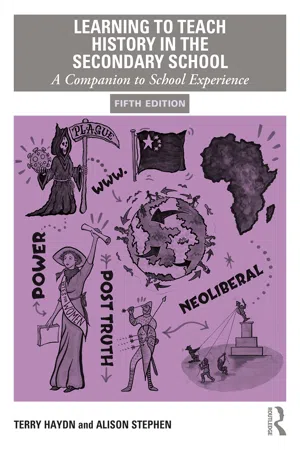
In some hands, history can be an inspirational and rewarding subject, yet in others it can seem dry and of little relevance. Learning to Teach History in the Secondary School, now in its fifth edition and established as one of the leading texts for all history student teachers, enables you to learn to teach history in a way that pupils will find interesting, enjoyable and purposeful. It incorporates a wide range of ideas about the teaching of history with practical suggestions for classroom practice.
The fifth edition has been thoroughly updated in the light of recent developments in the field of history education. The book contains chapters on:
• Purposes and benefits of school history
• Planning strategies
• Teaching approaches and methods
• Developing pupils' historical understanding
• Ensuring inclusion
• New technologies in the history classroom
• Assessment and examinations
• Your own continuing professional development
Each chapter includes suggestions for further reading, weblinks to useful resources and a range of tasks enabling you to put learning into practice in the classroom. Written by experts in the field, Learning to Teach History in the Secondary School offers all training and newly qualified teachers comprehensive and accessible guidance to support the journey towards becoming an inspirational and engaging history teacher.
‘I’ve come to a frightening conclusion that I am the decisive element in the classroom. It’s my personal approach that creates the climate. It’s my daily mood that makes the weather. As a teacher, I possess a tremendous power to make a child’s life miserable or joyous. I can be a tool of torture or an instrument of inspiration. I can humiliate or heal. In all situations, it is my response that decides whether a crisis will be escalated or de-escalated and a child humanised or dehumanised.’
(Ginott, 1972: 15–16)
THE AIM OF THIS BOOK
The aim of this book is to provide practical guidance on how to become an effective and successful history teacher. This involves the development of insights into the factors which influence the extent to which pupils learn what we are trying to teach and a clear grasp of the wide range of ways in which young people can benefit from learning about the past. As the opening quotation indicates, we will argue that it is also important to teach history in a way which elicits the interest and enthusiasm of pupils. Almost every person who reads this book will have studied history as a school subject and will be aware of the difference the teacher can make to the experience of learning about the past. If you think back to your own experience of learning history at school, was the subject equally fascinating whoever the teacher was, or was it more interesting and rewarding with some teachers compared to others? In some hands, school history can seem a boring subject, of dubious relevance or purpose; in others, it can seem inspirational, important and rewarding. Research in English schools suggests that pupils believe it is not the topic, the syllabus, the teaching approach or even the subject itself which is the main determinant of how interesting and worthwhile history lessons will be but the knowledge, skills and persona of the teacher (Harris and Haydn, 2006, 2012; QCA, 2005). You must not assume that because you probably enjoyed learning history at school that this is the case for all pupils. There has always been a substantial proportion of pupils in English schools who have regarded the study of the past as useless and boring (Aldrich, 1987; Harris and Haydn, 2006). One of the challenges history teachers face (which does not confront teachers of subjects like maths and English) is persuading pupils to commit wholeheartedly to wanting to learn and do well in history and to believe that learning about the past is important and relevant to the lives they will lead outside school and after they leave school.
But it is not just a question of making lessons interesting or ‘entertaining’ for pupils, or ‘getting bums on seats’ after history becomes optional as a school subject. It is important that the subject is taught in a way which brings about positive outcomes for pupils and for society. There is no shortage of evidence to suggest that school history has sometimes been used for ethically dubious purposes (Ferro, 1984; Foster and Crawford, 2006; Macmillan, 2009; Nakou and Barca, 2010; Tosh, 2008). As Chapter 2 will indicate, there are ethical dimensions of teaching history as a school subject, and it is important that history student teachers are aware of the ethical dimensions of their work. The experience of school history can change pupils’ lives, not just in terms of which direction they take at Key Stage 4 and beyond (in England, under current arrangements, pupils can drop history at the end of Key Stage 3, aged 13 or 14), but in terms of what they will be like as adults. In the words of historian Christopher Hill, ‘History, properly taught, can help men to become critical and humane, just as wrongly taught it can turn them into bigots and fanatics’ (Hill, 1953: 9). It is not surprising that politicians in the UK and elsewhere have taken a keen interest in the way history should be taught in schools.
WHAT IS INVOLVED IN BECOMING AN EFFECTIVE AND ACCOMPLISHED HISTORY TEACHER?
Most people acknowledge that although subject knowledge is important, it is not the only factor involved in becoming a good history teacher. There is no necessary correlation between how well you did in your history exams and how good you will be at teaching history to children, although it is difficult to envisage how to teach history without a sound grasp of the topics you are required to teach. Good subject knowledge is a necessary, but not sufficient, prerequisite for effective teaching. Having degree-level knowledge of the English Civil War does not in itself guarantee that you will be able to teach it in a way that makes sense to 12-year-olds.
What are the other factors involved in teaching history, and how are the knowledge and skills involved best acquired? Practical guidance on these questions includes the question of how to bring together theory (ideas about teaching) and your own developing classroom practice. Teaching is not just a trade that you can simply pick up on the job with a bit of practice and experience of working with anyone who happens to have done it for a while. There is a substantial body of knowledge about effective teaching in history, and it is helpful to try and learn from this body of knowledge. Reading is one of the ways teachers get better at what they do. This book does not offer a one-stop shop for becoming a history teacher. You will have to become acquainted with many other texts in the course of your training. Learning to become an expert and comprehensively accomplished history teacher is a complex (and long and ongoing) process. Even a book of over 300 pages cannot cover in depth every facet of what you need to become good at, although we do hope it will indicate the range of issues which you need to learn about, provide an effective introduction to these agendas, and guidance as to where to look for further development of your expertise in these areas. Many of the resources we will suggest are freely available on the internet, and most of the books and history magazines/journals we mention should be available from the institution providing your training, but there are some resources and websites where you have to pay for access (see Chapters 9 and 12), and there are obviously difficult judgement calls about what choices you make here, according to your priorities and the state of your finances.
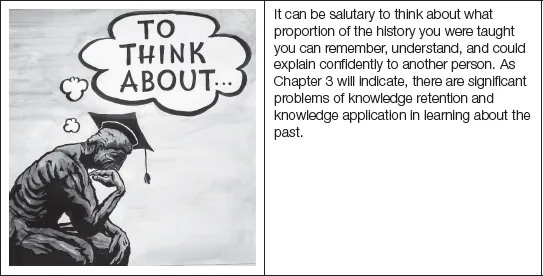
Figure 1.1 To think about …
There is more to it than some commentators imagine (it is said that one eminent academic historian once argued that teaching history was very easy and straightforward: ‘You tell people things and they write them down’). You will find that it is more complicated than this. There are lots of things to learn about teaching history; more than can be encompassed in a single text. We will, however, try to provide guidance and links to other resources we believe are useful. Chapter 3 attempts to unpack the wide range of knowledge and ideas of which history teachers need to be aware if they are to be able to teach any topic, to any group of pupils, in a way that maximises the potential benefits of learning about that aspect of the past for all pupils.
WORKING WITHIN FRAMEWORKS
It is important to remember that in most education systems teachers have a substantial degree of latitude in terms of the ways in which they approach the teaching of their subject and the topics which are specified by the curriculum or examination specification. However, you are not a completely free agent, and there are frameworks in place of which you must take account if you are teaching history in a school where it is mandatory to teach the National Curriculum (NC). Perhaps the most important of these is the NC for history. In spite of concerns that an NC would significantly erode the professional autonomy of history teachers (Phillips, 1991; Thatcher, 1993), it should be remembered that the NC is a framework for the teaching of history, not a straightjacket (see Byrom and Riley, 2003; Lee and Shemilt, 2003; Riley, 2000). It requires initiative, imagination and interpretation to transform curriculum specifications into something that engages pupils and which makes sense to them.
We are aware that you are preparing to be a history teacher in different situations and contexts. We have tried to make the content of this book relevant to all student teachers of history but, when talking about the statutory requirements for history, have for ease of reference referred to the NC for England. Those of you who are subject to other regulations should still find that much of what is said is of relevance.
Another essential document in your initial teacher education (ITE) course, if you are learning to teach in England, is the framework of The Teachers’ Standards, laid down by the Department for Education (DfE, 2012). Unless you have reached competence in all the areas of teaching expertise specified by this document, it will not be considered appropriate to unleash you on future generations of pupils. The statements of competence stipulated by The Teachers’ Standards are at the heart of the development of teaching capability, and you should refer to them regularly throughout your course, remembering that, in terms of all these areas of competence, there is a continuum between complete ignorance and inadequacy on the one hand and the (in practice, unattainable) mastery of a teaching competence on the other.
Other important frameworks involved in your development as a history teacher are the schools and the history departments with which you work. History departments are organic and co-operative enterprises which have a collective responsibility for delivering the history curriculum effectively and for contributing to whole-school policies. You have to harness your own talents and ideas to those of the department with which you are working, so as to optimise the quality of experience for you, the department and the pupils in your care. At its best, it can be a mutually enriching and positive experience for both the department and for the student teacher, but it is not invariably thus, and you need to deploy personal and professional qualities in addition to technical competence in the classroom. Just as you have to learn to fit in to the department in which you are working, departments have to fit in with the ethos and policies of the school as a whole. This can be particularly difficult in terms of whole-school assessment policy, where there may be philosophical differences between a department and the senior management team of the school about how best to monitor and report pupil progress (see Burnham and Brown, 2004; Christodoulou, 2017; Ofsted, 2011 for further development of this point). However, although there will hopefully be constructive professional dialogue between departmental heads a...
Table of contents
Cover
Half Title Page
Series Page
Title Page
Copyright Page
Dedication Page
Contents
List of figures
List of tasks
Website linked to this book
Acknowledgments
1 Introduction
2 Ideas about the purposes and benefits of school history
3 Subject knowledge: What do history teachers need to know?
4 Planning for learning
5 Teaching approaches and methods: What can you do in a history lesson?
6 Developing historical understanding (1): Time, cause, change, similarity and difference, empathy, significance
9 The use of new technology in the history classroom
10 Assessment in the classroom
11 Teaching for external examinations
12 Continuing professional development
Index
Trusted by 375,005 students
Access to over 1.5 million titles for a fair monthly price.
Study more efficiently using our study tools.
Frequently asked questions
Yes, you can cancel anytime from the Subscription tab in your account settings on the Perlego website. Your subscription will stay active until the end of your current billing period. Learn how to cancel your subscription
No, books cannot be downloaded as external files, such as PDFs, for use outside of Perlego. However, you can download books within the Perlego app for offline reading on mobile or tablet. Learn how to download books offline
Perlego offers two plans: Essential and Complete
Essential is ideal for learners and professionals who enjoy exploring a wide range of subjects. Access the Essential Library with 800,000+ trusted titles and best-sellers across business, personal growth, and the humanities. Includes unlimited reading time and Standard Read Aloud voice.
Complete: Perfect for advanced learners and researchers needing full, unrestricted access. Unlock 1.5M+ books across hundreds of subjects, including academic and specialized titles. The Complete Plan also includes advanced features like Premium Read Aloud and Research Assistant.
Both plans are available with monthly, semester, or annual billing cycles.
We are an online textbook subscription service, where you can get access to an entire online library for less than the price of a single book per month. With over 1.5 million books across 990+ topics, we’ve got you covered! Learn about our mission
Look out for the read-aloud symbol on your next book to see if you can listen to it. The read-aloud tool reads text aloud for you, highlighting the text as it is being read. You can pause it, speed it up and slow it down. Learn more about Read Aloud
Yes! You can use the Perlego app on both iOS and Android devices to read anytime, anywhere — even offline. Perfect for commutes or when you’re on the go. Please note we cannot support devices running on iOS 13 and Android 7 or earlier. Learn more about using the app
Yes, you can access Learning to Teach History in the Secondary School by Terry Haydn,Alison Stephen in PDF and/or ePUB format, as well as other popular books in Education & Education General. We have over 1.5 million books available in our catalogue for you to explore.