In this third book of the Shingo Model series, Continuous Improvement focuses on five of the Shingo Guiding Principles: seek perfection, embrace scientific thinking, focus on process, assure quality at the source, and improve flow and pull.
Each chapter in Continuous Improvement is designed to enhance your comprehension of one or more aspects of the Continuous Improvement dimension of the Shingo Model and to increase your understanding of how the dimension interrelates with and complements the other principles in the Shingo Model. Ultimately, this explanation grounds the technical science of continuous improvement with a powerful social science that focuses on people development. It is this combination that creates the opportunity for improvement to be truly continuous.
Because tacit learning is critical to deepening your continuous improvement knowledge, "Reader Challenges" are included throughout the text to encourage you to apply what you have read within the context of your own organization. This hands-on practice is necessary to understand the interrelatedness of principles, systems, and tools that are inherent in the Shingo Model.
The Shingo Institute recognizes that "the transformation from traditional philosophy and practices to organizational excellence does not occur without the courage, creativity, and persistence of everyone in the organization—from executives to managers to team members on the frontline."
Organizational Excellence and the Shingo Institute
DOI: 10.4324/9781003216698-2
Too many organizations are failing to be competitive, not because they cannot solve problems, but because they cannot sustain the solution. They haven’t realized that tradition supersedes tools, no matter how good they are. Success requires a sustainable shift in behaviors and culture, and that needs to be driven by a shift in the systems that motivate those behaviors.1
—Gerhard Plenert
Gerhard Plenert, Discover Excellence: An Overview of the Shingo Model and Its Guiding Principles (Boca Raton, FL: CRC Press, 2018), 1.
For every organization, the answer to the question, “What does excellence mean to your organization?” will always be different. No two organizations will respond the same way. Following are some of the key definitions of organizational excellence that the Shingo Institute has learned from organizations across the world.
Organizational excellence is:
Instilling purposeful change to mitigate the root cause of performance problems.
Improving the work. It is not just about the processes. It is about engaging the whole workforce and making a better company.
Creating a great environment for the people, looking for the same objectives, and having fun everywhere.
A status in which an organization has not only achieved financial or market results, but also transcended to a different level where respectful people, culture, and principles are key factors in a strategy to sustain growth over generations.
Understanding what customer needs are.
Trying to optimize the value for customers.
Being never satisfied. Constantly moving forward, constantly thinking. An organization where it is safe to challenge everything.
A focus on culture and behaviors.
One that enhances culture because it brings focus on the customer.
Back to Basics
The term Lean was first introduced in 1990 in the book The Machine That Changed the World: The Story of Lean Production. In it, the authors, James Womack, Daniel Jones, and Daniel Roos, describe Lean as manufacturing systems that are based on the principles employed in the Toyota Production System (TPS). They wrote:
Lean … is “lean” because it uses less of everything compared with mass production—half the human effort in the factory, half the manufacturing space, half the investment in tools, half the engineering hours to develop a new product in half the time. Also, it requires keeping far less than half the inventory on site, results in many fewer defects, and produces a greater and ever-growing variety of products.2
J. P. Womack et al., The Machine That Changed the World: The Story of Lean Production—Toyota’s Secret Weapon in the Global Car Wars That Is Now Revolutionizing World Industry (New York, NY: Simon & Schuster, Inc., 1990), 14.
In the intervening years, the philosophy of Lean has gone through numerous iterations. It stresses the maximization of customer value while simultaneously minimizing waste. The goal of Lean is to create increased value for customers while simultaneously utilizing fewer resources. Countless organizations have, at one time or another, begun a Lean journey or implemented an improvement initiative of some sort. At the foundation of these initiatives are a plethora of tools (over 100) that seem to promise exciting new results. They are utilized to optimize the flow of products and services throughout an entire value stream as they horizontally flow through an organization.
While many organizations may initially see significant improvements, far too many of these initiatives meet disappointing ends. Leaders quickly find that tools such as Six Sigma, SMED, 5S (sort, set in order, sweep, standardize, and sustain), and just-in-time (JIT) are not independently capable of effecting lasting change.
The Shingo Institute
The Shingo Institute has assessed organizations in various industries around the world. The Institute has seen firsthand how some organizations have been able to sustain their improvement results, while far too many have experienced such a decline. In fact, initially, the Shingo Prize focused on tools and systems and how those tools and systems drive results. The Prize was originally given out on the basis of these results.
But when far too many Shingo Prize–recipient organizations reverted to their old ways, the Shingo Institute realized there was a big piece missing in its earlier model of organizational excellence based only on systems, tools, and short-term results. So, the Shingo Institute set out to determine the key difference between short-lived successes and sustainable results. Over time, the Institute discovered a common theme: the difference between sustainable and unsustainable effort is centered on the ability of an organization to ingrain into its culture timeless and universal principles, rather than rely on the superficial implementation of tools and programs. This is because principles help people understand the “why” behind the “how” and the “what.” Sustainable results depend upon the degree to which an organization’s culture is aligned to specific, guiding principles rather than depending solely on tools, programs, or initiatives.
The Shingo Institute discovered that what was lacking was sustained superior performance, a sustained culture of excellence and innovation, and a sustained environment for social and ecological leadership. To really make progress in a journey to organizational excellence, we must have long-term sustainability. Change could no longer be something that happened once a year during a Lean event. Instead, organizations need to constantly look for improvement opportunities.
The Shingo Model and the Shingo Prize
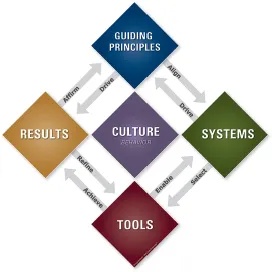
To best illustrate its new findings, the Shingo Institute developed the Shingo ModelTM, the accompanying Shingo Guiding Principles, and the Three Insights of Organizational ExcellenceTM. The principles are timeless and universal. They apply to all cultures and they do not change over time. They provide a solid foundation for developing a roadmap to excellence.
Now, the Shingo Prize is awarded to organizations that have robust key systems driving behavior closer to ideal, as informed by the principles of organizational excellence, and measured by strong key performance indicator (KPI) and key behavioral indicator (KBI) trends and levels. Shingo Prize recipients show the greatest potential for sustainability as measured by the frequency, intensity, duration, scope, and role of the behaviors evident in the organizational culture. The Shingo Prize has become the global standard for organizational excellence. As an effective way to benchmark progress toward excellence, organizations throughout the world may apply and challenge for the prize. Recipients receiving this recognition fall into three categories: Shingo Prize, the Shingo Silver Medallion, and the Shingo Bronze Medallion.
Most organizations do not wait until they believe they might qualify for the Shingo Prize to challenge for it. In fact, many organizations do not intend to ever challenge for the Shingo Prize. But they use the Shingo Model and the assessment process to measure themselves as they work toward the highest standard of excellence in the world. They use the guidelines to direct them, to inspire them, and to hold themselves responsible.
Over the years, the Shingo Institute’s scope has expanded to include various educational offerings, a focus on research, and a growing international network of Shingo Institute Licensed Affiliates. The Shingo Model is the primary subject of the Institute’s popular workshops and publications. These materials have been developed to share throughout the world so organizations can learn how to create a sustainable cultural shift, which will ultimately lead to organizational excellence.
Similarly, volunteer Shingo examiners, who are international experts in all aspects of organizational excellence, focus on determining the degree to which the Shingo Guiding Principles are evident in the behavior of every team member in an organization. They observe behavior and determine the frequency, intensity, duration, scope, and role of the desired principle-based behaviors. They observe the degree to which leaders are focused on principles and culture, and the degree to which managers are focused on aligning systems to drive ideal behaviors at all levels.
As part of its educational offerings, the Shingo Institute offers a series of six workshops that are designed to help participants understand the Shingo Model, its Guiding Principles, and its Insights. Ultimately, these workshops help participants strive for excellence within their respective organizations. Each of the workshops is described below.
Discover Excellence
This foundational, two-day workshop introduces the Shingo Model, the Shingo Guiding Principles, and the Three Insights to Organizational Excellence. With active discussions and on-site learning at a host organization, this program is a highly interactive experience. It is designed to make learning meaningful and immediately applicable as participants discover how to release the latent potential in an organization to achieve organizational excellence. It provides the basic understanding needed in all Shingo workshops; therefore, it is a prerequisite to all the other Shingo workshops. During this workshop, participants will learn and understand the Shingo Model, discover the Three Insights of Organizational Excellence, and explore how the Shingo Guiding Principles inform ideal behaviors that ultimately lead to sustainable results. They will also understand the behavioral assessment process through an interactive case study and on-site learning.
Systems Design
This two-day workshop integrates classroom and on-site experiences at a host facility to build upon the knowledge and experience gained in the DISCOVER workshop, and focuses on the Systems and Tools diamonds in the Shingo Model. It begins by explaining that all work in an organization is the outcome of a system. Systems must be designed to create a specific end objective; otherwise, they evolve on their own. Systems drive the behavior of people, and variation in behavior leads to variation in results. Organizational excellence requires well-designed systems to dri...
Table of contents
Cover
Half Title
Series
Title
Copyright
Dedication
Contents
Acknowledgments
Introduction
Chapter 1 Organizational Excellence and the Shingo Institute
Chapter 2 The Continuous Improvement Dimension
Chapter 3 Seek Perfection
Chapter 4 Embrace Scientific Thinking
Chapter 5 Focus on Process
Chapter 6 Assure Quality at the Source
Chapter 7 Improve Flow & Pull
Chapter 8 Theory in Practice
Chapter 9 Improvement Systems and Behaviors
Chapter 10 Where Do I Go from Here?
Glossary
Bibliography
Recommended Reading
About the Editors
Index
Trusted by 375,005 students
Access to over 1.5 million titles for a fair monthly price.
Study more efficiently using our study tools.
Frequently asked questions
Yes, you can cancel anytime from the Subscription tab in your account settings on the Perlego website. Your subscription will stay active until the end of your current billing period. Learn how to cancel your subscription
No, books cannot be downloaded as external files, such as PDFs, for use outside of Perlego. However, you can download books within the Perlego app for offline reading on mobile or tablet. Learn how to download books offline
Perlego offers two plans: Essential and Complete
Essential is ideal for learners and professionals who enjoy exploring a wide range of subjects. Access the Essential Library with 800,000+ trusted titles and best-sellers across business, personal growth, and the humanities. Includes unlimited reading time and Standard Read Aloud voice.
Complete: Perfect for advanced learners and researchers needing full, unrestricted access. Unlock 1.5M+ books across hundreds of subjects, including academic and specialized titles. The Complete Plan also includes advanced features like Premium Read Aloud and Research Assistant.
Both plans are available with monthly, semester, or annual billing cycles.
We are an online textbook subscription service, where you can get access to an entire online library for less than the price of a single book per month. With over 1.5 million books across 990+ topics, we’ve got you covered! Learn about our mission
Look out for the read-aloud symbol on your next book to see if you can listen to it. The read-aloud tool reads text aloud for you, highlighting the text as it is being read. You can pause it, speed it up and slow it down. Learn more about Read Aloud
Yes! You can use the Perlego app on both iOS and Android devices to read anytime, anywhere — even offline. Perfect for commutes or when you’re on the go. Please note we cannot support devices running on iOS 13 and Android 7 or earlier. Learn more about using the app
Yes, you can access Continuous Improvement by Larry Anderson, Dan Fleming, Bruce Hamilton, Pat Wardwell, Larry Anderson,Dan Fleming,Bruce Hamilton,Pat Wardwell in PDF and/or ePUB format, as well as other popular books in Business & Manufacturing. We have over 1.5 million books available in our catalogue for you to explore.