"An expansive work about healing, resilience, humanity, respect, inheritance, Indigenous teachings, and most of all, love" from the author of
Indian Horse (
Literary Hub).
"We may not relight the fires that used to burn in our villages, but we can carry the embers from those fires in our hearts and learn to light new fires in a new world."
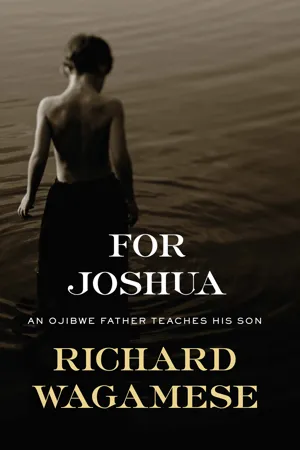
Ojibwe tradition calls for fathers to walk their children through the world, sharing the ancient understanding "that we are all, animate and inanimate alike, living on the one pure breath with which the Creator gave life to the Universe." In this intimate series of letters to the six-year-old son from whom he was estranged, Richard Wagamese fulfills this traditional duty with grace and humility, describing his own path through life—separation from his family as a boy, substance abuse, incarceration, and ultimately the discovery of books and writing—and braiding this extraordinary story with the teachings of his people, in which animals were the teachers of human beings, until greed and a desire to control the more-than-human world led to anger, fear, and, eventually, profound alienation.
At once a deeply moving memoir and a fascinating elucidation of a rich indigenous cosmology,
For Joshua is an unforgettable journey.
"Told lyrically and unflinchingly,
For Joshua is both a letter of apology and another attempt at self-identification for the writer. A must-read for Wagamese fans, and a good primer for his novels." —
Minneapolis StarTribune
"A well-written, introspective book on fatherhood and loss that will especially interest readers and students of First Nations life and literature." —
Library Journal
- 212 pages
- English
- ePUB (mobile friendly)
- Available on iOS & Android
eBook - ePub
About this book
Information
III
INTROSPECTION
I woke in the rain. Sometime around dawn the clouds had moved in and the rain started pouring down in sheets. My little circle quickly became muddy. My blanket was sopping wet. My hair hung over my eyes, plastered to my face by torrents of water. I shivered. There were trees a footstep away from the edge of the circle and I wanted to step over and sit beneath their branches for shelter. I craved shelter as much as I had hungered for food the night before. It rained and rained and rained. I felt miserable. I pitied myself. I bemoaned my decision to come here and the difficulty in learning this way, its senselessness, its hardship. The trees and the bright dry spot beneath them looked like a palace to me. I agonized over whether I should step out of the circle and into the trees. I wanted to stay where I was and learn whatever I was going to learn about myself, about the Native way, about the world, and about my right place within it. But I was cold, shivering, miserable, alone, and afraid. Once again, I did as John suggested and admitted my feelings to Creation. I talked about my agony and I felt the rain grow warmer. As I stomped around I vented my frustration and I began to feel more at ease. Then I realized that the rain felt good. For two days I had sat in the sun, wind, and dust, sweating out all kinds of things my body had absorbed. The rain was washing all of that away. The more I focused on that fact, the less I wanted to abandon my circle. Soon I was holding my face up to the rain and feeling the cool water splash against my eyelids. It was refreshing. Not just because it soothed the dust and dryness of things, but because it seemed to wash away the purple stain I felt inside, the one that revisiting myself and my life had created.
I thought about the reasons John might have had for bringing me to this point in his teachings. I needed release. I needed to be free from the stranglehold in which my past held me. I needed to cut the ropes of shame, guilt, and fear, to see my life for what it had been and walk forward to a better way. Those were the reasons he’d decided to bring me here. And as much as I understood, though, I still felt the cold nuzzle of fear in my belly. The habits that nearly killed me were still my crutch—and I could not imagine life without them. I didn’t know how I was going to acquire, or even if I had the ability to acquire, new skills, new tools, new ways of being.
The rain slacked off to a drizzle, then to a light mist. Finally it stopped completely. I was relieved. I lay my blanket flat on the ledge to dry. It was cool but I removed my shirt, too, and did some jumping jacks to get my blood flowing and warm myself. When I felt the goose pimples disappear from my arms I sat down again and looked outward over the trees. My eyes came to rest on something so commonplace, so ordinary, that it had escaped my attention all the times I had visited that ledge.
It was a tree, no more than a twig really, sticking out from a small cleft in the ledge. It was sparse and dry and twisted. It looked as though it should be dead, as if its roots had no soil to grip that rock. But it lived. There was a tiny clump of foliage near its tip and the fresh rain glistened on it. I don’t know how I could have missed it all along but right then I was riveted to it. Strange as it seemed to me, I felt as though that little tree was trying to tell me something. So I sat and watched it, studied it, and waited for its message.
I began to think of how hard I had sought a footing in my life. I thought about the struggle. Then, I remembered a time when the battle had grown too hard and I had given up, surrendered, capitulated, and become willing to allow the world to toss me where it would.

I was twenty-three years old. That summer I had taken off again and headed into the west. When I arrived in Regina, Saskatchewan, I stopped to look around for work. The only place I could afford to stay was the Salvation Army, and I hated it there. But I needed to earn money to keep on travelling so I gritted my teeth and held on. But I was never too good at holding on and eventually I went to the bars in search of those things I knew how to deal with. And I found them. It wasn’t long before I was in the company of a group of young Native people who were just like me. They were drinkers, hardcore and remorseless, and they were lost, dispossessed, and angry.
They welcomed me as a brother because of the colour of my skin, and if I didn’t know anything about my language, culture, or history it didn’t seem to matter to them. All that mattered was that I was another “skin”—short for redskin—and that I would do as they did. We drank. Lots. There were fights, brutal ones sometimes, that even the women joined in. Fights with baseball bats and knives, broken beer bottles, and even a rifle once. But there was camaraderie, laughter, and a caring that reminded me of the winos I’d hung with years earlier. They helped each other when they were sick with the drink, and nothing was too much to ask if you needed help. I wanted to be a big part of that so I listened and learned.
Many of the young men in our group had grown up under the influence of militant Native groups like the American Indian Movement. They wore their hair long, in braids or long ponytails, and they weren’t ashamed to wear colourful patches bearing one message of solidarity or another. They were pro-Indian and anti-white. There was no middle ground or room for negotiation in that. From them I learned about the genocidal policies of governments in Canada and the U.S. I heard for the first time the story of the residential schools and how generations of our people had been abducted from their homes and sent to learn the white man’s way. I heard how language had been lost, ceremonies outlawed, how Indians had needed a pass from the Indian Agent in order to leave the reserve, how it had been illegal for them to meet in groups, that we hadn’t even been allowed to vote until 1960, and that recent government policy had been directed at making Indians a part of the mainstream, abolishing the Indian Act and the reserves—the heinous “White Paper on Indian Policy.”
I heard all of that and more. It wasn’t long before I had a red headband, the colour of AIM, and was reciting the rhetoric I had adopted from my new “brothers in the struggle.” I became racist in my thinking and it was easy to blame the white man and society for my ordeals. In fact, it made more sense than anything I’d thought of or heard before. It had never been me that had caused my troubles—it had been the bigoted hand of the white man that yanked me from my family, tossed me into a foster home, adopted me, tried to make me white, and then threw me into prison when I couldn’t or wouldn’t assume his colour or his thinking. My life finally made sense to me and I had a purpose.
Unfortunately, I continued to drown that sense of purpose in alcohol. Trying to fit in with this new group meant that I believed I needed to prove myself. I drank even more to screw up the courage to be outrageous. Somehow, during a blackout, I managed to get hold of a credit card. When I came to, there was a large group of us in a motel room somewhere outside Regina and the party was in full swing. It scared me to think that I’d done something I couldn’t remember and I grew fearful of being arrested. The next morning I left. I used the card to get a plane ticket and fly back to Ontario where I used it to keep on drinking, stay in good hotels, buy clothes, and keep on drinking. Finally, I was arrested, charged with fraud, and jailed for ten months.
During the months I spent in custody I continued to read pro-Indian material. I devoured Bury My Heart at Wounded Knee, God Is Red, and The Indian Manifesto. The only friends I allowed myself to make in jail were other Native men with whom I shared my beliefs in the wrongs of the white man. I came to the belief during that stretch of jail time that being an Indian meant being a warrior, fighting against the power structure, fighting to bring that power down and restore the people to their rightful place as owners of this land. My hair grew longer as my resolve deepened. This, I remember thinking, is what I had been looking for all my life.
I decided to live without the few privileges jail offered.
The white guards and the white warden wouldn’t get me to buy into their cycle of dependency. I went without canteen supplies and saved the incentive allowances we were allowed at that time. When I was released after six and a half months I had a few hundred dollars in my account, and my plan was to head back west where I imagined the heart of the Indian rebellion was centred.
But I’d made a friend while I was inside and he had talked endlessly about the hot rod he was fixing up in his mother’s garage in Toronto. He’d shown me pictures, from the day he’d bought it at a junkyard, right through the restoration process to the point where it was rebuilt, fitted with a new engine, and primed for the paint job he wanted to do once he was out. So I went to visit him and see this car before I caught my bus to western Canada.
We had a great visit. It was good to see a “brother” on the street. I met his family, we drank some beers, and we tinkered with his car. Early that evening I left to catch my bus. As I was leaving he tossed me a black denim jacket. The back was emblazoned with a bright red fist clutching an eagle feather. “Red Power” was written boldly beneath it.
“You’ll need this,” he said, and he smiled.
“Thanks,” I replied. “It’s great. You sure?”
“Oh, yeah,” he said. “Besides, it looks better on you than on me.”
We hugged and I left him. Walking down the street I felt filled with pride. The emblem and the words on my back gave me strength. I believed that I walked taller and prouder just wearing it. As I passed store windows I looked at my reflection: a tall, lean, long-haired Native man with a headband and a Red Power jacket looked back at me. For the first time in my life I felt fully dressed.
I was lost in the thoughts of what I would do once I got back to Regina and I didn’t notice the police cruiser until it was blocking my path across a laneway. The two officers got out and stood in front of me.
“Where you headin’, Chief?” the one asked.
“Bus station,” I said.
“Oh, yeah?” his partner asked. “Where’d you come from?”
“I came from Burtch Correctional Centre,” I said. “I just got out this morning. I’m heading home.”
“That right? Well, you won’t mind if we search you then, an upstanding citizen like yourself.”
I had nothing to hide and I’d been honest, so despite the anger I could feel boiling in my chest I leaned against the wall and allowed them to frisk me. I figured I’d be on my way in a few minutes.
“Well, well, what do we have here?” I heard and I was twisted around to face the two of them. In his hands one of the officers had the small screwdriver and two thin wrenches I’d been using in my friend’s garage and forgotten about.
“Tools,” I said. “I was working on a friend’s car and I forgot that I had them. If you want we can go back and ask him.”
“That where you got the three hundred, too?” the first officer asked.
“That’s what I saved during my bit,” I said. “You could check that, too, I guess.”
I was put in the back of the cruiser while they ran my identification on the computer. It came up clean, as I knew it would. No wants or warrants. But it also showed my record.
“Seems you’ve been a pretty busy boy. Break and enters, too. You know this area’s been pretty bad for B&E’s lately and here you are with burglary tools in your pocket and a bunch of money,” the second officer said, turning back in his seat and fixing me with a hard glare.
“I told you. I was helping a friend fix a car and that money’s what I earned in Burtch.”
“You been drinking, too, Chief. So I think we’re going to take you in for possession of burglary tools. What do you think of that?”
I was stunned. I couldn’t believe what I was hearing when all that was needed was for them to drive me back to my buddy’s and things could get straightened out. Then I remembered all the things I’d read and learned over the past year. That was my mistake.
“I think you’re both a couple of pigs and if I was Joe White Guy walking down this street you wouldn’t even have bothered. But you see an Indian, you gotta pull a move. Pigs,” I said. “Couple of fuckin’ pigs.”
Twelve hours after I’d been released I was back in lockup. When they closed the door to my cell that night I laughed. It was all so ridiculous that anyone with an ounce of comprehension would see the situation for the charade that it was. My anger boiled over and by morning I’d decided that I would make a mockery of the whole thing. I’d plead guilty and once the facts were revealed, the judge and everyone in that courtroom would see how ridiculous it was. I didn’t need a lawyer. To me, at that instant, a lawyer was just going to be one more white man I didn’t need and this whole thing was silly anyway.
I was sentenced to six months.
For a whole week I spoke to no one. I paced the cell block and I thought. I thought about how I’d been judged on the way I looked, on what I represented. I thought about my place in the world—a place and a world that seemed beyond my control, defined and arranged by an order of others, comprised of anyone who had ever done me harm, that I could think of only as they. I had been tossed away as something unimportant, something inconsequential that their system wanted out of the way. I was an Indian and because I chose to express my identity through long hair and clothing they decided I needed to learn my place. My place apparently was not on the streets of their city. I was a threat to their peace of mind. The anger over the injustice of what had happened to me felt hot and rancid in my throat. I burned with it.
In the end I decided that I wasn’t going to play nice any longer. If they were responsible for the struggles of my life, if they were to blame for everything I’d gone through, for my sense of being lost, for not knowing about myself or my culture and heritage, then they were going to pay. If they could say that I was a criminal and put me where they figured I belonged, then I would prove that they were right. I would rebel, and hard. I would cease to care. I would get out and get all that I could for myself without regard for anyone else.
I needed a symbol of my rebellion. Until then I had never had a tattoo, although “tatties” were considered strong symbols of a rebel heart. My next-door neighbour was a tattoo artist, and he’d rigged up a homemade needle that he’d used to tattoo other men. It cost me a couple bales of tobacco, but one night he drew a marijuana leaf on my right forearm. It hurt. The needle was made out of a thread-wrapped pencil that held a darning needle. The needle was dipped in ink and then jabbed continuously in the desired emblem. It took about an hour, and with each jab I clenched my teeth and allowed my anger to numb the pain. Then it was over. I was going to war. I would be a warrior and screw anyone else, and especially screw them. They could do what they wanted with me. As long as I could know that I was fighting back, tossing it all in their faces, showing them that they had created me, that I was their invention and their punishment.
The sun came out. It flashed on that little tree in the rock like a spotlight and I snapped back to the ledge. That little tree was rebelling, too. It was refusing to die. It was choosing life despite its desperate circumstances. No matter how difficult the climb, that little tree was reaching for the sky, reaching for all that it could be, for its truest expression of itself. I admired that little tree. I had never had that kind of courage. And as I looked back at those days of my imprisonment I saw that I had been willing to cling to any cleft in any rock at any time. I’d been willing to become a militant warrior. I’d been willing to be a rebel, a career criminal, and a revolving-door inmate as long as I didn’t have to face myself as I really was. And the truth was that I had been a scared little boy all along, terrified that someone would uncover my secret, know me as flawed, unworthy, and send me off alone again. Because I had been that little boy, the only cleft I clung to that l...
Table of contents
- Cover
- Title Page
- Copyright
- Contents
- Author’s Note
- For Joshua
- For Joshua
- Initiation
- Innocence
- Humility
- Introspection
- Wisdom
- For Joshua
- Acknowledgments
Trusted by 375,005 students
Access to over 1.5 million titles for a fair monthly price.
Study more efficiently using our study tools.
Frequently asked questions
Yes, you can cancel anytime from the Subscription tab in your account settings on the Perlego website. Your subscription will stay active until the end of your current billing period. Learn how to cancel your subscription
No, books cannot be downloaded as external files, such as PDFs, for use outside of Perlego. However, you can download books within the Perlego app for offline reading on mobile or tablet. Learn how to download books offline
Perlego offers two plans: Essential and Complete
- Essential is ideal for learners and professionals who enjoy exploring a wide range of subjects. Access the Essential Library with 800,000+ trusted titles and best-sellers across business, personal growth, and the humanities. Includes unlimited reading time and Standard Read Aloud voice.
- Complete: Perfect for advanced learners and researchers needing full, unrestricted access. Unlock 1.5M+ books across hundreds of subjects, including academic and specialized titles. The Complete Plan also includes advanced features like Premium Read Aloud and Research Assistant.
We are an online textbook subscription service, where you can get access to an entire online library for less than the price of a single book per month. With over 1.5 million books across 990+ topics, we’ve got you covered! Learn about our mission
Look out for the read-aloud symbol on your next book to see if you can listen to it. The read-aloud tool reads text aloud for you, highlighting the text as it is being read. You can pause it, speed it up and slow it down. Learn more about Read Aloud
Yes! You can use the Perlego app on both iOS and Android devices to read anytime, anywhere — even offline. Perfect for commutes or when you’re on the go.
Please note we cannot support devices running on iOS 13 and Android 7 or earlier. Learn more about using the app
Please note we cannot support devices running on iOS 13 and Android 7 or earlier. Learn more about using the app
Yes, you can access For Joshua by Richard Wagamese in PDF and/or ePUB format, as well as other popular books in Social Sciences & Social Science Biographies. We have over 1.5 million books available in our catalogue for you to explore.