Learn how reestablishing bonds of compassion and empathy for others leads to an empowered life filled with satisfaction and contentment.
The pace of life is steadily increasing. The list of daily tasks that need to be completed continues to grow longer and the pressure of time slipping away makes people stressed and anxious.
People's perspectives shift away from thinking about others, creating distance between them and the rest of the world. This distance causes people to lose touch with the basic human values that everyone shares and that assist in developing meaning and connection in their lives. Integrity, kindness, compassion, and love are gifts that go dormant when people cease to use their power to cultivate and nurture them. The outcome is that they stop treating one another with respect, love, dignity, and acceptance and instead live their lives sitting in judgment, being fearful and giving up their peace.
Live Your Humanity teaches readers how to overcome these obstacles by detailing how to activate the human values that they already have. When they do this, they experience a life free of fear and judgment and instead realize a life of meaning and connection.
eBook - ePub
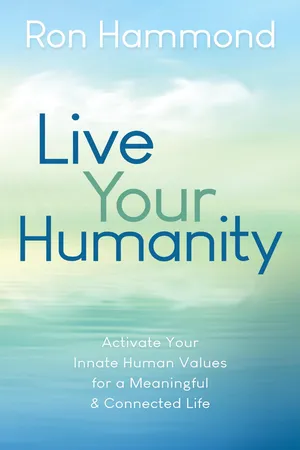
Live Your Humanity
Activate Your Innate Human Values for a Meaningful and Connected Life
- English
- ePUB (mobile friendly)
- Available on iOS & Android
eBook - ePub
About this book
Information
Topic
Personal DevelopmentSubtopic
Personal SuccessCHAPTER 1
Activate Compassion and End Suffering
I’ve always been fascinated by what makes people tick. I’m keenly aware of almost every detail that they present to the world. I notice things like how they walk and their mannerisms, but my attention typically gravitates most strongly towards how they treat their fellow humans. There are times when our interactions with one another are not positive and kind and sometimes it feels like we don’t understand what having compassion for one another really means. I’ve struggled with this myself in the past, but I recently had an experience that helped put me on the path to understanding what compassion really is.
How an alley and a bottle of water helped me understand suffering and develop compassion
The city that I currently live in is experiencing a homelessness crisis. The population of homeless people is rising and, as the available supply of housing becomes stretched and housing costs continue to climb, more and more people are in the unfortunate position of living on the street. For many years, encampments that house homeless people have existed downtown, but as the city has become more gentrified and growth has boomed, the homeless are looked upon as an unsavory aspect of the new, modernized landscape. Business owners and residents want them removed, and the city government has been exploring different measures to address the issue. Some of the measures developed, while made with the best of intentions, have instead resulted in harsh realities.
Approximately two years ago, in an attempt to move the homeless from the encampments, the police raided the camps and proceeded to block those areas of the city off so that they were no longer accessible. Unfortunately, while the homeless shelters perform an important role, there was (and still is) a lack of enough shelter space to accommodate everyone, forcing many to spread out miles away from the city center. Some of the encampments where they are now living are close to my neighborhood, and as I’ve driven or walked past them, I’ve noticed that a good many of them are densely populated. I’ve quietly wondered about what it must be like to live practically stacked on top of one another in confined, noisy and chaotic environments. But even as I understood that the situation wasn’t ideal, I continued on with my day and never gave it a second thought. That was about to change.
One Monday, I walked into the alley behind my home to collect the emptied garbage bin and bring it into my backyard for storage. I was startled to see a homeless man sitting next to my garage. He was looking at me warily and when I acknowledged him, he said that he would be on his way shortly, that he was sitting next to my garage because he needed a quiet place to eat his lunch. I told him that he was just fine where he was and was welcome to hang out for a while. As I continued to pull the garbage bin into the backyard, it suddenly hit me that this man, who I would normally pass on the street without a word uttered between us, craved something that I take for granted every day. He simply wanted to eat his lunch in peace, away from the noise and chaos of his normal environment. I felt overcome by how hard his life must be and I had a strong desire to do something to help him.
I went inside my house and grabbed a bottle of water and took it to him, telling him that I noticed that he didn’t have anything to drink with his lunch. Based on his reaction, you would have thought that I had given him the world. He was so grateful for such a small gesture, and it opened the door for the two of us to talk. I eventually asked him how he ended up in his situation. He told me that he was 35 years old and college educated, but that he had made some bad decisions that led to him living on the streets. He didn’t elaborate on what those decisions were and I didn’t ask, but he went on to explain that he was living in an encampment nearby. He said he preferred being there to being in a shelter because of the drug use and crime that runs rampant in those facilities. He explained that the likelihood of being assaulted in a shelter is quite high and that any possessions that you may have are frequently stolen if they’re not watched closely. He said that he feels safer in the encampments or sleeping in an alley. After 15 more minutes of talking, we parted ways. Before I left, I told him that he was welcome to have his lunch next to my garage when he felt like he needed some peace and quiet.
That experience left a mark and defined for me what the true meaning of compassion is. When you feel bad for someone else’s hardship and then help alleviate them of the suffering that comes from that hardship, you are living with compassion.
While our paths haven’t crossed since that day, I frequently find my thoughts returning to him, wondering if he’s doing OK. The empathy that I felt toward this gentleman helped me to understand his humanity, and it also helped me to feel and understand his emotions around his situation. Even though offering a tiny amount of help didn’t solve all of his problems, at least I could do something.
I now look at everyone that I see each day a little differently, reminding myself that nothing is ever as it appears on the outside and that I don’t have a clue what kind of challenges others face in their lives. I am filled with the desire to help others and am joyful at the prospect of doing so whenever I can.
What is compassion?
The Dalai Lama is the unifying symbol of the Tibetan state and is revered around the world as the human picture of compassion. If you’ve ever spent time reading his books or other writings, you have most likely noticed that compassion is a common element that drives his life. I recently came across a quote from him that perfectly sums up what he believes compassion to be: “I believe compassion to be one of the few things we can practice that will bring immediate and long-term happiness to our lives. I’m not talking about the short-term gratification of pleasures like sex, drugs or gambling (though I’m not knocking them), but something that will bring true and lasting happiness. The kind that sticks.” To him, the more that we care about the happiness of other people, the greater our own sense of well-being becomes. When you have compassion for another person, you want to provide assistance in elevating someone from their suffering, which in turn makes you happy.
By now, you might be asking how you can offer compassion to other people, but there really isn’t a one size fits all approach that fits each possible situation that you may find yourself in. The best thing that you can do is to increase your awareness of what is happening around you and be ready. Look for situations where you can be compassionate to someone and then offer it up. You’ll feel good and so will they.
Why compassion matters
Why does compassion matter? The simple answer is that it makes life easier for others. Think about my interaction with the homeless man. While he chose (for understandable reasons) not to take advantage of the services of a homeless shelter, others do depend on shelters for an opportunity to sleep in a warm bed and eat a hot meal each day. Homeless shelters all over the country would have never been built if our communities didn’t have at least some understanding of the suffering of the homeless. This is compassion. Also consider the compassion that you see in action after natural disasters, such as when a tornado rips through a town and destroys people’s homes and businesses. Within hours, the citizens of that particular community come together to help their neighbors rebuild. It is compassion that drives their actions. You may also see compassion demonstrated after a large snowstorm, when neighbors gather together, snow shovels in hand, spending hours together shoveling sidewalks and digging cars out so that others can safely pass through.
I have actually heard people say that compassion is a weakness, but that is simply not true. Offering compassion is a sign of strength. I have witnessed people being moved to tears when they see compassion in action and this makes them view the person extending it in a favorable light. They’re viewed as being trust-worthy and humble, strong and dependable. So, the next time that you find yourself with an opportunity to extend compassion, put any thoughts of it casting you in a weak light out of your mind and offer it anyway. You’ll be glad that you did.
Can you imagine what the world would be like right now if every governing body made compassion a cornerstone of their governing policy? There is a lot of division and lack of compassion in the world today. For example, the current crisis at the U.S. southern border is one of the most divisive in our history and there is a systemic lack of compassion for human beings that are attempting to flee circumstances that are unimaginable to most of us. Fear tactics are being used to create divisions that have fractured people into polarized groups on either side of the argument. The same thing is also occurring with the ongoing healthcare debate, where some elected officials are putting their own political interests ahead of their constituents, not making an effort to understand the negative impacts that a broken healthcare system is having on the average person. Some people are losing everything they have due to a healthcare insurance system that leaves them bankrupt when a major health event occurs.
These types of divisions are weakening the very foundation of society. It reminds me of Abraham Lincoln’s quote “a house divided against itself cannot stand.” Being brave and ginning up the willingness to remember that what affects one ultimately affects everyone provides a reminder that having compassion is a sign of strength.
If you want to see compassion in action, why it matters, and how it can become a major force in your life, spend some time volunteering in a local nonprofit that interests you. I have been fortunate to witness compassion first-hand while volunteering with the Ronald McDonald House in my city. For those of you who are unfamiliar with what the Ronald McDonald House is, it is like a hotel where families in need who have sick children can stay free of charge while their children receive medical care. It is heartwarming to witness the level of compassion that all of the staff freely share with the families that are staying there, and the families are so grateful for it. There are two house managers that I’ve worked with, Holly and Sandra, both of whom are walking examples of compassion. They get to know every single one of the families, what their children’s illnesses are and how long their treatment will last. When a family needs anything, Holly and Sandra are right there to provide it to them. They listen to the struggles that these families face, and when the families are returning back to the house after a long day at the hospital, Holly and Sandra are there to greet them and offer an encouraging word. All of this comes from the heart, letting the residents know that they’re cared for and supported. If you ever have an opportunity to volunteer or to financially support your local Ronald McDonald House, I encourage you to do so. I promise that seeing what compassion in action looks like will compel you to activate your compassion and share it with others.
You alone have the power to activate compassion within yourself and you also have the capacity to offer it at a moment’s notice. It is the right thing for you to do, not only for your own benefit, but for the benefit of all of society. When you inevitably find yourself in a spot where you may not be comfortable extending compassion outwardly, quietly remind yourself that you already have it inside of you, notice how empowered you feel and then go for it. The rewards that you and society reap from doing so are immeasurable.
Identifying suffering in others
The key to offering compassion is to be able to identify when someone else is suffering. You may believe that suffering is the result of a painful physical event, such as when you break an arm or are healing from injuries due to an accident. While those experiences are indeed painful, they don’t necessarily cause you to suffer. Suffering is caused by how you think about and resist what is occurring in your life at any given time. You may experience suffering when you suddenly find yourself without a job and are feeling lost and without a purpose, when you are dealing with an important decision and you don’t know which way to turn, when you are in conflict with someone else because of something they either did or said that offended or hurt you or when you find yourself in a loop of negative emotional thoughts surrounding the ending of a relationship.
How someone experiences suffering is very unique and personal to them, so identifying it can be challenging. But if you’re open and you have a little curiosity, you can quickly gain an understanding of what is triggering suffering in someone else. How do you do it? The simplest thing that when you notice someone is a little off, you can simply ask them what’s going on. Merely asking can be so powerful. It says that you are there, that you care and that you are being sincere and are open to helping, which develops trust and makes it easier for someone to share with you what they’re going through. It also helps to make an effort to spend time with someone who you know is going through a tough spot in their life. Make the time to share a meal or to sit down and really talk with them and you will provide a gateway for them to trust you. Eventually, they’ll share what is causing them to suffer with you and also let you help them. The more often you do this, the easier it becomes, and you become a living and breathing example of compassion for others to follow.
Why compassion fatigue is detrimental
Life can sometimes become so busy that compassion takes a back seat. Your job demands more and more of you, leaving you feeling tired and worn out at the end of the day, and when you get home, your work begins again. Dinner has to be made, homework done, the clutter picked up and the children put to bed so that you can turn around and do it all over again the next day. Social media and the news inundate you with negative messages and it becomes overwhelming to process everything that is coming at you from all directions. This closes down the well of compassion that you have inside of you. This state of mind is called “compassion fatigue.”
I believe that compassion fatigue has three components. The first component is the overwhelming amount of negative information that you receive every day surrounding happenings in your local community and all over the world. It’s impossible for one person to process the astounding level of suffering that is occurring every day. As you first learn of these things, you probably feel a bit of concern around what’s occurring, but then in an act of self-preservation, you quickly push it out of your mind telling yourself there’s nothing that you can do to help the situation. It’s natural for you to act in this way, but over time, as you are exposed to more information like this, you begin to instantly push it out of your mind without even thinking about it, closing off compassion.
Compassion fatigue can also make you dig in on your long-held beliefs. When you become blind to the suffering that’s going on around you, you can find yourself believing that there is only one way to see the world. You may believe that someone is causing their own suffering through their actions. Do everything you can to cast your judgments aside and stop allowing your ego to take control of your thoughts. When you put your ego in charge, you shut down your ability to understand what is causing someone else’s pain and suffering, making it virtually impossible to have feelings of compassion.
Finally, compassion fatigue is also caused by a lack of self-compassion. You cannot have real compassion for someone else unless you already have it for yourself. Be conscious of your inner dialogue telling you that you’re not enough. These same thoughts tell you that you have to be perfect at every single thing that you do—and in turn you expect this kind of perfection from others, which can get in the way of compassion. You’re human and you are not perfect by any stretch of the imagination. You will make mistakes, but these same mistakes help you to learn and contribute positively to your growth. Stop ruminating on what others may or may not think of you because in reality, they really aren’t thinking about you all that much. They have their own issues, inner dialogues and mistakes that they’re dealing with. Elevate yourself above the negative messages that you tell yourself and accept yourself for who you are right now.
The problems of the world are too big for anyone to handle individually, but you can have a positive impact on the spread of compassion by offering it up each day to those that are in your community or workplace. Remember, it doesn’t have to be elaborate and grandiose, because sometimes the smallest acts of compassion have the largest impact. Sharing compassion is contagious and you have the power to make a positive and sustained impact on the world by taking the lead and allowing others to witness your acts of compassion.
How activated compassion benefits you
The phrase “it’s better to give than to receive” is a perfect reflection of compassion. When you reflect back on times in your life when you have given something to someone else, whether it was a gift, your time or help, the feeling that most likely comes to your mind is a pronounced sense of pleasure. The same feelings come to you when you give compassion. Extending compassion to others improves your sense of well-being and it has its own built-in reward system that makes you want to do it over and over again.
When you activate compassion within yourself, you are consciously choosing to provide meaning to your life through the act of serving others. Compassion makes you feel purposeful and good about yourself, so it’s natural that once you offer it to other people, you want to keep on doing so. You will also notice that you are not as stressed out and that you have lower levels of anxiety. Studies have proven that lower levels of stress lead to lower inflammation levels within the body, bringing with it the possibility of increased longevity.
Compassion also broadens your horizons and changes your perspective on long held beliefs that you may be holding in your mind. When you step out of your comfort zone, going deep within yourself to observe and think about what is causing someone else’s suffering, you begin to have a new understanding of the world that you may have never considered before. You will find yourself softening on some of your beliefs and will experience an increased willingness to learn a different perspective on something that you may not have been comfortable with before.
Be conscious about noticing how you feel when you exercise compassion, and take note of the positive internal reactions to your new thought process. I’m sure that you will feel a sense of serenity and calm wash over you along with an unselfish willingness to help someone else end their suffering
Suggestions for activating compassion within yourself
- In order to extend compassion to others, you must first have compassion for yourself.
- Remind yourself constantly that no matter what happens or what anyone believes or says about you, you are perfect just the way you are at this very moment. Give yourself the space to appreciate and accept who and what you are, with all of your flaws and imperfections.
- Increase your awareness of your immediate surroundings and your community so that you are proactively looking for ways to assist others. Take direct action by making a conscious effort to hold the door open for someone, to practice random acts of kindness towards other people without the expectation of receiving anything in return and to support organizations that help those who are in need by volunteering your time.
- When engaged in conversation, put forth the effort...
Table of contents
- Cover
- Title
- Copyright
- Table of Contents
- Introduction
- Chapter 1: Activate Compassion and End Suffering
- Chapter 2: Activate Love and Eradicate Separation
- Chapter 3: Activate Gratitude and Experience Fulfillment
- Chapter 4: Activate Joy and Be at Peace
- Chapter 5: Activate Generosity and Feel Good
- Chapter 6: Activate Courage and End Fear
- Chapter 7: Activate Integrity and Live in Your Truth
- Chapter 8: Activate Kindness and Have Lasting Well-Being
- Chapter 9: Activate Humility and Gain Perspective
- Chapter 10: Activate Forgiveness and Put the Past Behind You
- Conclusion
- Acknowledgments
- About the Author
Trusted by 375,005 students
Access to over 1.5 million titles for a fair monthly price.
Study more efficiently using our study tools.
Frequently asked questions
Yes, you can cancel anytime from the Subscription tab in your account settings on the Perlego website. Your subscription will stay active until the end of your current billing period. Learn how to cancel your subscription
No, books cannot be downloaded as external files, such as PDFs, for use outside of Perlego. However, you can download books within the Perlego app for offline reading on mobile or tablet. Learn how to download books offline
Perlego offers two plans: Essential and Complete
- Essential is ideal for learners and professionals who enjoy exploring a wide range of subjects. Access the Essential Library with 800,000+ trusted titles and best-sellers across business, personal growth, and the humanities. Includes unlimited reading time and Standard Read Aloud voice.
- Complete: Perfect for advanced learners and researchers needing full, unrestricted access. Unlock 1.5M+ books across hundreds of subjects, including academic and specialized titles. The Complete Plan also includes advanced features like Premium Read Aloud and Research Assistant.
We are an online textbook subscription service, where you can get access to an entire online library for less than the price of a single book per month. With over 1.5 million books across 990+ topics, we’ve got you covered! Learn about our mission
Look out for the read-aloud symbol on your next book to see if you can listen to it. The read-aloud tool reads text aloud for you, highlighting the text as it is being read. You can pause it, speed it up and slow it down. Learn more about Read Aloud
Yes! You can use the Perlego app on both iOS and Android devices to read anytime, anywhere — even offline. Perfect for commutes or when you’re on the go.
Please note we cannot support devices running on iOS 13 and Android 7 or earlier. Learn more about using the app
Please note we cannot support devices running on iOS 13 and Android 7 or earlier. Learn more about using the app
Yes, you can access Live Your Humanity by Ron Hammond in PDF and/or ePUB format, as well as other popular books in Personal Development & Personal Success. We have over 1.5 million books available in our catalogue for you to explore.