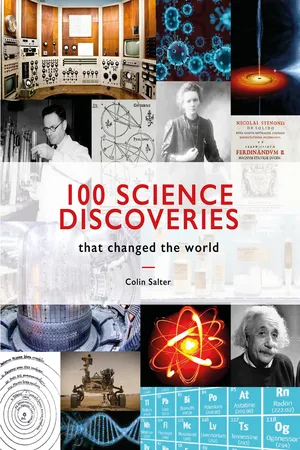
100 Science Discoveries That Changed the World
eBook - ePub

100 Science Discoveries That Changed the World

  1. 224 pages
  2. English
  3. ePUB (mobile friendly)
  4. Available on iOS & Android
eBook - ePub

100 Science Discoveries That Changed the World

About this book

Arranged in chronological order from the early Greek mathematicians, Euclid and Archimedes through to present-day Nobel Prize winners, 100 Science Discoveries That Changed the World charts the great breakthroughs in scientific understanding.

Each entry describes the story of the research, the significance of the science and its impact on the scientific world. There is also a resume of each scientist's career along with their other achievements, sometimes – in the case of Isaac Newton – in a completely unrelated field (laws of motion and the component parts of light).

The book covers all branches of science: geometry, number theory, cosmology, the laws of motion, particle physics, electricity, magnetism, the laws of gasses, optical theory, cell biology, conservation of energy, natural selection, radiation, quantum theory, special relativity, superconductivity, thermodynamics, genomes, plate tectonics, and the uncertainty principal.

Scientists include: Albert Einstein, Alessandro Volta, Alexander Fleming, Amedeo Avogrado, Andre Geim, Antoine Lavoisier, Antony van Leeuwenhoek, Archimedes, Benoit Mandelbrot, Carl Friedrich Gauss, Charles Darwin, Christian Doppler, Copernicus, Crick and Watson, Dmitri Mendeleev, Edwin Hubble, Enrico Fermi, Ernest Rutherford, Erwin Schrodinger, Euclid, Fermat, Frederick Sanger, Galileo Galilei, Georg Ohm, Georges Lemaitre, Heike Kamerlingh, Isaac Newton, Jacques Charles, James Clerk Maxwell, James Prescott Joule, Jean Buridan, Johanes Kepler, John Ambrose Fleming, John Dalton, John O'Keefe, Joseph Black, Josiah Gibbs, Lord Kelvin, Lord Rayleigh, Louis Pasteur, Marie Curie, Martinus Beijerinck, Michael Faraday, Murray Gell-Mann & George Zweig, Neils Bohr, Nicholas Steno, Peter Higgs, Pierre Curie, Ptolemy, Robert Boyle, Robert Brown, Robert Hooke, Roger Bacon, Rudolf Clausius, Seleucus, Shen Kuo, Stanley Miller, Tyco Brahe, Werner Heisenberg, William Gilbert, William Harvey, William Herschel, William Rontgen, Wolfgang Pauli.

Trusted by 375,005 students

Access to over 1.5 million titles for a fair monthly price.

Study more efficiently using our study tools.

Information

Publisher
Pavilion
Year
2021
Print ISBN
9781911663546
eBook ISBN
9781911682677

Index

Alexander the Great 14
Alexandria 14, 18, 22
Almagest, The (Ptolemy) 22
Appleton, Edward 142
Archimedes 14, 16–17
Aristotle 30, 33
Arithmetica (Diophantus) 46
Arlandes Marquis d’ 76
Arrhenius, Svante 130–1
Astbury, William 185
Astronomia nova (Kepler) 39
astronomy
Adam Reiss 208–9
Albert Einstein 140–1
Carl Friedrich Gauss 79
Caroline Herschel 74–75
Cecilia Payne-Gaposchkin 154–5
Charles Messier 66–7
Edwin Hubble 152–3
Fritz Zwicky 174–5
Galileo Galilei 43
Illustration
Danish physicist Niels Bohr who helped establish quantum theory and for whom the element bohrium is named.
Georges Lemaître 160–1
Jocelyn Bell Burnell 196–7
Johannes Kepler 38–9
Joseph Hooton Taylor Jr. 202–3
Louise Webster 200–1
Nicolaus Copernicus 34–5
Paul Murdin 200–1
Ptolemy 22–3
Russell Alan Hulse 202–3
Seleucus of Seleucia 20–1
Subrahmanyan Chandrasekhar 166–7
Tycho Brahe 36–7
William Herschel 72–73
atomic theory
Amedeo Avogadro 86–87
Archibald Scott Couper 104–5
August Kekulé 104–5
C. V. Raman 164–5
Enrico Fermi 180–1
Ernest Rutherford 142–3
Ernest Walton 172–3
George Zweig 192–3
Henry Moseley 148–9
James Chadwick 170–1
John Cockcroft 172–3
John Dalton 84–85
Murray Gell-Mann 192–3
Niels Bohr 150–1
Peter Higgs 194–5
Robert Brown 92–3
Avogadro, Amedeo 86–7
Bacon, Roger 30–1
Ballot, Buys 97
Banks, Sir Joseph 92
Bateson, William 114
Bayliss, William 138–9
Becquerel, Henri 133
Beijerinck, Martinus 126
Bell, Eric 79
Bernoulli, Daniel 62–63
Bernoulli, Jacob 62
Illustration
Dani...

Table of contents

  1. Cover
  2. Title
  3. Contents
  4. Introduction
  5. Euclid: Geometry
  6. Archimedes: Value of pi
  7. Eratosthenes: The size and shape of the Earth
  8. Seleucus of Seleucia: Moon’s effect on the tides
  9. Ptolemy: Prediction of planetary movements
  10. Omar Khayyam: Length of the calendar year
  11. Shen Kuo: True North
  12. Fibonacci: Numbers
  13. Roger Bacon: Optical theory
  14. Jean Buridan: Theory of impetus
  15. Nicolaus Copernicus: A heliocentric universe
  16. Tycho Brahe: Observation of a supernova
  17. Johannes Kepler: The elliptical orbit of planets
  18. William Gilbert: The Earth’s magnetic field
  19. Galileo Galilei: Laws of falling bodies
  20. William Harvey: Blood circulation
  21. Pierre de Fermat: Fermat’s Last Theorem
  22. Isaac Newton: Laws of motion
  23. Robert Boyle: Law of gasses
  24. Robert Hooke: The biological cell
  25. Nicolas Steno: Fossil theory
  26. Antonie van Leeuwenhoek: Bacteria
  27. Daniel Gabriel Fahrenheit: Temperature scale
  28. Carl Linnaeus: A system of classification of the natural world
  29. Daniel Bernoulli: The Bernoulli principle
  30. Anders Celsius: Celsius temperature scale
  31. Charles Messier: A catalogue of astronomical objects
  32. Joseph Black: Carbon dioxide
  33. Antoine Lavoisier: Law of conservation of gases
  34. William Herschel: Uranus
  35. Caroline Herschel: Comets
  36. Jacques Charles: Law of ideal gases
  37. Carl Friedrich Gauss: Number theory
  38. Alesandro Volta: Chemical generation of electricity
  39. Humphry Davy: Anaesthetic effect of nitrous oxide
  40. John Dalton: Atomic theory
  41. Amedeo Avogadro: Avogadro’s law of gases
  42. Hans Christian Ørsted: Electromagnetism
  43. Georg Ohm: Ohm’s Law
  44. Robert Brown: Brownian motion
  45. Michael Faraday: Electromagnetic induction
  46. Christian Doppler: The Doppler Effect
  47. James Prescott Joule: Laws on the conservation of energy
  48. William Thomson: Definition of absolute zero
  49. Rudolph Virchow: Cellular pathology
  50. August Kekulé: Atom bonding and carbon rings
  51. Charles Darwin: Theory of evolution by natural selection
  52. Louis Pasteur: Germ theory
  53. James Clerk Maxwell: Theory of electromagnestism
  54. Rudolf Clausius: Entropy
  55. Gregor Mendel: Genetics
  56. Dmitri Mendeleev: The Periodic Table
  57. John Ambrose Fleming: Fleming’s left-hand and right-hand rule
  58. Heinrich Hertz: Radio waves
  59. Friedrich Reinitzer: Liquid crystals
  60. Santiago Ramón y Cajal: Neuron theory
  61. Dmitri Ivanovsky: Viruses
  62. Wilhelm Röntgen: X-rays
  63. Svante Arrhenius: Link between CO2 and global temperature
  64. Marie Curie: Theory of radioactivity
  65. Karl Landsteiner: Blood groups
  66. Max Planck & Wolfgang Pauli: Quantum theory
  67. Ernest Starling & William Bayliss: The first hormone, secretin
  68. Albert Einstein: Special and general relativity
  69. Ernest Rutherford: Atomic nucleus
  70. Heike Kamerlingh Onnes: Superconductivity
  71. Alfred Wegener: Continental drift
  72. Henry Moseley: Atomic numbers
  73. Niels Bohr: Model for the atom
  74. Edwin Hubble: Galaxies beyond the Milky Way
  75. Cecilia Payne-Gaposchkin: Composition of the Sun
  76. Erwin Schrödinger: The Schrödinger equation
  77. Werner Heisenberg: The Uncertainty Principle
  78. Georges Lemaître: Big Bang theory
  79. Alexander Fleming: Penicillin
  80. C. V. Raman: Light imparts energy to molecules
  81. Subrahmanyan Chandrasekhar: Massive stars can collapse under their own gravity
  82. Linus Pauling: Valence bond theory
  83. James Chadwick: The neutron
  84. Ernest Walton & John Cockroft: Nuclear fission by proton bombardment
  85. Fritz Zwicky: Dark matter
  86. Hans Krebs: The Krebs Cycle
  87. B. F. Skinner: Operant behaviourism
  88. Enrico Fermi: Nuclear fission by neutron irradiation
  89. Stanley Miller: Origins of life on Earth
  90. Rosalind Franklin, Maurice Wilkins, James Watson & Francis Crick: DNA structure
  91. Frederick Sanger: Sequence of amino acids in insulin
  92. Yang Chen-Ning and Lee Tsung-Dao: The non-conservation of parity in weak nuclear interactions of particles
  93. Jane Goodall: Social structure in primates
  94. Murray Gell-Mann & George Zweig: Quarks and gluons
  95. Peter Higgs: The Higgs boson elementary particle
  96. Jocelyn Bell-Burnell: Neutron stars
  97. John O’Keefe: Place cells in the brain
  98. Louise Webster & Paul Murdin: Black holes
  99. Russell Alan Hulse & Joseph Hooton Taylor Jr: Gravitational waves
  100. Benoit Mandelbrot: Fractal geometry
  101. Polly Matzinger: The danger model in the immune system
  102. Adam Reiss: Dark energy
  103. Andre Geim & Konstantin Novoselov: Graphene
  104. Özlem Türeci and Ugur Sahin: mRNA vaccine
  105. Index
  106. Copyright

Frequently asked questions

Yes, you can cancel anytime from the Subscription tab in your account settings on the Perlego website. Your subscription will stay active until the end of your current billing period. Learn how to cancel your subscription
No, books cannot be downloaded as external files, such as PDFs, for use outside of Perlego. However, you can download books within the Perlego app for offline reading on mobile or tablet. Learn how to download books offline
Perlego offers two plans: Essential and Complete
  • Essential is ideal for learners and professionals who enjoy exploring a wide range of subjects. Access the Essential Library with 800,000+ trusted titles and best-sellers across business, personal growth, and the humanities. Includes unlimited reading time and Standard Read Aloud voice.
  • Complete: Perfect for advanced learners and researchers needing full, unrestricted access. Unlock 1.5M+ books across hundreds of subjects, including academic and specialized titles. The Complete Plan also includes advanced features like Premium Read Aloud and Research Assistant.
Both plans are available with monthly, semester, or annual billing cycles.
We are an online textbook subscription service, where you can get access to an entire online library for less than the price of a single book per month. With over 1.5 million books across 990+ topics, we’ve got you covered! Learn about our mission
Look out for the read-aloud symbol on your next book to see if you can listen to it. The read-aloud tool reads text aloud for you, highlighting the text as it is being read. You can pause it, speed it up and slow it down. Learn more about Read Aloud
Yes! You can use the Perlego app on both iOS and Android devices to read anytime, anywhere — even offline. Perfect for commutes or when you’re on the go.
Please note we cannot support devices running on iOS 13 and Android 7 or earlier. Learn more about using the app
Yes, you can access 100 Science Discoveries That Changed the World by Colin Salter in PDF and/or ePUB format, as well as other popular books in Medicine & Medicine Biographies. We have over 1.5 million books available in our catalogue for you to explore.