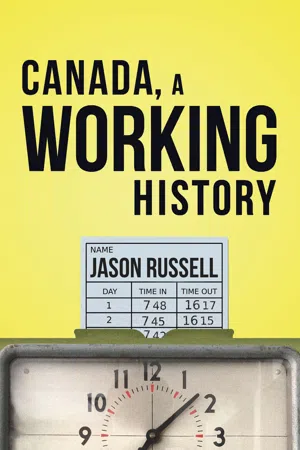
A deep exploration of the experience of work in Canada Canada, A Working History describes the ways in which work has been performed in Canada from the pre-colonial period to the present day. Work is shaped by a wide array of influences, including gender, class, race, ethnicity, geography, economics, and politics. It can be paid or unpaid, meaningful or alienating, but it is always essential. The work experience led people to form unions, aspire to management roles, pursue education, form professional associations, and seek self-employment. Work is also often in our cultural consciousness: it is pondered in song, lamented in literature, celebrated in film, and preserved for posterity in other forms of art. It has been driven by technological change, governed by laws, and has been the cause of disputes and the means by which people earn a living in Canada's capitalist economy. Ennobling, rewarding, exhausting, and sometimes frustrating, work has helped define who we are as Canadians.
- 352 pages
- English
- ePUB (mobile friendly)
- Available on iOS & Android
eBook - ePub
Canada, A Working History
About this book
Information
1 BEFORE AND AFTER EUROPEAN COLONIZATION
The history of work in Canada begins with the land. North America, which also includes the United States of America and Mexico, began to be created 175 million years ago when the supercontinent Pangaea was gradually broken into new continents. Containing widely varying topography, North America possessed a range of climates, from tropical temperatures in the far south to sub-zero cold and ice in the distant north. Three oceans — Atlantic, Pacific, and Arctic — surrounded North America along with the Caribbean Sea. These were names that did not exist prior to the arrival of European settlers, and the many Indigenous Peoples and communities who lived in what would become Canada — a word derived from the Haudenosaunee word for village — thought of the land in terms far different from those who came from the other side of the Atlantic. Indigenous Peoples lived on the land and considered themselves part of it. For many Europeans, land was something to be transformed and put to use.
The early impact of geography, the arrival of Indigenous Peoples, and the eventual appearance and proliferation of European colonists in North America were part of a long stretch of years leading toward Canada’s ultimate independence from Britain. What happened in the 16th century when Europeans arrived in what would become Canada may seem remote and inconsequential compared to what would happen in more recent decades, but crucial patterns of working and living were established in pre-Confederation Canada that would endure and shape the country and its workers far into the 20th century. The pre-Confederation period involved colonization, the introduction of European work methods and property ownership, slavery and indentured servitude, a system of law that favoured employers over workers, and the grievous death and displacement of Indigenous Peoples for whom the European idea of work was entirely unknown.
There was a long-standing consensus among historians, anthropologists, archaeologists, and other academics that deemed that North, Central, and South America were first populated by people from Asia who made their way across an ice bridge spanning what became known as the Bering Strait. That view is now being contested, since Indigenous Peoples may have come from different places at different times, but it is clear they were living in North America 20,000 years ago. Some Indigenous groups were more technologically advanced than others, with several like the Maya and Aztecs leaving wondrous cities erected in jungles and clear evidence of sophisticated if somewhat violent societies.
The Indigenous Peoples of Mexico, Central America, and South America left more clues about how they lived than their counterparts farther north. There is often a public assumption that Indigenous Peoples everywhere leave oral records of their history if they did not have technology to hand down written accounts. The way Indigenous Peoples lived in what is now Canada is revealed through archaeology, what was observed about them when Europeans came across the ocean, and the traditions they have preserved. Their lives are often misrepresented in contemporary portrayals and descriptions of them. There is considerable variation in the estimates of how many people lived in the Americas prior to European contact, with the numbers ranging from 8 to 112 million. They were not always nomadic, as often portrayed in media, with many living in established communities and engaged in agriculture.
There is peril in generalizing what it meant to be Indigenous in pre-colonial North America. There were clear social hierarchies in some Indigenous nations such as those on the coast of what is now British Columbia. The leadership of some nations was chosen by women rather than men. Indeed, hundreds of languages were spoken across North and South America before European arrival. The land and interaction with it was key to their survival. Nations living on the plains were dependent on the buffalo for food, shelter, and clothing. In comparison, nations in coastal areas, like the Mi’kmaq, were closely tied to fishing. Indigenous Peoples engaged in trade, and some used basic forms of currency such as beads, but the idea of accumulating surplus wealth through exploiting labour was not part of daily life.
The nations that lived across North America did share some cultural similarities with Europeans. They lived in a world shaped by their own ideas of spirituality and the afterlife, but their gods were linked to nature. Europeans had also once been organized on tribal lines, although their nation-states were forms of large groups with competing interests. Indigenous nations did not use religion as a lever to compel people to work, while the Christian deity was routinely employed by wealthy property owners and aristocrats to rain down fire and brimstone on the workers of Europe. People worked during the pre-colonial period, but it was the work of everyday life: hunting, fishing, making clothes, farming, building as part of a community. That all changed when Europeans began arriving.
The first Europeans to come to North America were Vikings who, while hardy seafarers and fierce warriors, were not capable of bringing immigrants across the Atlantic in large numbers and changing the continent. Archaeological evidence shows that a Viking settlement existed at L’Anse aux Meadows in northern Newfoundland in the late 10th century, with the likely purpose of obtaining timber. Vikings had a history of engaging in commercial trade and knew about making a profit. The Newfoundland settlement founded by Leif Erikson did not endure, but settlements in Greenland lasted for several hundred years. Vikings, or Norsemen, also kept a record of their travels through their sagas, so they left an account of the Vinland settlement that could be substantiated through archaeology. They did not fundamentally alter Newfoundland or any other areas of the continent, but their successors had a profound and lasting influence.
European colonization that began in the 15th century is undergoing new and necessary reconsideration in the 21st century. The reasons people braved the long and uncertain crossing across the Atlantic were often not well conveyed in older histories of colonization. Wealth and political influence were the principal motivations behind colonization. The United Kingdom had yet to be formed in the 15th century, and Spain was the pre-eminent European power at that time, followed by France. Europeans had long traded with Asia and Africa, and the routes to those regions — both water and land — were long and easily disrupted. Countries understandably wanted a shorter route to Asia. The first forays across the Atlantic from Western Europe were led by people interested in trade and accumulating wealth, and they were not always inspired by anything more noble. The “discovery” of the New World is popularly associated with the voyage of Christopher Columbus, an Italian explorer financed by the monarchs of Castile and Aragon. In 1492, he landed on an island the Indigenous Lucayan people called Guanahani and Columbus renamed San Salvador (part of the Bahamian archipelago). Thus began a process of Europeans — French, Spanish, English, Portuguese, and Dutch — steadily crossing the Atlantic to exploit the physical resources of North, South, and Central America and the people living there. Indeed, the term Americas was derived from the Latin base of the name Amerigo Vespucci, another Italian explorer, who sailed for Spain and Portugal and proved that the coasts of the newly found lands across the ocean were not part of Asia.
Colonization patterns were not uniform across the Americas. The first Europeans to head to the East Coast of Canada came to fish on the Grand Banks, then returned home with the holds of their ships full of salted cod. Interaction with Indigenous Peoples happened to the extent required to finish fishing and sail home. The land that became occupied by Canada and the United States was not known in the 15th and 16th centuries to hold vast deposits of gold and silver, but both metals were found in abundance in Mexico and in territories farther south. Indeed, it was so ubiquitous that the Aztecs quickly realized that the Spanish coveted gold more than anything else and consequently gave them a quantity of it with the understanding they would get back on their ships and leave.
The land that became Canada and the United States was still a veritable treasure trove of other natural resources such as fish, timber, furs, and herbs. Most people living in Europe in the 15th and 16th centuries were poor, cold, and hungry for the entirety of their lives, which helps explain the interest England, Spain, France, and Portugal had in fishing in waters off North America’s Atlantic coast.
Europeans might have been hungry in those centuries and routinely ravaged by diseases such as bubonic plague, but they did not smoke. That situation changed when they observed Indigenous nations harvesting and smoking tobacco, a plant that holds sacred properties for many Indigenous Peoples, including the Huron. It is one of four sacred herbs, along with sweetgrass, cedar, and sage.
Recognizing the role that tobacco played in the lives of Indigenous people, Europeans quickly noted that the plant held great commercial potential, and it became a crop to be grown and exported back across the ocean. The recreational use of tobacco quickly became common in Europe. The process of bringing plants and animals back and forth across the Atlantic was not confined to tobacco. The tomato, which is usually associated with Italian and other Mediterranean cuisines, came from Peru. Coffee was first grown in Ethiopia and was deliberately introduced to Central and South America for commercial reasons. Tea was grown in China but became a staple of the British colonial diet and would eventually play a key role in starting the American Revolution.
Indigenous communities responded in varying ways to European arrival. The Aztecs fought the Spanish and were defeated despite their superior numbers. The Beothuk in Newfoundland avoided English settlers and fought them when the two groups came into contact. Most Indigenous people found Europeans to be entirely alien both in appearance and in social and cultural practices. Indigenous societies were numerous and vibrant prior to the end of the 15th century, but they were not prepared for the influx of disease the Europeans brought with them. Europeans were so frequently exposed to perils such as smallpox, influenza, measles, and tuberculosis that, while many still died from exposure, they had at least some immunity against such diseases. Indigenous people had no defences and up to 90 percent of them died as a result of exposure to foreign illnesses.
The death of so many Indigenous people across the Americas due to European contact, whether through disease or warfare, made the colonization process different from what occurred in other parts of the world. Later, Europeans colonized most of Africa, while Britain made India into a colony, but the populations of Africa and the Indian sub-continent were not wiped out as a result of that. North America was virtually emptied of the people who had been living there for millennia before European arrival, which meant that resistance proved difficult while making the process of bringing immigrants from Europe much easier.
The European nations that came to North America staked out different settlement areas, some of which were near one another. They also brought conflicts with them. An English settlement was founded in Jamestown in what is now Virginia in 1607. Spain eventually claimed most of Central and South America and a wide swath of North America. France’s principal colonies were Quebec, Louisiana, and islands in the Caribbean. The Portuguese colony in South America eventually became Brazil. The Dutch had smaller colonies in what is now the northeastern United States and in the Caribbean. Settlers in the Americas came from a Europe that included great diversity in terms of language, culture, and geography, but less so when it came to government and politics. Monarchs still had great power in Europe, and the Catholic Church was even more influential than many kings. England had a parliament, but few people had voting rights. Most average Europeans had little political power and lived lives that were bounded by rigid social parameters. Europe in the 15th and 16th centuries was a place where God was invoked to justify the burning of supposed witches, the waging of war, and the preservation of a feudal economic system that kept aristocrats wealthy and in power. This was the system that was introduced in the Americas.
2 SLAVERY
As so many people sailed west in hope of gaining fame and fortune, a key problem arose: Who would do the work necessary to generate wealth? Controlling workers in countries like England posed challenges for aristocrats and merchants with money, but the social order was still occasionally upset by popular dissent. The Reformation, which brought the rise of Protestant faiths and weakened the hold of the Catholic Church on European society, produced social changes, but the class structure of Europe did not immediately change as a result of it. The challenge with settling North America was that spending weeks travelling across the ocean while risking exposure to disease and possible death cost money. Peasants did not have the resources to cross an ocean. Initial European communities in North America consequently failed to closely reflect the demographics of their home nations. They were disproportionately comprised of soldiers, clergy, and traders, virtually all of whom were overwhelmingly male. Efforts to enslave Indigenous people were made, particularly by the Spanish, but they were not successful in colder climates. A seemingly easy and lasting solution was seized upon: enslave Africans.
The consequences of forcibly bringing people from Africa to toil across the Americas did not occur to slave traders or the people who paid them. Slavery was entirely related to labour shortages, and slaves worked harder and lived far harsher lives than anyone else who came across the Atlantic. The first slave ship to land in British North America was called the White Lion, and it arrived at Jamestown in late summer 1619 carrying 20 enslaved Africans. The problem of alleviating the colonial labour shortage had been found but at enormous human cost. The 20 Africans who were taken against their will to Jamestown eventually became part of 12 million seized from their home territories and transported to the western hemisphere, with approximately two million dying along the way.1
African slavery was important to North America for several reasons. Slavery had not been a common practice in Europe since the Roman Empire spread across that continent. There were countries where peasants lived as vassals of the aristocracy, especially in Russia, but putting people into bondage in Europe because of skin colour was uncommon when it was introduced in the Americas. Using enslaved labour required the deliberate process of dehumanizing someone based on race. Enslaved workers were brutally treated, and this became a pattern for future relations with workers of colour as well as people from different ethnic backgrounds. Slaves also suffered immeasurably because they came as individuals and not in families. They were never able to form lasting family bonds because they lived under the continual threat of seeing their parents, siblings, spouses, and children sold to another master.
Slavery had a profound impact on global commerce from the late 1600s to the mid-1800s. Several European countries became dependent on it for economic growth. It made the production and sale of crops such as tobacco, molasses, cotton, sugar, and coffee possible. Slavery also fostered the formation of a rigid class structure in the various American colonies. Landowners and merchants were at the top of colonial society, followed by white tradespeople and farmers, with slaves and Indigenous people at the bottom. African-American historian W.E.B. Du Bois theorized in the early 20th century that poor whites were compensated with a psychological wage, which meant they could take comfort that they were not at the bottom of social hierarchies because their race always put them above poor African Americans. This process really had its genesis in the 17th century, and it applied in Canada as much as it did in the United States.
Canadians might note with satisfaction that slavery was widespread in the United States up until the end of that country’s Civil War in 1865, and that the British Empire began outlawing slavery in its colonies in 1834. Slavery was common enough that slave owners had runaway slave notices printed in newspapers. For example, a man named John Rock published a notice in the Nova Scotia Gazette and Weekly Chronicle in 1772 in which he promised a $2 reward to whoever could locate an enslaved girl named Thursday.
There were 3,000 enslaved Black people in Canada in the 1790s, with the highest percentage found in the Maritime colonies. Canada had a population of more than 161,000 in 1790. In contrast, there were over 595,000 enslaved people in the United States in 1781, which had a population of 3.5 million. There were proportionally far more enslaved Black people in the United States than in Canada, which shows the key role that enslaved labour played in the U.S. economy.2
Canadian historian H. Clare Pentland explained that the reason slavery was not as prevalent in Canada as it was in the United States can be attributed to climate rather than any possible moral reason. Slave owners needed to force slaves to work year-round to maximize their horrid investment in human bondage, and the cold climate in Canada mitigated against having anyone work intensely throughout the year. There was another solution that was instead introduced in North America starting in the colonial period: indentured servitude.3
3 EARLY WORK REGULATION
The Black Death, an epidemic of bubonic plague, ravaged Europe in the middle part of the 14th century, and in the process eliminated between 30 and 60 percent of the continent’s population. It also had a profound impact on work and labour. The plague originated in Asia and spread westward, cutting a swath through the global population. It was the first plague pandemic experienced in Europe and was caused by infection brought by flea-bearing rodents. There was scant medical knowledge in the 14th century — religious faith was the main defence — and the plague’s rapid spread illustrated the nature of public hygiene at that time. Cities and towns were dangerous environments. There was considerable lawlessness, human waste and sewage ran through streets, bathing was rare if it happened at all, water was often undrinkable, and life expectancy was short. It was inevitable that plague would thrive in such conditions. One consequence of the disease was to build resistance to it among those Europeans who survived it.
A significant labour shortage was one of the main side effects of the plague. Skilled craftsmen, noting there was now a dearth of people like them, attempted to raise their wage rates. The aristocracy’s response was immediate and punitive: the Statute of Labo...
Table of contents
- Cover
- Title Page
- Copyright
- Dedication
- Contents
- Introduction
- Part I: European Arrival to Confederation
- Part II: Confederation to the 1930s
- Part III: The Second World War to the 1960s
- Part IV: The Tumultuous 1970s and 1980s
- Part V: The Anxious 1990s and 2000s
- Part VI: Working in the 21st Century
- Looking Back, Looking Forward
- Acknowledgements
- Notes
- About the Author
Trusted by 375,005 students
Access to over 1.5 million titles for a fair monthly price.
Study more efficiently using our study tools.
Frequently asked questions
Yes, you can cancel anytime from the Subscription tab in your account settings on the Perlego website. Your subscription will stay active until the end of your current billing period. Learn how to cancel your subscription
No, books cannot be downloaded as external files, such as PDFs, for use outside of Perlego. However, you can download books within the Perlego app for offline reading on mobile or tablet. Learn how to download books offline
Perlego offers two plans: Essential and Complete
- Essential is ideal for learners and professionals who enjoy exploring a wide range of subjects. Access the Essential Library with 800,000+ trusted titles and best-sellers across business, personal growth, and the humanities. Includes unlimited reading time and Standard Read Aloud voice.
- Complete: Perfect for advanced learners and researchers needing full, unrestricted access. Unlock 1.5M+ books across hundreds of subjects, including academic and specialized titles. The Complete Plan also includes advanced features like Premium Read Aloud and Research Assistant.
We are an online textbook subscription service, where you can get access to an entire online library for less than the price of a single book per month. With over 1.5 million books across 990+ topics, we’ve got you covered! Learn about our mission
Look out for the read-aloud symbol on your next book to see if you can listen to it. The read-aloud tool reads text aloud for you, highlighting the text as it is being read. You can pause it, speed it up and slow it down. Learn more about Read Aloud
Yes! You can use the Perlego app on both iOS and Android devices to read anytime, anywhere — even offline. Perfect for commutes or when you’re on the go.
Please note we cannot support devices running on iOS 13 and Android 7 or earlier. Learn more about using the app
Please note we cannot support devices running on iOS 13 and Android 7 or earlier. Learn more about using the app
Yes, you can access Canada, A Working History by Jason Russell in PDF and/or ePUB format, as well as other popular books in History & Labour Economics. We have over 1.5 million books available in our catalogue for you to explore.